On Sun, 3/22/09, Jimmy Jumshade wrote:
Whoo Cares??!! All Sindhis are slaves of MQM & Urdu speaking.
On Sat, 3/21/09, Mohammad Khan Sial wrote:
Performance of Sindhi columnists: I have seen a column published in a Sindhi daily by our friend Mr Aajiz Jamali. This is not a first time that a columnist has tried to use "Sindh Card" favouring PPP govt instead of presenting an impartial view of the situation.
Mohammad Khan Sial
==========================================
We are all forgetting that it was all politics and nothing else so please dont bring Ethnic Hate into it because it was a Punjabi Chief Justice [Read Chief Justice Iftikhar Muhammad Chaudhry] who took suo moto notice against the extra judicial killing of a Sindhi Labour Rasool Bux Broi in 2006 - Read the details [1][2]
 Chief Justice of Pakistan, Mr. Justice Iftikhar Muhammad Chaudhry
After the text below read an excellent article by Nadeem F. Paracha of daily Dawn.
 Late. Sardar Akbar Shahbaz Khan Bugti [July 12, 1927 – August 26, 2006]
Dont forget that CJ Mr Justice Iftikhar Muhammad Chaudhry had very cordial and friendly relations with Late. Sardar Akbar Bugti. It was Late. Sardar Akbar Bugti who appointed him the Advocate General of Baluchistan in the late 80s.
 Mr Ayaz Amir, Renowned Pakistani Columnist for The News International/Daily Dawn and he is also an Elected Member of Parliament and member of PML-Nawaz.
I wonder what is your opinion on Mr Ayaz Amir [a Pure Punjabi from Chakwal and a Retired Captain of Pakistan Army as well]? But Late. Sardar Akbar Bugti had suggested Ayaz Amir’s name as a Mediator to settle the problems of Balochistan.
 Hasan Nisar, Another Columnist of Daily Jang and GEO TV Anchor
How would you guage Mr Hasan Nisar [another Punjabi] who praised MQM and recently he was a guest of Mr Altaf Hussain as well. I dont know if you and other Ethnic Bigots on this Forum are even aware as to where this Ethnic Hate would lead all of us? If not then read History of Rwanda, Bosnia, and many African Countires and believe me picture you would find will not be very rosy and not even the worse person in Pakistan would like to repeat those Tragedies of Ethnic Riots of 70s, 80s and 90s. This is a very dangerous path and poor and impartial people [from any racial group] would like to suffer as happened in the past. This is a dangerous path and everybody should avoid this in the heat of discussion.
Please read on before jumping the gun
 Nadeem F. Paracha http://nadeemfparacha.wordpress.com/
Smoker's corner: Cobwebs by Nadeem F. Paracha Sunday, 22 Mar, 2009 01:12 AM PST
http://www.dawn.com/wps/wcm/connect/Dawn%20Content%20Library/dawn/in-paper-magazine/images/smokers+corner+cobwebs
In a terrific new documentary called “The Revolution Will Not Be Televised,” director Kim Bartley convincingly pushes forward the idea that the right-wing coup that toppled Venezuelan President, Hugo Chavez in 2002, was propagated by a string of private television channels that are owned by the country’s elite.
With the help of a series of images and sound bytes taken from talk shows and news programmes on these channels, the documentary reveals how the media promoted demonstrations against Chávez, and how the programming on these channels created an anti-Chávez climate leading to the day of the coup.
According to the Venezuelan TV channels, the coup, led by conservative politicians backed by some military personnel, was pulled off in the name of “democracy.”
However, the overwhelming agitation and response by Chavaz’s main constituency, comprising of the urban working classes and the rural peasantry, managed to crumple the new government within a week, paving the way for Chivaz’s return. It rudely rendered as biased and sensationalist the claim of the electronic media that had insisted that Chavaz’s toppling was a popular undertaking. The claim was nothing more than upper and middle-class wishful thinking propagated by the channels as “revolutionary” and “democratic” action.
I feel the documentary is just too close to what we have been witnessing in Pakistan in the last two years. This is not to suggest that President Zardari is Chevaz — far from it — but the bulk of the Pakistani electronic media is certainly the bastion of new urban middle-class aspirations. It is a stark reflection of what certain quarters of the country’s urban middle-classes (especially in the Punjab), are metamorphosing into. In a queer twist, people who were demanding radical action in the name of democracy, free media and the judiciary, most of them have had a class and generational history of backing military dictatorships, staunch politico-religious initiatives and social conservatism.
So what made entities like PML (N), Jamat Islami, the electronic media, and political minnows like Imran Khan pose as the new ambassadors of revolutionary politics in Pakistan?
There are two interesting theories that may answer the above question.
The first view is that in countries like Pakistan, whenever a progressive or populist political party manages to graduate from the streets to the corridors of governmental power and gets assimilated by the politics of pragmatism, an ideological vacuum appears.
Consequently entities that are inherently conservative readjust their ideological orientation by giving their conservatism a face-lift and start expressing it in a language that was once strictly the linguistic and symbolic gesture of Cold War-era leftists. Mind you, the irony is, during the Cold War the leftists were gleefully bludgeoned by the same urban classes and political entities who today are claiming fresh revolutionary ground in Pakistan in the name of democracy and the judiciary.
The second theory in this respect is closely-knitted to the above one. It suggests that the recently triumphant lawyers’ movement and the agitation exhibited by PML (N), is a symptom of an unprecedented occurrence in which the largest province of Pakistan, the Punjab, has for the first time found itself largely outside the power circles of state and government.
This theory suggests that secular/progressive parties such as the PPP, ANP and MQM, that prospered more outside the Punjab in the last fifteen years, have discovered that if together they are able to win most seats in the NWFP, Balochistan and Sindh, they can still manage to construct a coalition government at the centre without the need to do well in the Punjab. And the reason why the radical action and language being heard from Punjab’s streets and drawing-rooms today is coming from conservative/rightist elements is because it was largely bourgeois conservatism that flourished in the Punjab as the dominant psyche ever since the 1980s. So, ever since the Musharraf coup in 1999, and especially after the formation of the PPP-led coalition government in 2008, this conservatism increasingly found itself alienated by a new-found regional alignment at the centre, and thus the reaction.
Can this mean that the current trend of “democratic radicalism” that was otherwise being portrayed as a nationwide phenomenon by the electronic media, was basically a chant confined to the Punjab?
Can this also mean that even if there were some genuinely progressive elements in the lawyers’ movement, they completely failed to avoid hijacking bids by reactionary elements (JI), and democratic-conservatives (PML-N)?
The progressive/populist uprising against the Ayub Khan dictatorship in 1968, and the rightist/Islamist movement against the Z A. Bhutto regime in 1976 were both a national phenomenon, encompassing participation of all the four provinces. The lawyers’ movement wasn’t. So does this mean the lawyers’ movement too was largely a provincial phenomenon?
These questions may be sidelined in the current mist of euphoria (in the Punjab), and silent cautious hope demonstrated elsewhere in Pakistan at the reinstatement of Iftikhar Chaudhry , but the regional cobwebs that they may have generated must be addressed before they turn into the kind of ethnic and politico-religious monsters Pakistan is infamous for nurturing.
===============
1 - PAKISTAN: Two persons were killed in police encounter [1]
http://www.ahrchk.net/ua/mainfile.php/2008/2928/
[NOTICE: The AHRC has developed this automatic letter-sending system using the "button" below. However, in this appeal, we could not include e-mail addresses of some of the Pakistan authorities. We encourage you to send your appeal letters via fax or post to those people. Fax numbers and postal addresses of the Pakistan authorities are attached below with this appeal. Thank you.]
ASIAN HUMAN RIGHTS COMMISSION - URGENT APPEALS PROGRAMME
Urgent Appeal Case: AHRC-UAC-156-2008 12 July 2008
---------------------------------------------------------------------
PAKISTAN: Two persons were killed in police encounter
ISSUES: Encounter killings, police assault, custodial death, impunity, rule of law
---------------------------------------------------------------------
Dear friends,
The Asian Human Rights Commission has received information that two persons have been killed whilst in police custody. One of the deceased was a political activist. In the first statement issued by the police they reported that no weapons were found in the possession of the victim. However, a subsequent statement issued the following day reported that the victims were traveling in a stolen car and that a pistol and ammunition had been recovered.
CASE DETAILS:
Mr. Ali Gohar Chandio, 36, a property dealer and activist of the Pakistan Peoples’ Party (Shaheed Bhutto faction) was going to his business with his driver, Mr. Ghulam Nabi Chandio, on July 10. When they reached the Abul Hassan Isphani road, Karachi, a car with plain cloth police officers intercepted their car and stopped them. Without warning or any explanation as to why the car had been stopped Mr. Ishaq Lashari, Inspector Investigation officer of Feroz Abad police station, came out with his accomplices and fired at the rear windscreen. Mr. Ali Gohad and Mr. Ghulam tried to get out of the car and take shelter. When Mr. Ali Gohar Chandiocame out from the car, Inspector Ishaq Lashari opened fire at him, killing him at the spot. The driver was later on shot and injured and the police would not allow anybody to assist him. He succumbed to injuries before reaching the hospital. This incident took place at noon and the police issued its version of police encounter in the late evening. Police said that a police party chased the car from Ferozabad police station, P.E.C.Housing Society, a distance of almost 12 kilometers from the original place of incident, and stopped the car, the occupant of car dodged the police and fired some shots.
On the next day, July 11, police came out with a second statement that a police party headed by Mr. Ishaq Lashari, investigating officer (I.O.) of the Ferozabad police station stopped a suspected car carrying two persons but the driver dodged the police and started firing at the officers. This report went on to say that the police party has stopped the car at Abul Isphahani Road and during that exchange of firing the two men were killed and an AK-47 rifle, one pistol and some currency was taken into. But when contacted the Mubeena police station which has jurisdiction over the area where the incident happened they reported that they came to know of the incident only later and that I.O. Mr. Lashari has not requested permission to take action in the area nor informed them of the incident. According to the police regulation and the law, the Investigation officer has no right to stop any car or pursue it in a division outside his own jurisdiction. The operation division has the authority to work on field operations, not the investigation division. Inspector Lashari, crossed not one but three police jurisdictions without informing the relevant stations or seeking permission from them.
Inspector Ishaq Lashari has a notorious reputation for his involvement in what are believed to be fake police encounters. On July 12, 2006 he entered a village at Moro, 350 kilometers far from Karachi, and arrested several persons. While taking the arrestees back to Karachi one of them, Rasool Bux Brohi was killed and shot dead in mysterious condition. Inspector Lashari declared him a notorious dacoit (robber) with the name of “Mashooq Barohhi” and reported that he had been killed in a police encounter. He later received an award from the police but the media exposed the truth that Inspector Lashari and his team had killed an innocent villager. Following that Inspector Lashari and high officials of Sindh provincial police arrested several members of a family and allegedly tortured them to confess that the deceased was a notorious dacoit. Inspector Lashari and the other police officers involved were jailed through the Suo Motu action of the then Chief Justice Iftekhar Choudhry. However, after Mr. Choudhry was relieved of his post the new judiciary, handpicked by President Musharraf, released all the police officers.
SUGGESTED ACTION:
Please write to the authorities named below expressing your concern in this case about the fake police encounter in which it is apparent that the police are killing people to settle business disputes. Please also demand that police officers involved should be arrested and that an independent inquiry should be conducted. Compensation should also be paid to the victims’ families.
The AHRC has written a special letter to the UN Special Rapporteur on Extrajudicial and Summery Execution regarding this matter.
=======
2 - Justice Iftikhar Chaudhary Petition in Supreme Court [2]
http://www.paktribune.com/Petition-GAK-18-04-07.pdf
IN THE SUPREME COURT OF PAKISTAN (ORIGINAL JURISDICTION) Constitutional Original Petition No. __________ of 2007 Chief Justice of Pakistan, Mr. Justice Iftikhar Muhammad Chaudhry, Chief Justice House, Islamabad. . . . . . . . . . . . . Petitioner
VERSUS
1. The President of Pakistan (As the Referring Authority Under Article 209 of the Constitution), Through the Secretary to the President The Presidency, Islamabad.
2. The Federation of Pakistan Through the Secretary Law and Justice, Civil Secretariat, Islamabad.
3. Supreme Judicial Council, Through its Secretary, Supreme Court Building, Islamabad
4. Registrar, Supreme Court of Pakistan, Supreme Court Building, Islamabad.
5. Registrar, Sindh High Court High Court Building, Karachi
6. Registrar, Lahore High Court High Court Building, The Mall, Lahore
. . . . . . . Respondents
Petition under Article 184 (3) of the Constitution of Pakistan 1973 seeking to challenge the Reference dated 09.03.2007, Notification No. F.1 (2)/2005.A.II dated 09-03-2007, whereby the petitioner was suspended, notifications of Acting Chief Justices and Notification No.F.1(2)2005.A.II dated 15-03-2007 whereby the petitioner was sent on forced leave the Constitution and competence of the Supreme Judicial Council as well as the mode and manner of the proceedings before the Council.
2
It is submitted that:-
PRELIMINARY SUBMISSIONS:
1. Despite references herein to the Referring Authority, the Acting Chief Justice, the Supreme Judicial Council (SJC) and to members of the SJC, the Petitioner contests the competence and legality of each, and no such reference may be treated as a concession by or on behalf of the Petitioner that these are competent and lawfully what they purport to be.
2. The members of the Council are not being impleaded in the present case due only to the fact that they are judges of the Superior Courts. However the respective Registrars are being impleaded to enable them to file replies, if required, after seeking instructions from the members concerned.
SECTION I. POINTS OF LAW:
The questions of law that arise in this petition include:-
A. Competence and Composition of SJC:
1. Does the Chief Justice of Pakistan (the Petitioner) not have the same right to the protection afforded by Article 4 of the Constitution that is (at least notionally) enjoyed by every other citizen of this state?
2. Does the Constitution permit or envisage the filing of a Reference against the Chief Justice of Pakistan, even after following the whole process laid down in Article 209?
3. Can the Supreme Judicial Council take cognizance of a case against the Chief Justice of Pakistan under Article 209 of the Constitution?
4. Is not the purported filing of the Reference against the Chief Justice of Pakistan and its purported cognizance by the Supreme Judicial Council (as presently constituted) not ultra vires Article 209 as well as the other provisions of the Constitution?
5. Does the Constitution permit or envisage the Supreme Court of Pakistan functioning without Chief Justice of Pakistan, especially when he is available and physically and mentally capable of performing his functions?
6. Is a fully functional Chief Justice of Pakistan not a sine qua non for the proper constitution of the Supreme Court of Pakistan as per its own judgments?
7. Does the situation that prevails at present not amount, therefore, to the very subversion of the Supreme Court itself?
3
8. Whether the Supreme Judicial Council, as it met on March 9, 2007 and thereafter, was (is) a lawfully constituted body under Article 209 of the Constitution?
9. Does, therefore, the Supreme Judicial Council not continue to be illegally constituted even after the purported Order dated March 15, 2007?
10. Does not the Constitution, as held by this Court itself, provide another and distinct forum and process for the trial of the Chief Justice of Pakistan?
11. Can such a forum, of plenary and exclusive jurisdiction, be bypassed to the convenience of the Referring Authority?
12. Can the Supreme Judicial Council be properly and lawfully constituted without its being presided over by the Chief Justice of Pakistan and contrary to the precedent of this Court itself?
13. Is it not essential that the Supreme Judicial Council be constituted properly, legally and in accordance with the Constitution before it embarks on the trial of any respondent before it?
14. Is the Supreme Judicial Council not, as presently constituted, not therefore coram non judice and the Reference to it incompetent and non est?
B. Personal bias and prospects of advancement:
15. Can persons who stand directly and personally to benefit from, and whose personal careers will obviously be advanced by an outcome that is adverse to the Petitioner, sit as members of the Supreme Judicial Council particularly when the Constitution provides for their replacement (unlike the Chief Justice)?
16. Can any person with intense personal bias and animosity against the petitioner sit in the Supreme Judicial Council in judgment upon the petitioner?
17. Are the particulars given in Section III (Grounds) Para B-3 below of inveterate hate and manifest prospects of personal advancement and financial gain not alone sufficient to disqualify the members of the SJC mentioned therein? [Please see Section III (Grounds) Para B-3 below].
18. Should such judges not recuse themselves from the proceedings in the light of para 1 of Article IV of the Code of Conduct of Judges which categorically states that:
“A judge must decline resolutely to act in a case involving his own interest.”?
19. Should such judges not recuse themselves from the proceedings in the light of para 4 of Article IV of the Code of Conduct of Judges which categorically states that:
“To ensure that justice is not only done but also seen to be done, a Judge must avoid all possibility of his opinion or action
4
in any case being swayed by any consideration of personal advantage, either direct or indirect.”?
20. In view of the above, can a learned judge who expects to become the Chief Justice of Pakistan and to hold that office for a term of over three and a half years but only if the Petitioner is removed from that office, be objective and impartial in the decision of the Reference?
21. Also in view of the above, can a learned judge who expects to be elevated to the Supreme Court to add another three years to his judicial career (retiring at 65 years instead of retiring at 62) only if the Petitioner is removed from the office of CJP, be objective and impartial in the decision of the Reference?
22. And even if such member does not consider himself to be biased, is he not disqualified, ipso facto, on account of such interest?
23. Will justice be done or even be seen to have been done in the event that the aforesaid judges do not recuse themselves from the Council?
24. Can a member of the Supreme Judicial Council be a Judge of his own personal bias and his own ability to do impartial justice in a case in which personal interest and bias are alleged, particularly when he purports to sit as a Member of Supreme Judicial Council?
25. Is the subjectivity test relied upon by the respondents not unjust and unfair denuding the trial and proceedings of justice and fairness?
26. And does the “subjectivity test” at all apply where there is a direct personal stake and interest in the outcome of the proceedings?
27. Has the so-called subjectivity test not become out-dated and been replaced by other more sensitive tests?
28. Does the subjectivity test apply at all in matters in which a personal or pecuniary interest of the judge, howsoever small, is established and patent on the record?
29. Is such interest not inherent in the career advancement implicit in the elevation to offices respectively of Chief Justice Pakistan and Judge Supreme Court?
30. Is such pecuniary interest not also implicit in the increase in salaries and emoluments in each of the prospective positions that the judges concerned expect to achieve but only if the Petitioner is removed from the office of CJP now?
31. If despite what is stated above and with greater particularity in Section III: Grounds: para B sub-para 3 below, the concerned members continue to sit on the Council, will that not be a reconfirmation of their vested interest to ensure a particular outcome of the proceedings because their recusal will not cause any injury to the cause of justice though it may do so to their own interest?
5
32. Are the precedents of the superior courts not consistent and conclusive that in such matters and when such facts exist the concerned judges should recuse themselves from the Council/Court?
33. Is personal bias and interest in advancement not a question of fact, particularly when the Petitioner (respondent in the Reference) has so categorically alleged that he has no expectation, hope or chance of justice at the hands of the concerned justices for the stated and demonstrable reasons of personal hatred and personal expectation of advancement?
34. Should the above not be decided as a question of fact rather than as a subjective matter in the discretion of the judges concerned?
35. Can judges bearing motive of advancement and/or harbouring personal bias, take refuge behind the tenuous rule that in some situations judges may be the judges of their own objectivity (which is not conceded) even when there is palpable evidence of advantage and personal hatred and/or advancement and benefit?
36. Does the prospect of the slightest financial benefit not, ipso facto, disqualify the judge concerned without the need even to prove the likelihood of bias?
37. Is it not necessary for the Supreme Judicial Council first, and foremost, to decide, as a matter and issue of fact, the matter of the personal bias of any of its members, reconstitute itself accordingly in accordance with law, and then proceed with any further step in the matter, including matters of jurisdiction and preliminary issues?
38. Must, therefore, the allegation of bias made by one and denied by the other not first be determined as a matter of fact before further proceedings can be undertaken, particularly where the allegations are that a member harbours deep and inveterate hatred for the Petitioner or stands to gain by his removal, and the latter even seeks an opportunity to establish that hatred the manifestations of which during the earlier hearings had already been pointed out to the other members?
C. Mala fides and collateral purpose:
39. Is the Referring Authority’s executive action to file the reference against the CJP/Petitioner not tainted with mala fide and malice?
40. Is the Referring Authority’s executive action to file the reference against the CJP/Petitioner not whimsical?
41. Is the Reference not the product of a conspiracy hatched by people extraneous to Article 209 of the Constitution as reported in the national press and not denied by the respondents or the persons referred to therein?
42. Is the advice of the Prime Minister, as reflected in the Reference, not mala fide in the light of the judgment of the Supreme Court in the Steel Mills Case authored by the Petitioner which obviously caused embarrassment to the Prime Minister?
6
43. Is the the Reference, not mala fide. In the light of the various judgments and the various notices issued in Chamber, or by Benches presided over by the Petitioner in such matters as the Gwadar land allotments, the conversion of parks into commercial ventures, the New Murree project, the disappearances during the tenure of the Referring Authority as detailed in para.2 of Section II: FACTS IN BRIEF below.
44. Is the Reference not a mala fide reaction to the Petitioner’s refusal to resign from the office of the Chief Justice when persuaded and give the option to do so by the Referring Authority?
45. Was the demand (or even the expectation, if it be called that by the respondent) of resignation not a gross subversion of justice and the judiciary?
46. Is it lawfully possible to compel a person (and the CJP at that) to submit his resignation by detaining him, cutting off telephone lines, television channels, removing his vehicles and manhandling?
47. Does malice not vitiate the most solemn proceedings including the Reference, and the process that has been pursued thereafter?
48. Are all the actions that have been taken against the Petitioner not mala fide and illegal?
49. Is it not therefore to be questioned whether the Referring Authority, when forming his ‘opinion’ as required by Article 209, met the objective tests of opinion-formation that has been laid down by this Court?
50. Is not the Referring Authority’s executive action to file the Reference against the CJP/Petitioner disproportionate?
51. Is not the Referring Authority’s executive action to file the Reference against the CJP/Petitioner discriminatory?
52. Is malice not further betrayed by the public promises being made by Chief Ministers that such lawyers who support the Government against the Petitioner will be granted government jobs and plots?
53. Does this not show that State resources are being freely used to oust the Petitioner and that the entire enterprise is mala fide?
D. Unholy haste:
54. Does the unholy haste that is apparent from the record not indicate that the Referring Authority did not apply any dispassionate, impartial, independent and unbiased mind to the merits of the allegations contained in the Reference nor to the process, procedure and forum to be adopted before the opinion was formed to send the reference to the SJC?
55. Does not the haste itself, and the illegal course adopted by the respondents, including the physical humiliation and manhandling, not make the malice evident on the face of the record itself?
7
56. Does the haste with which the ACJ took oath on 09.03.07, even while the Chief Justice himself was under physical restraint (to say the least) not betray collateral purpose and a pre-conceived design?
57. Does the haste with which the SJC met on 09.03.07 in Islamabad, (with two of its members flying in from Lahore and Karachi on special planes), and proceeded to restrain the CJP (a power it did not possess) not vitiate the proceedings?
58. Do the steps taken in haste (and spelt out in the narration of FACTS below) not betray that there was a collateral purpose and a settled arrangement between the several personages on the executive and judicial establishments to remove the CJP by whatever means possible, legal or illegal?
E. Illegal suspension, restraint and sending on forced leave:
59. Does the Constitution anywhere envisage the possibility of any executive authority having the legal power to stop any judge of the Supreme Court or High Court from performing his judicial functions?
60. Does the Constitution anywhere permit or envisage the drawing of distinction between stopping a superior judge from performing his judicial functions and his removal from office after completion of inquiry by the Supreme Judicial Council?
61. Does the Referring Authority have any inherent powers to suspend and thus remove any judge of High Court or Supreme Court from office before completion of formalities laid down under Article 209?
62. Does the Supreme Judicial Council have any inherent powers to suspend any judge of Supreme Court or High Court, especially when it does not have any authority remove that judge?
63. If the Respondent’s stand is that every time a reference is filed against a judge, then either the President or the SJC must automatically suspend that judge, will such a construction of Article 209 not render Sub-Article 7 of Article 209 superfluous and redundant?
64. Does the Referring Authority have any authority to send any judge of superior court on ‘forced leave’ on the basis of an ordinary statute, that became “law” two years after the Constitution was adopted?
65. Is the Judges (Compulsory Leave) Order 1970 (PO 27 of 1970) a valid and subsisting law?
66. Does PO 27 not fall foul of entry 55 of the Federal Legislative List in the Constitution?
67. Is the Judges (Compulsory Leave) Order 1970 (PO 27 of 1970), which was validated through an ordinary Act of Parliament in 1975, not contrary to the Injunctions of Islam and therefore an invalid law on the basis of Article 227(1) of the Constitution?
8
68. Could a valid Order be passed under P.O. 27 of 1970?
69. Is the order under P.O. 27 of 1970 not vitiated by malice?
70. Is P.O.27 of 1970 not in any case ultra vires Article 209 of the Constitution particularly when the over-riding effect of that Article has been maintained even when found in conflict with the other provisions of the Constitution itself?
71. Was the Referring Authority’s executive action of 9 March 2007 to suspend the CJP/Petitioner on the express basis of his ‘inherent’ powers, legal?
72. If the Referring Authority’s action to suspend the CJP/Petitioner on 9 March 2007, was legal, what is the legal basis for the SJC, subsequently, and on the same date, suspending/restraining an “already suspended/restrained judge”?
73. If the Referring Authority’s action to suspend/restrain the CJP/Petition on 9 March 2007 was not legal, then what are the legal consequences flowing from it such as the validity of all actions that were taken including induction of Acting Chief Justice, transfer of Registrar by him, and the convening of the SJC?
74. If SJC’s decision of 9 March 2007 to suspend the CJP/Petitioner is not legal, what are the legal consequences flowing from it?
75. If the SCJ’s decision of 9 March 2007 to suspend the CJP/Petitioner is valid, then what was the need for the Referring Authority on 15th March 2007 to send the CJP/Petitioner on forced leave, whereas common sense demands that if at all, the Referring Authority could only send the CJP/Petitioner on forced leave if, (in view of the Referring Authority), the CJP/Petitioner was still functioning as Chief Justice of Pakistan?
76. Are all the above three orders valid?
77. If so, what was the need to pass three orders?
78. Which, if any, of the aforesaid three orders is the valid order preventing the Chief Justice of Pakistan from performing his functions?
79. Or is it only brute physical force not any lawful order?
80. Is the incapacity provided in Article 209(3) not limited by the maxim Epressio unius est exclusion alterius meaning thereby that the Judge in question remains judge for all other purposes?
81. Can any executive authority assume to itself or claim to exercise any power based on the Constitution if such power is not clearly expressed in the Constitution?
82. What is the legal implication of the fact that while various statutes expressly provide for suspension of civil servant during the pendency of an inquiry being conducted against him, the makers of the present Constitution did not deem it appropriate to provide that power in Article 209?
9
F. Illegal assumption of office by the Acting Chief Justice:
83. Whether the oath taken by the Acting Chief Justice on March 9, 2007 was constitutional and legal?
84. Whether any Acting Chief Justice could be appointed and could take oath in the presence of the incumbent Chief Justice of Pakistan?
85. Whether the Supreme Judicial Council, as it met on March 9, 2007 and thereafter, was (is) a lawfully constituted body under Article 209 of the Constitution under the Chairmanship of an Acting Chief Justice?
86. Does, therefore, the Supreme Judicial Council not continue to be illegally constituted, even after the purported Order dated March 15, 2007, as it is being presided over by an Acting Chief Justice?
87. What exactly is the interpretation of the following expression in Article 180 of the Constitution: …‘the Chief Justice of Pakistan …… is unable to perform the functions of his office due to any other cause.’
88. Does this expression include inability to perform functions because of suspension or forced leave?
89. Was it not the intention of the Constitution makers that ‘any other cause’ has to be independent and separate from any disabling act of either the Referring Authority or the SJC?
90. How can the Referring Authority itself provide, or contrive the “cause” and then itself proceed to act on it?
91. If the interpretation of Article 180 is that ‘due to any other cause’ does not include inability arising purely out of suspension then is the appointment of earlier ACJ valid?
92. If the interpretation of Article 180 is that ‘due to any other cause’ does not include inability arising purely out of CJP having been sent on forced leave, then is the appointment of present ACJ valid?
93. Would this power (if permitted) to “refer and to suspend” simultaneously, not subvert the independence of the judiciary?
G. Independence of the Judiciary and Trichotomy of Powers:
94. With the Constitution of Pakistan based on trichotomy of powers, with an overriding need to keep the judicial organ separate and independent of the executive, would any use by the executive authority of any power not derived from any express Constitutional provision and that is aimed at suppressing the independence of judiciary, not be immediately struck down as illegal?
95. Is the Referring Authority’s executive action to file the Reference against the CJP/Petitioner, not led by extraneous factors such as the need to subjugate and damage the independence of the judiciary?
10
96. While the Indian Supreme Court, in a recent judgment, treats Article 32 of the Indian Constitution (that deals with judicial review), as an integral part of basic constitutional structure that even the Parliament cannot abrogate, can there be any scope for this power of judicial review in Pakistan without independence of judiciary, and can there be independent judiciary without security of tenure in letter and spirit?
97. Whether it is not necessary to set aside all the orders restraining the Chief Justice in any manner whatsoever from performing his functions as such so as to establish the principle of the independence of the judiciary and the trichotomy of powers that has also been held to be the very basis of our Constitution?
98. Even today, can Parliament adopt any statute that empowers the President to suspend any judge of Supreme Court or High Court?
99. Will not such a statute be invalid given the overall scheme of the Constitution that guarantees independence of judiciary, especially Article 209(7) and the Judgment in Al Jehad Trust Case?
100. Even today, can the Parliament adopt any statute that empowers the President to send any judge of a superior court on forced leave?
101. Is a coram non judice proceeding against the Chief Justice of Pakistan, with the collateral and illegal measure of preventing him from performing the functions of that office, not a grievous blow to the independence of the judiciary and thus ultra vires?
102. If the power to suspend a judge of a superior court, or to send him on forced leave is upheld, will this not strike a fatal blow to the superior court’s Constitution-based powers of judicially reviewing executive decisions as held in the past?
103. Will violation of the principles of independent judiciary not result in the violation of the Fundamental Rights in Chapter 1 of Part II of the Constitution especially Articles 9, 10, 12, 14, and 25 to the Petitioner as well of the Pakistani citizens in general?
H. Proceedings in camera versus open public trial and procedure:
104. Are camera proceedings not themselves a jurisdictional illegality vitiating the entire trial as contrary to due process guaranteed by the Constitution and the Fundamental Rights given therein?
105. Are SJC Procedure Rules 2005 not exclusively applicable to the proceedings pursuant to information from private citizens envisaged by the 17th Constitutional Amendment?
106. Whether Rule 13 of the 2005 Rules is at all applicable to the References made by the Referring Authority?
107. If so, is Rule 13 not ultra vires the Constitution and violative of the rights of the petitioner?
108. If the Rules of 2005 do indeed apply, then did the SJC not act contrary to its own Rules and is it not enjoined by the law that a
11
thing prescribed to be done in a particular manner must be done in that manner alone or not at all?
109. Is the Supreme Judicial Council not bound, in any case, to invoke its right to determine its procedure to act reasonably and fairly particularly when the petitioner (respondent before the Council) seeks a Public Trial?
110. Should each and every step in the trial not have been in public?
111. When allegations against the Petitioner have been made public, has he not the right to defend the same in public? Public interest demands the same as, whatever the findings of the SJC, the respect for rule of law will be restored?
112. Can judges bearing motive of advancement and/or harbouring personal bias, take refuge behind camera proceedings and choose to continue on the Council?
113. Will the camera proceedings not prejudice the petitioner in his defence particularly when:-
(i) His adversary the Referring Authority and Federal Ministers as well as Chief Ministers have made, and continue to make, countless public statements on the necessity of the Reference and use media and state resources;
(ii) Manifest maltreatment of the petitioner (Chief Justice) at the hands of the state functionaries has established to his peers and the public at large that physical force can be applied by the state to the highest personage in the judicial hierarchy?
114. Is the Supreme Judicial Council not bound, as per its own precedent, to treat the proceedings in the Reference as a trial?
115. Is not the petitioner entitled to the full and complete protection of the law available to any other ordinary citizen accused of misconduct, including a public and open trial before and unbiased tribunal?
116. Whether the actions of the SJC do not suffer from such substantive as well as procedural defects as vitiate its very object, as well as the sanctity and legality of its process?
J. Further insidious implications:
117. Would a finding that this petition is incompetent not be judicial suicide insofar as it will be an acceptance that each judge is subject, at the whim and fancy of the executive, to:
i. first: the fatal stroke of a Reference which shall automatically entail:
ii. the judge being packed forthwith on forced leave?
118. Would such authority to “refer and simultaneously to suspend” not vest in any whimsical and arbitrary executive head (seeking to subordinate and over-awe the judges or to turn around the course
12
of pending proceedings or impending judgments), a power to subvert judges and justice?
119. If a contrary view is taken: will not the entire edifice of the independence of the judiciary crumble like a house of cards as any judge, about to deliver a judgment against the executive, will run the jeopardy of being effectively and summarily sent home?
120. Which judge will then stand up to the executive?
121. Where then will go such landmark judgements as Sharaf Faridi (PLD 1989 K 404), Azizuullah Memon (0LD 1993 SC 341), Al-Jehad Trust (PLD 1996 SC 324) Malik Asad (PLD 1998 SC 161) which have asserted and reiterated the principles of judicial independence and immunity from adverse executive action?
122. Will the pious declarations of intent therein be treated as holy shibboleths and be consigned to the dustbins of history?
123. Will it not amount to consigning the very concept of judicial review, on which an entire and rich jurisprudence has evolved, to the graveyard?
124. Will the giving to the executive the unfettered right under Article 209 and PO 27 of 1970 (neither of which, in the circumstances, is conceded by the Petitioner) endorse an executive sword of Damocles dangling over the head of every judge in land?
125. Would such power of filing Reference coupled with automatic suspension not be used only against independent judges?
126. Will it not amount to the enslavement of the judiciary for now and for ever?
127. Since under Article 215(2) the tenure of Chief Election Commissioner has been given the same protection of Article 209, will any interpretation of Article 209 that enables the executive to suspend a judge or send him on forced leave, not leave the CEC equally exposed?
128. If Article 209 is construed as including the power to suspend a judge, will not an executive, seeking to rig elections, be able to exert pressure on the CEC to do the government’s bidding or else to face suspension, at least for the period of elections?
129. On the basis of its ratio in Zafar Ali Shah’s case, is this Court not liable to give legal recognition to the fact that virtually all the legal community, represented by bar councils all over the country have unanimously condemned the impugned actions of the Referring Authority as mala fide and as an illegal and insulting attack on their highest judicial organ, whose respect and honour all the lawyers in the country hold so dear?
130. By filing the Reference, and by humiliating, insulting, and suspending, and keeping the Chief Justice of Pakistan physically incarcerated at least for six days, and thus provoking unanimous protests from thousands of lawyers all over Pakistan, has the Referring Authority not landed itself, the whole country and the
13
Supreme Court itself in one of the most serious and embarrassing crises in the constitutional history of Pakistan?
131. Is it, therefore, not a case in which this Honourable Court should take immediate action by holding the Reference to be without lawful authority and by allowing the CJP/Petitioner to function as the Chief Justice of Pakistan?
132. Is this not therefore also a matter of great public importance involving the very basis, enforcement and enforceability of Fundamental Rights both of the Pakistani citizen in general and of the Petitioner is particular?
SECTION II. FACTS IN BRIEF:
The narration of facts that follows is the barest minimum and by no means exhaustive. Details are being avoided only so as not to burden the record of the Court, but the petitioner reserves the right to further elaborate if and when so required:
1. The petitioner was elevated to this Court on February 04, 2000 and finally took oath as Chief Justice of Pakistan on June 30, 2005.
2. That during his tenure as Chief Justice the petitioner obviously incurred the intense displeasure and ire of the Prime Minister, the Referring Authority and of many of their close associates because of the facts that the petitioner took notice of more than 6000 cases of Human Rights abuse in the length and breadth of the country in one calendar year alone, set aside the privatization of the Pakistan Steel Mills, began inquiring into the land allotments to influential people in Gawadar, restrained environmental degradations by such projects as New Murree, prevented parks from being converted into commercial enterprises such as CDA Mini Golf Course and the Multiplex Commercial Venture in Gulberg, Lahore, sought information about hundreds of missing persons whose relatives were daily demonstrating outside the Supreme Court. Only a few landmark instances, wherein the petitioner took notice and action, are being cursorily referred to as follows merely as illustrative of the petitioner’s deep concern for the ordinary citizen, a concern that irked the executive authorities:
a. Police excesses in such cases as Sonia Naz, Nazia, Rasool Bux Brohi, Shahnaz Fatima, Torture Cells;
b. Jirga cases in which infant girls were given in marriages, vani cases, Watta satta case;
c. Abductions of Manoo Bheel’s family in which one Abdur Rehman Brohi, close associate of Pir Pagara was arrested;
d. Minor children were freed from private jails; even in Balochistan more than 41 children were recovered through IG Balochistan;
e. Cases of forcible conversion to Islam;
f. Cases wherein influential convicts had been released on parole contrary to law, were taken notice of;
14
g. IGs and SSPs were put to task in all provinces to protect human rights.
h. Deteriorating Law & Order throughout the Court was taken notice of and constant instructions were given to chief Secretaries and IGs besides other law enforcing agencies;
i. Important petitions pending, impending or decided included the followings:
i. Review Petition about uniform of the President;
ii.
Petitions challenging the office of the President which were likely to be taken up in March and the government was well aware of it;
iii.
Petition against the privatization of Habib Bank;
iv.
Petition against the privatization of PTCL;
v.
Petition about the regulation of petrol prices;
vi.
Basant Killings (even an Ordinance was passed against this judgment);
vii.
Ban on wedding meals and its enforcement;
viii.
Sales of Spurious medicines;
ix.
Preservation and reconstruction of the West Wing of the Lahore High Court demolished under the administration of the CJ LHC.
x.
Environment and public interest related issues, including the restraints on the elitist:
•
New Murree Project, the conversion of a public park into an exclusive mini golf course in Islamabad;
•
The conversion of a cricket ground into a commercial plaza in Gulberg Lahore.
3. The petitioner was thus providing relief where all other avenues and officials/persons mandated to give relief had failed. Although he merely performed his duty by his conscience, it may also be mentioned that petitioner has been appreciated for his active, independent initiatives at home and abroad.
4. That on 9th March 2007, the Referring Authority summoned the Petitioner, and in the presence of the Prime Minister and others (Whose names etc, will be disclosed at a later appropriate stage through an affidavit) he referred to such baseless charges as had already been published from a letter written by an advocate, and gave him the option, and indeed fervently persuaded him to resign from the office of Chief Justice of Pakistan. All manner of offers were also made.
5. It may be mentioned that the Referring Authority has publicly admitted that he suggested that the Petitioner should resign.
6. The President was most upset when the Petitioner refused to resign.
7. When it became evident that he could not be persuaded to resign then by an Order of the same date the Referring Authority purportedly restrained the Petitioner from performing the functions of Judge of the Supreme Court and Chief Justice of Pakistan. The officials of the Referring Authority thereupon also placed physical restraints on the Petitioner preventing him, from leaving his office till 5 pm.
8. On the same day Mr. Justice Javed Iqbal, Judge Supreme Court, purportedly took oath as acting Chief Justice on the obvious
15
assumption that the petitioner was incapable of performing the functions of Chief Justice.
9. On the same day the Council also met and, purporting to act as the Supreme Judicial Council passed another order also purporting to restrain the petitioner from performing his functions as Judge Supreme Court and Chief Justice of Pakistan. In fact, no agenda had been prepared for the meeting.
10. On the same day the learned Attorney General also associated himself with the proceedings of the Council. The Council went through the record, took cognizance of the Reference and decided to invite the Petitioner to appear before it on 13.03.2007 at 1:30 p.m. It also, surprisingly and beyond its authority ordered that the respondent shall not perform functions as judge of the Supreme Court and as the Chief Justice of Pakistan till the references are answered by the Council.
11. The question is how and when did the Attorney General associate himself with the proceedings? How and why was he present in the unscheduled meeting of SJC on 03-03-07after 6.00PM on Friday, particularly when he asserts that he is on the “Court Notice” and not representing the Referring Authority when there is no such notice on the record? And when if there be one, how could it precede the order of 09-03-2007?
12. The SJC also acted with such haste that it did not even abide by the Rules (that apply according to the counsel for the Referring Authority) which mandated certain obligations upon the Secretary prior to its convening. But the Secretary (who was also the Registrar of the Supreme Court) was hurriedly fired by the Acting Chief Justice at 8.30 PM long after the Council had dispersed and the record of his office seized. The entire staff of the Petitioner’s office was also allowed to be picked up and taken by the Intelligence Agencies. Nothing was known of them for a few days during which time they were harassed and interrogated. What was the purpose, or was it all under the dictate of the Referring Authority?
13. Thus on that very day the petitioner was illegally stripped of all vestiges of office of Chief Justice including the flags flying on his car and his residence and was physically detained inside that residence along with all his family members. Telephone lines and television connections were cut off and only such persons were given access to the petitioner whose names were approved by the officials serving under the Referring Authority. Even Judges of Supreme Court were refused entry until permission had been granted by those officials.
14. The manifest stripping of all the vestiges of office, the detention, the removal of cars from his house by a fork-lifter, the cutting off of telephone lines and TV cables was obviously intended to cut him off from the world, and to punish him for his refusal to resign at the behest of the Referring Authority. As such the entire process is singularly mala fide and for a collateral purpose: namely to oust the Petitioner one way or the other because of a personal dislike. Irked by the Petitioner’s refusal to resign the Reference was crafted as the alternative mode of ouster. In addition the severest forms of physical restraint and deliberate humiliation were inflicted upon the Chief
16
Justice of Pakistan out of that ire and what was taken as an affront by him to “higher authority”.
But the Petitioner without prejudice to his pleas i.e. competency of referring authority to file a reference against the CJP is prepared to contest all charges leveled against him provided the forum is public in accordance with the Constitution and comprises of unbiased members who do not have any personal interest in the final outcome of the proceeding and to whose presence the Petitioner objects.
15. Although the petitioner was summoned to appear before the Supreme Judicial Council (as purportedly constituted) on 13.3.2007 but he was denied access to his counsel and was denied visitors and entry and exit to and from his house. In fact such was the intent to demean him and his office that even his cars were picked up by a fork lifter and removed from his residence.
16. That on 13.03.07 in the course of his journey to the Supreme Court Building from his residence the petitioner was harassed, manhandled and humiliated by the officials and personnel of the police and the administration. (This has been established in the Inquiry Report submitted by Mr. Justice Ijaz Afzal of Peshawar High Court). However the SJC hearing was adjourned to 16.03.2007 with an order from the Council and an assurance from the Attorney General that the petitioner’s counsel will have free access to the petitioner at all times of their convenience.
17. It may be mentioned that realizing that the orders restraining the petitioner passed on 09.03.2007 was illegal the Referring Authority (acting as President of Pakistan) purported to restrain the Petitioner under P.O. 27 of 1970 and purporting further to send the petitioner on compulsory leave.
18. That on 16.03.2007 the proceedings had again to be adjourned because the Petitioner’s counsel had been obstructed by the police and the District Administration and denied access to the petitioner. Despite the request for a longer date to accommodate prior commitments of his counsel, the SJC however fixed the next hearing on 21.03.2007.
19. Before 21.03.2007, however, and without convening, the SJC adjourned the 21.03.2007 hearing to 03.04.2007. No information of the postponement was initially provided to the counsel for the Petitioner.
20. On 03.04.2007 and 13.04.07 purporting to take cognizance of the Reference the SJC convened in camera and heard arguments on the legality of denying the petitioner an open trial and even decided to hear his objections as to the participation of some members of Council in camera. Needless to say that this process is to the extreme prejudice of the Petitioner as well as to the norms of justice.
21. The salutary principle of justice that it must not only be done, it must manifestly be seen to have been done, is thus violated and desecrated in any proceeding in camera. In fact even by the proceedings so far conducted in camera, the Petitioner’s case has been prejudiced as it has given the authority to the Council to decide upon important
17
questions without the scrutiny of the public eye: that insurer of justice and fairplay even by the highest forum.
22. Thus Over 200 years ago Bentham was moved to write—
“In the darkness of secrecy sinister interest, and evil in every shape, have full swing. Only in proportion as publicity has place can any of the checks applicable to judicial injustice operate. Where there is no publicity there is no justice. Publicity is the very soul of justice, It is the keenest spur to exertion, and surest of all guards against improbity. It keeps the judge himself while trying under trial.”
23. The attention of the Court is also invited to the view of the Supreme Court of United States on the subject of camera or open trials in the case of Re: William Oliver (92 Law Ed. 682) where the Court observed in the most uncertain terms:-
“The traditional Anglo-American distrust for secret trials has been variously ascribed to the notorious use of this practice by the Spanish Inquisition, to the excesses of the English Court of Star Chamber, and to the French monarchy’s abuse of the letter de cachet. All of these institutions obviously symbolized a menace to liberty. In the hands of despotic groups each of them had become an instrument for the suppression of political and religious heresies in ruthless disregard of the right of an accused to a fair trial. Whatever other benefits the guarantee to an accused that his trial be conducted in public may confer upon our society, the guarantee has always been recognized as a safeguard against any attempt to employ our Courts as instruments of persecution. The knowledge that every criminal trial is subject to contemporaneous review in the forum of public opinion is an effective restraint on possible abuse of judicial power”
SECTION III: THE GROUNDS
The grounds giving rise to this petition, inter alia, include the following:-
A. The competence and composition of the Supreme Judicial Council:
1. Article 209 also does not provide for the filing of a Reference against Chief Justice of Pakistan.
2. The Council is coram non judice. Only the incumbent and permanent Chief Justice of Pakistan can preside over it. It cannot convene or function under the chairmanship of an Acting Chief Justice (even if the latter were lawfully appointed). This Court has itself in Al-Jehad Trust vs. The Federation (PLD 1996 S.C. 324) observed:
“In the explanation appointment of Acting Chief Justices is expressly excluded which clearly shows that the intention of the Constitution-makers is that the Acting Chief Justices are allowed to function for a short time and more importance is to be attached to permanent Chief Justices and in the absence of permanent Chief Justices of the High Courts or,
18
even for that matter, of the Supreme Court, the composition of the Supreme Judicial Council becomes imperfect and the Body as such becomes unfunctional.”
3. In any case as stated below the appointment of ACJ being itself illegal, the SJC is also coram non judice for this further reason.
4. The fact is that the Supreme Judicial Council must, at all times be presided over by the Chief Justice of Pakistan so as to be constitutionally constituted, be does not imply that the petitioner seeks to avoid or escape accountability. He only seeks that the constitution be followed and an incompetent, unconstitutional forum for accountability be repelled. Thus:
i. As a matter of fact, not only is the CJP an integral and inavoidable Chairman of the SJC but he can not even be tried by the Council. That is only logical. If he has to be the Chairman of the Council (as held by this Court in the Al-Jehad case) he must also necessarily be immune from its jurisdiction.
ii. It may be noted that unlike clauses (b) and (c) of Sub-Article (2) of Article 209, clause (a) provides for no substitute as provided in Sub-Article (3).
iii. In view of the afore-going the SJC is neither lawfully constituted without the chairmanship of the petitioner nor is it competent, in any case, to try the petitioner. It is coram non judice.
iv. In fact it could also be said that, like in Supreme Court of the United States the presence of the Chief Justice is a sine qua non to its composition. Thus, for instance, the incumbent Chief Justice of the United States, Justice John Roberts, sat on the Court reviewing his own judgment (as Judge of Court of Appeal for the District of Columbia Circuit, reported as (415. F.3d. 33 (2005)) in the case of Salim Ahmad Hamdan V Donald H Rumsfeld, Secretary of Defense, now reported as 126 S.Ct. 2749 (2006)). Here too the presence of the CJP is constitutive of the Council and without him there can indeed be no Council (as held by this Court itself in the Al-Jahad case).
5. The appointment of an Acting Chief Justice, therefore, in the presence of the CJP is thus also illegal and mala fide. In fact if the CJP is obstructed the entire Supreme Court must seize to function. There can be no Supreme Court without a Chief Justice. There is thus an impending constitutional crisis in that orders passed by the Supreme Court and its benches will be illegal and even the doctrine of necessity will not be applicable as applied in Malik Asad’s case to save orders in the interregnum.
19
B. Personal bias, career advancement and other financial interest/prejudice:
1. Trial and judicial process by an impartial forum has been declared by our courts to be a fundamental right guaranteed by Article 9 of the Constitution:
PLD 1989 K 404 (Sharaf Faridi) A bench of 7 Judges
PLD 1993 SC 341 (Azizullah Memon)
PLD 1996 SC 324 (Al-Jehad Trust)
1998 SCMR 1863 (Aftab Shaiban Mirani)
2. The Supreme Judicial Council, as presently constituted, will be incapable of doing justice in the cause of the Petitioner because at least three of its five members will either benefit directly and substantially from the removal of the Petitioner from the office of Chief Justice or harbour ill-will and hostility towards the Petitioner, or both.
3. More specifically the following members of the Supreme Judicial Council are disqualified to sit on it for the reasons of personal interest, personal bias, and prejudice and the Petitioner can expect neither a fair trial nor any justice at their hands and as long as they sit in the Council for the reasons given hereunder:
a. Mr Justice Javed Iqbal because:
i. The removal of the Petitioner from the office of Chief Justice will open up the prospect of Mr. Justice Javed Iqbal becoming the permanent Chief for a term of more than four years. Can he escape then the temptation of voting to oust the Petitioner?
ii. He thus has a very substantial economic and financial stake in the ouster of the Petitioner from the office of Chief Justice as the salary and emoluments of the Chief Justice are also higher than those of Judge Supreme Court.
Needless to say that the slightest fiscal and financial interest in the matter disqualifies the Judge without the necessity of having to prove the likelihood of bias. And here there is enormous interest.
iii. He accordingly rushed to take oath as Acting Chief Justice and celebrated the occasion even as the Chief Justice of Pakistan (the Petitioner) was still detained in Rawalpindi in the office of the Referring Authority. This was seen by the entire country on the national media.
v. Since he did not apparently even inquire about the whereabouts and conditions of restraint/detention of his Chief Justice before taking oath, nor for four days thereafter, it is apparent that he was both in a rush to occupy that seat and was also in design.
vi. The first allegation against the Petitioner in the Reference is that he allegedly procured an unmerited admission of his son, Arsalan Iftikhar, in the Bolan Medical College. Even though the charge against the Petitioner has no basis, it is
20
more pertinently applicable to Mr. Justice Javed Iqbal. He obtained admission for two of his daughters, Ayesha Javed and Qaiser Javed, in the Bolan Medical College despite having failed to qualify for admission on merit. The former was adjusted against a “special quota” in 1995 and the latter against an “Azad Jammu and Kashmir quota” in 1998.
vii. The second allegation against the Petitioner is that he obtained career advancement for his son against the Rules. This is denied. But Mr. Justice Javed Iqbal, undeniably, got his son-in-law, a Civil Judge, transferred and posted as a Deputy Secretary in the Home and Tribal Affairs Department, Baluchistan against the Rules that do not allow any such posting in this manner to any Civil Judge.
viii. An undue keenness to oust the Petitioner was also shown in the haste with which the meeting of the Council was called by him on 9th March after office hours and purporting to procure a quorum as well as the presence of the Attorney General at the meeting. There was no urgency to convene the meeting as Mr. Justice Rana Bhagwan Das, the senior judge, was only away on a temporary absence and the meeting could have been convened by him on his return (subject, of course, to all just exceptions herein).
ix. He has already, and publicly on the national and international media, asserted that all steps that have been taken with regard to the Reference have been in accordance with the Constitution. He made this definitive observation to the press and the electronic media immediately after the oath-taking by Mr. Justice Rana Bhagwan Das as Acting Chief Justice. This amounts to prejudging the entire issue as the Petitioner has, from day one, disputed the legality and steps of all the actions taken so far. If Mr. Justice Javed Iqbal has already, and conclusively, declared all that to have been lawful and legal, then he has “prejudged” the issue. That amounts to “prejudice”. This alone disqualifies him from sitting on the Council.
x. Despite the undeniable fact documented by the entire media that the Petitioner was kept in confinement in his house between 9th and 13th March, when all visitors including judges of the Supreme Court, were being prevented from seeing him, when battalions of Policemen surrounded and barricaded his house (also witnessed by all judges of the Supreme Court living nearby), when phone lines were cut and the Petitioner held incommunicado, Mr. Justice Javed Iqbal spoke to the press and (joining his voice with the respondent Federal Government and its Ministers), said that the “security at his (Petitioner’s) house was just a matter of routine.” Could anything else be farther from the truth?
xi. Similar was his support of the Government’s (and hence of the Referring Authority’s) position when he justified the unmitigated Police brutality upon lawyers with the logic: “if you shower stones, you will get stones in response.” Without
21
witnessing the brutality of the Police, the unprecedented and shocking use of tear gas inside the premises of the Lahore High Court, and the intrusion of an armoured car into the High Court premises, as well as the fiercest, and unprovoked, stone throwing, baton charge and tear gas upon lawyers, Mr Justice Javed Iqbal passed judgement upon the issue in support of the Government’s version.
b. Mr. Justice Abdul Hameed Dogar because:
i. He too rushed to administer oath to Mr. Justice Javed Iqbal as Acting Chief Justice and celebrated the occasion even as the Chief Justice of Pakistan (the Petitioner) was still detained in Rawalpindi in the office of the Referring Authority. This was seen by the entire country on the national media. What was there to celebrate?
ii. A Reference/complaint is pending against him concerning the alleged misappropriation of funds of the Shah Abdul Latif Bhitai University, Khairpur. That is already on the record of the Council. If the mere referral of a charge against a Judge is sufficient to make him “non-functional”, then he should be suspended before he sits on the Council.
c. Mr. Justice Iftikhar Hussain Chaudhry, because:
i. Even otherwise the Council is not properly constituted on account of the personal bias and the inveterate hatred that the Chief Justice of the Lahore High Court harbours for the petitioner. This was specifically brought in the notice of the Council and the matter agitated in the hope that either the said Chief Justice would recuse himself or the Council, by majority, would decide, that he be excluded.
ii. Because of this state of settled ill-will he does not expect that his career will advance if the Petitioner remains the Chief Justice of Pakistan. He does not hope to be elevated to the Supreme Court, and thereby to add another three years to his judicial career at a higher salary and emoluments after the expiry of his tenure as Chief Justice/Judge High Court. He, therefore, also has a substantial financial and economic stake in the outcome of this Reference.
Needless to say that the slightest fiscal and financial interest in the matter disqualifies the Judge without the necessity of having to prove the likelihood of bias. And here there is enormous interest.
ii. Several references/complaints against him are pending. In fact the Petitioner, as Chief Justice and Chairman, entertained these and assigned these for initial scrutiny by Mr. Justice Javed Iqbal. Today both have common interest and both are hostile towards the Petitioner.
iii. He has developed a strong and settled hostility towards the Petitioner which is widely known to members of the Bar and the Bench.
22
iv. In fact he was actively involved in the conspiracy to disable the Chief Justice of Pakistan (the Petitioner) as has been stated in undenied press reports which clearly identify him as one the prime movers behind the Reference.
v. His recommendations for elevation of Advocates and Judicial Officers to the High Court were not approved by the Petitioner.
vi. His elevation to the Supreme Court was opposed by the Petitioner as CJP in August 2005.
vii. He has, unfortunately, not even been on talking terms with the Petitioner. Nor do they even shake hands. His hostile was even pointed out to the other members of the Council during the earlier hearings.
viii. This has particularly been so when the Petitioner intervened and gave directions in a petition concerning the demolition of the West Wing of the Lahore High Court Building which the CJ LHC took as a personal affront to his authority.
ix. Such has been the open display of hostility by him that even when the Petitioner, as CJP, visited the Punjab Bar Council at its invitation, he, as CJ LHC, instructed all his judges not to attend the function. Accordingly none did. This was unprecedented and quite a departure from judicial norms and propriety.
x. He accordingly also boycotted two national and international Conferences of judges and lawyers held in 2006 and 2007 only so as not to participate in a function presided over by the Petitioner.
xi. Such indeed is his hostility towards the Petitioner that the CJ LHC went so far as to issue unprecedented directions to the entire subordinate judiciary throughout Punjab to dismiss the petitions/plaints of all lawyers who failed to appear on 16.03.07 the days on which the Bar Associations had called for a strike to protest the manhandling of the CJP at the hands of the local Police. Not only that. He also issued directions that the courts were not to restore any case dismissed on any such day.
xii. His own brother is in the Federal Cabinet and has been severely criticizing the Petitioner and openly justifying the action of the Referring Authority in the press and the media.
4. It is evident that the submissions made above preclude the aforesaid members from sitting in the Council in judgement on the Reference against the Petitioner by virtue also of Article 4 of the the Judges’ Code of Conduct 2005 which, inter alia, prescribes that:
“To ensure that justice is not only done but is also seen to be done a judge must avoid all possibility of his opinion or action in any case being swayed by any consideration of personal advantage either, direct or indirect”.
23
5. The judges concerned must therefore recuse themselves and are disqualified to sit in the proceedings in the light of para 1 of Article IV of the Code of Conduct of Judges which categorically directs that:
“A judge must decline resolutely to act in a case involving his own interest….”
6. Similar standards have been adopted at International levels by such bodies as the International Bar Association.
7. In fact their insistence on continuing on the Council will further reinforce the belief that they have a settled and inherent interest and prejudice in a certain outcome of the Reference which they want to ensure by personally remaining on the Council. Otherwise it would only be natural for them to say (as Judges do so often every day) “Not before me”. Justice might even then be done insofar as their substitutes will also be senior judges in the hierarchy of the judiciary of Pakistan.
8. The Petitioner also sought the opportunity to prove the bias, as a question of fact, by leading evidence in that behalf. However that opportunity has not been granted.
9. In this view of the matter there is no possibility of the Petitioner obtaining any justice, or even a fair trial, from a Council that of which the above-mentioned three justices are members.
10. It is once again reiterated that the Petitioner does not seek immunity from accountability. All he seeks is for the Court/Tribunal trying him to be free of bias, impartial and competent. This is his fundamental right. He is prepared to face all the charges but must be tried by a constitutionally competent forum whose members are neither biased, nor prejudiced, nor overly interested in the outcome of the proceedings.
11. Now the law and precedents of our courts and those across the globe are very clear. These provide, in the strictest terms, that such judges are disqualified from sitting in judgement. For instance, just to take a few example of the sensitivity of the matter:
i. It has been held, first, that pecuniary or personal interest, howsoever small, (be it “less than a farthing”) disqualifies the judge ipso facto:
•
PLD 1969 SC 689 (Mohammad Akram Sh) 12 Judges.
“Even if it be less than a farthing” (a formulation Justice Blackburn approved by our Full Court).
Another proposition approved by the Full Court was:
“the doctrine which is applied to Judges, not merely of the superior courts, but to all Judges, that not only they be not biased, but that even though it be demonstrated that they would not be biased, they ought not to act as Judges in a matter where the circumstances are such that people – not necessarily reasonable people – but many people, would suspect them of being biased.”
24
Thus even though a judge be demonstrably impartial, if many people would nevertheless (merely) suspect him of being biased, he cannot sit.
Thus did Justice Ajmal Mian recuse himself in the case of Malik Asad (PLD 1998 SC 161).
ii. This test of the possibility of the concerned Judge being “suspected of bias” was adopted, inter alia, as early as 1894 by the Queens Bench Division in Allinson’s case, and more recently as “the possibility of bias” by Lord Denning in Metropololitan Properties (1969). Contemporaneously the House of Lords in the Pinnochet Case adopted the disqualification test even more stringently and held that Lord Hoffman was disqualified because (even though there was no bias in fact) there could be “an appearance of possible bias”.
iii. The Supreme Court of India prescribed another easy, but simple, test in the case of Ranjit Thakur (AIR 1987 SC 2386). It requires the Judge not to ask himself: “Am I biased?”, but to see whether the party before him might think that he is.
iv. Sensitive to the primacy of the rule that justice must not only be done but must also be seen to have been done, the US Supreme Court Justice Frankfurter recused himself, (in Public Utilities 343US451) with no personal interest whatsoever in the matter but just because he traveled in the same train the conditions of which were in question before the court. Similar has been the invariable practice in Australia [Q Vs. Watson ex p. Armstrong: and Webb Vs. R (1994).].
v. Personal hostility also automatically disqualifies the judge:
•
PLD 2001 SC 568 (Asif Ali Zardari)
And even if the hostility not be with the respondent but even with any member of the public involved in the case:
•
Locabail Vs Waldorf [2000] 1 All ER 65.
12. Little wonder, therefore, that even where as a matter of fact no bias has been found, judges of the highest courts have been wrapped on the knuckles for not having recused themselves from the Bench when merely suspected of bias or when having the slightest interest in the outcome of the case:
•
PLD 1966 SC 140 (M.H. Khundkor): where even though both the Chief Justice and Justice M.R. Khan were held to be free of bias (in fact the challenge was found to be contemptuous) but Cornelius CJ, and Justices S.A. Rahman and B.Z. Kaikaus expressed extreme surprise why they had not sent the case for hearing to some other Bench.
25
•
Dimes Vs. Grand Junction Canal Co. Where it was clearly stated that Lord Cottenham, the Lord Chancellor, was certainly not biased, not even aware of his interest in the company litigating, but the decision was set aside because of the personal interest, “howsoever small”.
•
Such is the sensitivity that if even one member in a panel is found to have been suspected of bias the entire judgement is vitiated:
PLD 1951 FC 62 (Ghulam Rasool Vs. Crown).
PLD 1964 Lah 743 (Abdullah Vs RTC).
Rex Vs. Myers (1876 QBD 173).
Webb’s Case (supra_.
13. With the courts showing such hyper-sensitivity and zero-tolerance to bias how can the learned judges concerned, who stand to benefit so manifestly from the removal of the Petitioner, who have hostility towards him and who are also the subject of proceedings under Art. 209, do justice in his cause? The Petitioner has categorically stated before them, and states so now, that he does not expect justice at their hands.
14. And if the learned Judges nevertheless continue to insist that they are not biased then the Petitioner should be entitled to lead evidence of the bias and personal interest in open court as submitted below as a question of fact. Both opportunities have been denied.
C. Mala fides, collateral purpose, whimsical order and undue haste:
1. The Referring Authority’s impugned action to file the reference against the CJP, and the manner in which it has done so, is an attempt by the Referring Authority to humble, humiliate, subjugate and thus render the judicial organ of the state completely subservient to the Referring Authority, specially at a time when the organ was just beginning to assert its constitutional authority by giving relief to the common man.
2. The Referring Authority’s impugned action to file the reference does not appear to be an objective, impartial and well-considered attempt to have the SJC inquire into certain grave and well-founded allegations; instead it is an action tainted with mala fide and is for a collateral purpose and therefore illegal, specially in view of the undisputed facts and circumstances narrated below.
3. The Reference is also vitiated by malice as it is in direct reaction to the fact that the Petitioner chose not to resign when being persuaded by the Referring Authority to do so instead of contesting the allegations contained in it. At that point of time, also, there appeared to be some informal notes of what purported to be a Reference but the Petitioner, confident of his innocence chose, much to the ire of the Referring Authority, to contest the charges. It was quite evident that the Referring Authority was extremely upset and disturbed by the option being exercised by the Petitioner.
26
4. The first time the CJ was confronted verbally with the contents contained in a statement on 9th March 2007, in the Army House, facing the Chief of Army Staff, dressed in his Army uniform.
5. Admittedly, during that meeting, both the Referring Authority and the Prime Minister sought to persuade the Chief Justice of Pakistan to resign, even before they had been able to get the allegations inquired into by the SJC. This shows the Referring Authority’s prime concern was not to have the allegations received properly inquired into by the SJC, and, if found baseless, to have these allegations thrown out, but just to remove the CJP/Petitioner from office.
6. When CJP/Petitioner refused to give in to the Referring Authority and Prime Minister’s pressure, he was not allowed to leave until such time that the new ACJ had taken oath.
7. While CJP/Petitioner was at the Army House , two members of SJC, both administrative heads of Lahore and Sindh High Court, were told to leave whatever they were doing and were flown to Islamabad to participate in the Acting CJ oath taking ceremony.
8. Immediately afterwards, CJP/Petitioner was sent to his house and for the subsequent several days, he was kept under house arrest, where even senior lawyers and Pakistan Bar Council Executive Committee members and members of the Supreme Court Bar Association were not allowed to see him.
9. On the first day that the CJP/Petitioner departed his house to attend the first hearing before the SJC, the police manhandled him, something that could not be done without the express or implied blessing from the highest executive officials including the Referring Authority.
10. All the above harassment and insult continued against the CJP/Petitioner, while all other persons who may have played any alleged illegal role in the commission of the alleged acts attributed to the Petitioner are at liberty, serving in their jobs, and facing no disciplinary inquiry or suspension.
11. The Prime Minister, on whose advice the reference has been filed, was himself found, in a judgement authored by the Petitioner, to have been engaged in some serious omissions and commissions in the Pakistan Steel Mills case, in which the Attorney General had himself admitted that the whole process was ‘convoluted’; and on the basis of that judgment, PM faced no confidence motion in the National Assembly While NAB and other authorities failed to take any action against the Prime Minister on such serious findings of wrongdoings amounting to billions of rupees in that case, how can a reference that has been filed on the advice of such a Prime Minister to seek removal of the author of that Judgment be seen otherwise than mala fide, specially when an application seeking review of Pakistan Steel Mills judgment is pending before this Honourable Court.
27
12. The Prime Minister not only advised the Referring Authority to file a Reference against CJP/Petitioner, but he also advised the Referring Authority to immediately use his self-assumed ‘inherent powers’ to suspend the CJP/Petitioner and thus stop him from performing his official functions both as a judge and as CJP.
13. By the time CJP/Petitioner was taken to his house, it was 5 pm and Mr. Justice Javed Iqbal, Judge Supreme Court, had already purportedly taken oath as acting Chief Justice on the obvious assumption that the petitioner was incapable of performing the functions of Chief Justice of Pakistan.
14. On the same day Attorney General also associated himself with the proceedings of the Council. On that day, the so-called Council also met and, purporting to act as the Supreme Judicial Council, passed an order purporting to restrain the petitioner from performing his functions as Judge Supreme Court and Chief Justice of Pakistan. In fact, no agenda had been prepared for the meeting. The Council went through the record, took cognizance of the Reference and decided to invite the Petitioner to appear before it on 13.03.2007 at 1:30 p.m. It also, apparently basing its actions on some inherent powers, ordered that the respondent shall not perform functions as judge of the Supreme Court and as the Chief Justice of Pakistan till the references are answered by the Council.
15. The prompt manner in which the learned Attorney General associated himself with the unscheduled meeting of SJC even before the CJP/Petitioner discovered the existence of a Reference being filed against him is moot.
16. How and when did the Attorney General associate himself with the proceedings of SJC? How and why was he present in the unscheduled meeting of SJC on 03-03-07 after 6.00PM on Friday, particularly when he asserts that he is on the “Court Notice” and not representing the Referring Authority! But there is no such notice on the record? And when if there be one, how could it precede the order of 09-03-2007?
17. The SJC also proceeded to act with such haste that it did not even abide by its own Rules which mandated certain obligations upon the Secretary prior to its convening. But the Secretary (who was also the Registrar of the Supreme Court) was hurriedly fired by the Acting Chief Justice at 8.30 PM long after the Council had dispersed and the record of his office seized.
18. The entire staff of the CJP/Petitioner’s office was also allowed to be picked up and taken away by the Intelligence Agencies. Nothing was known of them for a few days during which time they were harassed and interrogated. What was the purpose, or was it all done under the dictat of the Referring Authority?
19. Thus on that very day the petitioner was illegally stripped of all vestiges of office of Chief Justice including the flags flying on his car and his residence and was physically detained inside that
28
residence along with all his family members. Telephone lines and television connections were cut off and only such persons were given access to the petitioner whose names were approved by the officials serving under the Referring Authority. Even Judges of Supreme Court were refused entry until permission had been granted by those officials.
20. The manifest stripping of all the vestiges of office, the detention, the removal of cars from his house by a fork-lifter, the cutting off of telephone line and TV cables was obviously intended to cut him off from the world, and to punish him for his refusal to resign at the behest of the Referring Authority. As such the entire process is singularly mala fide and for a collateral purpose: namely to oust the Petitioner one way or the other because of a personal dislike. Irked by the Petitioner’s refusal to resign the Reference was crafted as the alternative mode of ouster. In addition the severest forms of physical restraint and deliberate humiliation were inflicted upon the Chief Justice of Pakistan out of that ire and what was taken as an affront by him to “higher authority”.
21. Upon the Petitioner’s refusal to resign every thing was done in unholy haste. This is also evident from the so-called Reference itself. It is patent on the face of the record and can be established, inter alia, by para 32 of the Reference which says:
“32. Deleted.”
It is evident that a draft was hurriedly converted into a final document, without even a cursory application of mind, even a plain reading by the concerned authority.
22. Unholy haste is also evident in the time (or lack of it) that the then “Acting Chief Justice” took to take oath viz. even before the Petitioner had been allowed out of the office of the Referring Authority.
23. It is evident from the above facts that upon the wholly unexpected refusal of the Petitioner to resign, and in sheer desperate haste, a hotch-potch of a Reference was adopted as such, he was then restrained in the office of the Referring Authority to enable an Acting CJ to take oath, and for the SJC to assemble on the same day for which two Chief Justices were flown into Islamabad on special flights. (The irony is that the Petitioner is to be tried by them for, inter alia, the use special flights to travel!).
24. The petitioner while returning from Referring Authority’s office in Rawalpindi, was not allowed to go to Supreme Court and in his absence his office was sealed and record removed under the supervision of Mr. Muhammad Ali, acting as Acting Registrar, by the Intelligence Officials, especially ISI.
25. The haste and manner in which Reference No. 43/2007-SJC has been taken up, and order passed to restrain the Petitioner while no such order has been passed in several other References predating this Reference clearly manifest mala fide purpose and intent.
29
26. Reference No. 43/07 was signed by the Referring Authority on 09.03.2007. It should not have been known to the members of this SJC before it was received by them. But on the same date (09.03.2007) the Council had assembled with the Chief Justices of Lahore High Court and Sindh High Court also present.
27. The failure to pass similar restraint orders against any other Judge who is the subject of scrutiny by the SJC makes the action against the Petitioner discriminatory and mala fide. And mala fide action is void and a nullity in the eyes of law.
28. Such action is also in conflict with Article 25 of the Constitution and hence void. Thus, too, is the order purporting to be an order under P.O. 27 of 1970 illegal and without jurisdiction.
29. Earlier References, (predating Reference No. 43) include References against learned members of this Council. However, regardless of who is the Respondent in any such Reference filed under Article 209 predating Reference No. 43/2007-SJC, action of suspension and restraint upon functioning should, in accordance with judicial propriety, have been taken against those respondents before action with respect to the instant Reference.
30. The argument that some of them were received during the time that the Petitioner performed the functions of Chief Justice and had not been heard by him and therefore need not be taken cognizance of now is spurious. Had the Petitioner passed any orders suspending or restraining any such respondent (not that such order would have been valid) he would have passed the orders in those References in the Supreme Judicial Council in obvious chronological order. He would not have discriminated in the matter. References predating against Chief Justice, Lahore High Court were marked to Mr. Justice Javed Iqbal and are still pending with the latter for scrutiny.
31. Moreover, the undue and unholy haste adopted by the respondents concerned establishes that no dispassionate, unbiased, independent and objective mind has been applied to the compiling of the charges in the Reference, its transmission to the SJC or to the proceedings in the SJC thereafter. This non-application of any dispassionate, unbiased, independent and objective mind vitiates the entire proceedings from A to Z.
32. The Referring Authority’s decision to file a reference against the Petitioner is whimsical as, according to his own admission in his interview, the Referring Authority did not give much thought or consideration before referring the Reference to SJC, hence making the whole action illegal.
33. The Referring Authority’s decision to file a reference against the Petitioner suffers from the legal defect of disproportionality as the allegations even if correct (though Petitioner strongly denies each allegation), should not, in all reasonableness, call for such a drastic action as to seek the removal of CJP/Petitioner.
34. Malice and collateral influence are further betrayed by the public promises being made by Chief Ministers that such lawyers who support the Government against the Petitioner will be granted
30
government jobs and plots. This shows that State resources are being freely used to oust the Petitioner and that the entire enterprise is mala fide.
E. Illegal “suspension”, restraint, sending on forced leave, and illegal appointment of Acting Chief Justice:
1. The Referring Authority’s appointment of the Acting Chief Justice, at least in the present circumstances, is illegal. Hence, too, the illegality in the composition of the SJC.
2. Article 180 that deals with the appointment of Acting Chief Justice provides as follows:
‘At any time when –
(a) the office of Chief Justice of Pakistan is vacant; or
(b) the Chief Justice of Pakistan is absent or is unable to perform the functions of his office due to any other cause.’
It is an admitted position of all parties that the office of Chief Justice of Pakistan is not vacant at present. Also, admittedly, he is not absent as well. Thus the only ground on the basis of which the Acting Chief Justice could have been appointed (though not conceded) is if the Honourable CJP were ‘unable to perform the functions of his office due to any other cause.’ That is not the case.
3. What is the exact nature of that ‘other cause’ because of which it may be said that the Petitioner is unable to perform his functions. In UK, USA and Canada, the above expression has always been interpreted as meaning physical or mental illness.
4. Even otherwise, reason demands that this ‘any other cause’ has to be independent and separate from any disabling act of either the Referring Authority or the SJC.
5. It will be highly absurd for the Referring Authority or the SCJ to first suspend the CJP, and then claim that because of their own suspension order, CJP is ‘unable to perform the functions of his office’, thus entitling the Referring Authority to appoint ACJ.
6. The appointment of the Acting Chief Justice, therefore, in the presence of the CJP is thus also illegal and mala fide.
7. In fact if the CJP is obstructed, the entire Supreme Court must seize to function. There can be no Supreme Court without a Chief Justice. There is thus an impending constitutional crisis in that orders passed b y the Supreme Court without a Chief Justice and its benches will be illegal and even the doctrine of de-facto will not be applicable as applied in Malik Asad’s case to save orders in the interregnum.
31
8. Article 209 of the Constitution, as it stands today, does not give latitude to the executive to send any judge of the High Court or Supreme Court on forced leave.
a) When adopting the present Constitution in 1973, the framers of the Constitution, while providing an objective, clear and exclusive mechanism for removal of superior judges through Article 209, had before them the Judges (Compulsory Leave) Order, 1970(P. O. No. 27 of 1970), but they specifically avoided to give Constitutional validation to this Order. It therefore follows that the scheme for removal from office of a superior judge, as provided in 1973 through Article 209, according to the intention of the Constitution makers, did not include the executive’s power to send any judge on forced leave. This deliberate omission is crucial in the interpretation of Article 209.
b) When Article 209 was adopted by the framers of Constitution, the objective scheme and mechanism for removal of superior judges laid down in that Article did not include the executive’s power to send any judge on forced leave. It naturally follows that once this constitutional scheme had been adopted in 1973, the same could not be amended or altered except through a Constitutional amendment. In 1973 and 1974, the executive could not send any judge on forced leave. This being the Constitutional position, an Act adopted in 1975, purporting to give temporary validation to the Judges Compulsory Leave Order 1970, cannot be construed as having altered the scheme put in place by Article 209 of the Constitution.
c) Validation merely means that a validated instrument has to be treated as if it has been adopted by a constitutionally empowered authority. It merely gives protection with regard to the promulgation of such statute. Validation does not give any immunity to the statute from being challenged before a court on the basis of being unconstitutional.
d) Article 270 of the Constitution itself gives the Parliament the power to give temporary validation to certain statutes. While Sub-section (2) of Article 270 provides some immunity to the validating statute, sub-section (3) gives similar immunity to the validated instrument, but restricts such immunity to a period of two years from the date of commencement.
e. It is evident that the SJC was not itself convinced that PO 27 of 1970 was valid and subsisting law and therefore did not take recourse to it on 09.03.07 since a similar challenge to another such purported law had been upheld by this Court.
32
9. The scheme of Article 209 itself excludes any power to suspend the judge against whom a Reference may have been sent by the Referring Authority. Article 209(3) itself provides as follows:
‘If at any time, the Council is inquiring into the capacity or conduct of a judge who is a member of the Council:
i. if such member is a Judge of the Supreme Court, the Judge of the Supreme Court who is next in seniority...
shall act as a member of the Council in his place.’
Any restriction that can be placed upon the Petitioner upon the filing of the Reference has to flow from Article 209 and the extent to which Article 209 itself provides for incapacitation of a Judge who is facing a Reference is only to the level of his non-participation in the proceedings of SJC that is hearing his Reference. The express imposition of this limited incapacity in Article 209 has to be construed as meaning that this Article does not allow any further or wider levels of incapacity for the judge facing a Reference under Article 209.
The Respondent’s stand is that there will always be an automatic suspension of a judge against whom the Referring Authority sends a Reference. If this construction is placed on Article 209 then Sub-Article 3 of Article 209 becomes superfluous and redundant.
10. Sub-Article 5 of Article 209 provides as follows:
‘If, on information received from the Council or from any other source, the Referring Authority is of the opinion that a Judge of the Supreme Court …
(a) may be incapable of properly performing the duties of his office by reason of physical or mental incapacity……
the Referring Authority shall direct the Council to inquire into the matter.’
The above provision shows that even in case a judge becomes completely physically or mentally incapacitated from performing his functions, even then the Referring Authority, upon receipt of information in this regard (whether that information is received from the Council itself or from any other source), will make up his opinion, and then direct the Council to conduct a 209 inquiry into the matter. Thus even in case of a judge becoming completely disabled from performing his functions, the Referring Authority is still required to first have the matter inquired into by the Council and only subsequently, he may decide to remove that judge.
11. Thus even in the extreme case of mental incapacity, the framers of Constitution did not deem it fit to give the Referring Authority the power to suspend that judge until such time that
33
the Council has held an inquiry and has sent to him a confirmation report. The object is quite clear. Under no circumstances, even in the case of Judge becoming mentally incapable, the executive, has been given the power to suspend that judge. The aim is to ensure independence of judiciary that has to be fiercely safeguarded against any abuse, interference, influence and pressure, from the Executive under any pretext or excuse whatsoever.
12. CJP/Petitioner’s suspension by the Referring Authority is illegal as being in violation of the safeguard of continuity of judicial office guaranteed under Article 209(7).
13. In the present reference, the Referring Authority has purported to exercise two quite separate and independent powers:
a. Requiring the SJC to inquire into the allegations contained in the reference
b. Suspending the CJ from performing his functions as CJ.
14. The exercise of the second power raises the following questions:
i. The very thrust of Article 209 goes against such assumption:
209(6) provides that if ‘after inquiring into the matter’, the Council reports to the Referring Authority that the judge in question should be removed from office, the Referring Authority may “remove the Judge from office”.
209(7) provides: ‘A Judge of the Supreme Court or of the High Court shall not be removed from office except as provided by this Article.’
The expression ‘as provided by this Article’ has to be construed as ‘except after completion of the whole procedure as laid down in Sub-section 6 above’.
The whole thrust of above underlined expression is to provide protection and security of judicial office of judges.
CJ of Pakistan was effectively removed from office – he no longer enjoys any judicial or administrative powers – before the SJC even began its enquiry.
ii. All over the world, high constitutional officials, for obvious reasons, may not be suspended even while they may be facing a serious inquiry against them. For instance, the whole Congress conducted impeachment proceedings against US President Bill Clinton, while he continued to perform all his powers and functions as
34
President of USA. No acting President was appointed. Same is the case with the President of Pakistan. Under the Constitution of Islamic Republic of Pakistan, if impeachment proceedings start against him, he would not ipso facto stand suspended.
iii. The above logic draws support from the fact that to expressly provide for it various statutes themselves expressly envisage and equip the disciplinary body with the second power. With no such power having been expressly provided in Art. 209, the power is non est.
14. Thus when Article 209(7) provides: ‘A Judge of the Supreme Court or of the High Court shall not be removed from office except as provided by this Article,’ the expression ‘shall not be removed from office’ has to be interpreted as ‘shall not be stopped from performing judicial functions’. Article 209(7) guarantees protection of judicial office (not protection of job) from executive interference and abuse.
15. What the executive in this case is seeking to do is illegally apply to the judicial removal the same approach that it applies in case of removal of ordinary civil servants.
16. That both the Orders dated 09.03.2007 purporting to restrain the petitioner from performing the functions of his office and the Order dated 15.03.2007 purporting to send him on compulsory leave are illegal ultra vires Clause 7 of Article 209 of the Constitution.
That the Order dated 09.03.2007 purportedly passed by the SJC restraining the Petitioner is illegal for the further simple reason that the Council, not having the power to pass any final order, has no authority to pass an interim order.
17. The Council has no power to remove a judge of a Superior Court. It can only forward its opinion to the Referring Authority to do so. The Referring Authority may or may not accept this advice. Bereft of the power to pass a final order removing a Judge, the Council, ipso facto has no power to pass any interim order suspending the Chief Justice of Pakistan himself. The order passed on 09.03.2007 is thus ex facie without lawful authority.
18. That with regard to the Order dated 09.03.2007 purportedly passed by the Referring Authority, the order is illegal, without lawful authority and ineffective as he has no such authority under the Constitution as well as the principle of trichotomy of powers to encroach upon the independence of the judiciary.
19. In any event in purporting to promulgate another Order dated 15.03.2007 the Referring Authority/Referring Authority impliedly admitted that the earlier order was illegal and ineffective by promulgating fresh order, this one under P.O. 27 of 1970, seeking to send the petitioner on compulsory leave.
35
20. That even otherwise the validity of P.O. 27 of 1970 (even if the validity is presumed, without prejudice) expired on 28th July 1977.
21. Even otherwise, the PO 27 of 1970 as a whole is un-Islamic and void.
22. Without prejudice any of the afore-going and even otherwise, in guarantying the independence of the judiciary Article 209 (7) enjoins that “a Judge of the Supreme Court or of a High Court shall not be removed from office except as provided by this Article”. This clearly spells a protection and inviolability to judges of Superior Courts. The implication is inescapable and based on long tradition that even a temporary interference or obstruction would amount to removal, albeit for a temporary period. Nor can a judge be restrained by any executive authority.
23. Such is the pre-eminence of Clause (7) of Art. 209 that even constitutional provisions falling foul of its clear prescription have been declared as subservient allowing Clause (7) to prevail. P.O. 27 is no such provision. It is, therefore, manifestly ultra vires the Constitution.
24. Moreover, since Article 209 does not itself envisage action, such as restrain or leave being regulated by law, P.O.27 of 1970 is ultra vires Article 209 of the Constitution.
25. In any case P.O. 27 could not have been validated to the extent that it is in clear conflict with the Constitution itself. To that extent it became non-est and a nullity with effect from 14.08.1973 (if not earlier) and there was nothing left to be validated. That which does not exist in the eyes of law cannot be given life.
26. Thus, too, while Clause (2) of Article 270 purports to give protection to the law made by Parliament, (the Act), Clause (3) provides only a limited, time-bound validity to the instruments referred to in the law (the Act). That time having passed P.O. 27 is no longer valid.
27. Even otherwise, (and without conceding) if suspension power is construed as being part of Article 209, this would mean a severe threat to the independence of judiciary whereby the executive authority can, at any time, suspend any judge, while filing any Reference on any flimsy grounds.
28. This is specially true in the legal system of Pakistan which has long and well-established effective practice of judicial review of executive powers, where sometimes even Presidential decisions to dissolve assemblies have been subjected to strict judicial review. If this door, allowing executive to suspend any judge of High Court or Supreme Court is not closed, then at any time, whenever the executive feels threatened or unhappy about any judicial finding or any potential judicial finding, it may suspend the judge from whom an adverse
36
judgment is expected before the announcement of judgment.
29. Power to suspend a judge upon filing of a Reference has to be illegal because upholding such a power would lead to absurd consequence. For instance, if a reference is filed today against the Acting CJ Mr Justice Rana Bhagwan Das and he is also suspended. Now, if after a hearing of more than one year, even if the SJC reports to the Referring Authority that all allegations against the Acting Chief Justice are baseless, yet such findings of SJC would have no effect (apart from clearing his name) on his status as he would stand retired by that time, which would mean that the executive had effectively removed him from service by filing a reference.
30. It may only be reiterated here that the suspension and compulsory leave of the Petitioner being illegal, the appointment of the Acting Chief Justice as well as the constitution of the SJC are also illegal.
E. Proceedings in camera are wholly illegal:
1. Without prejudice to the afore-going the trial of the petitioner in camera is illegal and without lawful authority. It is in violation of the fundamental rights of the Petitioner.
2. That in any case, and according to precedent, the Trial in camera could take place only with the consent of the petitioner.
3. In view of the haste with which it has passed an order it had no jurisdiction to pass, grave suspicion has arisen as to its independence and impartiality. These need to be established. For that purpose it is necessary that the Referring Authority and Supreme Judicial Council should first restrain those other respondents, including members of this Council, from performing their functions. Otherwise it must hold that its order dated 09-03-2007 purporting to suspend the respondent are a nullity.
4. Even the proceedings conducted so far in camera have prejudice the defence and trial in the Council.
5. That in any case, and according to precedent, the Trial in camera could take place only with the consent of the petitioner. This stance of the Petitioner also draws support from the ‘Basic Principles on the Independence of Judiciary’ that were adopted by the UN Congress in Milan in 1985 and were subsequently endorsed by the UN General Assembly Resolutions No. 40/32 of 29.11.1985 and 40/146 of 13.12.1985. These principles lay down the minimum standards that each member state, including Pakistan, has agreed to meet for guaranteeing independence of their judicial organ.
No 17 of these Principles provides:
‘A charge or complaint made against a judge in his/her judicial and professional capacity, shall be processed expeditiously and fairly under an appropriate procedure. The judge shall have the right to a fair hearing. The examination of the matter at its initial stage shall be kept confidential, unless otherwise requested by the judge’.
37
6. Even otherwise camera proceedings will prejudice the petitioner in his defence particularly when:-
a. His adversary the Referring Authority/Referring Authority, the Prime Minister, Federal Ministers as well as Chief Ministers have made, and continue to make, countless public statements on the necessity of the Reference and have used the media, state resources and personnel for the purpose;
b. Manifest maltreatment of the petitioner (Chief Justice) at the hands of the state functionaries has established to his peers, and the public at large, that physical force can be applied by the state to the highest personage in the judicial hierarchy
7. Passages from Bentham and the US Supreme Court judgement in William Oliver’s case have already been quoted above to show that: “In the darkness of secrecy sinister interest, and evil in every shape, have full swing. Only in proportion as publicity has place can any of the checks applicable to judicial injustice operate. Where there is no publicity there is no justice. Publicity is the very soul of justice, It is the keenest spur to exertion, and surest of all guards against improbity. It keeps the judge himself while trying under trial.” And “The traditional Anglo-American distrust for secret trials has been variously ascribed to the notorious use of this practice by the Spanish Inquisition, to the excesses of the English Court of Star Chamber, and to the French monarchy’s abuse of the letter de cachet. …… Whatever other benefits the guarantee to an accused that his trial be conducted in public may confer upon our society, the guarantee has always been recognized as a safeguard against any attempt to employ our Courts as instruments of persecution.”
G. A word of caution:
1. A word of caution in conclusion. To hold the Petitioner’s petition as incompetent or not deserving relief will amount to judicial suicide. This is not being pedantic but forthright. In that case this Court will have to accept that each one of its judges, as well as judges of the High Courts, are subject, at the whim and fancy of the executive to a Reference coupled with simultaneous suspension. And this country has indeed seen many a whimsical and arbitrary military heads turning in wrath towards independent judges and seeking to subordinate and over-awe the judiciary, sometimes to turn around the course of pending proceedings or impending judgments.
2. If a contrary view is taken the entire edifice of the independence of the judiciary will crumble like a house of cards as any judge, about to deliver a judgment against the executive, will run the jeopardy of being effectively and summarily sent home. This has indeed happened in the past in his country in times when the Constitution stood abrogated or had been suspended/“held in abeyance”. In such times Benches, about to deliver judgements, were disbanded by such illegal expedients. These cannot, of course, now be allowed to be resorted to while the Constitution is fully operational and in force.
38
3. If a contrary view is taken which judge will then stand up to the executive?
4. If a contrary view is taken where then will go such landmark judgements as Sharaf Faridi (PLD 1989 K 404), Al-Jehad Trust (PLD 1996 SC 324) Malik Asad (PLD 1998 SC 161)? Will these pious declarations of intent be treated as holy shibboleths and be consigned to the dustbins of history? It would certainly amount to consigning the very concept of judicial review, on which an entire and rich jurisprudence has evolved and developed, to the graveyard.
5. To give the executive the unfettered rights under Article 209 and PO 27 of 1970 (neither of which, in the circumstances, is conceded by the Petitioner) is to endorse an executive grip on a perpetual sword of Damocles that must then hang over the head of every judge in land. That would be the enslavement of the judiciary for now and for ever.
6. The absurdity of the argument that the power to suspend the CJP is implicit in the power to file a Reference against him can be illustrated in another way. If such power is conceded to the executive, it will be equally applicable to such other Constitutional office bearers as the Chief Election Commissioner who, too, (by virtue of Art. 215 (2) read with Art. 209) may then be instantly suspended by the expedient of merely filing a Reference against him. This could put the entire electoral exercise hostage to the arbitrary will of the executive. That surely cannot be the intention of the Constitution.
H. Finally:
1. The petitioner denies the charges contained in the Reference. He has served the Court, Pakistan and its people with honesty and without fear or favour. He is absolutely innocent and seeks an open public trial by an impartial, non-biased and legally competent forum with full opportunity to obtain the record required for his defence an to lead evidence in his defence. That is his fundamental right under the
Constitution.
2. The Petitioner is also in a position to demolish all the charges in so far as the facts stated in the Reference purport to suggest any complicity or liability on his part. He can indeed show that the charges are absurd and, if at all there is any substance in them (which is vehemently denied) these should be preferred against other persons who have been held immune from all accountability. It is reiterated that this is not to concede the validity of any charge but only to show the malice that is implicit in and apparent on the face of the Reference.
3. The Constitution of the Supreme Court is a matter concerning the fundamental rights of every citizen in country and is also of the greatest public importance as this Court is itself the most important vehicle for the enforcement of those Rights. The issue of the appointment, continuance and processes for the removal of judges of superior courts have already been entertained, examined and determined by this Court under Article 184 (3) of the Constitution. This is amply one such case in which the Petitioner himself also has no other remedy to avoid proceedings that, inter alia, are coram non
39
judice and yet affect the very constitution of this Court itself. Hence this petition.
4. It is no small and insignificant detail that the Chief Justice of Pakistan is himself constrained to petition this Court for relief and for the enforcement of his rights and the restoration of his status which has illegally been denied to him. This is thus a matter of great public importance.
SECTION IV: RELIEF:
The Chief Justice of Pakistan (the Petitioner) thus seeks from this Court the following relief:
That this Court:
1. Declare that no Reference can be filed by the Referring Authority or examined by the SJC against the Chief Justice of Pakistan under Article 209 of the Constitution; nor can the Supreme Judicial Council inquire into the conduct of, or to try, the Chief Justice of Pakistan;
2. Declare that the Supreme Judicial Council cannot be lawfully constituted in the absence of the Chief Justice of Pakistan and an Acting Chief Justice cannot preside over the SJC in his stead;
3. Declare, as such, that the Supreme Judicial Council otherwise constituted (as it purports to be) is coram non judice and without lawful authority;
4. Declare that the Reference filed against the Petitioner is mala fide and for a collateral purpose;
5. Declare that the orders purporting to restrain the Petitioner from performing his functions or purporting to send him on forced leave are without lawful authority and hence ineffective;
6. Declare that the Petitioner remains the Chief Justice and cannot be restrained in any manner so long as he continues to occupy that office;
7. Declare accordingly that the appointment of any other Judge as Acting Chief Justice of Pakistan is illegal and without lawful authority;
8. Declare that all proceedings taken in an unseemly and unholy haste are mala fide and thus without lawful authority;
9. Direct that all constraints, restraints and impediments in the way of the Petitioner’s performing the functions and exercising the powers of that office be removed immediately and forthwith;
10. Direct, therefore, the Supreme Judicial Council and the other concerned respondents by means of a permanent injunction, to refrain from hearing the Reference in question;
40
11. Declare (without prejudice to clauses 1,2, 3, 7, 9 and 10 above) that, in any case, no person who harbours, or against whom the Petitioner has sufficient reason to allege personal bias against the Petitioner, can remain a member of the Supreme Judicial Council;
12. Declare, therefore, (without prejudice to clauses 1, 2, 3, 7, 9 and 10 above) that Mr. Justice Javed Iqbal, Mr. Justice Abdul Hameed Dogar, and the Chief Justice of the Lahore High Court Mr. Justice Iftikhar Hussain Chaudhry do not have the right to sit on the Supreme Judicial Council while it is hearing, deliberating upon or deciding any Reference against the Petitioner;
13. Restrain accordingly (without prejudice as above) the aforesaid members from sitting in the Supreme Judicial Council;
14. Declare, in any case, and without prejudice to the foregoing, that trial in camera is ultra vires the Constitution, will violate the fundamental rights of the Petitioner and will amount to a travesty of justice and fair play;
15. Restrain therefore (without prejudice to clauses 1, 2, 3, 4, 7, 9 and 10 above concerning its lack of jurisdiction) the Supreme Judicial Council from conducting any proceeding in camera or in haste;
16. Grant such other relief or reliefs to which the Petitioner may be found entitled.
DRAWN BY
Aitzaz Ahsan,
Senior Advocate,
Supreme Court of Pakistan
FILED BY
M.S. Khattak
Advocate-on-Record
Supreme Court of Pakistan
Gohar Ali Khan
Barrister-at-Law
Aitzaz Ahsan & Associates
5-Zaman Park, Canal Bank,
Lahore
Phone: 042-631 6800
House No.10, Street No.16, F-6/3
Islamabad
Phone: 051 2206545-6


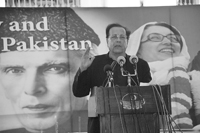

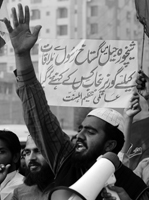
 Salmaan Taseer did not commit blasphemy. We should get this straight. He was not a Gustakh-e-Rasool (insulter of the Prophet). He did not remotely commit or say anything falling in the category of what the most charged of believers take to be blasphemy. Yet in the name of the Prophet, whom we revere as the Last Messenger of God, he was gunned down by one of his guards. It is at the gates of such madness that we as a nation have arrived. And if there can be anything worse, it is the reaction of assorted clerics, doctors of the faith and muftis of the media, who instead of condemning this act openly have uttered tongue-twisters and adopted convoluted postures which amount to justifying it. The road to hell is paved with such equivocations. One of the media muftis pontificating on television when Taseer’s blood had hardly dried was heard saying that it was strange of the slain governor to have visited in prison someone convicted of blasphemy — a reference to the unfortunate Christian woman, Aasia Bibi. This amounted to saying that the governor was almost asking for what happened to him.
 There is no such thing as positive journalism, a notion put about, mostly in a whining manner, by government information departments. Journalism is at its most responsible when it is explosive and incendiary, shaking people out of accepted modes of thinking. It is at its most irresponsible when it follows the dotted line. Demagogues and second-rate politicians play to the gallery or dance to the tune of public opinion. The journalist with some respect for his calling looks at the other side of the coin. Priests and other doctors of the cloth may deal in the currency of faith. The journalist treads on less hallowed ground. His primary tool is language for without it he would be like a soldier unskilled in the use of arms. But his highest education is in doubt and cynicism. The journalist points the path to no celestial heaven. His Valhalla is here and now. Good intentions he leaves to professional charity workers. For he knows where the best of intentions so often lead.


