A half-truth is a deceptive statement that includes some element of truth. The statement might be partly true, the statement may be totally true but only part of the whole truth, or it may utilize some deceptive element, such as improper punctuation, or double meaning, especially if the intent is to deceive, evade, blame or misrepresent the truth http://www.merriam-webster.com/dictionary/half-truth - The Board of intermediate and secondary education in Hyderabad resolved to make Sindhi the official language of the Board making the language compulsory. This led a wave of Mohajir protest against the University and the Board. Nawab Muzaffar Hussain, convenor of the Mohajir Punjabi Pathan Mahaz (MPPM-a political party founded in the 1960s and which won the elections in Hyderabad in 1970) led the Mohajir protest against the decision of the University and the Board. - Hyderabad was the provincial capital when Karachi was the federal capital of Pakistan, and is a city that has always been ripe with politics and political figures. During the pre- and post-partition years, however, just four families dominated the political arena in Hyderabad until the Pakistan People's Party (PPP) came into being: the Kazi Brothers, the Mir Brothers, the Memon community and Syed Mubarak Ali Shah (Moti Mahal). Later during the post-partition era, Nawab Muzaffar Hussein, who founded an alliance comprising the Mohajirs, Pukhtoons, and Punjabis to decrease the dominance of Sindhi-speaking people, became an important name. REFERENCES: Sindh Chronology - Page 8 http://www.safhr.org/index.php?option=com_content&view=article&id=73&Itemid=374&limitstart=7
September 18. Combined Opposition Parties (COP) stuns Ayub’s camp by nominating Miss Fatima Jinnah, popularly called "Mother of the Nation" as presidential candidate for the elections to be held in Jan, 1965. The 9 point program of COP includes restoration of direct elections, adult franchise, democratization of 1962 Constitution. After suffering a brief ban, the Jamaat-e-Islami does an about-turn on its established dogma of not accepting the leadership of a woman and supports Miss Fatima Jinnah for head of state against Ayub Khan. November. A round of political meetings with the Basic Democrats is underway, in which Ayub Khan and Fatima Jinnah appear before their electors in each area at different times but usually on the same days. While Ayub Khan is probably groomed by his oratorial Foreign Minister Zulfikar Ali Bhutto not to be bogged down by statistics (Ayub's tragic flaw) and instead focus on emotionalizing his speeches to his limited capacity, the Opposition Leader Miss Fatima Jinnah is coming out as a bitter critic of everything that smacks of a dictatorial stamp on it - from the personal traits of Ayub Khan to his son's alleged abuse of power for strengthening his 'Gandhara Motors' to the general character of Zulfikar Ali Bhutto whom she recently dubbed as 'inebriate and a philanderer.' Even Ayub stooped below his usual level of decorum when, at a press conference in Lahore, he exclaimed that Miss Jinnah has been leading an 'unnatural' life (obviously a reference to her spinsterhood) and was surrounded by 'perverts.' November 19. The elections for the Basic Democrats have ended today. Under the Constitution in force in Pakistan since 1962, it is these elected representatives of the people and not the people themselves who will vote in the forthcoming Presidential Elections. The Government earlier decided not to issue party tickets to the contestants of these elections, and the opposition is seeing it as a shrewd move: it is now more convenient to purchase the Basic Democrats. In the absence of a definite categorization of the Basic Democrats both parties are claiming victory. The official Muslim League claims that 80% of the BDs were Ayub's supporters while the Combined Opposition Party (COP) claims 90% of the winners to be its own. December 1. Ayub warns Urdu-speaking BD members from Karachi against voting for his opponents: "Agay samandar hai…" - Courtesy: Mr. Khurram Ali Shafique - The Chronicle of Pakistan Compiled by Khurram Ali Shafique 1964 http://pakistanspace.tripod.com/chronicle/1964.htm
January. As results of presidential elections are announced, Fatima Jinnah loses with 28,345 votes against Ayub’s 49,647. Mian Bashir Ahmad gets 65 and K.M.Kamal 183 votes. In a press statement issued on the eve of her defeat, Miss Jinnah says: "The system under which these elections were fought was initially devised to perpetuate the… incumbent of the Presidential Office. Neither does it provide room for the free expression of the popular will, nor does it conform to the known and established principles of democracy in the civilised world… There is no doubt that the elections have been rigged. I am sure that the so-called victory of Mr. Ayub Khan is his greatest defeat. The election campaign… was only the beginning of our march for the emancipation of the country from the shackles of an authoritarian rule. We shall, therefore, continue to work with renewed faith for the achievement of our destined goal and restore to the people their sovereignty which will usher in true democracy in the country." January 4. Ethnic riots erupt in Karachi as citizens protest against violation of Section 144 by President’s son and Pukhtoon transporters, who took out a procession to celebrate election victory. Aggressors raid colonies in the night. Bloody massacres are witnessed, yet official sources claim only six dead. Courtesy: Mr. Khurram Ali Shafique - The Chronicle of Pakistan Compiled by Khurram Ali Shafique 1965 http://pakistanspace.tripod.com/chronicle/1965.htm
Please also see the following report from Milwaukee Journal of January 19 1965 regarding Gohar Ayub Khan’s shamefule role in the violence in Karachi following the 1964-65 elections. He is a politician whose entire political career seems to consist of pitting his own constituents against other groups in the country just for his own short-term political gain. (Captain Gohar Ayub Khan shaking hands with his own Father i.e. Field Marshal (without fighting any war) and American Backed Martial Law Administrator of Pakistan "General Ayub Khan" (1958 to 1969)
"QUOTE"
Interview of Late. G M Syed on Sindh's Politics vis a vis Pashtuns and Urdu Speaking Communities.
Q. A large ntunber of Urdu-speaking people live in Sind. Will they be invited to join the SNA?
A. A group within us did not want the mohajirs to be included, since there is a section of mohajirs in Sind that was speaking out against the front. Another group wants to trust the Punjabis more than the mohajirs. However, the door is now open for non-Sindhi speaking persons to join the alliance. Before it was for Sindhi-speaking people only, now it is for those who live in Sind. I had talked about this to Nawab Muzaffar a longtime ago. And Isaid that with four conditions we could come together. The first was that we would like-to separate politics from religion. We believe i.n a secular state, a majority of mohajirs do not subscribe to this view. The second condition was that Muslims should not be viewed as a separate nation. The third was to refute the ‘nazariya e-Pakistan.-' At the time agreement could not be reached on those conditions. Those who came from elsewhere, they did themselves to be part of us. Their biggest leader now is Altaf Hussain. He came to see me in hospital, we are on good terms. But how we are to work together, this we did not discuss.
Q. Sind's urban situation has dramatically changed with the emergence of the MQM. What are your views on this phenomenon?
A. l see it merely as a change of tactics by imperialism and the ruling cliques. The same cliques who were operating the Mohajir-Punjabi-Pathan Mahaz during the Ayub regime are still active. They change their signboards and do the same thing all over again. At that time they created many problems for the people of Sind. They were always with me military, always with the ruling class. They have never changed their ideology. They opposed the quota system at that time. They are doing it now. They were opposed to Sindhi culture. They are still opposed to Sindhi culture. They are setting fire to the Sindhology Department, capttuing the cultural heritage of the Sindhi people, Hyderabad fort and all that. www.sanalist.org/Sangat/september1988.pdf
"UNQUOTE"
Nawab Muzzaffar's son Rashid Hussain Khan then joined PML (read IJI and you can also read Mehran Bank League), some say that Mohajir Punjabi Pathan Mahazthat was created by General Yahya during the last days of Ayub to counter movement against One Unit. To understand the complete background, here are few quotes from BBC Urdu
Altaf greets people of Sindh on birth anniversary of GM Syed - KARACHI: Muttahida Qaumi Movement (MQM) chief Altaf Hussain has greeted the people of Sindh on 107th birth anniversary of veteran politician GM Syed. Altaf Hussain said GM Syed was a patriotic veteran politician, said a statement issued by MQM here on Monday. MQM chief said the veteran politician had struggled peacefully throughout his life, for the protection of the rights of the people. app Altaf greets people of Sindh on birth anniversary of GM Syed - Tuesday, January 18, 2011 http://www.dailytimes.com.pk/default.asp?page=2011\01\18\story_18-1-2011_pg12_12
Harron ur Rasheed (Jang Group) Spits Venom against Sindhi Community with Sweeping Statement.
Nazir Naji also use "Sweeping Statement" against Sindhi Nationalists without bothering to name them to warn People of Pakistan to beware from Short Sighted Sindhis.
Would Mr. Nazir Naji care to explain his very own Conduct Unbecoming.
On 14 July 2011, Hamid Mir, Haroon ur Rasheed and Nazir Naji (Jang Group) were discussing Ill mannered Zulfiqar Mirza and Waseem Akhter whereas watch this video and witness "the naked Verbal abuse of Jang Group Journalists":)
Would Mr. Nazir Naji put the blame of the violence mentioned below on "Short Sighted Sindhis"
Front line with Kamran Shahid Special – 16th August 2011 (PART - 1)
URL: http://youtu.be/QVpmPoP09KA
KARACHI: Life stopped for Pakistani cab driver Ghulam Mohammed when his seven-year-old daughter was shot dead on her way home from school, a victim of senseless political and ethnic violence sweeping Karachi. Shumaila was Mohammed’s only child, born after he and his wife struggled for 12 years to have a baby. It took two stray bullets to bury all the hopes and dreams they had for the future. “She was the one who gave meaning to our life. Now we have no reason to live,” said the tearful 36-year-old, a resident of Qasba Colony, one of a series of troubled neighbourhoods in western Karachi turned into a battlefield. Shumaila was one of 300 people whom the independent Human Rights Commission of Pakistan (HRCP) says died in political and ethnically linked shootings in Karachi last month and one of the 800 killed since the start of this year. She was carrying her books when the bullets pierced her abdomen and splintered a rib. Seriously wounded, she was eventually picked up by an ambulance after medics struggled to access the street under gunfire. REFERENCE: Pakistan’s poor dying in Karachi violence AFP Yesterday http://www.dawn.com/2011/08/07/pakistans-poor-dying-in-karachi-violence.html
Front line with Kamran Shahid Special – 16th August 2011 (PART - 2)
URL: http://youtu.be/fxOHFOQ6qjo
“Someone told me my daughter had been shot and I rushed to hospital despite all the risks, only to find her dead in the morgue,” Mohammed said. Authorities appear powerless to stop the bloodshed, human rights activists say, pointing out that most of the victims are innocent civilians. “People have been killed because of their political affiliations, but it seems most are killed because of their ethnic background,” Zohra Yusuf, chairwoman of the HRCP, told AFP. “The majority of them are poor and destitute.” Shumaila was Pashtun. Her father arrived in Karachi from the northwest 20 years ago looking for work and then settled down and got married. Today the northwest is on the frontline of Taliban and Al-Qaeda-linked bomb attacks and the migrant flow to Karachi is even greater. Shumaila’s bereaved parents live on a congested street in a neighbourhood of Urdu and Pashtun speakers, where trigger-happy gunmen from both sides can quickly reduce the area into a battlefield. HRCP says Karachi suffers political, ethnic and sectarian “polarisation”. But the government blames vague mafias involved in land grabbing and drug pushing for the killings, and for creating “misunderstandings” among political parties and ethnic hatred. “It should not be called ethnic violence,” said Sharfuddin Memon, an official in the home ministry of the southern province Sindh, of which Karachi is the capital. “The mafias are killing people in such a manner that rival communities and parties are left with the impression of an ethnic war which is not there. The mafias do this to get stronger and weaken the writ of the state.” REFERENCE: Pakistan’s poor dying in Karachi violence AFP Yesterday http://www.dawn.com/2011/08/07/pakistans-poor-dying-in-karachi-violence.html
Front line with Kamran Shahid Special – 16th August 2011 (PART - 3)
URL: http://youtu.be/1GGxhiGsKZQ
The Urdu-speaking family of Anwer Ali, 22, say he was walking to work when unknown gunmen shot him dead. “He was the only bread earner for his mother and two sisters,” said his cousin Mohsin Ali. The family rent a one-room house in a squatter settlement near the area of Katti Pahari, a flashpoint for the most recent violence, and are deeply frightened about the future. It is not just shootings. People have seen everything they own go up in smoke, with their houses, buildings and vehicles set alight by arsonists. Despite the deployment of extra police and paramilitary forces, residents complain that the security personnel do nothing to help. “Mafias are involved in the killings, but armed wings of political parties have played a big role in creating the mess,” said Tauseef Ahmed Khan, who teaches mass communications at Urdu University. The armed wings work to maintain party influence, prevent rival groups from infiltrating their territories and force people to remain loyal, he said. “There are killings on ethnic grounds while most of the victims are poor people who don’t know the reason why they are being killed,” Khan said. REFERENCE: Pakistan’s poor dying in Karachi violence AFP Yesterday http://www.dawn.com/2011/08/07/pakistans-poor-dying-in-karachi-violence.html
Front line with Kamran Shahid Special – 16th August 2011 (PART - 4)
URL: http://youtu.be/sTZLV2-9J1Q
Statistics compiled by the HRCP Karachi chapter shows that a total of 1138 people have been killed in the city during the first half of 2011, with 490 of them falling prey to targeted killings on different grounds including political, sectarian and ethnic basis. “Karachi has been under the influence of political parties for the past several months and continuous surge in killings in the city reflects the government’s inefficiency to cope with the mounting threat of insecurity,” said Zohra Yusuf, Chairperson HRCP while sharing statistics during the press briefing at their office. For appeasing the ruling coalition partners, she noted, the government had failed to take any decisive action against culprits causing unrest in the city. Of the 490 victims of target killings, 150 were killed apparently for their association with various political, religious and or nationalist parties, 56 for their ethnic background and eight on sectarian grounds. According to the HRCP report, as many as 65 women were killed during first six months of this year – 24 of them were killed by relatives, 26 by unidentified culprits, four were set on fire, three killed on railway tracks, 2 each killed by robbers and Lyari gangsters, three on the pretext of Karo-Kari, while one woman was killed by police. Meanwhile 37 men lost their lives in the ongoing Lyari gang war this year. The report listed 56 ethnic killings which were reported this year. Of those targeted, 51 of the victims were male, while one female and four children were killed. The figure shows that 250 people with no political affiliation were also killed in Karachi this year while 139 killings were reported during the corresponding period of last year. This indicated a rise of 179% in the killings this year. The report detailed names of parties (political, religious, nationalist and banned organizations) or groups and the number of their activists assassinated during the first six months of 2011. It said 77 target killing victims belonged to Muttahida Qaumi Movement; 26 to Pakistan People`s Party; 29 to Awami National Party; 16 to Mohajir Qaumi Movement-Haqiqi; 7 to Sunni Tehreek; 9 to Jamaat-e-Ahl-e-Sunnat; two to Jamiat-e-Ulema Islam; one to Pakistan Muslim League-Nawaz (PML-N); one to Jamaat-i-Islami (JI); one each to PML-Functional, Jeay Sindh Qaumi Mahaz, and Punjabi-Pakhtun Ittehad and four to Sipah-e-Sahaba (banned). During the first six months of 2010, the figures were comparatively low as MQM-H had their 34 activists killed; MQM 22; PPP 11; PPP-S 2; Punjabi Front 1; ANP 16; Sunni Tehreek 4; PML-N 1; PML-Quaid-i-Azam 1; PML-F 1; JI 3; Jamiat Ulema-i-Islam 2; JSQM 2; PPI 1; Sipah-i-Sahaba (banned) 3; and Tehreek-i-Taliban (banned) 1. REFERENCE: HRCP report indicates rise in killings this year By PPI Published: July 6, 2011 http://tribune.com.pk/story/203309/hrcp-report-indicates-rise-in-killings-this-year/
Karachi Target Killing ki Front Line Se – 17th August 2011 (PART - 1)
URL: http://youtu.be/YUN6_PvdXqw
KARACHI: The wave of ‘ethnic violence’ that largely affected Orangi Town on Tuesday spread to other parts of the city on Wednesday, when the most gruesome incident of the day took place early in the morning in Gulshan-i-Iqbal where five men were found shot dead in a minibus. The minibus, of route D7, was found parked in Block 1 of Gulshan-i-Iqbal containing the five bodies, which the police shifted in a single ambulance to the Jinnah Postgraduate Medical Centre. The bodies were later identified as those of minibus driver Wali Mehsud, Ghulam Jan, Ahmed Jan and Niaz Jan. A spokesman for the Awami National Party said that the latter three were relatives. They hailed from Bajaur Agency and lived in Landhi. The fifth victim was later identified as Liaquat Baloch, a resident of Gulberg. His body was found stuffed in a gunny bag, police said.
They said the four men were shot in the head by unidentified assailants, while Liaquat Baloch had strangulation marks. Quoting the conductor of the minibus, who had jumped off the minibus and fled to safety, SSP Niaz Ahmed Khosa told Dawn that the minibus had started its journey at Sohrab Goth for Landhi. When it reached near the Fazal Flour Mill on Rashid Minhas Road, suspects riding two motorcycles stopped and boarded the bus and held the passengers at gunpoint. The ill-fated minibus was caught on CCTV cameras at three spots when it was travelling in Gulshan-i-Iqbal. The footage showed two motorcyclists tailing the minibus, a senior police officer told Dawn. In Gulshan Block 1, two men stopped a van of the Gulshan-i-Iqbal police station and informed the police that they had heard shots being fired inside the minibus as it passed by. Subsequently, the police van drove in the direction and soon found the minibus dripping with blood. The spot where the minibus was abandoned was also covered in the CCTV footage obtained by the police in which three suspects could be seen coming out of the minibus and running to the two motorcycles, the police said. “The minibus stopped at the spot at 5.57am and within a few seconds the three suspects disembarked it and escaped. Two minutes later the police van reached the scene,” said SSP Khosa. However, the body found stuffed in the gunny bag remained a mystery. Police collected seven spent bullet casings of 9mm and .30-bore pistols in the minibus.
The family of the murdered driver said Wali Mehsud, 26, had married about six months back. In other incidents of violence, the body of a young man bearing a gunshot wound was found within the remit of the Mauripur police station. The police said the victim was later identified as Nasir Khan, an ANP activist. The victim was a resident of Rasheedabad. Police said that later when the body was taken to his home in Rasheedabad, people in Baldia resorted to indiscriminate firing in the area that resulted in the death of Salman Shaikh, a factory worker who was going for lunch. The incident occurred within the jurisdiction of the Site-B police station. His body was taken to the Civil Hospital Karachi for medico-legal formalities.
In the Muslimabad area of Orangi Town, Sharafat was killed and two others were wounded when gunmen opened fire on them. A spokesman for the ANP claimed that Sharafat was a party worker. His body was taken to the Qatar Hospital in Orangi Town. Meanwhile, two persons wounded in Orangi Town on Tuesday died in the Abbasi Shaheed Hospital on Wednesday, hospital sources said. They were identified as Jahan Bibi, who was brought from Qasba 2½, and Rameez. In the early hours of Wednesday, Naresh Kumar, 23, was killed by unidentified assailants riding motorcycles within the remit of the Napier police station. The victim was a resident of Murad Memon Goth and had come to Lyari to attend a family gathering, the police said. Similarly, also in the early hours of Wednesday, another young man, Sha’aban, was shot dead in Khadda Market. The victim was a resident of Nayabad. On Wednesday, two men were targeted in a different incident in Gulshan-i-Iqbal and North Nazimabad, police said.
In the first incident, Haji Abdussalman, 25, was targeted by gunmen riding a motorcycle near the Dhaka Sweets shop in Gulshan-i-Iqbal. The victim was rushed to a private hospital, where he was pronounced dead on arrival. The police said a pistol was found in the possession of the dead. In North Nazimabad, a man was killed within the remit of the Shahrah-i-Noor Jahan police station. The North Nazimabad SP said Asghar Khan, 40, was on the rooftop of his house when he was hit by a bullet. Police said he did not have any political affiliation. However, a spokesman for the ANP said that Asghar Khan, son of Umar Khattab, was the vice president of its Ward UC-2. Orangi Town SP Khurram Waris said that 12 suspects were arrested in different parts of the town and weapons were seized from them. As many as 10 people were killed and dozens others were wounded in violence on Tuesday. As firing continued and tension prevailed on a second day of violence, residents of Qasba Colony, Kati Pahari and other parts of Orangi Town remained confined to their homes and ran short of basic commodities of daily use. REFERENCE: CCTV cameras capture gunmen behind minibus massacre By S. Raza Hassan | From the Newspaper July 7, 2011 (3 weeks ago) http://www.dawn.com/2011/07/07/cctv-cameras-capture-gunmen-behind-minibus-massacre.html
Karachi Target Killing ki Front Line Se – 17th August 2011 (PART - 2)
URL: http://youtu.be/sNuWIilP_nw
With the world becoming increasingly connected, political correctness in ideas and behaviour is becoming essential for minimising frictions, and for that reason it also is becoming the hallmark of the educated. We Pakistanis often complain about the lack of “randomness” at airport security checks abroad and go livid at any generalisation linking Pakistanis to terrorism, but then sadly, this indignation is reserved for foreign lands only, the same is definitely not displayed within Pakistan. Pick up any mobile phone here, and it is bound to have SMSed jokes with the racist stereotyping of Pathans. While such stereotyping for the sake of humour is at times tolerable, one is simply astonished to find the same to be believed for real. During the recent spate of violence in Karachi, I was shocked to come across a very high proportion of educated Urdu speaking Karachiites who believe the Pashtun ethnicity to be nothing short of a deformity, and the Pashtun influx as a curse for Karachi. One of the main fears expressed, is that since Pashtuns are more likely to be associated with terrorism and theft, stopping their inflow would naturally result in a more peaceful Karachi. Besides being horrifyingly similar to the “all Pakistanis are terrorists” argument often used by anti-immigration groups in the West, this one stoops even lower as it seeks to quarantine fellow Pakistanis on the basis of ethnicity. This argument conveniently ignores the fact that if the profession of gate keeping and driving in Pakistan can be associated with one ethnicity, then it is the Pashtuns. While I am no fan of generalisations, but if one is to be done, then considering the typical Pashtun professions shouldn’t the generalisation be one of trust, rather than distrust?
Pashtuns are also held responsible for bringing the drugs and Kalashnikov culture into Karachi. This argument completely ignores the well-documented planning and financing of the so called “Afghan jihad”, furthermore, people who say such things basically consider Karachi as an entity separate from Pakistan. The arms and drugs trade was crucial in financing the jihad, and the inflow of drugs and guns was not something new just for Karachi, it was the same for Peshawar, FATA as well as the rest of Pakistan. Pashtuns as an ethnicity are facing the brunt of that blunder committed by our “strategists” in the 80s. But, to completely ignore that whole episode and blame it on the DNA of an ethnicity would be too ignorant a conclusion. It goes without saying that the response to an increase in violence and drugs is better policing and not racial discrimination. There also is a ridiculous belief that Pashtuns are somehow incapable of “culturally assimilating” into Karachi, reasons usually given are the inability to speak Urdu and having more conservative norms. To begin with almost all Pakistani Pashtuns are bilingual; it is very rare to find someone in Peshawar who can’t speak Urdu let alone find a Pathan in Karachi who wouldn’t. Furthermore, the norms of the Pashtuns might be considered conservative, but that is if compared with those of the Brazilians. Karachi is no Rio de Janeiro, as testified by the fluttering black burqas on Sea View and Gidani, and also as the former stronghold of Jamaat-e-Islami, Karachi can never be too liberal for even the most conservative of Pakistanis. Those who consider the Westernised bubbles of Clifton and Defense as the real Karachi are sadly mistaken.
These generalisations mask a worry, which emanates from rising Pashtun numbers in Karachi. Frustrated by wars and lack of economic opportunity, these Pashtuns are heading towards Karachi for a better life. But then, Karachi is not unique in receiving such migrants, just across the border, Mumbai is going through the same. Interestingly, the Urdu/Hindi speaking migrants from Uttar Pradesh, form the bulk of migrations into Mumbai. Those who are worried about this influx into Karachi, should consider the fact that Karachi used to have a Sindhi majority, a fact that changed after the Mohajir influx. If there was nothing illegitimate about that phenomenon, then assuming no bigotry, there should be no apprehensions about Karachi becoming a Pashtun majority city, because in essence the only difference between an Urdu speaking Mohajir and a Pashtu Speaking Mohajir is that of the date on their train tickets. Sadly, the expression of this apprehension is not limited to verbal racism, statistics on the ethnicity of the victims show that they are overwhelmingly Pashtun. Mehr Bokhari’s show on the 7th of July, 2011, revealed that in the violence till that point, 80 Pashtuns and 7 Mohajirs were killed. The irony of the situation is that those who are bent upon declaring the Pashtun as a separate species, also make a case for victimhood based on post-partition hostilities doled out to Pakistan’s Mohajir community. It should be obvious that the pre-requisite for claiming a higher moral ground based on those injustices, is not to rationalise the same (if not worse) that is being doled out to Karachi’s new Mohajirs. The writer is an Islamabad-based development economist. He blogs at iopyne.wordpress.com REFERENCE: Karachi’s Pashtun “Problem” By:Imran Khan http://www.pakistantoday.com.pk/2011/07/karachi%E2%80%99s-pashtun-%E2%80%9Cproblem%E2%80%9D/
Karachi Target Killing ki Front Line Se – 17th August 2011 (PART - 3)
URL: http://youtu.be/yMqPqYEbAUE
KARACHI, March 23: While parts of the city have been in the grip of ethnic violence once again for the past many days, it is observed that the victims of targeted attacks as well as patients belonging to certain communities were usually not taken to the nearest government hospital. The alarming trend where people with a certain ethnic background avoid some hospitals even if they are in a precarious condition has developed over the years, though it becomes noticeable during spates of ethnic killings and violence that the city often witnesses. “Yes, there is a clear pattern that Pakhtun victims of targeted attacks are not taken to the Abbasi Shaheed Hospital for treatment; they even don`t allow the bodies of targeted killing victims to be taken to the ASH,” said a senior official of the medico-legal section of the Sindh government on the condition of anonymity. The official cited the recent killing of ANP general secretary of district west Advocate Mohammad Hanif Khan, saying that the victim was attacked in SITE`s Metroville area but was taken all the way to the Jinnah Postgraduate Medical Centre, where he was pronounced dead.
A senior doctor of the JPMC also confirmed the pattern, saying that the JPMC received patients, including those with gunshot wounds, from as far as central and west districts of the city. “There have been several instances where the body of a targeted killing victim was shifted to the Abbasi Shaheed Hospital mortuary but the heirs took away the body to another hospital,” charity workers said.
`Ambulance workers know`
Senior official of the Edhi Foundation Anwer Kazmi also confirmed to that the trend had been in evidence for the past many years. He said people belonging to a certain community avoided going to some hospitals. “Now even ambulance drivers have learnt as to which hospital the body of a victim from a certain ethnic background should be shifted,” Mr Kazmi said, adding that in case a friend or relative of the victim was present at the time of shifting the driver acted on their advice. “Generally people belonging to the Pakhtun community go to the Jinnah Postgraduate Medical Centre for treatment, while those belonging to the Urdu-speaking community by choice visit the Abbasi Shaheed Hospital,” he said. Former President of the Pakistan Medical Association Dr Habibur Rehman Soomro confirmed the trend, saying that certain ethnic communities avoided visiting some hospitals. “Everyone is witness to this alarming trend but no one is ready to point it out,” he said, citing the air of mistrust prevailing in the metropolis. He said the practice was followed not only by the Pakhtun community, but also by people from other ethnic backgrounds. He explained that if there was a conflict going on between the Urdu-speaking and Sindhi-speaking people, the Sindhi-speaking people would avoid visiting certain hospitals. The former PMA president said that the trend had been there for the past 10 to 15 years. He went on to say that certain private-sector hospitals were also following such a trend and were offering community-based services.
`Just an impression`
However, Sindh Health Minister Dr Saghir Ahmed dispelled the impression that Pakhtuns avoided going to the Abbasi Shaheed Hospital for treatment. “A visit to the hospital would show you that the Pakhtuns are under treatment at the Abbasi Shaheed Hospital,” he said. He added that if statistics from the police surgeon office were examined, they would also dispel this impression. “There may be an impression, but it`s not true in reality,” he insisted. REFERENCE: Ethnic divide hits city hospitals By S. Raza Hassan | From the Newspaper March 24, 2011 http://www.dawn.com/2011/03/24/ethnic-divide-hits-city-hospitals.html
Karachi Target Killing ki Front Line Se – 17th August 2011 (PART - 4)
URL: http://youtu.be/eEM5Heok8ak
Story of a Short Sighted, Extremely Prejudiced and Narrow Minded Sindhi
"QUOTE"
Mutineer G M Syed with Patriot Muhammad Ali Jinnah
The Working Committee meets in Bombay, 1942
LATE. Mr. Ghulam Murtaza Shah AKA G M SYED [A DIE-HARD COMPANION OF LATE. JINNAH]
Read the Sindh Assembly Resolution:
“QUOTE”
SEVENTEENTH SESSION
RESOLUTION ON MATTERS OF GENERAL PUBLIC IMPORTANCE
On 3rd March, 1943, Mr. G.M. Syed moved the Historical Pakistan Resolution:-
“This House recommends to Government to convey to His Majesty’s Government through His Excellency the Viceroy, the sentiments and wishes of the Muslims of this Province that whereas Muslims of India are a separate nation possessing religion, philosophy, social customs, literature, traditions, political and economic theories of their own, quite different from those of Hindus, they are justly entitled to the right, as a single, separate nation, to have independent national states of their own, craved out in the zones where they are in majority in the sub-continent of India.
“Whereas they emphatically declare that no constitution shall be acceptable to them that will place the Muslims under a Central Government dominated by another nation, as in order the order of things to come, it is necessary for them to have independent National States of their own and hence any attempt to subject the Muslims of India under one Central Government is bound to result in Civil War with grave unhappy consequences.”
Walkout by Hindu Members
The Honourable mover of the resolution stated that his resolution was intended to convey the views and sentiments of only the Mussalmans of Sind and not of the entire population of Sind. The Chair also held that it was only the wish of the Mussalmans of Sind which was going to be conveyed by this resolution. In view of this ruling of the Chair that the Hindus had no interest in the resolution and that it was only the religion and sentiments of the Mussalmans of Sind that were to be conveyed through it, the following Hindu members left the House.
Mr. Nihchaldas C. Vazirani, Mr. Dialmal Doulatram, Mr. Ghanumal Tarachand, Mr. Partabrai Khasukhdas, mr. Akhji Ratansing Sodho, Mr. Mukhi Gobindram and Rao Bahadur Hotchand Hiranand.
Division
The Resolution was pressed to division.
RESULT OF DIVISION ON PAKISTAN RESOLUTION.
YES.
SHAIKH ABDUL MAJID
KHAN BAHADUR ALLAH BAKHSH K.GABOL
KHAN BAHADUR HAJI AMIR ALI LAHORI.
MR. ARBAB TOGACHI.
MIR BANDEHALI KHAN TALPUR.
MIR GHULAM ALI KHAN TALPUR.
HONOURABLE SIR GHULAM HUSSAIN HIDAYATULLAH.
KHAN BAHADUR GHULAM MUHAMMAD ISRAN.
SAYED GHULAM MURTAZA SHAH.
KHAN BAHADUR SAYED GHULAM NABI SHAH.
HONOURABLE PIR ILLAHI BAKHSH NAWAZ ALI.
NAWAB HAJI JAM JAN MUHAMMAD.
MRS. JENUBAI G. ALLANA.
S.B. SARDAR KAISER KHAN.
SYED MUHAMMAD ALI SHAH
HONOURABLE KHAN BAHADUR M. A. KHUHRO.
HONOURABLE HAJI MUHAMMAD HASHIM GAZDAR.
MR. MUHAMMAD USMAN SOOMRO.
MR. MUHAMMAD YURI CHANDIO.
SAYED NUR MUHAMMAD SHAH.
RAIS RASUL BAKHSH KHAN UNER.
MR. ALI GOHAR KHAN MEHAR.
MR. SHAMSUDDIN KHAN BARAKZAI
KHAN SAHIB SOHRAB KHAN SARKI.
NOES.
THE HONOURABLE RAI SAHIB GOKALDAS MEWALDAS
THE HONOURABLE DR. HEMANDAS R. WADHWAN
MR. LOLUMAL R. MOTWANI.
The Historical Pakistan Resolution was passed by the Sindh Legislative Assembly on 3rd March, 1943 during the Session, out of 38 Members 24 Members favoured and 3 Members opposed the Pakistan Resolution.
ISLAMABAD: Allegations against two senior journalists, The News Editor Investigation Ansar Abbasi and Geo TV Senior Anchor Kamran Khan, of being agents of CIA and Indian agency RAW by senior PPP leader Raja Riaz and other MPs have been widely denounced by all political parties and members of civil society including stalwarts of the PPP. The MQM said in a statement that to criticise was part of democracy. "Had the PPP alleged that a few journalists are running a negative campaign against the government, no Pakistani along with the MQM would have objected, but calling someone RAW and CIA agent is condemnable." "The PPP should avoid this sort of allegations otherwise confrontation might reach the point of no return," the statement said. PML-Q spokesman Kamil Ali Agha said it was below his level to comment on an allegation hurled by Raja Riaz of the PPP. "First Raja Riaz should himself clarify about his character and then hurl allegations on journalists who expose corruption," he added. Pervaiz Shaukat, president of the Pakistan Federal Union of Journalists, while condemning the allegations hurled by PPP leaders, said anybody could differ with the news published by a journalist, but calling someone an agent of RAW and CIA did not suit to any government. REFERENCE: PPP allegations against newsmen slammed by all By Usman Manzoor Wednesday, October 20, 2010 Zi Qad 11, 1431 A.H. http://www.thenews.com.pk/Todays-News-13-1428-PPP-allegations-against-newsmen-slammed-by-all
Hamid Mir and GEO TV had said that Pakistan has lost it Territory:)
In an unprecedented move, Punjab Assembly unanimously ratified a motion, placed before the House by PML-N member Sanaullah Masti Khel, against media on Friday, according to reports. Interestingly, no assembly member opposed the said motion. The assembly also condemned the programmes being aired casting aspersions on the MPAs. Earlier, some members of the assembly including the female members delivered fiery speeches in the House blaming generals- judges-journalists nexus conspiring against the democratic dispensation. On the other hand, the media persons, sitting in the gallery, immediately left Punjab Assembly and boycotted the proceedings. Later, the journalists held a peaceful demonstration outside the assembly. The journalists raised slogans against this gang up of the lawmakers against the media, set ablaze copies of resolution in protest and chanted slogans in front of Chief Minister Shahbaz Sharif and members of Punjab assembly. REFERENCE: Why media is being targeted? http://www.thenews.com.pk/blog/blog_details.asp?id=713
RAWALPINDI: In the Geo News programme 'Aaj Kamran Khan Ke Saath,' the host Kamran Khan has expressed surprise that after having failed to nab killers of thousands of people, the government had identified Indian agents in the country. And it was Senior Minister in the Punjab cabinet Raja Riaz who had made the disclosure. He claimed that it was a conspiracy against democracy and also against the party that had been confronting the establishment, he said. Kamran Khan, however, reminded that in Pakistan establishment means Army. And according to Prime Minister Yousuf Raza Gilani the government not only enjoyed best of relations with it but also had been moving ahead with it shoulder to shoulder. Gilani had made these claims while addressing the nation the other day and during those moments he was accompanied at the dais by important members of the PPP. Kamran Khan reminded that Raja Riaz, contrary to Gilani, claims from the floor of the Punjab Assembly that PPP had been confronting the establishment or the Army. Raja Riaz's views with regard to Army are well known. On December 24, 2009 he had told the media that PPP had never succumbed to dictators or the Generals. It's difficult to digest as whether PPP had become anti-state or the Jang Group and Geo, Kamran Khan said. He said the Jang Group and Geo had been pin pointing as to who had plundered the national wealth and where it had taken place? Where merit had been flouted and where poor people are being killed just because of the incompetent government. He said it was a well-thought and well-conceived plan and Jang and Geo had fallen victim to it. REFERENCE: After failing to nab killers, govt finds Indian agents: Kamran News Desk Wednesday, October 20, 2010 Zi Qad 11, 1431 A.H. http://www.thenews.com.pk/Todays-News-13-1426-After-failing-to-nab-killers-govt-finds-Indian-agents-Kamran
Credibility of Ansar Abbasi and Sources of Ansar Abbasi is being revealed by his own colleague i.e. Nazir Naji.
Jang Group Journalists declaring each other Agent - 1 (Capital Talk 5th Nov 2009)
LAHORE: Following some heated arguments between the PML-N and the PPP MPAs over corruption scandals, the PPP parliamentary leader and Senior Minister Raja Riaz, speaking on a point of order, started criticising Daily Jang, Geo News and its senior reporters including Kamran Khan and Ansar Abbasi. The PPP minister claimed that Kamran Khan, the famous Geo TV anchorperson, presented 560 news stories solely on President Asif Zardari, mainly to target him. He alleged that Ansar Abbasi was also working on the same agenda, i.e. to weaken democracy in Pakistan. He termed both the senior journalists ‘Indian agents’. He said for the last two-and-a-half years, the PPP leadership was being targeted by the media and these journalists, though the coalition government wanted to strengthen democracy. At this point, no one from the house, especially from the PML-N, rose to defend the Jang Group, Geo News and senior journalists. Raja Riaz also claimed that the PPP leaders were ready to appear before the courts whether they are summoned in the morning, afternoon or in the evening. The entire PPP camp comprising Punjab Finance Minister Tanvir Ashraf Kaira, IT Minister Farooq Ghurki, Revenue Minister Haji Ishaq and all other members thumped desk in support of Raja Riaz’ remarks against Jang and Geo. REFERENCE: PPP rulers catch journalist agents of America, India! Updated at: 0931 PST, Tuesday, October 19, 2010 http://geo.tv/10-19-2010/73082.htm
PPP's Leadership About Indian Agent - 19 October 2010 - 1
GEO TV colloborates with the Voice of America, which is an official news arm of the government of the United States. Yet, GEO claims to be indpendent and objective.
As per a note blogger "Cafe Pyala"
"QUOTE"
Guess who was spotted on November 9 in Washington D.C. at a reception for American and Pakistani media personnel thrown by US AfPak ambassador Richard Holbrooke's media assistant Ashley Bommer? Mir Ibrahim Rehman, scion of the house of Jang and CEO of the Geo TV Network. He walked in with The Friday Times editor and Dunya TV's Najam Sethi but stayed long after Sethi left the party.
Mir Ibrahim Rehman (c) at his master's convocation earlier this year
Mir Ibrahim (MIR) apparently jetted in for a mysterious three-day visit to the US, during which, our sources say, the main objective was to convince the US administration that Geo was neither anti-US nor anti-democracy, the line being peddled by the Pakistan Peoples Party (PPP) government. MIR also wished to gather official American support for the Jang Groupagainst the PPP boycott of the group as an instance of an assault on freedom of the media.
Our sources claim that MIR did not find too much traction among US officials against the idea of a media boycott, perhaps because the Obama administration itself has a similar boycott against Fox News (albeit without the shoe-throwing rent-a-demos and vile grafitti scrawlsagainst Fox News owners). However, what is particularly interesting about the Jang Group's attempts to woo the American establishment is the fact that there has been apparently a lot of discussion within the US government about whether it should support and even subsidize a media group that has no qualms about running shrill propaganda against the US, and sometimes even promoting a pro-Taliban line. In particular,Hamid Mir's contribution to whipping up Blackwater hysteria in Pakistan,Ansar Abbasi's rants about Western puppets, and the space given to nutjobs such asZaid Hamid(Aag TV) andAhmad Quraishi(Aag TV and The News) have apparently raised quite a few eyebrows in the US administration.
The Americans have reason to be upset with the Jang Group, and MIR has reasons to find their upset unsettling. The running of the banal American propaganda Voice of America (VoA) programme Khabron Se Aagay[Beyond the Headlines] as an 'advertorial' on Geo since 2005 has netted the Jang Group and its owners, by some accounts, millions of US taxpayer dollars. Although the exact 'compensation package' doled out to Geo by the US government is still secret, it should be noted that the deal between Geo and VoA was mediated during the Bush-Musharraf era by the then Information Secretary Anwar Mahmood and advertising whiz-kid Asif Salahuddin, the latter of whom is reputed not to touch 'small' deals. Apparently, part of MIR's discussions with the US administration included those on the future of the Geo-VoA deal.
Incidentally, while Najam Sethi was ostensibly in the US for medical check-ups and may have been present at the Bommer reception only coincidentally, as we have reported in the past, he too has been trying to persuade American-backed NGOs to fund a new 'liberal' channel to be headed by him.
Coming back to MIR, it seems that more than American upset, a potential threat of withdrawal of lucrative financial support may be the trigger for a panic at the Jang Group. As they say, bullshit may walk but it's money that talks. I have a strong feeling that you may well see the (media) house line shifting very soon. If you suddenly begin to miss the casual anti-US vitriol in the group's publications and on Geo, you'll know why. REFERENCE: Money Talks TUESDAY, NOVEMBER 16, 2010 http://cafepyala.blogspot.com/2010/11/money-talks.html
ISLAMABAD: The Sindh Police department has initiated the process of appointing over 5,000 constables amid serious warnings that highly politicised persons enjoying the backing of the ruling Pakistan People’s Party (PPP) are being inducted into the police. An official source in the Sindh government warned that under the most powerful figure in the Sindh regime today, Home Minister Zulfikar Mirza, the process for the appointment of over 5,000 constables had already kicked off with the clear understanding that only favourites would be inducted in the police department, which is already ineffective and corrupt because of similar appointments made in violation of merit in the past. The source said the Sindh chapter of an elite intelligence agency had also raised similar apprehensions and reported to its headquarter that serious attempts would be made to appoint highly politicised individuals in the provincial police department. It is pertinent to note that the MQM, which is passing through turbulent times in the coalition both at the Centre and in Sindh, early this year alleged that the PPP was inducting 5,000 ‘criminals’ in the police force. REFERENCES: 5,000 Jiyalas likely to join Sindh Police By Ansar Abbasi Saturday, November 13, 2010 Zilhajj 06, 1431 A.H. http://www.thenews.com.pk/13-11-2010/Top-Story/2044.htm
One can attribute anything which cannot be substantiated to the "Alleged Sources" but lets watch what Jang Group's very own Senior Columnist Nazir Naji says about his colleague i.e. Mr. Ansar Abbasi's "SOURCES"
Wild Accusation, Hamid Mir and Ansar Abbasir in particular are synonymous and now watch this program and see for yourself as to how Correspondents of Jang Group behave with each other.
Jang Group Journalists declaring each other Agent - 1 (Capital Talk 5th Nov 2009)
Jang Group Journalists declaring each other Agent - 2 (Capital Talk 5th Nov 2009)
Jang Group Journalists declaring each other Agent - 3 (Capital Talk 5th Nov 2009)
Jang Group Journalists declaring each other Agent - 4 (Capital Talk 5th Nov 2009)
Off and On Love Affair of Ansar Abbasi with ISI [Note: Jang and The News have removed many stories from internet which was done by Ansar Abbasi against Pakistan Army and ISI]
“QUOTE”
Enough is enough message to government.Governments keeping mum over intrusive policies of a foreign power towards Pakistan targeting the Pakistan Army its prime intelligence agency the ISI and the countrys nuclear programme has left no option for the powerful establishment but to defend the national interest of Islamabad without much worrying about foreign or local reaction.The recent dismissal of the Kerry Lugar Bill in its present shape by the corps commanders meeting and the on going crackdown against foreign and local security agencies in and around the federal capital convey Rawalpindis clear message that enough is enough and there will be no compromise on ISI no give and take on the nuclear programme and no politicisation of the military establishment. Last year there were serious apprehensions raised and even shared with some leading politicians of the country about Asif Ali Zardari and if he after becoming the President of Pakistan would show the guts to resist foreign game plan to de nuclearise Pakistan by weakening the ISI and hurting the military those apprehensions could be subsided.Then one of the leading political leaders told me in the presence of a key party man that he was conveyed by the establishment that anti Pakistan foreign powers would expect from the new civilian government to make key changes in the military including that of the Army Chief DG ISI DG Strategic Planning Division etc bring the nuclear programme under the civilian control and reform the ISI.The leader also said that he could not trust the head of the state and admitted that a powerful country was after Pakistan and its nuclear programme but said that he would not like to do anything because he did not trust the establishment either because of his own past experiences.
The coming weeks and months however showed the things unraveling as was apprehended.The first piece of evidence came in the shape of governments decision to bring the prime military led intelligence of the country ISI under the control of Interior Ministry.The notification was issued the day Prime Minister Yusuf Raza Gilani flew for Washington via London in his first official tour to the US.However by the time he arrived at Dallas airport the notification had been cancelled.But the talks about reformation of ISI continued.In the meantime a PPP Senator now sidelined was told by a senior general that the establishment was getting vibes about an effort to transfer the countrys nuclear apparatus from under the militarys control to the civilian.“This will only be possible over our dead bodies ” the PPP Senator was told but he never conveyed this to the partys high command.
But later what we saw was a major cut in the budget of the strategic institutions including Pakistan Atomic Energy Commission (PAEC) Kahuta Research Laboratories and others.Not an ordinary but one of the top officials of one of these strategic institutions had shared with me some months back his extreme concern about this budgetary cut of the countrys nuclear programme and how seriously it was denting what was generally considered as the topmost priority of Pakistan.He was really feeling helpless and extremely concerned.Till recently everything was behind the scene and if there was any tension it was not visible as such.The recent operation against Inter Risk was the consequence of ISIs work.There is no explanation as to why the Inter Risk got licences of sophisticated weapons.The Deputy Commissioner Islamabad office record showed the Inter Risk to have received gifted foreign arms from a local tribesman in Bannu.
What added to the establishments worries were the repeated incidents of clashes between the foreign diplomats and local officials in Islamabad.The foreigners in clear violation of law of the land were also carrying with them arms and in one case even pointed gun at an Islamabad police inspector.The ISI was keen to see the foreign diplomat/official who pointed the gun at the Islamabad police inspector to have been declared as persona non grate but before the Foreign Office could proceed in this case the Islamabad police made a compromise with the embassy of the foreign country.In another case which shook the establishment was the Islamabad polices initiative to lodge a formal complaint against the ISI after the agency official questioned four foreigners who were caught red handed carrying sophisticated weapons near Peshawar More Islamabad.However later the Interior Ministry was made to remove the SP on whose order the ISI was booked.The same SP was also said to be instrumental while letting go scot free another vehicle carrying four foreigners who were wearing Taliban like look.
Such repeated incidents left no option for the establishment but to check the crossing of limits by the foreigners.Operation against Inter Risk is a clear message to all and sundry that no one would be allowed to raise private army here.And Blackwater in any disguise is not welcomed in Pakistan.While the Islamabad police on the instructions of the security agencies was carrying out operation against Inter Risk the Interior Ministry was clueless as to what was happening on ground.However later the Interior Ministry was made to cancel the licence of the Inter Risk.While at home we were facing a subtle flooding of Blackwater operatives in Washington the Kerry Lugar Bill was in the making.No proper consultation was done with concerned quarters here to assess as to what final shape the bill would take.
Besides the media and amongst politicians many even in the establishment believe that most of the “contentious” conditionalities concerning army and the security agencies were included in the bill later.The bill looks at the Pakistans nuclear programme with abhorrence paves the way for politicisation of the military by allowing the government to have its greater role in army promotions and appointments suggests (indirectly) civilian control over the ISI for its possible reformation talks of furthering the presence of foreigners in Pakistan condemns al Qaeda and Taliban and the Lashkar e Tayyaba but is silent about Tehrik e Taliban Pakistan and other local terrorist networks including Lashkar e Jhangvi that are hurting only Pakistan but not the US India etc.Instead as Pakistan witnessed the latest terrorist attack on GHQ reports of Pakistani intelligence agencies suggest that these terror networks are getting support from across the borders in India and Afghanistan. REFERENCE: Establishment conveys Author:Ansar Abbasi Posted On: Wed,Oct 14,2009 http://pakistanherald.com/Articles/Establishment-conveys-2032
“UNQUOTE”
Now read as to how Ansar Abbasi “protected” one of the figure involved in the whole Judicial Crisis Mess and NRO Negotiations with Late. Benazir Bhutto
ISLAMABAD: Long-drawn-out persuasion by the top brass of Pakistan`s elite intelligence agencies and high-ranking officials failed to convince a resolute chief justice Iftikhar Muhammad Chaudhry to step down before a presidential reference was filed against him. He stood like a rock, ready to face the challenge, in the hours-long persuasive sessions. A family source close to the “non-functional” chief justice quoted Justice Chaudhry as saying that during the critical Friday meeting with the president, he was given two options by General Pervez Musharraf — resign or face the reference. “I opted not to succumb,“ the source quoted him as telling the tale of his five-hour stay in the Army House on Friday. After the suspended chief justice told the president that he would never step down, the source revealed that almost 18 officials, including the top brass of the intelligence agencies, kept on swaying him, one after the other, to avail the first option, but he chose the hard one.
He, however, made it clear that he was not mistreated at any stage of the extended sessions. He was also offered lunch. He told his friends and acquaintances, who were able to meet him before the present security cordon around his official residence was clamped by the government, that he had immediately made up his mind that he would not bow out.
The source, who is still in contact with the chief justice and his family because of a not yet tracked communication means, said Justice Chaudhry had also told his sympathisers that the “charge sheet“ read by the president was the replica of the much-condemned open letter of a Supreme Court lawyer, who, it is generally believed, was written as a precursor to the reference.
After an almost five-hour stay in the Army House and following his consistent refusal to quit, he was allowed to go. One obvious change he immediately noticed as soon as he came to board his staff car was the missing of the chief justice’s flag from his official limousine. Acting Chief Justice Javed Iqbal took the oath of his office at a time when the chief justice was in the Army House.
When Justice Chaudhry came back, the world had changed for him altogether. Although the government claims that the suspended chief justice is not under house arrest, within hours of his return from the Army House, the top judge`s official residence was cordoned off, the telephone lines were disconnected and even the available mobile phones were taken away. The television cable was working till Saturday morning, but it was also cut off later.
The suspended chief justice was also not provided with newspapers although he was getting the crux of the media coverage on his issue through a lone communication mean that is still breathing. Except those allowed to meet him on Sunday as has happened in selected cases, no one can get in or out.
“It`s a pity that the man who spent all his life in delivering justice to people is now himself in need of justice,“ the source said, adding that the suspended chief justice is treated in a manner as if he were involved in some major corruption case. “But Justice Iftikhar`s track record speaks of his financial integrity,“ the source said, adding that “Pakistan is not the property of a few in power; this is our country.“ The source said the only hope left is the media that should raise its voice for justice and it is certain that the people of conscience will come forward and do their maximum to stop this injustice. REFERENCE: CJ proves hard nut to crack By Ansar Abbasi 13 Mar 2007 http://www.chowk.com/interacts/11721/1/1/24
When one tries to keep everybody happy through lies then this effort is often result in worst kind of Intellectual Dishonesty of which Mr Ansar Abbasi, the Senior Correspondent of Jang Group of Newspapers is a glaring example in particular and Jang Group in general. READ ANSAR ABBASI ON ISI AND THEN READ HIS OWN NEWSPAPER/GROUP ON ISI and Pakistan Army.
Although October 12, 1999 events were the outcome of the known mistrust between the then prime minister and the Army chief following the Kargil adventure of General Musharraf, in the present scenario the incumbent Army chief, General Ashfaq Parvez Kayani, is widely respected for his professionalism and pro-democracy stance. General Kayani is not only highly popular within the Army but is also admired by political parties for the excellent role that he had played during the last year’s general elections and later on the occasion of the judges’ restoration. In a situation when the Army as an institution has regained its respect and there is absolutely no sign of the military’s attempt to destabilise the democratic set-up, any effort by the president to make key changes in the Army top command would be extremely dangerous for the system. Last year, the government’s abrupt shifting of the ISI under the Interior Ministry was unacceptable to all and sundry, including the media, which resulted into the immediate cancellation of the government’s notification. Perhaps foreseeing the dangers ahead, different views were being expressed in the media as a reaction to the president’s speech such as, “There are only so many possibilities about where the threat Mr Zardari keeps referring to can come from. With his public comments, Mr Zardari may in fact be alarming the persons in those institutions that they could be the target of impending attacks themselves and, therefore, need to strike before they are struck against. Our advice: put up or shut up. The president is supposed to be a symbol of the federation, a unifying force rather than a hyper-partisan figure fuelling conspiracy theories. More presidential, less political – that’s what the county needs from Mr Zardari.” REFERENCE: Why the ‘put up or shut up’ calls to Zardari? Wednesday, December 30, 2009 Comment By Ansar Abbasi http://www.thenews.com.pk/top_story_detail.asp?Id=26362
NOW READ THE SAME MR. ANSAR ABBASI ON THE SAME MILITARY.
ISLAMABAD: The Pakistan Army has presently more than 125 general officers in its strength. While a lot is said and written about the civilian bureaucracy, not many know about the military bureaucracy, which is today far more bloated compared to what it was a few decades back. Today we have three full four-star generals, 30 three-star generals also called lieutenant generals while the number of two-star generals — major generals — is said to be almost 100. This number, however, includes those serving generals who are also presently occupying civilian posts including the Presidency. Although the serving general officers currently holding civilian positions are not in a huge number,there are hundreds of retired soldiers including dozens of ex-generals who are now occupying civil service positions including the key posts like ambassadors in Pakistan’s missions abroad, heads of authorities, corporations and departments. A list of ex-servicemen, serving against the civil posts, last presented before the Parliament and also published by some newspapers included almost 600 names. According to sources, the number of General officers in the pre-1965 Pakistan Army was about 30. But in the aftermath of the 1965 war the military was restructured and new formations were raised that took the number of general officers to almost 60.
The 1971 war yet again resulted into further growth in the number of General officers. However, it was during General Ziaul Haq’s tenure when a major expansion of army was done. During the present military rule, these sources said, the expansion was done in two areas — Army Strategic Force Command and Air Defence System. Promotions in the army and in the topmost ranks, it is said, are strictly done against the posts that are sanctioned by the government. “There is no such thing that you start promoting the officers and sending them to the civilian side,” a source said adding that besides clear vacancies certain promotions are made against “pool vacancies”. Unlike the distortions that are characteristics of the civilian bureaucracy and which furthered during the last eight years, the systems in the military have not been played with. While in the civilian bureaucracy no top mandarin gets retired and is generously allowed extension in complete violation of the law and rules, the Pakistan Army, during the last eight years, has seen just three cases of extensions. These exceptional military extensions include the case of General Musharraf himself who continues to be the Army Chief since 1998. The second extension that the top General granted during his rule was that of his Chief of Staff Lt Gen (retd) Hamid Javaid, who when offered another year’s extension a few years back preferred to hang his boots instead of depending on a leased military life. The third case of extension is that of Lt Gen Khalid Kidwai, who is presently heading the strategic planning division. Kidwai was to retire last year but Musharraf gave him one-year extension reportedly because of his technical assignment.
Amongst the full Generals that we presently have in the military, General Pervez Musharraf, who for being the Chief of Army Staff, tops the list. The two other four star Generals include General Ahsan Saleem Hayat, Vice Chief of Army Staff and General Ehsan ul Haq, Joint Chiefs of Staff Committee. The three star Generals, who are also appointed as Corps Commander, presently serving the Pakistan Army include Lt Gen Khalid Ahmed Kidwai, Director General Strategic Planning Division, Lt Gen Malik Arif Hayat, Director General C4I (Command, Control, Communications, Computers, and Intelligence), Lt Gen Ashfaq Pervez Kiani, Director General Inter-Services Intelligence, Lt Gen Tariq Majeed, Corps Commander Rawalpindi, Lt Gen Safdar Hussain, Chief of Logistics Staff General Headquarters, Lt Gen Salahuddin Satti, Chief of General Staff General Headquarters, Lt Gen Mohammed Sabir, Director General Military Services General Headquarters, Lt Gen Waseem Ahmed Ashraf, Corps Commander Gujranwala, Lt Gen Syed Athar Ali, Director General Joint Staff at Joint Staff Headquarters, Lt Gen Hamid Rab Nawaz, Inspector General Training and Evaluation General Headquarters, Lt Gen Imtiaz Hussain, Adjutant General General Headquarters, Lt Gen Afzal Muzaffar, Quarter Master General, General Headquarters, Lt Gen Syed Sabahat Hussain, Chairman Pakistan Ordnance Factories, Lt Gen Masood Aslam, Corps Commander Peshawar, Lt Gen Shafaatullah Shah, Corps Commander Lahore, Lt Gen Israr Ahmed Ghumman, Director General Heavy Industries Taxila, Lt Gen Raza Muhammad Khan, Corps Commander Bahawalpur, Lt Gen Hamid Khan, President National Defence University, Lt Gen Mushtaq Ahmed Baig, Surgeon General, General Headquarters, Lt Gen Sikandar Afzal, Corps Commander Multan, Lt Gen Sajjad Akram, Corps Commander Mangla, Lt Gen Nadeem Ahmad, Deputy Chairman Earthquake Rehabilitation and Reconstruction Authority (ERRA), Lt Gen Muhammad Zaki, Director General Infantry General Headquarters, Lt Gen Ahsan Azhar Hayat, Corps Commander Karachi, Lt Gen Ijaz Ahmed Bakhshi, Director General Weapons and Equipment General Headquarters, Lt Gen Mohammad Ashraf Saleem, Commander Army Air Defence Command, Lt Gen Shahid Niaz, Engineer-in-Chief Frontier Works Organisation, Lt Gen Khalid Shameem Wynne, Corps Commander Quetta, Lt Gen Muhammad Yousaf, Vice Chief of General Staff General Headquarters and Lt Gen Syed Absar Hussain, Commander Army Strategic Forces Command. REFERENCE: Steady growth in Army bureaucracy By Ansar Abbasi Saturday, September 01, 2007 http://www.thenews.com.pk/top_story_detail.asp?Id=9872
NOW READ THE SAME MR ANSAR ABBASI ON ISI
Former highly controversial deputy ISI chief Maj-Gen (retd) Nusrat Naeem is the latest addition to this bunch whose ‘adventurism’ and ‘innovations’ had finally led to their boss’s ouster. Naeem, however, when contacted categorically denied this charge and said he met the incumbent president only once during Asif Zardari’s visit to the ISI office before he was elected as the head of the state. It is a strange coincidence that Nusrat Naeem, Sharifuddin Pirzada, the Law Ministry and the Presidency both in 2007 as well as in 2009 are standing on the same position vis-a-vis the superior judiciary of the country. At that time, however, Musharraf enjoyed the complete support of the establishment, which is neutral today. According to sources, Nusrat Naeem, who had played an active role under Musharraf to target the independent judiciary, including Chief Justice Iftikhar Muhammad Chaudhry, has been in contact with President Zardari even before his becoming the head of the state. One of these sources even insist that last time the former deputy DG ISI met the president, was only a week when in the late evening he was escorted to the presidency by one of its security officials named Col (retd) Babar. The sources also alleged that Nusrat Naeem’s hobnobbing with the president also led to the latter’s negativity towards Army chief General Ashfaq Parvez Kayani, who has been Naeem’s boss in the ISI during Musharraf days. A respected retired lieutenant general, who was course mate of General Kayani, told this correspondent recently on condition of not being named that once Nusrat Naeem, after being superseded by Kayani, was using what he termed foul language against the Army chief. The retired general said that Naeem was snubbed for the same reason. Naeem, who had sought early retirement after his supersession, when contacted said he never met President Zardari after their only interaction in the ISI when the latter visited the prime agency’s headquarter. He also denied to have ever used foul language against the Army chief and instead showered all sort of praise on General Kayani, whom he dubbed as a highly professional soldier. He also denied to have played any role in poisoning the president against the Army chief. President’s spokesman Farhatullah Babar also denied that Nusrat Naeem was in contact with Zardari or had visited him recently. He believed that these reports were perhaps part of the rumour mongering that was already going on against President Zardari. REFERENCE: Those who sank Musharraf now advising Zardari By Ansar Abbasi Tuesday, January 19, 2010 http://www.thenews.com.pk/top_story_detail.asp?Id=26746
Mr. Ansar Abbasi seldom bother to check history that’s why he miserably fails to even hide his efforts and his motives to save somebody, read news from his very own Jang/The News to expose Mr. Ansar Abbasi.
ISLAMABAD: There were at least a dozen principal players, who had roles in clinching the National Reconciliation Ordinance (NRO) that was issued hours before the 2007 presidential polls in which Pervez Musharraf was re-elected. Apart from the then desperate and cornered Musharraf, Lt-Gen (retd) Hamid Javed, Tariq Aziz, Farooq H Naek, Makhdoom Amin Fahim, Rehman Malik, Safdar Abbasi, the then Inter Services Intelligence (ISI) chief Lt-Gen Ashfaq Parvez Kayani, Chaudhry Shujaat Hussain and Chaudhry Pervaiz Elahi played varying roles, an aide of the then president told The News on condition of anonymity. He said that these actors gave their inputs at different stages in the process of finalising the NRO. The controversial NRO is now before parliament for a final decision about its fate. Petitions are also pending in the Supreme Court. As the story narrated by the former Musharraf aide, who opted to be in the background since his ouster, the substantive talks about quashing corruption and criminal cases against Benazir Bhutto, Asif Ali Zardari and a multitude of others were held when Musharraf met the Pakistan Peopleís Party (PPP) chairperson for the first time in Abu Dhabi in July 2007. The meeting followed a hectic campaign by senior American and British officials to bring about a rapprochement between Musharraf and Benazir Bhutto and intense talks between Hamid Javed with Benazir Bhutto and her confidants in London. As Musharraf sought PPPís support in his October 2007 re-election, Benazir Bhutto expressed willingness, by boycotting the polls, but demanded two things in exchange ñ undoing of the embargo on her to serve as prime minister for the third term and all corruption and criminal cases registered in Pakistan and abroad against her, Zardari and others. REFERENCE: The many other players of NRO saga Thursday, October 22, 2009 By Tariq Butt http://www.thenews.com.pk/daily_detail.asp?id=204448
Interestingly, General Kayani was the only senior officer present with President Pervez Musharraf when he had the historic meeting with Benazir Bhutto at the Musharraf palace in the suburbs of Abu Dhabi in July this year. Then he was the director general inter-services intelligence (ISI). General Kayani also took part in the interactions and deliberations with different political leaders, including Benazir Bhutto, for quite sometime till his promotion as the four-star general. The meeting at the Presidency was also attended by the prime intelligence agencies and other heads of the law-enforcement agencies. The initial report that was submitted to the high-level meeting disclosed that Benazir Bhutto was hit by the ball bearings of the suicide bomber’s jacket that hit and cut her jugular vain. REFERENCE: It was not a bullet, president told at high-level meeting Friday, December 28, 2007 http://www.thenews.com.pk/print3.asp?id=11928
Here’s what I wrote two years ago: “By now, the dynamics set in place by America seem immutable: what Washingtonwants, it gets. Never mind about the people of Pakistan and what they wanted. Benazir Bhutto made Washington her second home this summer. And it paid off. The State Department turned a brokerage house facilitating political deals between Bhutto and the Pakistan Army led by General Musharraf’s heir-in-chief, General Kayani. The broker, that is America, stands to reap huge dividends… Secretary of State Rice admitted that America was pressing General Musharraf “very hard” to allow for free and fair elections. When asked if Benazir Bhutto had a role in the future political setup, she answered, “Well, I don’t see why not”. When asked how the corruption cases against Benazir Bhutto would play into the new equation, Condi Rice deflected it by going off on a tangent: “There needs to be a contested parliamentary system, but whether or not she is able to overcome that and whether Pakistanis are willing to allow that is really up to them.” The reason for her gobbledygook response is now as clear as the blue sky. Washington was working around the clock to get Musharraf to pass an ordinance providing amnesty to Bhutto for her alleged corruption. And Ms Rice was the one pushing the general to go for it.” REFERENCE: Last tango in Washington — II Wednesday, October 28, 2009 Anjum Niaz http://www.thenews.com.pk/daily_detail.asp?id=205482
Ansar Abbasi’s very own newspaper has to say this
Pakistan’s cadre of elite generals, called the corps commanders, have long been kingmakers inside the country. At the top of that cadre is Gen. Ashfaq Parvez Kayani, General Musharrafís designated successor as Army chief. General Kayani is a moderate, pro-American infantry commander who is widely seen as commanding respect within the Army and, within Western circles, as a potential alternative to General Musharraf. General Kayani and other military leaders are widely believed to be eager to pull the Army out of politics and focus its attention purely on securing the country. REFERENCE: If Musharraf falls… Friday, November 16, 2007 US making contingency plans http://www.thenews.com.pk/top_story_detail.asp?Id=11176
Mr. Ansar Abbasi conveniently “forget” that he himself had filed these “Damaging News” against the same ISI/Pak Army in his own newspaper and with full of mistakes and void of any facts.
ISLAMABAD: The announcement of head-money in millions on all the top commanders of the Taliban in Swat presents a perfect case of intelligence agencies’ failure to hunt down the extremist-cum-terrorist networks, as all the top commanders are still wanted and none has been apprehended or killed. Background interactions reveal despite the great challenge the country’s intelligence agencies are confronted with, average and below average defence and police officers have been posted in leading spy agencies, rendering them incompetent. In view of this situation, faulty reports have been generated, which led to wrong decisions. By announcing head-money on the key militant figures, the government has admitted that it has no knowledge of their whereabouts. It was a serious lapse on the part of the government and security agencies that they had launched the Swat operation but without ascertaining as to where the likes of Maulana Fazlullah, Muslim Khan, Ibne Amin and Shah Doraan were. So far, the Army claims to have killed more than 1,000 militants but none of the top militant commanders was included in this huge number of killings. Sources said the top posts, particularly in the military-dominated agencies — the Inter-Service Intelligence (ISI) and the Military Intelligence (MI) — are generally held by career generals, two-star and three-star. However, against the mid-level and most importantly field posts, those defence officers who do not have a promising career are appointed. “Without talented and career officers, the field intelligence apparatus of the country cannot meet the challenge they are entrusted,” a source said, adding only career officers with promising future would prove to be effective spies as in case of failures their career prospects would be affected. Rarely career officers of the level of captain, major and even colonel of the Pakistan Army, Air Force or Navy were posted to the ISI and the MI. Assigning them field positions was simply out of question. The Military Intelligence is a pure Pakistan Army’s baby; however, the ISI despite being a civilian agency is ruled by Army officers, who hold almost all its key positions: whether in the field or at its headquarters at Aabpara. REFERENCE: Head money on top terrorists shows failure of spy agencies By Ansar Abbasi Saturday, May 30, 2009 http://www.thenews.com.pk/top_story_detail.asp?Id=22434
Even if that was not enough Mr Ansar Abbasi had to say this:
ISLAMABAD: The country’s elite intelligence agency — the Inter-Services Intelligence (ISI) — has initiated a probe into the Punjab Auqaf Department’s land-leasing controversy. The ISI is digging into the matter to get to one of its former deputy chiefs — a retired major-general, who by using his influence had tried to grab Punjab Auqaf Department’s commercial land on a 30-year lease on nominal rent. Sources said the ISI officials have started contacting various sources to collect details of the case reported in this newspaper. The auction for the Auqaf land in Rawalpindi was scheduled for February 15 but it was cancelled at the eleventh hour after this newspaper reported on the same day. Tens of Kanals of the Auqaf’s commercial land in Rawalpindi was all set to be added to the fortunes of the retired major-general and former deputy of the ISI, and member of the Punjab Public Service Commission in the cancelled auction. REFERENCE: ISI looking for its ex-deputy chief Ansar Abbasi Saturday, February 17, 2007 http://www.thenews.com.pk/top_story_detail.asp?Id=5901
Mr. Ansar Abbasi in his very first story above was behaving like the “Defender of Pakistan Army” whereas the same Mr Ansar Abbasi used to file stories like these and not very long ago:
ISLAMABAD: Serving and retired officers of the armed forces continue to dominate the top civilian set-up and their number has crossed the figure of 500. Despite the Feb 18 election mandate and indications by the army high command that men in uniform were being pulled out, Prime Minister Yousuf Raza Gilani continues with majority of political appointments made by the previous government. Following prime ministerís direction, the Chief of Army Staff General Ashfaq Pervez Kayani has recalled a considerable number of serving Army officers back to the barracks but hundreds of ex-servicemen continue to serve on key government posts that were offered to them by Musharrafís military regime. This is the first-ever civilian set-up to have inherited not only a record number of political appointments but is also continuing with the same. Traditionally new governments do not carry the extra-luggage and resort to termination of the contracts of political appointments made by the previous regime. However, the incumbent regime of Yousuf Raza Gilani seems to be status quo-oriented. While the total number of political appointees runs into thousands, the number of Khakis, both serving and retired, occupying civilian posts, is more than 500. The dominant majority of these appointees fall in the category of ex-servicemen, most of them appointed without prior clearance from the GHQ. A number of serving army officers are presently holding the positions, which have been offered to the military officers traditionally. Details show that more than 50 key civilian posts are currently held by the serving or retired General or their equivalents in the Navy and Air Force; 91 by retired or serving brigadiers or equivalent; while there are hundreds of serving/retired colonels, majors and captains or their equivalent in Navy and Air Force in different civilian institutions.
Amongst others the retired/serving Generals serving the Gilani government include Lt Gen (retd) Muhammad Zubair, Member Planning Commission; Lt Gen (retd) Prof Dr KA Karamat, advisor (Health), Planning Commission; Lt Gen (retd) Javed Hasan, Rector National School of Public Policy (NSPP); Chairman FPSC Lt Gen (retd) Shahid Hameed; Lt Gen (retd) Abdul Ahad Najmi. Member FPSC; Rear Admiral (retd) Nishat Rafi, Member FPSC; Vice Admiral (retd) Ahmad Hayat, Chairman Karachi Port Trust; Air Marshal(retd) Shahid Hameed, Chairman Alternate Energy Development Board (recently removed); Vice Admiral (retd) M Asad Qureshi, Chairman Port Qasim Authority; Lt Gen Nadeem Ahmad, Deputy Chairman ERRA, repatriated to Army by the present regime; AVM (retd) Muhammad Ateeb Siddiqui, MD Federal Employees Benevolent and Group Insurance Funds; Rear Admiral Ahsanul Haq Chaudhry, Chairman Gwadar Port Authority; Lt Gen Syed Sabahat Husain, Chairman Pakistan Ordinance Factories; Air Marshal Khalid Chaudhry, Chairman Pakistan Aeronautical Complex Board, Kamra; AVM (retd) Ayaz Mahmood, Director General Ministry of Interior; Vice Admiral Interior Iftikhar Ahmad, MD Karachi Shipyard and Engineering Works; AVM Sajid Habib, Deputy DG Civil Aviation Authority; AVM Iqbal Haidar, Ambassador to Libya; AVM Interior Shahzad Aslam Chaudhry, Ambassador to Sri Lanka; Admiral (retd) Shahid Karimullah, Ambassador to Saudi Arabia; Lt Gen (retd) Khateer Hasan Khan, Ambassador to Thailand; Lt Gen (retd) Shahid Siddiq Tirmizi, Secretary Defence Production; Maj Gen (retd) Syed Asif Riaz Bukhari, DG Civil Service Reforms Unit; DG NIPA Lahore Maj Gen (retd) Sikandar Shami; Maj Gen (retd) Farooq Ahmad Khan, Chairman Prime Ministerís Inspection Commission; Maj Gen Akhtar Iqbal, Deputy Chief of Staff to President; Press Secretary to President Maj Gen (retd) Rashid Qureshi, who had actually retired as Brigadier from Army but was given shoulder promotion as Maj Gen by Musharraf; Maj Gen Tariq Salim Malik, Additional Secretary Defence Production Division; Maj Gen (retd) Muhammad Jaweed, Chairman Evacuee Trust Property Board; Maj Gen Mahmud Ai Durrani, Ambassador of Pakistan to US and now adviser to Prime Minister on National Security; Maj Gen Asif Ali, Surveyor General, Survey of Pakistan; Rear Admiral (retd)(retd) Syed Afzal, G Ports and Shipping wing, Port Qasim Authority; Maj Gen (retd)Syed Haider Jawed, Ambassador to Brunei Darussalam; Maj Gen (retd) Tahir Mahmud Qazi, Ambassador to Malaysia; Maj Gen (retd) Syed Shua-ul-Qamar, Chairman National Telecommunication Corporation; Maj Gen (retd) Ali Baz Khan, Ambassador to Indonesia; Maj Gen (retd) Ghazanfar Ali Khan, Ambassador to Ukraine; Maj Gen (retd) Muhammad Yasin, Member Administration, Federal Bureau of Revenue; Maj Gen (retd) Fahim Akhtar, DG Intelligence and Investigation, FBR; Maj Gen (retd) Syed Shahid Mukhtar Shah, DG National Institute of Science and Technology; Maj Gen (retd) Inayatullah Khan Niazi, Chairman Federal Lands Commission; Maj Gen (retd) Shahzada Alam, Chairman Pakistan Telecommunication Authority; AVM Tariq Matin, MD Stedec Technology Commercialization Corporation of Pakistan (Pvt) Ltd; Maj Gen Imtiaz Ahmad, Chairman National Highway Authority (NHA); Maj Gen (retd) Zaheer Ahmad Khan, Chairman State Engineering Corporation; Maj Gen (retd) Zafar Abbas Chairman National Fertilizer Corporation Ltd; Maj Gen (retd) Muhammad Javed, Chairman Pakistan Steels (recently removed); Maj Gen (retd) Shahida Malik, DG Health; Maj Gen (retd) Masood Anwar Executive Director National Institute of Health; Maj Gen Wajahat Ali Mufti, DG MI&C, Ministry of Defence; AVM M Kamal Alam, Director PIA; Maj Gen Syed Khalid Amir Jaffery, DG Anti-narcotics Force; Maj Gen Muhammad Siddique, Deputy Chairman NAB reverted to Army by the present regime; Maj Gen Aftab Ahmad, reverted to Army from NAB by the present regime; Maj Gen Mukhtar Ahmad, DG NAB, reverted to Army from NAB by the present regime; Maj Gen Shahid Ahmad Hashmat, DG NAB, also reverted to Army by this government.
The Brigade of the serving and retired Brigadiers include Brig Javed Iqbal Ahmad, DG Federal Directorate of Education; Brig Bilal Hameed, Inspector General Development Projects, Planning Commission; Brig Abdul Qadir, Secretary Health Gilgit; Brig (retd) Syed Ghulam Akbar Bukhari, MD PEAC; Brig (retd) Muhammad Sarfaraz, MD Baitul Maal; Brig (retd) Muhammad Younus, Deputy MD Baitul Maal; Brig (retd) Tariq Hamid Khan, DG National Security Council; Brig (retd) Faroghuddin Anjum, Director Education; Brig (retd) Atiqur Rahman, GM PTDC; Eng Brig (retd) Usman Shafi, GM Planning PTDC; Brig (retd) Dr Khaliqur Rahman Shah, Project Coordinator Higher Education Commission; Commodore (retd) Muhammad S Shamshad, Chairman Federal Board of Intermediate and Secondary Education, Islamabad; Brig Shahryar Ashraf, GM NHA; Brig Zaheer Ahmad Rashad, GM NHA; Brig (retd) Hafeez Ahmad, MD Utility Stores Corporation; Brig (retd) Allah Ditta, Coordinator Franchise Utility Stores Corporation; Brig (retd) Naseem Ahmad, Incharge Development Cell, State Engineering Corporation; Brig (retd) Abdul Qayyum, Principal Executive Officer Pakistan steel; Brig (retd) Akhtar Zamin, Chairman Employees Old-Age Benefit Institute; Brig (retd) Shakeel Ahmad, Consultant Pemra; Brig Riaz Ahmad Noor, DG Frequency Allocation Board; Brig (retd) Muhammad Mazhar Qayyum Butt, DG PTA; Brig (retd) Aslam Shahab Hasan, DG PTA; Brig (retd) Muhammad Zubair Tahir, Consultant PTA; Brig (retd) Asad Munir, Member CDA; Brig Nusratullah, Member CDA; Brig Zahid Ahmad Malik, Secretary NTISB, Cabinet Division; Brig Raja Imitaz Ayub, Cabinet Division; Brig Shahid Majid, Member NHA; Brig (retd) Ghulam Haider, GM NHA; Brig Sohail Masood Alvi, DG NHA; Brig Arshad Wahab, GM Pakistan Steel; Brig (retd) Asad Hakeem, DG PASB Department; Air Cdre M Najib Khan, GM PIA; Brig (retd) Sikandar Javaid, Project Director CDWA; Brig (retd) Muhammad Musaddiq, Director NAB; Brig (retd) Inayatul Ilyas, Consultant NAB; Brig (retd) Khalid Pervaiz, Consultant NAB; Brig (retd) Muhammad Ashfaq Ashraf, Consultant NAB; Brig (retd) Muhammad Irfan, Consultant NAB; Brig (retd) Farooq Hameed Khan, Consultant NAB; Brig (retd) Amir Najeed, Consultant NAB; Brig Abdul Rahman Raza Khan, COS NAB Headquarter, returned to Army by the present regime; Brig Sajjad Bakhshi, Director NAB, now returned to Army; Brig Tariq Suhail, director NAB; Brig Ihsanul Haq, Director NAB; Brig Gul Farid Khan, COS NAB; Brig (retd) Muhammad Ali Asif, GM OGDC; Brig (retd) Muhammad Khalid S Khokhar, MD Pakistan Mineral Development Corporation; Brig (retd) Mukhtar Ahmad, GM Sui Southern Gas Company; Brig (retd) Zulqarnain Ahmad, GM Sui Northern Gas Pipelines Ltd; Brig (retd) Syed Tariq Hassan, Director Punjab ASB Department; Brig (retd) Muhammad Akram Director Punjab ASB Deptt; Brig Babar Idress, ANF; Brig Sultan Mahmood Satti, Director ANF; Brig Pervez Sarwar Khan, Director ANF; Brig Amjad Pervez, Director ANF; Brig Faizul Karim Khan Kurki, ANF; Brig Pervez Khalid, ANF; Brig Muhammad Asif Alvi; Brig Saleem Mahmood; Brig (retd) Muhammad Younas, DG Board of Investment; Brig Riaz Arshad, Additional DG, Cabinet Division; Brig Ahmad Nawaz Zafar, Chief of Staff, PMís Secretariat; Brig Muhammad Anwar Khan, Director Civil Works, Ministry of Defence Production; Brig Ijaz Mahmood, Commandant, Ministry of Industries, Production and Special Initiative; Brig (retd) Saleem Ahmad Moeen, Chairman Nadra; Brig (retd) Shahid Akram Kardar, Member Directing Staff, Pakistan Administrative Staff College; Cdre M Saeed Kureshi, DG Ministry of Ports and Shipping; Air Cdre Zafar Iqbal Haider, OSD, Ministry of Defence Production; Brig Pervez Sarwar Khan, Director, Narcotics Ministry; Brig Ghulam Hafiz, Chief Engineer, Ministry of Information Technology; Brig Sher Afgan Khan Niazi, Member Erra; Brig Muhammad Salik Javed, Member Erra; Brig Shahid Saleem Lone, GM, Karachi Port Trust; Brig Abid Husain Bhatti, OSD, Defence Production Division; Brig Waqar Iqbal Raja, DG Erra; Air Cdre Abbas Petiwala, Chief of Calibration, Defence Ministry; Brig Akhtar Javed Warraich, DG Erra; Brig Muhammad Arshad Abbasi, Director General Wafaqi Mohtasib Secretariat; Brig Javed Iqbal, GM Ministry of Information Technology; Cdre Muhammad Ali, DG Gawadar Port Authority; Brig (retd) M Ashraf Siddiqi, DG Defence Production Division; Brig (retd) Muhammad Anwar Khan, DG, Ministry of Foreign Affairs; Brig (retd) Tariq Hamid Khan, DG National Security Council; Cdre Azhar Hayat, GM Ministry of Ports and Shipping; Brig Nadeem Mahmood, Chief Medical Officer, Ministry of Ports and Shipping; Brig (retd) Javed Iqbal Cheema, DG National Crisis Management Cell, Interior Ministry; Brig (retd) Javed Iqbal Sattar, Directing Staff, NSPP; Brig (retd) Anwar-ul- Haq, Directing Staff NSPP; Brig (retd) Zubair Ahmed Chaudhry, Directing Staff NSPP and others. The above list may include some names of serving officers, already repatriated to GHQ, or those ex-servicemen, who may have left during the recent weeks and months. Besides the long list of Khakis, a large number of re-employed retired civilian bureaucrats, contractual appointees from private sector and several dozen of those political appointees carrying huge salary package under MP scales have also been inherited by the present regime, which so far remains indifferent to such appointments. REFERENCE: The men in uniform still ruling the roost By Ansar Abbasi Tuesday, June 10, 2008 http://www.thenews.com.pk/print1.asp?id=117610
How qucikly “Ansar Abbasi” Forget and how even more quickly “Jang Group” removes the URL of unwanted News of Ansar Abbasi from its website cache.
ISLAMABAD: No matter who has authored the script of the ongoing Brig Imtiaz tamasha, engulfing the political arena, the establishment that includes the military-led intelligence agencies and the Pakistan Army have emerged as the main villains, presumably as the authors of the fiasco wanted. Nawaz Sharif and his party are uncomfortable; demand for Musharraf’s trial has been sidetracked at least for the time being; the MQM gets into a position where it believes that its stand is vindicated but the Jinnahpur controversy also created an opportunity for its opponents for a much open criticism of the party and its policies; the issues like the scrapping of 17th Amendment have now become more complex with the two leading parties setting up for a political confrontation after the PML-N finds the Presidency behind the current smear campaign against its top leadership; however, President Asif Zardari is least affected by this recently started political wrangling. It rather has favoured him by temporarily silencing the guns that were targeting him and the government from all around for their alleged misrule, on charges of corruption, the sugar scandal and the reported ruining of the state institutions. The PML-N, which is badly hurt by the revelations about the alleged provision of Rs3.5 million to its party chief Mian Muhammad Nawaz Sharif by former ISI chief Lt-Gen (retd) Asad Durrani, is pointing its finger at the president to have been the architect of the get-Nawaz campaign. However, the Presidency has strongly refuted these charges but different presidential aides are issuing the kind of statements that apparently show the presidency is getting amused with the situation. However, what is interesting is the unanimity between all these warring political forces showing their abhorrence over the role of the establishment in country’s politics. But in a strange dichotomy except the PML-N, the other two major warring political forces — the PPP and the MQM — are not interested in proceeding against Gen (retd) Musharraf under Article 6 of the Constitution. As one scans through the debates that took place in different talk shows of various private television channels after the recent emergence of the Jinnahpur controversy, the establishment is found to be the target of all.
The MQM, which had been the most trusted supporter of Gen Musharraf during his nine years rule, says that its Quaid Altaf Hussain is not returning to Pakistan because of the establishment. The PPP, too, said that the military operators and intelligences agencies have not been adhering to the command of the civilian governments whereas the PML-N is of the view that it has repeatedly found the establishment and Army chiefs overstretching their mandate. While appearing as a guest in one of the talk shows, PML-N information secretary Ahsan Iqbal has said it has been a harsh reality in Pakistan that policy decisions on some specific security and international issues have not been taken with the consultation or consent of the civilian government. He quoted the Kargil issue as one example and urged upon the need of rationalising the power structure in such a manner that no step could be taken against the wishes of the democratic government.
He said the PML-N differed with former Army chief Gen (retd) Aslam Beg after he issued a statement on the Gulf war that did not match the government’s policy. He said similarly Gen (retd) Asif Nawaz exceeded from the mandate he was given before launching the military operation against criminals, dacoits and anti-social elements in Sindh in 1992. Another Army Chief Gen (retd) Jehangir Karamat, he said, was removed because of his statement on the setting up of National Security Council. He said the PML-N government differed with Gen (retd) Musharraf on the Kargil issue. Senior PML-N leader Khwaja Muhammad Asif was of the view that the military-led intelligence agencies have been extremely powerful and instrumental in the making and breaking of the government. On the issue of the military operation in Karachi and the target killings there, Khwaja Asif said the agencies were mainly responsible for that. He said in both the 1992-93 and 1995-96 operations in Karachi, these were the military intelligence agencies that had played the important role. Interestingly, it was Khwaja Asif, who admitted that had the agencies not been so powerful MQM Quaid Altaf Hussain would have now been in Pakistan. Khwaja Asif said Altaf Hussain’s apprehensions towards the intelligences agencies, are barring him to come back and lead his party, which according to the N-leader would serve the political culture better.
Khwaja Asif also pointed out that the present situation in the tribal areas, Balochistan, Northern Areas and in Southern Punjab is also the outcome of what the agencies did during the last 20-22 years. The PML-N leaders have been distancing itself from the 1992 military operation against the MQM and insisted that it was the Army which had overstepped. In return, the MQM leaders, too, were mainly complaining to the PML-N and its leader Nawaz Sharif over his silence and the failure to stop the 1992 military operation against the MQM. MQM leader Haider Abbas Rizvi endorsed Khwaja’s views and said Hakim Saeed was killed by the agencies but the MQM was blamed for his murder. He lamented that the MQM workers were killed in an extra-judicial manner; military courts were created to try Muttahida workers, who were punished illegally and in violation of the Constitution through summary trials by these courts. Rizvi said in the 1992 operation what he called the Haqiqi terrorists were riding in military jeeps during the Army’s operation against the MQM. “It was all planted,” he said, and lamented the then-prime minister could not do anything to stop the operation.
Wasim Akhtar, another MQM leader, said in one the private channel that it’s a pity that the largest political parties of the country are today still dependent on Army and America. Dr Nadeem Ahsan of the MQM said MQM workers do not want Altaf Hussain to come back. He said the MQM Chief’s life is facing threats from the enemies of Pakistan. When asked to name these enemies, he pointed to both internal and external forces. When further probed, Dr Nadeem Ahsan initially named the Taliban and later said, “There are some other forces too. You can also name establishment.” When asked if the MQM fears from the establishment, he said, “Yes”. PPP information secretary Fauzia Wahab, too, in a talkshow talked of the political influence of the ISI which, according to her, grew after the agencies exposure in the Afghan war against former Soviet Union. Wahab, who is generally considered as her master’s (President) voice, said during the Afghan war the ISI became very resourceful and developed new technologies, which the agencies has to use somewhere to prove its worth. Referring to the history and also finding it true in the present day Pakistan, she said one thing is clear that in Pakistan democracy never got strengthened and the civilian authority has never been maintained. She said in her view there does not exist any central authority. Fauzia Wahab also added the 1992 operation is the reflection of the fact that the military operators at that time were not ready to concede the supremacy of the civilian leadership. She, however, believed the military interventions can’t be stopped by hanging a dictator but by improving the performance of parliament and through the vision and greater assertion of the political leadership. Dr Firdous Aashiq Awan, another PPP leader, blamed the establishment for the PPP government’s “mistake” to launch operation in Karachi against the MQM in 1995-96. REFERENCE: Establishment — the main target in current fiasco Wednesday, September 02, 2009 Politicians point finger at Army, ISI for debacles; all except the president are losers By Ansar Abbasi
Mr Ansar Abbasi is trying to incite MQM and quoted MQM in the very first paragraph of this post and now read
ISLAMABAD: No Mr Altaf Hussain, you are wrong. Your recipe to cleanse the Augean stables is flawed, unconstitutional and simply shocking. Your outburst negates the established principles of rule of law that is mandatory for justice and fair play in any society and for which we have been struggling since March 9, 2007. You have not only unmistakably invited ML but proposed dictatorial rule of one man that would be disastrous for my Pakistan. One’s despondency and disappointment from the Zardari-Gilani government to which Altaf Bhai’s MQM is an integral part is perhaps far more grave than what the MQM chief apparently claims. Undoubtedly the present regime is thoroughly corrupt and the worst example of bad governance. Time has also proved that Prime Minister Gilani is also helpless, hopeless, incompetent and lacks courage and is a mere burden on the system for his inaction and incapability to steer the country away from the challenges facing the nation. This is known to all that democracy is being used by the present rulers to give cover to their corruption, misrule and bad governance. Everyone knows that Zardari and the bunch of corrupt coterie surrounding him are on a suicide mission and have emerged as the greatest threat to democracy. The question that arises here is if, because of corruption, bad-governance and misrule of the rulers and regime, we should condemn democracy and let another dictator come, it would ruin everything. Targeting democracy would mean bowing down to whims and wishes of one man, moving against our own rights, abrogating Constitution and weakening institutions including independent judiciary and free media. It sounds strange that no-confidence against the system is coming from Altaf Hussain whose party is vital part of the corrupt federal as well as Sindh government. Being part of it, the MQM is bound to share the burden of all the wrongs being done by the Zardari-Gilani duo. Instead of targeting democracy, why don’t Altaf Bhai and his party hit the corrupt government and the corrupt rulers? The MQM, which has served as B-Team of General Musharraf during his nine-year dictatorial rule, should now serve democracy and as a first step get out of the coalition. The party can also exert pressure on the regime to behave by setting the conditions of good governance, across the board accountability and corruption free government if the PPP wants the MQM to stay in the coalition.
Following democratic norms, the MQM has the option of leaving the federal government. It would mean the immediate collapse of the Gilani regime. The PPP, which has just 126 members in the National Assembly and has made the government with the support of MQM, ANP, JUI(F), independents and others, can’t survive if it loses the support of 25 MQM MNAs. The collapse of the government could pave the way for re-adjustments of political divide within the National Assembly. It would mean forming a new government. Otherwise, we have mid-term elections. These are all democratic means to handle the kind of situation we are confronting today. Hatred against Zardari should not be allowed to turn into hatred against democracy. Just to recall Altaf Bhai, the present lot ruling the country had made its way into the corridors of power because of the NRO, which was promulgated and negotiated by the Generals. Therefore, Altaf Bhai, please let the cleansing be done by the system instead of the Generals, who have failed every time they ruled the country. Let’s start differentiating between democracy and government. We have the kind of rulers who have given us the sham democracy. Instead of reverting to the military rule we all should struggle for genuine democracy, genuine people who should serve people instead of serving the rulers. REFERENCE: MQM must push for a change within the system; Altaf Bhai should leave coalition first; force mid-term polls, not invite a dictator Tuesday, August 24, 2010 By Ansar Abbasi http://www.thenews.com.pk/24-08-2010/Top-Story/126.htm Wednesday, September 01, 2010, Ramzan 21, 1431 A.H
The Real game is this:)
ISLAMABAD: In a major political development, the PML-N and the MQM have developed channels of interaction likely to be visible soon when the two parties would not press their respective privilege motions against each other in the National Assembly. However, there still exists a level of hesitation between the two sides to frankly and freely talk about future cooperation, which if matures at a later stage might rattle the Gilani regime. At this stage, both the parties do not have the kind of comfort level where they can discuss the issue of in-house change. Background interaction with some key members of these two political parties reveal that two influential senators, one from each party, are presently in touch with each other to cool down the tempers, which ran high of late after the controversial statement of the MQM Chief Altaf Hussain. A source said that both the parties were inclined not to press their respective privilege motions in the forthcoming session of the National Assembly that was requisitioned by the PML-N to discuss the flood and devastation caused by this natural calamity. “There is also a possibility of the two parties withdrawing their privilege motions,” the source said, adding that after the detailed interview of the MQM chief on Geo and his clarification that his statement did not mean to invite martial law, the controversy stands settled. There is also realisation on both sides that at this critical juncture when almost 20 million Pakistanis are affected by the floods, they should discuss the flood situation in the forthcoming session instead of getting involved into a verbal war of accusations and counter accusations against each other.
When asked about the future cooperation between the two sides for a possible in-house change, a senior MQM leader said that the party would not like to go for any such thing while staying in the government. The Karachi situation and the future of democratic system, according to the MQM leader, are their concerns. “We don’t want to do anything that may shake the system or lead to a deterioration in law and order situation in Sindh,” the MQM source said. However, the MQM is willing to weigh different options. The PML-N too is not showing any immediate sign of taking initiative for an in-house change but the kind of frustration and despondency the party has developed vis-‡-vis the Gilani government is expected to lead to some upheavals in the political arena. The PML-N and the MQM have been coalition partners in both terms of Nawaz Sharif as Prime Minister. However, the relations between the two parties touched all time low when in an APC called by Nawaz Sharif in London in 2007, a resolution was passed against the MQM for its alleged involvement in 12 May, 2007 massacre. REFERENCE: PML-N, MQM relations warming up Wednesday, September 01, 2010 By Ansar Abbasi http://www.thenews.com.pk/01-09-2010/Top-Story/280.htm
But again “Ansar Abbasi” Forget this:)
On Thursday, February 05, 2009; 2:44 AM….In the Urdu daily Jang of February 2, 2009 there was a column titled “Would Altaf Hussain participate in long march ?”, by the famous journalist Mr. Ansar Abbasi known for his research and investigative journalism. This column was a direct response to MQM’s Quaid Mr. Altaf Hussain’s address to MQM’s rabita committee in London on Jan 27, 2009. During the address Mr. Altaf Hussain put a simple question to Mr. Nawaz Shareef vis-à-vis PCO judges. that “what does the Charter of democracy’s article 3, clause (a) & (b) says about those judges who took oath under the PCO and if Mian sahib can answer this question then MQM too would diligently work with them towards the enforcement of Charter of Democracy.”. But in case Mian Nawaz fails to answer the question then it will be morally binding on him and an obligation to reconsider his decision to participate in long march. Principally & professionally speaking the answer should have come from Mian Nawaz Shareef. Alas it never came; nevertheless Mr. Ansar Abbasi took upon himself to issue a rejoinder. Peoples Party’s Shaheed Chairperson Mohtarma Benazir Bhutto and Mian Nawaz Shareef put their signatures on the Charter of Democracy (COD) comprising of 7 pages, 4 important topics and 36 articles in London on May, 14, 2006. But here we will only talk about the relevant points brought up by Mr. Ansar Abbasi, explained and deliberated upon in the aforementioned column. Mr. Abbasi says that COD’s article 3(a) explains the procedure for appointment of new judges and that Article 3(b) addresses the already appointed judges of higher courts with relevance to their oath taken under PCO.
Indeed this is true that Article 3 (b) addresses the oath taken by superior courts judges under the PCO and this is exactly said in the COD that “No judge shall take oath under PCO and nor shall he take any oath whose language stands at odds with the 1973 constitution’s defined language for oath of judges”.
Let’s read the exact text of the relevant Article from the COD. Under Article 3(a) it says “The recommendations for appointment of judges to superior judiciary shall be formulated through a commission, which shall comprise of the following: (i). The chairman shall be a chief justice, who has never previously taken oath under the PCO.”
Ansar Abbasi in his column translates it as “The recommendations for the appointment of judges for the superior courts shall be undertaken through a Commission. This commission will comprise of following individuals.
1) The Commission’s chairman shall be a Chief Justice, who has never previously taken oath under PCO”. Mr. Ansar Abbasi himself mentions that “according to this Article Mr. Iftikhar Chaudhry (deposed) Chief Justice cannot become the chairman of this commission which has been entrusted with the task of making recommendations for the appointment of new judges. And for this any chief justice who in past did not take oath under PCO stands eligible to become chairman of this commission”. Our question to Mr. Ansar Abbasi when he openly admits that according to COD’s Article 3(a) Mr. Iftikhar Chaudhry (deposed) CJ cannot become chairman of the commission that will make recommendations for the appointment of judges to superior courts and is not eligible for the task then how can he according to Article 3(a) be eligible to hold the highest and honorable office of the superior court? Knowing this reality in its totality and fully well would it be right and legal to demand his restoration?
A very amusing point that MR Ansar Abbasi brings forth with regards to Article 3(a) in his column; it says “this sub-article has nothing to do with the current judges and that few people according to a well thought of plan are interpreting Article 3(a) in such a way so as to make the restoration of Mr. Iftikhar Chaudhry controversial and create confusion in common people”. But after explaining Article 3(a) he says “the authors of COD after much thought did not use the word “The Chief Justice” of Pakistan but used “a chief justice” since they knew that the chief justice of that time and those who will follow as chief justice will be those who took oath under the 2001 PCO”.
Quite strikingly Mr. Abbasi accepted the fact that in May 2006 this particular Article in the COD was specially included for the chief justice in office at that time and his brother justices who had taken oath under PCO so that Mr. Iftikhar Chaudhry and other justices who took oath under General Pervez Musharraf’s PCO will stand disqualified for appointment as superior court judges. Moreover this is absolutely true that on May 14, 2006 when Mohtarma Benazir Bhutto Shaheed and Mian Nawaz Shareef signed the COD, both the leaders had no clue and nor did the senior leadership of two parties knew anything or for that matter the leaders of lawyers movement had any idea that on march 9 a reference would be filed against Mr. Iftikhar Chaudhry the sitting chief justice of Pakistan, that on November 3 General Musharraf would again impose emergency in the country and that judges would again be required by him to take new oaths under the PCO. As for making Mr. Justice Iftikhar Chaudhry controversial, it is those parties who are dragging him into political rallies and processions that are to be blamed. As a justice Mr. Iftikhar Chaudhry deserves the respect and protocol that comes with the office. Sadly & with due respect the chief justices and judges of superior courts are not only and strictly prohibited from public appearances, attending or endorsing political rallies and agendas, but even barred from attending private functions of such nature. But the honorable justice thought it right to go ahead with attending political rallies and processions and let the exalted office of chief justice go to the street and let himself become a spectacle on top of being controversial.
PML (N) leadership came up with the ludicrous argument that PCO’s mention in the COD is with reference to those judges who took oath on November 3, 2007. The question is that when the signatures were being put on charter of democracy on May 14, 2006 it was way before November 3, 2007, then whether PML (N) leadership got the premonition that on November 3, 2007 judges will take oath under the PCO? As per Ansar Abbasi if Article 3(a) of COD has no relevance with current judges or of any consequence to them then who are these particular PCO judges mentioned in the COD, since before January 2000 the PCO came in General Zia-ul-Haq’s martial law in 1977 and none of those PCO judges from General Zia’s time were present in the judiciary of 2007. Accordingly it proves that in the COD announced on May 14, 2006 the very mention of PCO refers to the PCO of General Musharraf introduced in January 2000 and those who took oath on it.
The fact is that in the COD the issue of judges taking oath under PCO has been dealt with utmost seriousness and in Article 3(a) clause (2) with reference to procedure for appointment of judges in superior courts that it clearly says commission that makes recommendations for the appointment of judges, its members shall be Provincial High Court Chief Justices who have never taken oath under PCO. In case the criteria are not met then it will be senior most judges who will be members of the commission and those who have never taken oath under PCO. If in January 2000 there had been no PCO by General Musharraf and Justice Iftikhar Chaudhry and his brother justices not taken oath under the PCO and provided constitutional protection to General Musharraf’s dictatorship, then it is our firm belief that in COD the mention of judges who took oath under PCO and their appointment would not have been mentioned as an Article in order to disqualify them. But on the contrary this would not have been an issue at all.
Mian Nawaz Shareef, Qazi Husaain Ahmed, Imran Khan and their like minded political leaders, lawyers, Ansar Abbasi and others of same thought look down on the current Supreme Court Chief Justice Mr. Abdul Hameed Dogar and judges appointed under the PCO after the emergency of November 3, 2007 and don’t spare a moment in maligning them and consider them unconstitutional. Mian Nawaz Sharif has taken the extreme position of not recognizing them and has not hesitated in using derogatory and uncouth language such as “anti-state elements”, “traitors” and ”anti-Pakistan” and keeps using it in public. We have one question to all the above mentioned personalities and with all due respect we ask if Mr. Chief Justice Abdul Hameed Dogar and other judges taking oath under PCO on November 3, 2007 in their eyes was a serious and punishable crime then Mr. Justice Iftikhar Chaudhry’s oath on January 4, 2000 under General Musharraf’s first PCO too falls in the category of a serious and punishable crime. Then why do they present this one judge who committed the same unconstitutional act as a hero and the other as a traitor? Was General Musharraf’s PCO in 2000 was correct and in accordance with the constitution of Pakistan? If this is true then the Chief Justice of that time Mr. Saeed-uz-Zaman Siddiqui, Justice Nasir Aslam Zahid, Justice Wajeehuddin Ahmed, Justice Kamal Mansoor Alam, Justice Mamoon Kazi, and Justice Khalil-ur-Rahman would not have said no to taking oath under PCO and would not have said that we have already taken oath under the constitution of Pakistan and therefore we will not take a second oath under the PCO. These were the true heroes of judiciary those who demonstrated strength of character and were brave enough to not to take oath under PCO and instead submitted their resignations. This most important chapter in Pakistan’s legal history went unnoticed by Mian Nawaz Shareef and by the leadership of PML (N) who are always at the forefront of all kinds of foul and malicious attacks on Supreme Court. Rather they never came out on streets at that time, nor protested or bothered to become champions of judiciary. Nor did the lawyers who are ardently campaigning for restoration of deposed Chief Justice Iftikhar Chaudhry and equate it with freedom of judiciary ever bothered to come out at that time and launch protests. Neither did Mr. Ansar Abbasi custodian of the pen and freedom of expression bothered to come out and lodge angry protests and columns. The sad irony is that lawyers and those political leaders who are at the forefront of long marches, waving angry fists and raging in fury never bothered to come out for Chief Justice of that time Mr. Saeed-uz-Zaman Siddiqui, Justice Nasir Aslam Zahid, Justice Wajeehuddin Ahmed, Justice Kamal Mansoor Alam, Justice Mamoon Kazi, and Justice Khalil-ur-Rahman. Not even a mild protest or statement from these lawyers was registered or launched in favor of these true heroes of judiciary. Why this dual approach and where was the civil society then? And what were the prominent members of ex-servicemen’s society doing at that time or were they hiding in some hole? Where was their sense of democracy at that time? Had Justice Iftikhar Chaudhry taken the honorable and brave step of siding with the judges who refused to take oath under General Musharraf’s PCO in 2000 then MQM too would have been at his side, as MQM’s demand and stand is principled, MQM questions as to why is only the restoration of the Nov 2 2007 judges being demanded & why not the judges who refused to take oath under PCO in 2000 and are true heroes who stood up like true men and should all be restored.
MQM strictly adheres to the principled stand that if Justice Iftikhar Chaudhry’s taking oath in 2000 under General Musharraf’s PCO is acceptable and correct according to Ansar Abbasi and his confidantes and like-minded then how is that judges who took oath on November 3, 2007 under General Musharraf’s second PCO could be illegal ? If one judge who took oath under one PCO is judiciary’s hero, protector and flag bearer of the constitution and considered champion of law then how is it so that another judge who took oath under second PCO can be declared as the villain of judiciary ? and one who abrogated constitution ? If the oath taken on November 3, 2007 by judges was wrong then how is that oath taken earlier in 2000 under the first PCO by General Musharraf by justice Iftikhar Chaudhry was legit and right in the eyes of law ? Asking to restore judges appointed under the first PCO and taking out long marches in their support and when it comes to judges who took oath under second PCO showing utter and abject disregard , calling them as unconstitutional and demanding for them to be removed is nothing short of blatant dichotomy in the character and logic of those who are espousing Justice Iftikhar Chaudhry’s restoration. If the PCO of January 2000 was right and legit then how that is the PCO of November 3 2007 was wrong and illegal? If the second PCO was wrong and illegal then how can the first PCO be declared as right and legit?
Ansar Abbasi and his like minded political and religious leadership, members of legal community curse and accuse General Musharraf for breaking the constitution, twice introducing PCO, keeping both President & Army Chief offices, fighting elections in uniform and distorting the constitution of the country. Alongside they also demand the restoration of the judiciary of November 2, 2007. Basically they want the restoration of the judiciary whose Chief Justice was Iftikhar Chaudhry. For those with short memories let me remind them with great respect that General Musharraf’s takeover on October 12 1999 and his non-democratic step and his chief executive’s position was validated under doctrine of necessity by whom? In 2000 General Musharraf was allowed to postpone elections for two years by whom? Again in 2002 and in 2005 General Musharraf had both the offices of Chief of Army Staff as well as President and a constitutional writ that was filed against it in Supreme Court was rejected by whom?
Yet again on September 28th 2007 who gave permission to General Musharraf to fight elections in uniform? Was it the Dogar Judiciary as cynically put by Nawaz Shareef or was it the judiciary of November 2, 2007 that rejected the constitutional writs against General Musharraf regarding his Chief of Army Staff uniform, these writs according to Article 184(3) were declared as non maintainable and rejected by whom?
If Mr. Ansar Abbasi and his like minded friends and cronies call General Musharraf a dictator and usurper then who gave sanctuary and constitutional protection to this dictator’s extra-constitutional steps?
In due consideration and full acknowledgement of these facts and in light of this evidence Mr. Ansar Abbasi should sincerely ponder and seriously reflect as to whom is the true violator of the Charter of Democracy? Whether it is MQM or was it Nawaz Shareef and his political allies and confidantes who in demanding the restoration of PCO judges are standing accused of violating their own charter of democracy? If Ansar Abbasi and his confidantes and like minded political friends think and view the COD as that sacrosanct document that if its is not practiced then the entire judiciary, parliamentary system and democracy can be declared as non constitutional and can lead to the turning of tables on democracy and its lynching then principled approach and scruples tell us that if one has faith in COD then one should not talk of restoration of an individual who took oath under a dictator’s PCO, someone who provided full protection to the dictators extra constitutional transgressions. And if one only wants to talk out loud on the COD and not to practice it in spirit , then those who talk out the loudest on the COD should instead of long march go to the Constitution Avenue in Islamabad and burn this COD in the presence of public and in their court and to stop fooling people and pray for their forgiveness.
Would Mr. Ansar Abbasi exhibit moral courage to seek nation’s forgiveness for supporting Mr. Iftikhar Chaudhry a person who took oath under General Musharraf’s PCO, a person who provided constitutional protection on many occasions to General Musharraf’s extra-constitutional steps? MQM’s leader Mr. Altaf Hussain sacrificed his party’s interest in lieu of the sensitive national security situation, the perils that democracy is facing today and for its survival in Pakistan. But is that what Mr. Ansar Abbasi would like to see that we put the entire country at stake for one person’s ego arrogance and his employment? Would MR Ansar Abbasi like to sacrifice the entire country, throw democracy in tailspin and put it to the torment of long marches, shutter-down strikes, chaos and lawlessness in these perilous times? Is MR Ansar Abbasi ready to back a long march and sit-downs that aims to destabilize the elected parliaments and to rock democracy’s boat and only to lead to have it trampled under some new dictator’s boots? Mr. Ansar Abbasi and his confidantes and like minded friends will for the sake of democracy have to select between an individual and our country’s democratic system. Is Mr. Abbasi he ready to do it? REFERENCE: A Riposte to Ansar Abbasi By Mustafa Azizabadi Member – Central Rabita Committee & In charge Central Media cell. MQM http://www.mqm.org/English-News/feb-2009/azizabadi-article07-02-09.htm
Fight amongst Pakistani "Sanctimonious" Journalists on Residential Plots - Part 1
Kamran Khan the Alleged Investigative Correspondent of GEO/THE NEWS/JANG GROUP OF NEWSPAPERS files a story about Government Corruption - Rampant corruption causing collapse of govt organisations but fails to mention Corruption in Print and Electronic Media. REFERENCE: Kamran Khan, Rauf Klasra, The News, GEO TV & Plots. http://chagataikhan.blogspot.com/2009/08/kamran-khan-rauf-klasra-news-geo-tv.html
Friendly journalists – Mr Zardari’s supporters believe that cancelling the trip would not have helped him. “He would have been remembered and criticised even if there were no floods in the country,” said Prime Minister Yousuf Raza Gilani on Thursday. And indeed, the current anti-Zardari campaign in the media started before the floods hit the headlines. The criticism began after British Prime Minister David Cameron made remarks in India on 28 July where he accused some in Pakistan of “looking both ways”, exporting terror to neighbouring countries. On 31 July, Pakistan’s Geo TV reported that the chief of the ISI intelligence service, Lt Gen Ahmed Shuja Pasha, had cancelled a scheduled trip to the UK because of Mr Cameron’s remarks, but Mr Zardari was continuing with his planned trip. Pakistan’s ubiquitous TV news presenters began questioning President Zardari’s patriotism and personal integrity. The print media was not far behind. While President Zardari’s European tour had been “reduced to a pleasure trip” after Mr Cameron’s remarks, “the army reacted in a timely and dignified manner” by cancelling the ISI chief’s UK visit, an editorial comment in the Pakistan Observer newspaper said. The News newspaper called Mr Zardari’s visit a “pursuit of his own dynastic aggrandizement”. The floods only intensified this initial criticism. Two significant developments took place on Thursday. Firstly, Bilawal Bhutto denied he was planning to address the Pakistan Peoples’ Party rally in Birmingham, one of the main reasons for Mr Zardari’s trip.
Secondly, Prime Minister Gilani informed journalists that the ISI chief had not, in fact, scheduled a visit to the UK in the first place. Many quarters insist Bilawal Bhutto’s “cancellation” of an appearance at the Birmingham show may be the result of a rethink on the part of Mr Zardari’s advisers to minimise political damage. But what about the confusion over the story about the ISI chief’s visit to the UK? The initial report on Geo TV had come from mysterious, unnamed sources. And even more mysteriously, the army’s media wing – which normally keeps a hawkish eye on the news, correcting reports at the first possible stage – had not stepped in to clarify the report. The ties between the military and the media are strong. The military often use the media to protect its hold on the giant corporate empire which it has built. In the 1980s the military did this through open censorship. Since the 1990s it has evolved subtler ways. It controls almost all access to big stories, and has therefore been able to raise a corps of “friendly” journalists who now control most key jobs in Pakistani media due to their “contacts”. President Zardari’s supporters suggest the media could have made up the story of the ISI cancelling its trip to the UK in order to spark an anti-Zardari campaign, which intensified as the scale of the flood damage became clear. REFERENCE: Criticism of Zardari in Pakistan hides a political game By M Ilyas Khan BBC News, Islamabad 7 August 2010 Last updated at 15:10 GMT http://www.bbc.co.uk/news/world-south-asia-10901583

 September 18. Combined Opposition Parties (COP) stuns Ayub’s camp by nominating Miss Fatima Jinnah, popularly called "Mother of the Nation" as presidential candidate for the elections to be held in Jan, 1965. The 9 point program of COP includes restoration of direct elections, adult franchise, democratization of 1962 Constitution. After suffering a brief ban, the Jamaat-e-Islami does an about-turn on its established dogma of not accepting the leadership of a woman and supports Miss Fatima Jinnah for head of state against Ayub Khan. November. A round of political meetings with the Basic Democrats is underway, in which Ayub Khan and Fatima Jinnah appear before their electors in each area at different times but usually on the same days. While Ayub Khan is probably groomed by his oratorial Foreign Minister Zulfikar Ali Bhutto not to be bogged down by statistics (Ayub's tragic flaw) and instead focus on emotionalizing his speeches to his limited capacity, the Opposition Leader Miss Fatima Jinnah is coming out as a bitter critic of everything that smacks of a dictatorial stamp on it - from the personal traits of Ayub Khan to his son's alleged abuse of power for strengthening his 'Gandhara Motors' to the general character of Zulfikar Ali Bhutto whom she recently dubbed as 'inebriate and a philanderer.' Even Ayub stooped below his usual level of decorum when, at a press conference in Lahore, he exclaimed that Miss Jinnah has been leading an 'unnatural' life (obviously a reference to her spinsterhood) and was surrounded by 'perverts.' November 19. The elections for the Basic Democrats have ended today. Under the Constitution in force in Pakistan since 1962, it is these elected representatives of the people and not the people themselves who will vote in the forthcoming Presidential Elections. The Government earlier decided not to issue party tickets to the contestants of these elections, and the opposition is seeing it as a shrewd move: it is now more convenient to purchase the Basic Democrats. In the absence of a definite categorization of the Basic Democrats both parties are claiming victory. The official Muslim League claims that 80% of the BDs were Ayub's supporters while the Combined Opposition Party (COP) claims 90% of the winners to be its own. December 1. Ayub warns Urdu-speaking BD members from Karachi against voting for his opponents: "Agay samandar hai…" - Courtesy: Mr. Khurram Ali Shafique - The Chronicle of Pakistan Compiled by Khurram Ali Shafique 1964 http://pakistanspace.tripod.com/chronicle/1964.htm
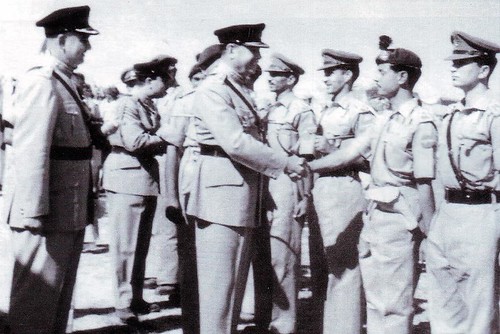


 KARACHI: Life stopped for Pakistani cab driver Ghulam Mohammed when his seven-year-old daughter was shot dead on her way home from school, a victim of senseless political and ethnic violence sweeping Karachi. Shumaila was Mohammed’s only child, born after he and his wife struggled for 12 years to have a baby. It took two stray bullets to bury all the hopes and dreams they had for the future. “She was the one who gave meaning to our life. Now we have no reason to live,” said the tearful 36-year-old, a resident of Qasba Colony, one of a series of troubled neighbourhoods in western Karachi turned into a battlefield. Shumaila was one of 300 people whom the independent Human Rights Commission of Pakistan (HRCP) says died in political and ethnically linked shootings in Karachi last month and one of the 800 killed since the start of this year. She was carrying her books when the bullets pierced her abdomen and splintered a rib. Seriously wounded, she was eventually picked up by an ambulance after medics struggled to access the street under gunfire. REFERENCE: Pakistan’s poor dying in Karachi violence AFP Yesterday http://www.dawn.com/2011/08/07/pakistans-poor-dying-in-karachi-violence.html
  Statistics compiled by the HRCP Karachi chapter shows that a total of 1138 people have been killed in the city during the first half of 2011, with 490 of them falling prey to targeted killings on different grounds including political, sectarian and ethnic basis. “Karachi has been under the influence of political parties for the past several months and continuous surge in killings in the city reflects the government’s inefficiency to cope with the mounting threat of insecurity,” said Zohra Yusuf, Chairperson HRCP while sharing statistics during the press briefing at their office. For appeasing the ruling coalition partners, she noted, the government had failed to take any decisive action against culprits causing unrest in the city. Of the 490 victims of target killings, 150 were killed apparently for their association with various political, religious and or nationalist parties, 56 for their ethnic background and eight on sectarian grounds. According to the HRCP report, as many as 65 women were killed during first six months of this year – 24 of them were killed by relatives, 26 by unidentified culprits, four were set on fire, three killed on railway tracks, 2 each killed by robbers and Lyari gangsters, three on the pretext of Karo-Kari, while one woman was killed by police. Meanwhile 37 men lost their lives in the ongoing Lyari gang war this year. The report listed 56 ethnic killings which were reported this year. Of those targeted, 51 of the victims were male, while one female and four children were killed. The figure shows that 250 people with no political affiliation were also killed in Karachi this year while 139 killings were reported during the corresponding period of last year. This indicated a rise of 179% in the killings this year. The report detailed names of parties (political, religious, nationalist and banned organizations) or groups and the number of their activists assassinated during the first six months of 2011. It said 77 target killing victims belonged to Muttahida Qaumi Movement; 26 to Pakistan People`s Party; 29 to Awami National Party; 16 to Mohajir Qaumi Movement-Haqiqi; 7 to Sunni Tehreek; 9 to Jamaat-e-Ahl-e-Sunnat; two to Jamiat-e-Ulema Islam; one to Pakistan Muslim League-Nawaz (PML-N); one to Jamaat-i-Islami (JI); one each to PML-Functional, Jeay Sindh Qaumi Mahaz, and Punjabi-Pakhtun Ittehad and four to Sipah-e-Sahaba (banned). During the first six months of 2010, the figures were comparatively low as MQM-H had their 34 activists killed; MQM 22; PPP 11; PPP-S 2; Punjabi Front 1; ANP 16; Sunni Tehreek 4; PML-N 1; PML-Quaid-i-Azam 1; PML-F 1; JI 3; Jamiat Ulema-i-Islam 2; JSQM 2; PPI 1; Sipah-i-Sahaba (banned) 3; and Tehreek-i-Taliban (banned) 1. REFERENCE: HRCP report indicates rise in killings this year By PPI Published: July 6, 2011 http://tribune.com.pk/story/203309/hrcp-report-indicates-rise-in-killings-this-year/
  KARACHI: The wave of ‘ethnic violence’ that largely affected Orangi Town on Tuesday spread to other parts of the city on Wednesday, when the most gruesome incident of the day took place early in the morning in Gulshan-i-Iqbal where five men were found shot dead in a minibus. The minibus, of route D7, was found parked in Block 1 of Gulshan-i-Iqbal containing the five bodies, which the police shifted in a single ambulance to the Jinnah Postgraduate Medical Centre. The bodies were later identified as those of minibus driver Wali Mehsud, Ghulam Jan, Ahmed Jan and Niaz Jan. A spokesman for the Awami National Party said that the latter three were relatives. They hailed from Bajaur Agency and lived in Landhi. The fifth victim was later identified as Liaquat Baloch, a resident of Gulberg. His body was found stuffed in a gunny bag, police said.
 With the world becoming increasingly connected, political correctness in ideas and behaviour is becoming essential for minimising frictions, and for that reason it also is becoming the hallmark of the educated. We Pakistanis often complain about the lack of “randomness” at airport security checks abroad and go livid at any generalisation linking Pakistanis to terrorism, but then sadly, this indignation is reserved for foreign lands only, the same is definitely not displayed within Pakistan. Pick up any mobile phone here, and it is bound to have SMSed jokes with the racist stereotyping of Pathans. While such stereotyping for the sake of humour is at times tolerable, one is simply astonished to find the same to be believed for real. During the recent spate of violence in Karachi, I was shocked to come across a very high proportion of educated Urdu speaking Karachiites who believe the Pashtun ethnicity to be nothing short of a deformity, and the Pashtun influx as a curse for Karachi. One of the main fears expressed, is that since Pashtuns are more likely to be associated with terrorism and theft, stopping their inflow would naturally result in a more peaceful Karachi. Besides being horrifyingly similar to the “all Pakistanis are terrorists” argument often used by anti-immigration groups in the West, this one stoops even lower as it seeks to quarantine fellow Pakistanis on the basis of ethnicity. This argument conveniently ignores the fact that if the profession of gate keeping and driving in Pakistan can be associated with one ethnicity, then it is the Pashtuns. While I am no fan of generalisations, but if one is to be done, then considering the typical Pashtun professions shouldn’t the generalisation be one of trust, rather than distrust?


