Showing posts with label Colonel Imam. Show all posts

Tuesday, June 26, 2012

Attack on AAJ News & Memory Loss of Pakistani Journalists.


Clarification: Let me clarify before I proceed that my criticism on Pakistani Media, Journalists, TV Channels and TV Anchors may please be taken as my opinion. I condemn Violence against anybody in strongest possible words. Differing with an opinion is one thing and supporting violence against anybody specifically the Journalists or Media is entirely different and is Totally Unacceptable. PERIOD. --- 26th June 2012 - Karachi: The terror group Tehrik-e-Taliban Pakistan (TTP) claimed responsibility for the firing attack which left 2 people injured including a security guard in Karachi. In a sadistic statement issued over the phonecall to Aaj News, the TTP spokesperson said, “It is stated that Tehrik-e-Taliban Pakistan accept the attack on Media Channel Aaj TV for the firing attack”. The spokesperson for TTP further said that this was due to the reason that the Jihadi Movement event was not given full coverage and they will continue further attacks if proper coverages are not provided. The dreadful incident rattled the media industry on Monday when Aaj TV office was targeted by four armed men who opened fire and fled the crime scene. The terrible incident resulted in two employees of the office being injured. The incident marked another attack on media with several questions raised. The attacks have been condemned by the President and the Primeminister. Prime Minister Raja Pervaiz Ashraf, along with his condemnation, stated that proper measure would be taken to provide protection to media personnel within the country. The PM further ordered the apprehension of the miscreants by the earliest possible time. REFERENCE: Tehrik-e-Taliban claim responsibility for attack on Aaj TV By: Bilal Khan, Uploaded: 26th June 2012  http://www.aaj.tv/2012/06/tehrik-e-taliban-claim-responsibility-for-attack-on-aaj-tv/

2008: Whole bloody West was looking for al-Qaeda commander Mustafa Abu al-Yazid and other such  absconders & Jang Group Geo Tv Reporters were interviewing him as if he was sitting in Cafe Khairabad near Jang Press, Karachi. How Ironic that Kamran Khan was not given the documents on Dr Arsalan but he ranted & he while sitting in Karachi telling tales on a subject whose even basic knowledge is lacked in every journalist what to talk of two bit Kamran Khan. Kamran Khan basically prepared case against Pakistan.


KARACHI: Senior al-Qaeda commander Mustafa Abu al-Yazid has claimed in an exclusive interview with Geo News that Pakistan has damaged the terrorist organisation more than any other country. The operational chief of al-Qaeda in Afghanistan also said that the recent attack on the Danish embassy in Islamabad was conducted by his organisation. He also claimed that al-Qaeda was growing in strength in Afghanistan and would soon occupy the entire country. He strongly debunked the view that al-Qaeda was actually protecting American interests and said it carried out the 9/11 attacks on the US and that 19 of its supporters launched the devastating attacks. He added that many of his comrades were involved in training the hijackers. These comments were made in an interview with Najeeb Ahmed that was broadcast on Monday on Geo TV's Aaj Kamran Khan Kay Saath programme. This was the first detailed interview in five years of a senior al-Qaeda leader. The 53-year-old Mustafa Abu al-Yazid is also known by the name of Sheikh Saeed. He was born on Dec 17, 1955 in Egypt. In 1981, he was incarcerated for three years in connection with the assassination of the then Egyptian president Anwar Saadat. In 1988, he became a member of al-Qaeda and went to Afghanistan. Later, in 1991, he moved to Sudan where he worked for Osama bin Laden as an accountant. By 1996 he returned to Afghanistan and taken over the responsibility of handling al-Qaeda's finances. Mustafa Abu al-Yazid had claimed his organisation's responsibility for Benazir Bhutto's assassination in Dec 2007. In his interview, Al-Yazid said the morale of fighters in Afghanistan is very high and they are putting up a tough fight against US troops. He said the resistance is gathering momentum and has become unstoppable. Listing the attacks launched by al-Qaeda, he took credit for the attacks on US embassies in Tanzania and Kenya. He said the Karzai government would meet the same fate as other 'traitors'. There is no government that supports al-Qaeda as the rulers have sold their faith and by doing so they have put themselves beyond the pale of Islam. In his view, the government that has damaged the Mujahideen the most is Pakistan's. Pervez Musharraf first inflicted suffering on the Mujahideen of the neighbouring country. He claimed that it was because of the sacrifices of the Mujahideen that Russia was unable to enter Pakistan. Musharraf's men arrested and subjected them to violence and handed them over to the Americans. What is a bigger example of collaboration with the infidels than this? This is a crime that can never be forgotten, he said. According to him, it was a matter of great honour that his supporters launched an attack on the Danish embassy in Islamabad. He congratulated his comrades for successfully executing this mission. He said they had picked a time to attack when there were no innocent Muslims in the vicinity. In any case, there was strict security around the embassy and it was not possible for ordinary Muslims to come near it. He said many eminent Islamic scholars have justified the practice of suicide bombing. The official Maulvis parrot those Fatwa that they are told to. He said the aim is to engage in direct combat but in many places it is not possible to reach the enemy. He maintained that it is not legitimate to target mosques in this way. He denied al-Qaeda's hand in the attack on Aftab Sherpao in a mosque, saying his supporters never target mosques. A statement to this effect was issued to the Pakistani press soon after the attack. He condemned violence near or inside mosques and said defending the sanctity of such places of worship is every Muslim's duty. He paid tributes to Khalid Sheikh and termed him a fearless person who the Muslim Ummah is proud of. He prayed that God's curse fall on the government that handed him over to the US. Reuters adds: The suicide bomber who carried out an attack on the Danish embassy in Islamabad last month came from Makkah, an al-Qaeda leader said in a rare interview with Geo News. It was unclear, from what Yazid said, whether the embassy bomber was a Saudi, as many non-Saudis have settled in Makkah, or whether he had been recruited while visiting the city. Yazid said the bomber had come to join a Jihad in held Kashmir or Afghanistan, but became enraged by the publication of blasphemous cartoons in Danish newspapers in 2005. REFERENCE: Al-Qaeda commander claims responsibility for 9/11 attacks Wednesday, July 23, 2008 http://www.thenews.com.pk/TodaysPrintDetail.aspx?ID=16144&Cat=13&dt=7/23/2008

AAJ News 2008 : Live with Talat - Allegations on Pakistan Scrapped Part 1


2012: Saudi Arabia helped India nab 26/11 handler Abu Jundal NEW DELHI: Saudi Arabia has helped India with a major breakthrough in the probe into the 26/11 attacks by facilitating the arrest of Syed Zabiuddin Ansari alias Abu Jundal, one of the key plotters of the Mumbai raid. Jundal, who directed Ajmal Kasab and other 26/11 attackers from the Lashkar control room, was picked up by the Saudi police, who put him on a New Delhi-bound flight after alerting the authorities here about their prize catch. The Lashkar terrorist , an Indian national wanted in many terror cases who was arrested on June 21, has since made the stunning claim that LeT chief Hafiz Saeed was present in the control room when the 26/11 masterminds choreographed the Mumbai attacks. He has also said that ISI and Pakistani army officials were involved in planning 26/11 and attended the meetings. After Kasab and David Headley, the arrest of Jundal is seen as the third major success in India's effort to unravel the 26/ 11 plot. Kasab's arrest was important since his Pakistani nationality exposed Islamabad's initial stubborn denial about involvement in the strike, and put paid to the plan to pin the blame on homegrown terrorists; even Hindu radicals. REFERENCE: Saudi Arabia helped India nab 26/11 handler Abu Jundal Neeraj Chauhan, TNN | Jun 26, 2012, 01.18AM IST http://timesofindia.indiatimes.com/india/Saudi-Arabia-helped-India-nab-26/11-handler-Abu-Jundal/articleshow/14396009.cms


AAJ News 2008 : Live with Talat - Allegations on Pakistan Scrapped Part 2


Tired of waiting for the US to help stem terrorist activities emanating from the Af-Pak borders, India has now belatedly turned to the Arab world to make common cause on the threat the Al Qaeda-Taliban combine poses to the region. Really, there couldn’t have been a better place to signal this shift than Saudi Arabia. So, Manmohan Singh’s visit last week, the first by an Indian prime minister in 28 years, came none too early. Rich in oil, flush with funds, and dominating the Islamic psyche ideologically and culturally, Saudi Arabia has helped tune Pakistani politics in the past—for instance, it played a crucial role in the return of Benazir Bhutto and Nawaz Sharif from exile. If Riyadh can’t persuade Islamabad to close the terror tap, the argument goes, no one can. The requisitioning of Saudi Arabia’s help to restrain Pakistan was much celebrated and commented upon in the Indian media. But lost in the obsession with Pakistan were some other aspects of the visit. The Riyadh Declaration, signed between Manmohan and King Abdullah bin Abdulaziz Al Saud, demonstrated significant changes in New Delhi’s approach to Palestine, Israel and Iran, marking what some call a shift in India’s West Asia policy. And Saudi Arabia reciprocated through a telling symbolic gesture—neither Manmohan’s wife Gursharan Kaur nor other women in the Indian delegation were required to do the mandatory hijab in their public engagements. Says a senior MEA official, “The Riyadh Declaration is one of the most significant policy statements by an Indian prime minister on West Asia. For the first time, India has commented on all the major issues before the Arabs—from Palestine to Iran to Iraq to Afghanistan.”

But first, the Pakistan-Afghanistan terror aspect. Reflecting Saudi perturbation at the infiltration of Al Qaeda into neighbouring Yemen and India’s concern at the sea-borne nature of the 26/11 attack, the Riyadh Declaration condemned terrorism and affirmed that “it is global and threatens all societies and is not linked to any race, colour or belief”. No talk of root causes here, no attempt to separate terrorism threatening Saudi Arabia from that plaguing India. True, the Riyadh Declaration does not name Pakistan; a third country is rarely mentioned in such declarations. But sources say the views exchanged in backroom parleys should comfort India. For one, the Saudis said the Pashtuns, because of their numerical preponderance, have to be an integral part of the solution in Afghanistan. But this does not mean, they insisted, that the Taliban are the only representatives of Pashtuns, who anyway shouldn’t allow the militant organisation to hijack the country’s political agenda. Again, no talk here of good Taliban and bad Taliban, demonstrating the similarity in India and Saudi’s perspectives. The Riyadh Declaration also expresses support for the “efforts aimed at helping Afghanistan develop its infrastructure and achieve social and economic development”—precisely what India is attempting there, and which Pakistan steadfastly opposes. In addition, sources say, Riyadh and other capitals in the Gulf realise there’s a growing “inter-connectivity” among terrorist groups—Lashkar-e-Toiba, Taliban or Al Qaeda—a view India has been articulating for years. But there are differences over what each sees as the causes underlying the political instability in Pakistan. The Saudis, though of the view that the political class there has not pulled its weight, is glad the army hasn’t intervened overtly. India, in contrast, thinks the army still calls the shots in Pakistan. Irrespective of this difference, sources say New Delhi wants the Saudis to “use their good offices” to help the military and political establishment in Pakistan see sense in stemming terror emanating from its soil.

Through the Riyadh Declaration, Manmohan has conveyed emphatically that India’s growing relationship with Israel —a cause of much worry in the region—wouldn’t be pursued at the expense of its traditional ties with Palestine. In doing so, though, Manmohan has been critical of Israel to an extent not seen in the recent past. Also, no prime minister in the last decade has been as supportive of the Palestinian issue as Manmohan.

Not only does the Riyadh Declaration call for resumption of the Middle East peace process in accordance with the UN Security Council resolution 242 and 338 for a “two-state” solution, it also stresses upon the need to complete negotiations within a “timeframe”. In addition, it also calls for a “united and viable Palestine” and dubs the building of settlements by Israel in Palestinian territory as a “stumbling block for the peace process”. This formulation signals India accepting the Arab position—the West Bank under the Fatah and Gaza under the Hamas must not be treated separately at the time of granting sovereignty to Palestine.

No wonder the Palestinians are happy. The Palestinian ambassador in New Delhi, Adli Shaban Sadeq, told Outlook, “We appreciate it.” He says it should reverse the infiltration of the Indian political system by Israel, which has exploited the focus on global terrorism and the wounds inflicted on India itself through terror strikes. “But India’s reaffirmation on Palestine (which includes the views expressed by Manmohan during the recent visit of Palestinian President Mahmoud Abbas to India) has surely put the issue to rest,” he says confidently.

The Riyadh Declaration also calls for making West Asia and the Gulf “free of nuclear weapons and weapons of mass destruction”. Though this could be perceived as raising serious concerns about Iran’s alleged “clandestine” nuclear weapons programme, it is also a swipe at the Israelis who have never declared their nuclear weapons. The call for a nuclear-free West Asia addresses the anxiety of the Sunni Arabs about a Shia power—and, simultaneously, expresses the region’s worry about Israel.

The Israelis, understandably, aren’t too happy, though they have refrained from making any official comments. Says an Israeli source, “From time to time Indian leaders have made such comments and we don’t see any significant shift in New Delhi’s stand on these issues. There are some changes in nuances, though.” In diplomacy, radical shifts are rare; nuances often mark the beginning of a shift. REFERENCE: DIPLOMACY: WEST ASIA Music In The Desert India warms up to the Arab world—vital in itself and in its effects PRANAY SHARMA MAR 15, 2010 http://www.outlookindia.com/article.aspx?264551


AAJ News 2008 : Live with Talat - Allegations on Pakistan Scrapped Part 3


25 December, 2008 and 2010: Saud Al-Faisal visits india to ease Indo Pak tension Foreign Minister Prince Saud Al-Faisal will visit New Delhi for talks with his Indian counterpart Pranab Mukherjee on bilateral, regional and international issues, said Muhammad Barri. Prime Minister Manmohan Singh is likely to visit Saudi Arabia early next year, sources in New Delhi told. Singh was set to visit Riyadh last month, but had to defer his plan due to prior commitments of King Abdullah, Custodian of the Two Holy Mosques. Amid the fresh chill in the Indo-Pak ties, Saudi Arabia`s Foreign Minister Saud Al-Faisal will be in Delhi on a brief visit on Friday during which New Delhi is expected to urge the influential Arab nation to use its influence on Islamabad to end cross-border terrorism. Al-Faisal will hold detailed talks with External Affairs Minister Pranab Mukherjee during which the Indian side is expected to share evidence about involvement of Pakistan-based elements in the November 26 Mumbai attacks. REFERENCE: Saud Al-Faisal visits india to ease Indo Pak tension 25 December, 2008 http://paktribune.com/news/Saud-Al-Faisal--visits-india-to-ease-Indo-Pak-tension-209305.html


AAJ News 2008 : Live with Talat - Allegations on Pakistan Scrapped Part 4

http://www.youtube.com/watch?v=03fPeob2OII


2010: What was the last mission of Khalid Khwaja? Hamid Mir Sunday, May 02, 2010 ISLAMABAD: The last mission of ex-ISI officer Khalid Khwaja failed but his assassination exposed many hidden secrets, including differences between the Afghan Taliban and the Pakistani Taliban, and has put a spotlight on his highly complex underworld life, as a mediator, sometimes on behalf of the Americans, a power-broker, a mover and shaker besides an ardent Islamic preacher. Squadron Leader (retd) Khalid Khwaja had been playing an active behind-the-scene role in domestic politics of Pakistan for the last 22 years. He became an important international player 11 years ago when he first tried to establish direct links between the Kashmiri militants and the Clinton Administration but failed.

He had been trying to establish direct contacts between the USA and the Taliban for the last five years. He also tried to mediate between the Pakistan Army and the Taliban many times in the last two years but all his efforts failed due to lack of trust between him and the current military leadership of Pakistan. His known contacts with some former CIA officials and an American businessman Mansoor Ijaz also created problems for him. He was intelligent enough in maintaining links with Americans and their critics like Hameed Gul at the same time but unfortunately he could not anticipate the seriousness of his adversaries, who did not miss any opportunity to strike against friends and foes alike.

He was sacked from the ISI on the direct orders of General Ziaul Haq in 1987 but he remained active with the ISI even after his sacking. He was the right hand man of former DG ISI Hameed Gul in 1988 and played a significant role in the making of the anti-PPP political alliance, the Islami Jamhoori Ittehad (IJI).

He claimed that he arranged a meeting between Osama bin Ladin and Nawaz Sharif in Saudi Arabia in 1989. He made this revelation just a few weeks before the dismissal of Nawaz Sharif government in 1999. Khalid Khwaja tried to convince Nawaz Sharif not to support Asif Zardari as president in August 2008 but the PML-N leader did not listen to him.

Khalid Khwaja was assassinated by a group of Punjabi Taliban on April 30 near Mir Ali in North Wazirastan. He was kidnapped on March 26 along with another former ISI official Col (retd) Ameer Sultan and a British born Pakistani filmmaker Asad Qureshi. An unknown group of Punjabi Taliban, with the name of Asian Tigers, alleged that Khalid Khwaja was working for the ISI and the CIA but that was not the main reason behind his killing.

A few weeks before his abduction, he met Taliban leader Waliur Rehman Mehsud in North Waziristan and handed over a list of some militants and alleged that they were working for Indian spy agencies. Within a few hours of that meeting, the vehicle of Waliur Rehman was attacked by a US drone but the Taliban commander survived. Waliur Rehman immediately informed the Punjabi Taliban to be careful about Khwaja, who then decided to trap him.

A spokesman for Punjabi Taliban hinted on Saturday that “charges against Col Imam are not strong and we may release him”. He also admitted that the Afghan Taliban were also putting pressure on the Punjabi Taliban to release the former ISI colonel.

While talking to this scribe on phone from North Waziristan, the spokesman reacted to the statement of Khalid Khwaja’s wife, who declared that her husband was a martyr because he was killed by some criminals.

The spokesman for the Punjabi Taliban said that both Mr and Mrs Khalid Khwaja played an active role in Lal Masjid tragedy in July 2007. They forced late Abdul Rashid Ghazi not to surrender but disappeared when the operation started.

Some friends of Khalid Khwaja, however, tell a different story. They say that Khwaja was arrested just a few days before the operation in Lal Masjid but they also admit that Khwaja was not supporting the surrender.

It is also learnt that Khalid Khwaja was investigated by a three-member committee of the militants for more than four weeks. Initially, Khwaja claimed that he had moved a petition in the Lahore High Court against the drone attacks along with former PML-N MNA Javed Ibrahim Paracha and he came to North Waziristan for recording the statements of drone victims to be produced in the court on April 6.

The militants confronted him as to why on the one hand he was opposing the drone attacks but on the other hand he was trying to establish contacts between the USA and the Taliban. The militants claimed that he arranged a meeting between US Under Secretary of State Karen Hughes and a religious cleric Javed Ibrahim Paracha in 2005 in Serena Hotel, Islamabad. They also produced some articles downloaded from the Internet and asked about his links with former CIA officials, James Woolsey and William Casey.

Khwaja had met these former CIA officials through an American businessman Mansoor Ijaz, who was very close to the Bill Clinton administration. Ijaz played a key role in forcing the Sudanese government to expel Osama bin Ladin from Khartoum in 1996 and helped Khwaja to establish direct links between the Taliban and the Bush administration in October 1999 when he wanted Mulla Omar to meet James Woolsey to avert an American attack on Afghanistan. Mulla Omar refused to meet the then CIA leader.

Next year, Khalid Khwaja tried to fix a meeting between American businessman Mansoor Ijaz and Kashmiri militant leader Syed Salahuddin. Khwaja contacted Salahuddin through his friends in Jamaat-e-Islami and informed him that Mansoor Ijaz wanted to deliver a letter from Bill Clinton. Syed Salahuddin came to know that Mansoor Ijaz had meetings with Indian Army officials in Srinagar in early 2000 and also with then Pakistani President Pervez Musharraf. He smelled a rat and refused to meet Mansoor Ijaz. Shortly after these attempts by Ijaz, a ceasefire was announced by a rebel Kashmiri militant commander Abdul Majid Dar in July 2000 but it failed. Majid Dar was assassinated after sometime in Kashmir.

Khalid Khwaja was arrested in 2002 after the murder of American journalist Daniel Pearl in Karachi. Khwaja had exchanged some e-mails with Pearl just a few days before his killing. Later, Marianne, the widow of Pearl, informed investigators that Pearl contacted Khwaja through Mansoor Ijaz and he only tried to help her husband in obtaining the contact numbers of some militants. Khwaja was released after a few weeks.

He surfaced again in 2005 when he gave an interview to a foreign newspaper and claimed that he was instrumental in arranging funds for a training camp established by a politician from Rawalpindi for Kashmiri militants. The same year he arranged a meeting of an MMA parliamentarian Shah Abdul Aziz, a religious leader from Kohat Javed Ibrahim Paracha and a pro-Taliban businessman Arif Qasmani with some top US officials, including Karen Hughes.

Javed Paracha confirmed that meeting to The News on Saturday and said that it was arranged by Khalid Khwaja. He said: “I was offered a huge amount of money for talking to the Taliban on behalf of the US government, but I told the Americans that first the Pakistan Army must give me a green signal and then I will proceed but Americans were acting on their own and the talks broke down.”

Javed Paracha also said that Khalid Khwaja came to his home on March 25 with Col Imam and a British journalist. Khawja wanted me to help him in his visit to North Waziristan. He said, “May be Khwaja was again trying to establish communication lines between the Americans and the Taliban but I received a clear message from Taliban that your friend is not welcome.”

Paracha claimed that he advised Khwaja not to go there. He said: “I also requested Col Imam not to take the risk. Col Imam was reluctant but Khwaja insisted and they left for Mir Ali against my advice.”

Both Javed Paracha and Khalid Khwaja had close relations with Lal Masjid clerics in 2007. Paracha met Maulana Abdul Aziz and Abdul Rashid Ghazi along with then Federal Minister Ejazul Haq and requested them to surrender. Khalid Khwaja advised Lal Masjid clerics otherwise.

Khwaja became very active in August 2008 when he contacted PML-N leaders and asked them to file a petition against the participation of Asif Ali Zardari in the presidential election. According to PML-N leader Senator Pervez Rashid, “Khalid Khwaja offered us that Nawaz Sharif should file a petition against Zardari and he will manage a Supreme Court verdict against Zardari within 24 hours but we refused to play in the hands of Khwaja.”

Khwaja had played a very active role against the government of Nawaz Sharif in 1999. He claimed in front of some JUI-F leaders that Nawaz Sharif took money from Osama bin Ladin in 1989 and promised that he would not act against Arab militants after coming into power. Those were the days when Americans were putting pressure on Nawaz Sharif to start operations against the Arabs living in Pakistan. The JUI-F and the JI started a mass campaign against Nawaz Sharif and within a few weeks his government was toppled.

This scribe tried to confirm the claim of Khalid Khwaja from Osama bin Ladin in November 2001 but he never confirmed it. Khwaja told American TV channel ABC in November 2007 that he had arranged a meeting between Nawaz Sharif and Osama bin Ladin in the Green Palace Hotel of Madina in 1989 just a few weeks before the no-confidence move against Benazir Bhutto. Osama was reported to have agreed to provide him some money.

US officials investigated this claim from many al-Qaeda operators arrested after 9/11 but only one, Ali Muhammad, told the FBI that a meeting between the representatives of Osama and Nawaz Sharif took place long ago in Saudi Arabia. He never confirmed a direct meeting between the two. Osama bin Laden never liked these claims of Khalid Khwaja who always claimed to be a friend of Osama. Khwaja had no meeting with Osama bin Laden in the last 20 years but he always claimed to be a friend of Osama.

Khwaja and Shah Abdul Aziz met Taliban leader Baitullah Mehsud in early 2009. They convinced Baitullah to write a letter to General Ashfaq Parvez Kayani for a ceasefire. The Pakistan Army leadership never trusted Baitullah Mehsud and this effort failed.

Khalid Khwaja filed many petitions in superior courts in his last days. One of them was against the constitutional immunity for the president. His political role is still a mystery. His friends claim that he definitely had relations with some Americans but he was not a CIA agent.

Sources in the military establishment said that he had no mandate of the Pakistan Army for talking to the militants. Some sources said that Khalid Khwaja was used by the Pakistani establishment against Nawaz Sharif and Benazir Bhutto many times but he was not trusted in his last days.

The whole drama of his kidnapping and assassination exposed the internal differences of many Taliban groups. A powerful Taliban commander of North Waziristan, Hafiz Gul Bahadar, tried his best to rescue Khwaja but failed due to his limited influence in Mir Ali. This area is mostly populated by Dawars but these days Mir Ali is controlled by Mehsud militants who have provided sanctuaries to different groups of the Punjabi Taliban, including some Kashmiris, who have developed differences with Pakistani establishment after the ban on many outfits during the last few years. These disgruntled militants don’t listen to Hafiz Gul Bahadar and Sirajuddin Haqqani group, which is influential in the areas close to Miramshah. It is also interesting that these Punjabi Taliban have no respect for staunch US critics like General Aslam Beg and Hameed Gul just because they don’t support bomb blasts in Pakistan. REFERENCE: What was the last mission of Khalid Khwaja? Hamid Mir Sunday, May 02, 2010 http://www.thenews.com.pk/TodaysPrintDetail.aspx?ID=28590&Cat=13&dt=5/2/2010

AAJ News 2008 : Live with Talat - Allegations on Pakistan Scrapped Part 5

http://www.youtube.com/watch?v=vnPcheFbuIc


2010: Taliban are in Punjab now — officially Umar Cheema Monday, May 17, 2010 ISLAMABAD: Though the provincial government is in a state of denial, the Punjab Police have officially admitted for the first time the movement of the Taliban, their network in district Jhang and southern Punjab and their fund-raising and recruitment drive in the province. The Jhang city police have filed an FIR, the first-ever in the Punjab, which is a severe indictment of the provincial government. The FIR No 320, registered under 11 F/7 Anti-Terrorist Act by the police itself on the basis of their human intelligence, depicts the grim realities of Talibanisation in the Punjab.

The criminal report filed against the district head of a defunct organisation, Jaish-e-Mohammad, discloses that Taliban commanders often come to the city on their way to southern Punjab as the network of Tehrik-e-Taliban is fast expanding in the region. SHO Kotwali Police Station (Jhang city) confirmed to The News the FIR, a copy of which is available with this correspondent, but was reluctant to go into the details. The DPO Jhang and the IG Punjab were not available for comments despite repeated calls and messages.

Jhang, the hotbed of sectarianism, is the hometown of the provincial police chief, Tariq Saleem Dogar. A recent World Bank report has found negligible development spending in the district, Rs 300 per person as compared to Lahore’s Rs 35,000 per person.

The Punjab government has always denied the presence of the Taliban network in the southern belt. The DG Rangers, who once dropped hint of their existence, was contradicted by provincial law minister, Rana Sanaullah, who had formed an electoral alliance with a defunct organisation in a by-election, ran campaign together with their top leader, and released the most dangerous sectarian militants as part of a deal.

The FIR and police intelligence reports indicate the Taliban are thriving in the region. The recruitment drive has also been launched recently in some religious schools. The FIR is registered against Dr. Imran, former head of Jaish-e-Mohammad in district Jhang, who has been accused of recently hosting a prominent Taliban commander carrying head money of Rs 10 million. It says Dr. Imran “runs the network of Tehreek-e-Taliban and Taliban would often come to see him on their way to other districts of South Punjab.” He has also been accused of involvement in fundraising.

The FIR is based on police intelligence that presents far more pessimistic picture than what has been reported in the FIR. The intelligence report indicates that the district head of Toba Tek Singh is a former gunman of Osama bin Laden and a driving force behind the network’s expansion in the southern belt. The Taliban commander mentioned in the FIR without name is Commander Qari Matiullah alias commander Abdul Samad, said a police officer.

According to the police intelligence, Taliban leaders frequent a number of seminaries in Jhang. An under-construction seminary in Jhang district serves as a meeting point of the Taliban leadership. Three other seminaries run by their sympathisers have launched a drive to recruit youth for training in the tribal area, says the report. Mentioning the discussion in a recent meeting held on May 1 in a seminary located in Jhang city, a police source said the religious leaders who spoke on the occasion urged the need for reviving the spirit of 1985 when a war was fought against the Afghan rulers. Jhang and other districts of central and South Punjab are now the main target of Taliban, said a police officer who cited under-development as the reason why such networks thrive. A recent World Bank report has found that the southern belt is the last priority in terms of development by the Punjab government as neither it is ready for fighting militancy nor investing in development. A Taliban sympathiser, however, claimed that Taliban are fighting against the killers of innocent people. He said innocent people were being killed in the name of war against terror. He said anyone whose mother or children were killed was bound to take up weapons. He said Taliban were not terrorists but wanted implementation of Sharia laws. REFERENCE: Taliban are in Punjab now — officially Umar Cheema Monday, May 17, 2010 http://www.thenews.com.pk/TodaysPrintDetail.aspx?ID=28885&Cat=13&dt=5/17/2010

AAJ News 2008 : Live With Talat-Background of Mumbai Fraud Part 3

http://www.youtube.com/watch?v=3--NEX-RLuw


2009: How an ex-Army commando became a terrorist Hamid Mir Sunday, September 20, 2009 ISLAMABAD: Once he was a blue-eyed boy of President General Pervez Musharraf. He got a cash award from the president for slitting the throat of an Indian Army officer in the year 2000 but after 9/11, he became a suspected terrorist. This terrorist was Ilyas Kashmiri, reportedly killed in a US drone attack in North Waziristan last week. US officials claimed that Ilyas Kashmiri was a senior al-Qaeda commander and his death was a huge loss for the militants fighting against the foreign forces in Afghanistan. Very few people know that Ilyas Kashmiri was a former SSG commando of Pakistan Army. He was originally from Kotli area of Azad Kashmir. He was deputed by Pakistan Army to train the Afghan Mujahideen fighting against the Russian Army in mid-80s. He was an expert of mines supplied to Afghan Mujahideen by the US. He lost one eye during the Jihad against Russian invaders and later on he joined Harkat-e-Jihad-e-Islami of Maulvi Nabi Muhammadi.


Ilyas Kashmiri was based in Miramshah area of North Waziristan where he was working as an instructor at a training camp. After the withdrawal of Russian Army from Afghanistan, Ilyas Kashmiri was asked by Pakistani establishment to work with Kashmiri militants. He joined the Kashmir chapter of Harkatul Jihad-i-Islami in 1991. After a few years, he developed some differences with the head of HuJI Qari Saifullah Akhtar.

Ilyas Kashmiri created his own 313 Brigade in HuJI. He was once arrested by Indian Army from Poonch area of Indian held Kashmir along with Nasrullah Mansoor Langrial. He was imprisoned in different Indian jails for two years and finally he escaped from there after breaking the jail. His old friend Langrial is still imprisoned in India.

Ilyas Kashmiri became a legend after escaping from the Indian jail. It was 1998 when the Indian Army started incursions along the Line of Control and killed Pakistani civilians many times by crossing the border. Ilyas Kashmiri was given the task to attack the Indians from their back. He did it many times.

Indian Army killed 14 civilians on February 25, 2000 in Lonjot village of Nakial in Azad Kashmir. Indian commandos crossed the LoC, spent the whole night in a Pakistani village and left early morning. They slit the throats of three girls and took away their heads with them. They also kidnapped two local girls. The next morning, the heads of the kidnapped girls were thrown towards Pakistani soldiers by the Indian Army.

The very next day of this massacre, Ilyas Kashmiri conducted a guerilla operation against the Indian Army in Nakyal sector on the morning of February 26, 2000. He crossed the LoC with 25 fighters of the 313 Brigade. He surrounded a bunker of Indian Army and threw grenades inside. After one of his fighters Qudratullah lost his life, he was able to kidnap an injured officer of the Indian Army. That was not the end. He slit the throat of the kidnapped officer.

He came back to Pakistan with the head of the dead Indian Army officer in his bag and presented this head to top Army officials and later on to the then Army Chief General Pervez Musharraf, who gave him a cash award of rupees one lakh.

The pictures of Ilyas Kashmiri with the head of a dead Indian Army officer in his hands were published in some Pakistani newspapers and he became very important among the Kashmiri militants. Maulana Zahoor Ahmad Alvi of Jamia Muhammadia, Islamabad, issued a fatwa in support of slitting the throats of Indian Army officers. Those were the days when Corps Commander, Rawalpindi, Lt Gen Mehmood Ahmad, visited the training camp of Ilyas Kashmiri in Kotli and appreciated his frequent guerilla actions against the Indian Army.

His honeymoon with the Pakistan Army generals was over after the creation of Jaish-e-Muhammad. Gen Mehmood wanted Ilyas Kashmiri to join JeM and accept Maulana Masood Azhar as his leader but the one eyed militant refused to do so. The militants of JeM once attacked the training camp of Ilyas Kashmiri in Kotli but he survived that attack. His outfit was banned by Musharraf after 9/11. He was arrested after an attack on the life of Pervez Musharraf in December 2003. He was tortured during the interrogation.

The United Jihad Council led by Syed Salahuddin strongly protested the arrest of Ilyas Kashmiri and on the pressure of Kashmiri militants, Ilyas Kashmiri was released in February 2004. He was a shattered man after his release. He disassociated himself from the Kashmiri militants and remained silent for at least three years.

It was the Lal Masjid operation in July 2007, which totally changed Ilyas Kashmiri. He moved to North Waziristan where he spent many years as a Jihad instructor. This area was full of his friends and sympathisers. He reorganized his 313 Brigade and joined hands with the Taliban but he was never close to al-Qaeda leadership. He attracted many former Pakistan Army officers to join hands with him. The strength of 313 Brigade in North Waziristan was more than 3,000. Most of his fighters were hired from the Punjab, Sindh and Azad Kashmir.

It is alleged that he organised many terrorist attacks in different areas of Pakistan, including the assassination of Major General (retd) Faisal Alvi in Rawalpindi. Alvi was also from the SSG and he led the first-ever Army operation in North Waziristan in 2004.

Kashmiri planned attacks on Alvi on the demand of Taliban in North Waziristan. Sources close to his family have yet not confirmed his death in a US drone attack but there is no doubt that Ilyas Kashmiri was actually a creation of the Pakistani establishment like Zakiur Rehman Lakhvi of the banned LeT.

The Pakistani establishment abandoned and arrested most of these militant leaders without realising that they had followers all over Pakistan and they could create problems for Pakistan anytime. The establishment is still without any policy about all those who were once declared “freedom fighters” and were honored by the top Army officials like Pervez Musharraf. REFERENCE: How an ex-Army commando became a terrorist Hamid Mir Sunday, September 20, 2009 http://www.thenews.com.pk/TodaysPrintDetail.aspx?ID=24626&Cat=13&dt=9/20/2009

AAJ News 2008 : Live With Talat-Background of Mumbai Fraud Part 4

http://www.youtube.com/watch?v=m8HWP-Q1HjY


2009: Who is Ilyas Kashmiri? Friday, October 02, 2009 Colnel (r) Imam Ex-SSG officer This is with reference to Hamid Mir's report (Sept 20) titled "How an ex-commando became a terrorist". It is total disinformation -- Ilyas Kashmiri neither had any association with the SSG nor did he serve in the army as a soldier. Being an ex-commando officer, I know that the SSG never indulges in such heinous crimes. It's a superior professional force of the army composed of responsible officers and men who carry out professional tasks. I would like to add that there is always an attempt by hostile agencies to defame the security forces of Pakistan with a malicious intent. Therefore, newspapers and columnists must refrain from falling prey to these fifth columnists. REFERENCE: Who is Ilyas Kashmiri? Friday, October 02, 2009 Colnel (r) Imam Ex-SSG officer, Rawalpindi http://www.thenews.com.pk/TodaysPrintDetail.aspx?ID=201054&Cat=11&dt=10/2/2009


AAJ News 2008 : Live With Talat-Background of Mumbai Fraud Part 5

http://www.youtube.com/watch?v=iLcK5lXu-JE


Friendly journalists: The ties between the military and the media are strong. The military often use the media to protect its hold on the giant corporate empire which it has built. In the 1980s the military did this through open censorship. Since the 1990s it has evolved subtler ways. It controls almost all access to big stories, and has therefore been able to raise a corps of "friendly" journalists who now control most key jobs in Pakistani media due to their "contacts". President Zardari's supporters suggest the media could have made up the story of the ISI cancelling its trip to the UK in order to spark an anti-Zardari campaign, which intensified as the scale of the flood damage became clear. REFERENCE: Criticism of Zardari in Pakistan hides a political game By M Ilyas Khan BBC News, Islamabad 7 August 2010 Last updated at 15:10 GMT http://www.bbc.co.uk/news/world-south-asia-10901583

Friday, March 30, 2012

DEATH SQUADS: Mawdudi, Khomeini, & Lessons for Karachi.

2003: When will the Americans start begging the world to let them off the hook in Iraq? It seems that the Americans are not going to start begging any time soon. What seems imminent is massive casualties in Baghdad as the Americans try to quicken its fall. We want our army generals to win all kinds of wars for us. In normal times, however, we rail against them for killing democracy in Pakistan instead of killing our enemies. We complain about the growing burden of the defence budget and beef about too many army officers holding civilian posts. But when there is war, we pluck the generals out of their obscurity and want them to give us solace. They do an honest job, giving us hope that we will not lose the war, but they do it at the cost of reality. They also do it at the cost of professionalism and all the lessons they were made to imbibe as officers. Ex-army chief General Aslam beg said in “Nawa-e-Waqt” (3 April 2003) that an invading army normally should have five-to-one superiority but the Americans didn’t have it in Iraq. But if the Americans wanted to yield some corpses they would attack Baghdad. Such an act would be disastrous for the Americans and would bog them down. After that, they would beg the world to extricate them from the quagmire but no one would be able to help them. Aslam Beg has always been strong on predictions which usually don’t come to pass. He predicted an American defeat at the hands of Saddam Hussein in 1991 and was proved wrong. Since he was then chief of the army in Pakistan his “defiance”, while much admired by the Urdu press, destabilised Pakistan’s political system. He believed that Americans would not fight on land after the defeat in Vietnam, but now the Americans seem willing to fight on land and even take body bags. The progress of war in Iraq is quite rapid despite some miscalculations by Rumsfeld and his cohorts in Washington. When is an army bogged down? One month? Two months? Two years? When will the Americans start begging the world to let them off the hook in Iraq? It seems that the Americans are not going to start begging any time soon. In fact Baghdad has fallen more quickly than most had anticipated. Talking to “Khabrain” (3 April 2003), General (Retd) Zahid Ali Akbar said that if America bombed Pakistan then Pakistan should threaten the United States with a nuclear strike on their naval fleet nearest to Pakistan. He said if too many body bags reached America the public there would reject Bush and elect a Democrat president who may firmly take the US back to the United Nations. He said if he was in Saddam’s shoes he would have made chemical weapons. He said if he was General Musharraf he would prepare a missile with a 2000-mile range so as to reach Israel. Zahid Ali Akbar got out of hand as happens usually with generals when they face the public and try to hand them a virtual victory through the use of loose language. A Pakistani threat of a nuclear strike against America is highly unrealistic. America is thousands of miles away and we don’t have an ICBM. Targeting an American fleet passing near Pakistan is comic because that would be a moving target and could simply float out of range upon being threatened. The same would apply to the base at Diego Garcia in the Indian Ocean if we have a missile that can go that far. The target would be too small. As for our missiles, Zahid Ali Akbar should know that they are not as “smart” yet as we would like them to be. The good thing about the Indian cities is that if you miss by a few miles you still hit human targets, but in the sea even the best missiles may miss. It is shocking that Zahid Ali Akbar wants to hit Israel without looking into the consequences of such an aggression on an empty stomach. In talking loose he may have pleased the public but he has put paid to the India-specific national nuclear strategy frequently announced by Islamabad. Famous war expert Captain (Retd) Saeed Tiwana wrote in daily “Pakistan” (3 April 2003) that American troops in Iraq desert would get roasted in the heat of the coming summer. He said the American war-planners were at each other’s throat and that President Bush was taking strong pain-killers like his father, Saddam’s earlier victim. He said America would get “phainti” (great beating) in Iraq and President Bush would stand trial for war crimes. Tiwana is unleashed every time there is war. He is a poor man’s Ollie North. It is good to hear that son Bush is taking pain-killers like father Bush, but Tiwana should tell us what pill we should take to dispel the disrepute into which he brings the Pakistan army every time he opens his mouth. We are all with Tiwana but he should know that we can produce better fantasy on the Iraq war than he can. REFERENCE: Second opinion: Threatening America with a nuclear strike? Khaled Ahmed’s Urdu Press Review Friday, April 11, 2003 http://www.dailytimes.com.pk/default.asp?page=story_11-4-2003_pg3_6


US Democrat Charlie Wilson with Colonel Imam


ISLAMABAD: Hafiz Mohammad Saeed, the chief of Jamaat ud Dawa (JuD) a charity organisation accused by West and India for exporting terror from Pakistan, has confessed for the first time about his meeting with al Qaida founding father Osama Bin Laden and said that he studied from the same scholar who taught bin Laden and Ayman al-Zawahiri. “Yes once I had met Osama Bin Laden but that is an old story I met him probably in 1982 in Saudi Arabia and in that meeting we just waived at each other,” said Saeed in an interview with Dawn.com. Saeed’s organisation was banned by the United Nations Security Council days after the Mumbai attacks in November 2008 for its alleged involvement in the attacks and extremists activities. However local courts have allowed the organisation to work in Pakistan. Saeed, the most wanted man by India, is a holder of double master’s degree in Islamic Studies and also is a former teacher at Engineering University, Punjab. He said he was a proud student of Sheikh Bin Baz. Bin Baz was the grand mufti (scholar) of Saudi Arabia from 1993 to until his death in May 1999. AfPak head and a retired CIA officer, Bruce Riedel in his book titled “The Search for Al Qaeda” has described Bin Baz as one who “preached a very reactionary brand of Islam, proclaiming earth is flat, banning high heels for women as too sexually provocative, barring men from wearing Western suits and imposing other restrictions on behavior.” When asked is it not a coincidence that he studied under the same cleric who taught Osama Bin Laden and Aiman al al-Zawahiri? Saeed said it was the honour for both the students and the teacher. When asked about the reports regarding the financial help by Osama Bin Laden for establishing Lashkar-i-Taiba back in 1989-90, Saeed denied by calling it “baseless allegation.” Asked how it was possible that he could not have met Bin Laden in neighboring Afghanistan while he was waging Jihad next door in Indian administered Kashmir, Saeed brushed aside the question saying, “put this matter aside.” Saeed declared the killing of Osama Bin Laden as extra judicial act and in the same breath he said that it was yet to be verified if the al Qaeda chief was in the Abbotabad compound or not. He said that US was the biggest terrorist who did not prove anything against bin Laden in any court of law. When asked if his men or he himself were helping the jihad in Afghanistan, Saeed said that the Afghanis were doing well themselves and they did not need anybody’s help. “We are doing what we can do for them,” he added. Saeed who used to hide from cameras has started appearing on television screen these days, when asked about the reason behind this change of mind he said that he has taken this decision to counter the propaganda against himself and his organisation. REFERENCE: Osama, Zawahri and I had same teacher: Hafiz Saeed By Azaz Syed http://www.dawn.com/2012/02/07/bin-laden-zawahri-and-i-had-same-teacher-hafiz-saeed.html

Saudi Salafi Shiekh Ibn Baz Fatwa of Apostasy against Saddam Hussein


http://www.youtube.com/watch?v=FUor52ke7pE


Late. Abd al-Aziz ibn Abd Allah ibn Baaz [Saudi Grand Mufti who issued Fatwa against Saddam and then against Osama Bin Ladin] Let me be blunt and allow me to say that since the first day of arrival of First Oil Rich Pedophile/Pederast Arab Rascal Sheikh in Pakistan our Rulers from General Ayub to Zardari [Bhutto is included] played the Role of Pimps and Paddlers for them e.g. Wild Hunting Parties [with every kind of vice] in the most poor areas of Pakistan i.e. South Punjab – The Seraiki Belt – or you may say the HQ of Punjabi Taliban. They way these Rascals Treat Working Class [Educated Middle Class] from Pakistan, India and Bangladesh could only be called worst kind of slavery and cruelty because from Airport to Work Place these Arabs [from Executive to Citizen] insult them and violate every Law given in the book particularly the Labour Laws. And these very Arabs are Financing the Khawarijs in Pakistan, let me show all of you their real face:


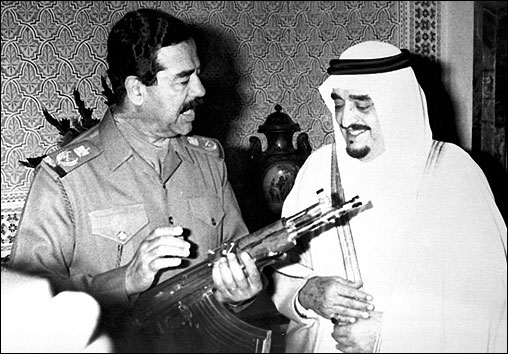
King Fahd presented Kalashnikov to another pervert Saddam Hussein [Fahd ordered Mutawwas to Issue Fatwa against the Same Saddam when Saddam fingered Wahabi Kuwait [Kuwait is even worst than Saudi Arabia] Enjoy the picture and after the pictutre read about the Debauch, Womanizer, Gambler Khadimul Haramian Sharifain.
http://cache.boston.com/bonzai-fba/Third_Party_Photo/2006/12/29/1167409329_2813.jpg


Khadim ul Harmain Sharifain - Shah Fahad The Debauch - In reality, it was a test of the ebullient Fahd’s capacity to govern. The Crown Prince would have to live down his personal reputation as a reckless womanizer, drinker, and gambler. REFERENCE: King Fahd’s Saudi Arabia by Harvey Sicherman August 12, 2005 http://www.fpri.org/enotes/20050812.middleeast.sicherman.fahdsaudiarabia.html

Real Face of King Fahd: There were stories of all night sessions at seedy clubs in Beirut, of affairs with belly dancers, and of the wife of a Lebanese businessman paid $100,000 a year to make herself available. Then in 1969, Fahd was said to have lost $1,000,000 in a single dusk-to-dawn marathon of Scotch-fuelled gambling at the tables of a MonteCarlo nightclub. He was summoned back to Riyadh by his brother, the then King Faisal Abdul Aziz ibn Saud. REFERENCE: Life and legacy of King Fahd By Paul Wood BBC defence correspondent Last Updated: Monday, 1 August 2005, 10:14 GMT 11:14 UK http://news.bbc.co.uk/2/hi/4734505.stm

Saudi Arabia’s King Fahd: [The Mutawwa in Chief due to his fingering Streets of Pakistan are burning] Real Face: His visits with his retinue of 3,000 had earned the local tradesmen riches indeed. It is estimated that an extra €30,000 (£21,000) a day was spent just in Puerto Banus. As heir apparent, Fahd first visited Marbella in 1974 and stayed at the Incosol hotel and spa. He booked 100 rooms but some of the princesses didn’t like the decor so he ordered the dark carpets to be changed to white. As a reward, Fahd left the hotel a tip of $300,000 — enough for the entire staff to receive, in effect, an extra year’s salary. He told one Spanish journalist that he liked Marbella because “it was a land blessed by Allah”, referring to the Arab occupation of most of Spain from the 8th to the 13th century. In the early 1980s he started the construction of his Mar Mar Palace, a replica of the White House. Because of increasing ill health (he suffered a stroke 10 years ago), he last visited in August 2002, just after a £134m refurbishment of the palace. REFERENCE: Marbella mourns its own King Midas King Fahd’s epic spending enriched his favourite part of Spain, says Deirdre Fernand From The Sunday Times August 7, 2005 http://www.timesonline.co.uk/tol/news/article552402.ece

Vice-President George H. W. Bush returns from his trip to the Middle East, where he has passed along a message to Iraq to step up its air war against Iran (see July 23, 1986). The covert machinations nearly become public knowledge when US embassy officials in Saudi Arabia, learning of the Saudi transfer of US arms to Iraq earlier in the year (see February 1986), question the Saudi ambassador to the US, Prince Bandar. Bandar, fully aware of the arms transfer, tells the officials that the transfer was “accidental” and the amount of arms transferred was negligible. The State Department is also curious about the transfer, warns that the arms transfer violates the Arms Export Control Act, and says it must inform Congress of the transfer. Such a notification would endanger the entire process, and possibly short-circuit another arms deal in the works, a $3.5 billion transfer of five AWACS planes to Saudi Arabia, of which Congress has already been informed. But after the White House notifies the chairman of the Senate Foreign Relations Committee, Richard Lugar (R-IN), and mollifies Lugar by telling him the arms sales to Iraq were “inadvertent,” “unauthorized,” and involved only a “small quantity of unsophisticated weapons,” Lugar agrees to keep silent about the matter. Another senator later approaches Lugar about rumors that Saudi Arabia is sending US arms to Iraq, and recalls that “Dick Lugar told me there was nothing to it, and so I took his word.” [NEW YORKER, 11/2/1992] REFERENCE: August 5, 1986: Covert Arms Sales to Iraq Nearly Revealed http://www.historycommons.org/context.jsp?item=us_iraq_80s_134#us_iraq_80s_134 Profile: Bandar bin Sultan a.k.a. "Bandar Bush", Prince Bandar http://www.historycommons.org/entity.jsp?entity=bandar_bin_sultan


Shaking Hands: Iraqi President Saddam Hussein greets Donald Rumsfeld, then special envoy of President Ronald Reagan, in Baghdad on December 20, 1983. REFERENCE: US NATIONAL SECURITY ARCHIVE Shaking Hands with Saddam Hussein: The U.S. Tilts toward Iraq, 1980-1984 National Security Archive Electronic Briefing Book No. 82 Edited by Joyce Battle February 25, 2003 http://www.gwu.edu/~nsarchiv/NSAEBB/NSAEBB82/

What a joke that Aal-e--Saud and Saudi Muttawwa Abd-al-Aziz ibn Abd-Allah ibn Baaz issued a Fatwa of Takfeer [Apostasy] against Saddam Hussein [that too after he was no more of any use to Corrupt Aal-e-Saud and Wahhaabi Muttawwas whereas an Anarchist Pakistan Ahl-e-Hadith Scholar Late. Ehsan Elahi Zaheer [who was on the payroll of Aal-e-Saud and Saudi Muttawwas rather he was student of Salafi Islamic scholars such as Muhammad Nasiruddin al-Albani and Abd-al-Aziz ibn Abd-Allah ibn Baaz] had addressed Sddam Hussein and his Ba'ath Party Member [as per Saudi Fatwa "Apostate, Secular, Socialist i.e. KAAFIR] REFERENCE: Ehsan Elahi Zaheer http://en.wikipedia.org/wiki/Ehsan_Elahi_Zaheer
صدام حسين مع إحسان إلهي ظهير رحمه الله - فيديو نادر

URL: http://www.youtube.com/watch?v=P68GstP37go

Really sometime "This Muslim Ummah" is so hypcortie that one wants to puke.


Secretary of Defense Dick Cheney, accompanied by senior aide Paul Wolfowitz and US CENTCOM commander-in-chief General Norman Schwarzkopf, visits Saudi Arabia just four days after Iraq invades Kuwait (see August 2, 1990). [SCHOOL OF INTERNATIONAL AND PUBLIC AFFAIRS OF COLUMBIA UNIVERSITY, 8/3/2000; DUBOSE AND BERNSTEIN, 2006, PP. 100] Cheney secures permission from King Fahd for US forces to use Saudi territory as a staging ground for an attack on Iraq. Cheney is polite, but forceful; the US will not accept any limits on the number of troops stationed in Saudi Arabia, and will not accept a fixed date of withdrawal (though they will withdraw if Fahd so requests). Cheney uses classified satellite intelligence to convince Fahd of Hussein’s belligerent intentions against not just Kuwait, but against Saudi Arabia as well. Fahd is convinced, saying that if there is a war between the US and Iraq, Saddam Hussein will “not get up again.” Fahd’s acceptance of Cheney’s proposal goes against the advice of Crown Prince Abdullah. [SCHOOL OF INTERNATIONAL AND PUBLIC AFFAIRS OF COLUMBIA UNIVERSITY, 8/3/2000; DUBOSE AND BERNSTEIN, 2006, PP. 100-101] With Prince Bandar bin Sultan translating, Cheney tells Abdullah, “After the danger is over, our forces will go home.” Abdullah says under his breath, “I would hope so.” Bandar does not translate this. [MIDDLE EAST REVIEW OF INTERNATIONAL AFFAIRS, 9/2002; HISTORY NEWS NETWORK, 1/13/2003] On the same trip, Cheney also visits Egypt’s Hosni Mubarak, who rejects Cheney’s request for US use of Egyptian military facilities. Mubarak tells Cheney that he opposes any foreign intervention against Iraq. [SCHOOL OF INTERNATIONAL AND PUBLIC AFFAIRS OF COLUMBIA UNIVERSITY, 8/3/2000] US forces will remain in Saudi Arabia for thirteen years (see April 30-August 26, 2003). REFERENCE: August 5, 1990 and After: Cheney Secures Permission for US Forces to Attack Iraq from Saudi Arabia http://www.historycommons.org/context.jsp?item=a080590cheneysaudi#a080590cheneysaudi Profile: Bandar bin Sultan a.k.a. "Bandar Bush", Prince Bandar http://www.historycommons.org/entity.jsp?entity=bandar_bin_sultan


USA/Great Britain/King Fahd financed Iraq Iran War but when Saddam Hussein entered Kuwait [Worst than Saudi Arabia] Fahd ordered Saudi Retard Toady Mutawwas to Issue Fatwa against the Same Saddam. Debauch Saudi Wahabi Somersault Fatwa of Takfeer against Saddam Hussein. In 1996 then-UN Ambassador Madeleine Albright was asked by 60 Minutes correspondent Lesley Stahl, in reference to years of U.S.-led economic sanctions against Iraq, “We have heard that half a million children have died. I mean, that is more children than died in Hiroshima. And, you know, is the price worth it?” To which Ambassador Albright responded, “I think that is a very hard choice, but the price, we think, the price is worth it.” - BAGHDAD, Oct. 10 — A team of American and Iraqi public health researchers has estimated that 600,000 civilians have died in violence across Iraq since the 2003 American invasion, the highest estimate ever for the toll of the war here. The figure breaks down to about 15,000 violent deaths a month, a number that is quadruple the one for July given by Iraqi government hospitals and the morgue in Baghdad and published last month in a United Nations report in Iraq. That month was the highest for Iraqi civilian deaths since the American invasion. But it is an estimate and not a precise count, and researchers acknowledged a margin of error that ranged from 426,369 to 793,663 deaths. It is the second study by researchers from the Johns Hopkins Bloomberg School of Public Health. It uses samples of casualties from Iraqi households to extrapolate an overall figure of 601,027 Iraqis dead from violence between March 2003 and July 2006. REFERENCE: Iraqi Dead May Total 600,000, Study Says By SABRINA TAVERNISE and DONALD G. McNEIL Jr. Published: October 11, 2006 http://www.nytimes.com/2006/10/11/world/middleeast/11casualties.html

Donald Rumsfeld meets Saddam Hussein 1983

URL: http://www.youtube.com/watch?v=zaP7ZrmkcuU


On the brink of war, both supporters and critics of United States policy on Iraq agree on the origins, at least, of the haunted relations that have brought us to this pass: America's dealings with Saddam Hussein, justifiable or not, began some two decades ago with its shadowy, expedient support of his regime in the Iraq-Iran war of the 1980's. Both sides are mistaken. Washington's policy traces an even longer, more shrouded and fateful history. Forty years ago, the Central Intelligence Agency, under President John F. Kennedy, conducted its own regime change in Baghdad, carried out in collaboration with Saddam Hussein. The Iraqi leader seen as a grave threat in 1963 was Abdel Karim Kassem, a general who five years earlier had deposed the Western-allied Iraqi monarchy. Washington's role in the coup went unreported at the time and has been little noted since. America's anti-Kassem intrigue has been widely substantiated, however, in disclosures by the Senate Committee on Intelligence and in the work of journalists and historians like David Wise, an authority on the C.I.A. From 1958 to 1960, despite Kassem's harsh repression, the Eisenhower administration abided him as a counter to Washington's Arab nemesis of the era, Gamal Abdel Nasser of Egypt -- much as Ronald Reagan and George H. W. Bush would aid Saddam Hussein in the 1980's against the common foe of Iran. By 1961, the Kassem regime had grown more assertive. Seeking new arms rivaling Israel's arsenal, threatening Western oil interests, resuming his country's old quarrel with Kuwait, talking openly of challenging the dominance of America in the Middle East -- all steps Saddam Hussein was to repeat in some form -- Kassem was regarded by Washington as a dangerous leader who must be removed. REFERENCE: A Tyrant 40 Years in the Making By Roger Morris Published: March 14, 2003 Roger Morris, author of ''Richard Milhous Nixon: The Rise of an American Politician,'' is completing a book about United States covert policy in Central and South Asia. http://www.nytimes.com/2003/03/14/opinion/a-tyrant-40-years-in-the-making.html


In 1963 Britain and Israel backed American intervention in Iraq, while other United States allies -- chiefly France and Germany -- resisted. But without significant opposition within the government, Kennedy, like President Bush today, pressed on. In Cairo, Damascus, Tehran and Baghdad, American agents marshaled opponents of the Iraqi regime. Washington set up a base of operations in Kuwait, intercepting Iraqi communications and radioing orders to rebels. The United States armed Kurdish insurgents. The C.I.A.'s ''Health Alteration Committee,'' as it was tactfully called, sent Kassem a monogrammed, poisoned handkerchief, though the potentially lethal gift either failed to work or never reached its victim.Then, on Feb. 8, 1963, the conspirators staged a coup in Baghdad. For a time the government held out, but eventually Kassem gave up, and after a swift trial was shot; his body was later shown on Baghdad television. Washington immediately befriended the successor regime. ''Almost certainly a gain for our side,'' Robert Komer, a National Security Council aide, wrote to Kennedy the day of the takeover. As its instrument the C.I.A. had chosen the authoritarian and anti-Communist Baath Party, in 1963 still a relatively small political faction influential in the Iraqi Army. According to the former Baathist leader Hani Fkaiki, among party members colluding with the C.I.A. in 1962 and 1963 was Saddam Hussein, then a 25-year-old who had fled to Cairo after taking part in a failed assassination of Kassem in 1958. According to Western scholars, as well as Iraqi refugees and a British human rights organization, the 1963 coup was accompanied by a bloodbath. Using lists of suspected Communists and other leftists provided by the C.I.A., the Baathists systematically murdered untold numbers of Iraq's educated elite -- killings in which Saddam Hussein himself is said to have participated. No one knows the exact toll, but accounts agree that the victims included hundreds of doctors, teachers, technicians, lawyers and other professionals as well as military and political figures. The United States also sent arms to the new regime, weapons later used against the same Kurdish insurgents the United States had backed against Kassem and then abandoned. Soon, Western corporations like Mobil, Bechtel and British Petroleum were doing business with Baghdad -- for American firms, their first major involvement in Iraq. REFERENCE: A Tyrant 40 Years in the Making By Roger Morris Published: March 14, 2003 Roger Morris, author of ''Richard Milhous Nixon: The Rise of an American Politician,'' is completing a book about United States covert policy in Central and South Asia. http://www.nytimes.com/2003/03/14/opinion/a-tyrant-40-years-in-the-making.html


But it wasn't long before there was infighting among Iraq's new rulers. In 1968, after yet another coup, the Baathist general Ahmed Hassan al-Bakr seized control, bringing to the threshold of power his kinsman, Saddam Hussein. Again, this coup, amid more factional violence, came with C.I.A. backing. Serving on the staff of the National Security Council under Lyndon Johnson and Richard Nixon in the late 1960's, I often heard C.I.A. officers -- including Archibald Roosevelt, grandson of Theodore Roosevelt and a ranking C.I.A. official for the Near East and Africa at the time -- speak openly about their close relations with the Iraqi Baathists. This history is known to many in the Middle East and Europe, though few Americans are acquainted with it, much less understand it. Yet these interventions help explain why United States policy is viewed with some cynicism abroad. George W. Bush is not the first American president to seek regime change in Iraq. Mr. Bush and his advisers are following a familiar pattern. The Kassem episode raises questions about the war at hand. In the last half century, regime change in Iraq has been accompanied by bloody reprisals. How fierce, then, may be the resistance of hundreds of officers, scientists and others identified with Saddam Hussein's long rule? Why should they believe America and its latest Iraqi clients will act more wisely, or less vengefully, now than in the past? If a new war in Iraq seems fraught with danger and uncertainty, just wait for the peace. REFERENCE: A Tyrant 40 Years in the Making By Roger Morris Published: March 14, 2003 Roger Morris, author of ''Richard Milhous Nixon: The Rise of an American Politician,'' is completing a book about United States covert policy in Central and South Asia. http://www.nytimes.com/2003/03/14/opinion/a-tyrant-40-years-in-the-making.html

Late. Abd al-Aziz ibn Abd Allah ibn Baaz [Saudi Grand Mufti who issued Fatwa against Saddam and then against Osama Bin Ladin] - When Saddam invaded Kuwait - [Immediately a Fatwa was issued against Saddam - "During the Iran-Iraq war, Saudi Arabia bankrolled the Saddam Hussein regime with the express approval of Washington DC which at that time saw Saddam Hussein as a bulwark against Shia fundamentalism. It came as a terrific shock to the Saudi Royals when Saddam Hussein turned his attention to Kuwait and Saudi Arabia. Again, the Royal family turned to the Ulema and obtained (with difficulty) a Fatwa, permitting the use of non-Muslim foreign troops on Saudi soil to defend Saudi Arabia against a foreign invader - one the Ulema regarded as a secular apostate. Thus the Saudi Royal family invited the USA to send it its troops for Operation Desert Storm- the operation to defend Saudi Arabia and liberate Kuwait - largely at Saudi expense." As per 9/11 Commission Report “In August 1990, Iraq invaded Kuwait. Bin Ladin, whose efforts in Afghanistan had earned him celebrity and respect, proposed to the Saudi monarchy that he summon mujahideen for a jihad to retake Kuwait. He was rebuffed, [Saudi Fatwa issued in 90s against Osama Bin Ladin - http://abdurrahman.org/jihad/binlaadin.pdf Usama Ibn Ladin Al-Kharijee (our position toward him and his likes) - By Abdul Aziz Ibn Abdullaah Ibn Baz [PDF] - Taken from http://www.troid.org/] and the Saudis joined the U.S.-led coalition. After the Saudis agreed to allow U.S. armed forces to be based in the Kingdom, Bin Ladin and a number of Islamic clerics began to publicly denounce the arrangement. The Saudi government exiled the clerics and undertook to silence Bin Ladin by, among other things, taking away his passport. With help from a dissident member of the royal family, he managed to get out of the country under the pretext of attending an Islamic gathering in Pakistan in April 1991.”

"QUOTE

Misconception: The Islaamic Threat

In recent years, a great deal of attention in the media have been given to the threat of "Islaamic Fundamentalism". Unfortunately, due to a twisted mixture of biased reporting in the Western media and the actions of some ignorant Muslims, the word "Islaam" has become almost synonymous with "terrorism". However, when one analyses the situation, the question that should come to mind is:

Do the teachings of Islaam encourage terrorism?

The answer: Certainly not!

Islaam totally forbids the terrorist acts that are carried out by some misguided people. It should be remembered that all religions have cults and misguided followers, so it is their teachings that should be looked at, not the actions of a few individuals. Unfortunately, in the media, whenever a Muslim commits a heinous act, he is labeled a "Muslim terrorist".

However, when Serbs murder and rape innocent women in Bosnia, they are not called "Christian terrorists", nor are the activities in Northern Ireland labeled "Christian terrorism". Also, when right-wing Christians in the U. S. bomb abortion clinics, they are not called "Christian terrorists". Reflecting on these facts, one could certainly conclude that there is a double-standard in the media! Although religious feelings play a significant role in the previously mentioned "Christian" conflicts, the media does not apply religious labels because they assume that such barbarous acts have nothing to do with the teachings of Christianity. However, when something happens involving a Muslim, they often try to put the blame on Islaam itself - and not the misguided individual.

Certainly, Islaamic Law (Sharee'ah) allows war - any religion or civilisation that did not would never survive - but it certainly does not condone attacks against innocent people, women or children. The Arabic word "jihaad", which is often translated as "Holy War", simply means "to struggle". The word for "war" in Arabic is "harb", not "jihaad". "Struggling", i.e. "making jihaad", to defend Islaam, Muslims or to liberate a land where Muslims are oppressed is certainly allowed (and even encouraged) in Islaam.

However, any such activities must be done according to the teachings of Islaam. Islaam also clearly forbids "taking the law into your own hands", which means that individual Muslims cannot go around deciding who they want to kill, punish or torture.

Trial and punishment must be carried out by a lawful authority and a knowledgeable judge. Also, when looking at events in the Muslim World, it should be kept in mind that a long period of colonialism ended fairly recently in most Muslim countries. During this time, the people in these countries were culturally, materially and religiously exploited - mostly by the so-called "Christian" nations of the West. This painful period has not really come to an end in many Muslim countries, where people are still under the control of foreign powers or puppet regimes supported by foreign powers.

Also, through the media, people in the West are made to believe that tyrants like Saddam Hussein in Iraq and Moamar Qaddafi in Libya are "Islaamic" leaders - when just the opposite is true. Neither of these rulers even profess Islaam as an ideology, but only use Islaamic slogans to manipulate their powerless populations. They have about as much to do with Islaam as Hitler had to do with Christianity! In reality, many Middle Eastern regimes which people think of as being "Islaamic" oppress the practice of Islaam in their countries. So suffice it to say that "terrorism" and killing innocent people directly contradicts the teachings of Islaam. .......... Prepared by: Abu 'Iyaad REFERENCE: Misconception: The Islaamic Threat http://www.fatwa-online.com/aboutislaam/0020221.htm http://www.fatwa-online.com/index.htm http://www.fatwa-online.com/worship/jihaad/jih009/index.htm

Question: O esteemed Shaykh, what is happening now (in Iraaq) so what is the position of the Muslim towards this trial, and is there a Jihaad, and are do those soldiers who are in the Gulf have the ruling of being mujaahideen, and may Allaah reward you.

Shaykh Ubayd al-Jaabiree: I dont know why this question (is asked) when, when we have just ended the speech with what I consider to comprise the answer to it and to its likes. However, despite this, just so that it is said, that Ubayd has neglected some of the questions.

So I say: Firstly, not all of the Iraaqi society is Muslim. Rather, amongst them is the Marxist, amongst them is the Ba'athist Heretic, and amongst them are numerous orientations. And there are Muslims amongst them...

And amongst them are the Raafidah. And the positions of the Scholars towards the Raafidah is well known, amongst them are those who declared them Disbelievers.

Secondly, we have Rulers and those who have authority, and it is obligatory to give them hearing and obedience, and around our rulers are those who have knowledge, and experience, and speciality in the political affairs. So we do not undermine them, and we have already mentioned previously that the general affairs are not for just any person. Rather, they are for whom? For those in authority.

And as it is appropriate, I also say that those who call to cutting off from the products of America and Britain and others, then those people have a resemblance to the Raafidah. Shaykh ul-Islaam Ibn Taymiyyah mentions in Minhaaj us-Sunnah, in the first volume, and I believe it is page 38, "From the stupidity of the Raafidah is that they do not drink from the river that was unearthed (i.e. dug out, like a well) by Yazeed". So those Harakiyyoon and Hizbiyyoon, have resembled the Raafidah. And what an evil model (that is). And the most repugnant for a person that his model, and way is that of the Raafidah.

Thirdly, the banner of fighting in Iraaq, who is carrying it? It is carried by Saddaam Hussain at-Takreetee, and he is the leader of the Ba'athi Party in his land...and the Ba'athi Party, is secularist, disbelieving, heretical. Its foundation is upon mixing and not differentiating between a Sunni Muslim, Guidance from the Scholars Concerning Iraaq and between the Jew, Christian, Communist, and others. They are all the same, equal. And for this reason, their slogan is, as their poet has said:

I believe in, -- (Shaykh Ubayd): I seek refuge in Allaah --
I believe in al-Ba'ath as the Lord which has no partner
And in Arabism as a religion, which has no other (religion)

This is their religion, qawmiyyah (nationalism) and shu'oobiyyah, and their religion is not Islaam. So built upon this, the one who fights under the banner of the Iraaqi government, then he is fighting under a banner of disbelief. And we do not dispute that the people of Iraaq have the right to defend themselves. They can defend themselves, their blood, their honour and their wealth, they can defend those who transgress upon them, whether America or Britain or other than them.

So it is obligatory upon us, the community of Muslims that we ask Allaah in our supplication that He delivers the Muslims amongst the people of Iraaq. So whoever said O Allaah save the [Iraaqi Society]1 , then he has erred. This supplication of his reaches even the Marxist and the Communist. And the Ba'ath Party is at the front of the [supplication of the] one who supplicates for the Iraaqi society (in general). No, but supplicate to Allaah that He delivers the Muslims amongst the people of Iraaq. And that he relieves them of their distress. This is what I can add now. .......... Translated by: Abu 'Iyaad REFERENCE: NEWS\ Monday 31 March 2003 Shaykh 'Ubayd al-Jaabiree on the Position Towards Iraq From a Paltalk Session today 31/03/2003 at 8:30pm UK Time http://www.fatwa-online.com/news/0030331.htm

"UNQUOTE"


Mawdudi’s works began to appear in Iran in the 1960s. They were translated into Persian from Arabic by Ayatollah Hadi Khusrawshahi and members of a translating team working with him. Articles on Mawdudi and excerpts from his works also appeared in various issues of Khusrawshahi’s journal Maktab-i Islam. Following the revolution of 1978–1979, a number of Mawdudi’s works were translated into Persian from Arabic by Ayatollah Sayyid Muhammad Khamana’i. Interestingly, the first Persian translation of a work of Mawdudi was done in Hyderabad, Deccan, by Mahmud Faruqi in 1946; RJI, vol. 4, 90. REFERENCES: The Vangaurd of the Islamic Revolution - The Jama‘at-i Islami of Pakistan Seyed Vali Reza Nasr UNIVERSITY OF CALIFORNIA PRESS Berkeley · Los Angeles · London © 1994 The Regents of the University of California - Should we just condemn only Khomeini and condone Mawdudi knowing well that Mawdudi was a close friend of Khomeini and was sympathetic to his course. In a book titled, 'Two brothers - Maududi and Khomeini' page 129, the following statement of Dr Ahmad Farouk Maududi (son of Abul-A'ala Maududi) was published in Roz Naame, Lahore - 29 September 1979, "Allama Khomeini had a very old and close relationship with Abba Jaan (father). Aayaatullah Khomeini translated his (fathers) books in Farsi and included it as a subject in Qum. Allama Khomeini met my father in 1963 during Hajj and my father's wish was to create a revolutionary in Pakistan similar to Iran. He was concerned about the success of the Iranian revolution till his last breath.'

Shia Death Squads Part - 1/5


http://www.youtube.com/watch?v=ihO1e8eTzh4


BAGHDAD — Iraq's two most deadly Shiite Muslim militias have killed thousands of Sunni Arabs since February, with the more experienced Badr Brigade often working in tandem with Al Mahdi army, collecting intelligence on targets and forming hit lists that Al Mahdi militia members carry out, a senior U.S. military official said Wednesday. In some cases, death squads have been accompanied by a "clerical figure to basically run" an Islamic court to provide "the blessing for the conduct of the execution," the official said. The disclosures came during a U.S. intelligence briefing that included details about Shiite militia death squad operations and links to Iranian finance and weapons networks. The military official said there were corrupt Iraqi security officers who allowed Shiite militia members to kill Sunni Arabs in Baghdad neighborhoods that had been secured by joint U.S.-Iraqi military sweeps aimed at quelling sectarian violence. The official spoke on condition of anonymity, but was one of a series of high-ranking American officials who gave detailed briefings to reporters this week, at a time when the U.S. military is struggling to restore order to Baghdad and to press the Iraqi government to move decisively against Shiite militias. The Badr Brigade, the military wing of the Supreme Council for Islamic Revolution in Iraq -- a member of the leading Shiite political bloc with 30 seats in parliament -- was responsible for most of the Shiite death squad killings last year, the official said. That changed in February, when Sunni Arab insurgents bombed the Shiite shrine of the Golden Mosque in Samarra, and Al Mahdi army, a militia loyal to radical anti-Western Shiite cleric Muqtada Sadr, moved to the front of a rising sectarian bloodbath. Sadr's political organization also holds 30 parliamentary seats and controls several government ministries. The hallmarks of the Shiite death squads have been mass killings in which the victims are found with their "hands bound, shot in the back or head," and their bodies showing signs of torture, the U.S. official said. Mosques and safehouses in Sadr City, a huge poor Shiite neighborhood that is the Al Mahdi stronghold in Baghdad, have been the base for many death squad operations, the official said. The official also said that Iraq's Interior Ministry, known to be heavily infiltrated by both Shiite militias, was complicit in many of the killings. Militia members have used Iraqi security forces' uniforms and vehicles during assassinations and checkpoint sweeps. "Those would get up to 60 individuals detained in a sweep," the official said. "OK, and again, often they would release those who were Shiite. We'd see that over the course of, say, that afternoon. And then there'd be individuals ransomed, and then there would perhaps be a mass killing in Sadr City and burial." American military officials have arrested at least 30 death squad members, the official said, all of them associated with extreme Al Mahdi militia elements. Death squad cells within the Badr Brigade still carry out killings, the official said, but the number of slayings by Al Mahdi extremist cells has far outstripped them. Al Mahdi militia's growth has hindered Sadr's ability to control the paramilitary force, the official said, citing instances when the cleric's commands to fighters to stand down were ignored by militia commanders. The official said U.S. investigators in Iraq have evidence that militiamen have acquired shoulder-fired rockets capable of shooting down aircraft, as well as Iranian-made explosives capable of puncturing armor plating. Iran has "enhanced violence" in some militia-dominated Iraqi cities with its flow of weapons, the official said, but he downplayed the Shiite-controlled country's long-term influence in Iraq, saying that Iraq's historic independent streak would eventually outweigh its affinities for its neighbor. REFERENCE: THE CONFLICT IN IRAQ Killings by Shiite Militias Detailed September 28, 2006|Solomon Moore | Times Staff Writer http://articles.latimes.com/2006/sep/28/world/fg-intel28

Shia Death Squads Part - 2/5


http://www.youtube.com/watch?v=jzVP1bvOnEM


In fact I suggested a number of people and I'm sure you've seen it in my messages to my superiors, a number of people who could meet with senior Iranian officials and various ways in which that could happen. In that January meeting I told him that I was not confident that we were headed in the right direction.. . .Mr. Ghorbanifar by then was aware of my role in support for the Nicaraguan resistance. He had seen my name in the newspapers. He is a very well-read individual. I had been told by the Central Intelligence Agency, by Director Casey himself and by others in the C.I.A., that they believed Mr. Ghorbanifar to be an Israeli intelligence agent. * * * Mr. Ghorbanifar took me into the bathroom and Mr. Ghorbanifar suggested several incentives to make that February transaction work. And the attractive incentive for me was the one he made that residuals could flow to support the Nicaraguan resistance. * * * I must confess to you that I thought using the Ayatollah's money to support the Nicaraguan resistance was a right idea. And I must confess to you that I advocated that. * * * And I saw that idea of using the Ayatollah Khomeini's money to support the Nicaraguan freedom fighters as a good one. I still do. I don't think it was wrong. I think it was a neat idea. And I came back and I advocated that and we did it. We did it on three occasions. Those three occasions were February, May and October. And in each one of those occasions as a consequence of that whole process we got three Americans back. And there was no terrorism, while we were engaged in it, against Americans. For almost 18 months there was no action against Americans until it started to come unraveled. I believed then and I believe now that we had a chance to achieve a strategic opening and right up until the last minute that I left the N.S.C. I was in communication with the Israelis and others who were working on the second channel to achieve that end. The fact is that whether it was Mr. Ghorbanifar himself who originated the idea or Mr. Nir or others within the Israeli Government, it was a good idea. It was a good idea because we weren't using the taxpayers' money, we were using the Ayatollah's money. And it went indeed to support the Nicaraguan resistance. REFERENCE: IRAN-CONTRA HEARINGS; Day 2: The President's Knowledge and the Ayatollah's Money Published: July 09, 1987 http://www.nytimes.com/1987/07/09/world/iran-contra-hearings-day-2-the-president-s-knowledge-and-the-ayatollah-s-money.html?pagewanted=all&src=pm


Shia Death Squads Part - 3/5


http://www.youtube.com/watch?v=yVUaQFxrEoo


The Mahdi Army: The Mahdi Army—named after a Shiite messianic figure—is a militia of several thousand members loyal to the young anti-U.S. cleric Muqtada al-Sadr. The group led two uprisings last year against U.S. forces before agreeing to a ceasefire in October 2004. The militia is heavily influential in Najaf, a city in southern Iraq, and in Sadr City, a Baghdad slum of some 2.5 million Shiites. Some news reports suggest the Mahdi Army may be regrouping and rearming itself. In recent months, Sadr’s group has been accused of abducting Sunni Arabs as well as members of rival Shiite militias like the Badr Organization, British troops, and journalists, including Rory Carroll, an Irish reporter for the British newspaper the Guardian. On October 27, in Medayna, a village northeast of Baghdad, a group of so-called Sadrists reportedly raided and set ablaze several homes suspected of harboring Sunni insurgents; the ensuing fight left some twenty people dead. Some experts say the group is not an organized, disciplined unit with clear political objectives. ''I think the Sadrists are a social movement, not really so much an organization,'' said Juan Cole, a Middle East expert at the Universityof Michigan , in an interview with the New York Times. ''So you have these neighborhood-based youth gangs masquerading as an 'army.' Then you have the mosque preachers loyal to Muqtada who try to swing their congregations, and who interface with the youth gangs.''Other experts say Sadr is receiving aid from Iran’s intelligence services and Revolutionary Guard, though this is widely disputed. “Sadr is a very poor prospect as an Iranian proxy,” argues Michael Knights, a London-based associate with the Washington Institute for Near East Policy. “He’s xenophobic. He’s very disenchanted with Iranian-sponsored exiles who are currently heading up Iraq’s Shiite block, including of course Prime Minister [Ibrahim al-] Jaafari and SCIRI. He has recently flexed militarily with SCIRI’s Badr forces, so he’s generally not an ideal proxy for the Iranians to use.” Regardless, Sadr has emerged as a powerful figure in Iraqi politics and relishes his new kingmaker position. Though he has refused to participate directly in Iraqi politics, his supporters won a handful of parliamentary seats in the January 30 elections and thirty of his candidates joined the mainstream Shiite coalition, the United Iraqi Alliance, ahead of the December 15 parliamentary elections. REFERENCE: Shiite Militias and Iraq's Security Forces Author: Lionel Beehner November 30, 2005 http://www.cfr.org/iraq/shiite-militias-iraqs-security-forces/p9316


Shia Death Squads Part - 4/5


http://www.youtube.com/watch?v=r_bhJWhQsZw


The Badr Organization: The Badr Organization, formerly known as the Badr Brigade, was built by Iraqi Shiite defectors and soldiers captured by Iran during the 1980-1988 Iran-Iraq War. Its members were funded, trained, and equipped by the Iranian Revolutionary Guard Corps. In 2003, the 10,000-strong militia changed its name from the Badr Brigade to the Badr Organization of Reconstruction and Development after pledging to disarm and devote itself to peaceful purposes and is now the armed wing of the Supreme Council for the Islamic Revolution in Iraq (SCIRI), a Shiite opposition party founded in 1982 by Iraqi exiles in Iran. SCIRI, which has emerged as Iraq’s most powerful political party, advocates the creation of a separate, Shiite-run region comprising nine oil-rich provinces in southern Iraq. In a rare November 27 interview with the Washington Post, SCIRI’s leader, Abdul Aziz Hakim, downplayed his organization’s ties to Iran and denied accusations that the Badr Organization practiced torture or targeted Sunni Arabs. The group, however, has remained armed, experts say, and has been accused of assassinating, torturing, and unlawfully detaining Sunni Arabs. Peter Khalil, former director of national security policy with the CPA and a Middle East analyst with the Eurasia Group, says the Badr Organization continues to receive support, both military and financial, from Iran (Al-Malaf.net, a Jordanian news site, alleges the Badr Organization still receives a monthly stipend from Tehran of roughly $3 million). The militia group has also said it will run candidates, separate from SCIRI, in the upcoming December 15 parliamentary elections as part of the United Iraqi Alliance, the most powerful Shiite coalition. The Badr Organization has recently clashed with British troops in Basra and with the al-Sadr’s Mahdi Army, also based in Iraq’s predominantly Shiite south. In August, after Sadr’s headquarters in Najaf were set aflame, the Mahdi Army staged a reprisal attack against Badr troops. “It’s a mafia-style war between two descendants of Iraq’s leading ayatollah-led families, the Sadrs and the Hakims, who don’t exactly express affection for each other,” writes Robert Dreyfuss, a national security expert, in TomPaine.Com. Further attacks were called off by Sadr after Grand Ayatollah Ali al-Sistani intervened to quell the dispute. The Badr Organization denied responsibility for setting fire to Sadr’s offices. REFERENCE: Shiite Militias and Iraq's Security Forces Author: Lionel Beehner November 30, 2005 http://www.cfr.org/iraq/shiite-militias-iraqs-security-forces/p9316


Shia Death Squads Part - 5/5


The Wolf Brigade: One of the Badr Organization’s offshoots is the Wolf Brigade, a unit of roughly 2,000 special commando police officially under the Ministry of the Interior that is among Iraq’s most feared groups. Last November, the brigade—which was formed in the fall of 2004 by a former three-star Shiite general and SCIRI official whose nom de guerre is Abu Walid—fought alongside U.S.-led forces in Mosul, a Sunni stronghold northwest of Baghdad. Its members dress in garb—olive uniform, red beret, wraparound sunglasses—redolent of Saddam’s elite guard; their armband logo is a menacing-looking wolf. Last December, the Wolf Brigade won further notoriety after the success of Terrorism in the Grip of Justice, a primetime show on U.S.-funded al-Iraqiya television that featured live interrogations of Iraqi insurgents by Wolf Brigade commandos. In one show, Abu Walid questioned around thirty shabbily dressed suspects, some clutching photos of their victims, waiting to confess their crimes. The Wolf Brigade was reportedly responsible for the July seizure of eleven Sunni bricklayers who were then locked in the back of police cars and held for sixteen hours in scorching-hot temperatures. The brigade’s fierceness has given it a mythological aura among Shiite Iraqis: Parents are said to warn their children about the “wolves.” There are also patriotic songs devoted to the group. However, in May, the Sunni-controlled Muslim Scholars Association and other Sunni Arab leaders accused the Wolf Brigade of targeting Palestinian refugees in Iraq, using torture to extract confessions from prisoners, raiding Sunni homes, and engaging in “mass killings” and arrests in northeastern Baghdad. Walid denies the charges. Yet human rights groups say the Wolf Brigade, because of its counterterrorism television show, is violating the Geneva Conventions by publicly humiliating detainees. Despite its heavy-handed tactics, the group has proved useful to counterinsurgency operations. In mid-November 2004, the Wolf Brigade successfully arrested more than 300 suspected insurgents, including several Sunni officials, in Baqubah, a city northeast of Baghdad. The militia has also spawned copycat groups, not necessarily under the aegis of the Interior Ministry, with names like the Tiger, Scorpion, or Snake brigades. REFERENCE: Shiite Militias and Iraq's Security Forces Author: Lionel Beehner November 30, 2005 http://www.cfr.org/iraq/shiite-militias-iraqs-security-forces/p9316