"QUOTE"
 Excerpts from a book: Pakistan’s Drift into Extremism: Allah, the Army and America’s War on Terror By Hassan Abbas published by An East Gate Book. M.E. Sharpe Armonk, New York, London England. “The Khomeini revolution in Iran already bolstered the confidence of the Shias, and they were not about to take Sunni dictates in religious matters lying down. Hard-liners among Sunni, for their part, felt that such dictation was their right, and those on the extreme right of the Sunni spectrum simply cut the Gordian knot by taking a position that, correct or not, Pakistan had a Sunni majority and as such it should be declared a Sunni Muslim state in which Shia should be treated as a minority. Since achievement of this holy goal would likely to take some time, some of them decided that the interregnum ought not to be wasted. Thus in 1985 they formed Anjuman Sipah-e-Sahaba (ASS) – an organization piously dedicated to ridding the country of the nettlesome presence of the Shias by eliminating them physically. Later, when they realized what the organization’s acronym meant in English, they changed the name to Sipah-e-Sahaba Pakistan (SSP).”
“The zealous emissaries of the Iranian Revolutionary Regime started financing their organization Tehreek-e-Nifza-e-Fiqah-e-Jafaria (TNFJ – Movement for the Implementation of Jafaria Religious Law) and providing scholarships for Pakistani student to study in Iranian religious seminaries. For the Zia regime though, the problematic issue was Shia activism leading to a strong reaction to his attempts to impose Hanafi Islam (a branch of Sunni sect). For this he winked to the hard-liners among the Sunni religious groups in order to establish a front to squeeze the Shias. It was in this context that Jhangvi was selected by the intelligence community to do the needful. It is also believed that the JUI recommendation played the decisive part in this choice. The adherents of the Deobandi School were worried about Shia activism for religious reasons anyhow. State patronage came as an additional incentive. Consequently, in a well-designed effort, Shia assertiveness was projected as their disloyalty to Pakistan and its Islamic Ideology.” “In a few months, Saudi funds started pouring in, making the project feasible. For Saudi Arabia, the Iranian revolution was quite scary, for its ideals conflicted with that of a Wahabi monarchy. More so, with an approximately 10% Shia population, Saudi Arabia was concerned about the expansion of Shia activism in any Muslim country. Hence, it was more than willing to curb such trends in Pakistan by making a financial investment to bolster its Wahabi Agenda. According to Vali Raza Nasr, a leading expert on the sectarian groups of Pakistan, the flow of these funds was primarily routed through the Pakistan Military and the ISI. It is not known whether American support for this scheme was readily available, but the Zia regime knew well that the United States would be glad to acquiesce, given the rising US – Iran hostility. However, some analyst believe that CIA funds were involved in the venture.”
"UNQUOTE"

The intercepts make clear, however, that Crown Prince Abdullah was insistent on stemming the corruption. In November of 1996, for example, he complained about the billions of dollars that were being diverted by royal family members from a huge state-financed project to renovate the mosque in Mecca. He urged the princes to get their off-budget expenses under control; such expenses are known as the hiding place for payoff money. (Despite its oil revenues, Saudi Arabia has been running a budget deficit for more than a decade, and now has a large national debt.) A few months later, according to the intercepts, Abdullah blocked a series of real-estate deals by one of the princes, enraging members of the royal family. Abdullah further alarmed the princes by issuing a decree declaring that his sons would not be permitted to go into partnerships with foreign companies working in the kingdom. Abdullah is viewed by Sultan and other opponents as a leader who could jeopardize the kingdom's most special foreign relationship— someone who is willing to penalize the United States, and its oil and gas companies, because of Washington's support for Israel. In an intercept dated July 13, 1997, Prince Sultan called Bandar in Washington, and informed him that he had told Abdullah "not to be so confrontational with the United States." The Fahd regime was a major financial backer of the Reagan Administration' s anti-Communist campaign in Latin America and of its successful proxy war in Afghanistan against the Soviet Union. Oil money bought the Saudis enormous political access and leverage in Washington. Working through Prince Bandar, they have contributed hundreds of millions of dollars to charities and educational programs here. American construction and oil companies do billions of dollars' worth of business every year with Saudi Arabia, which is the world's largest oil producer. At the end of last year, Halliburton, the Texas-based oil-supply business formerly headed by Vice-President Dick Cheney, was operating a number of subsidiaries in Saudi Arabia. In the Clinton era, the White House did business as usual with the Saudis, urging them to buy American goods, like Boeing aircraft. The kingdom was seen as an American advocate among the oil-producing nations of the Middle East. The C.I.A. was discouraged from conducting any risky intelligence operations inside the country and, according to one former official, did little recruiting among the Saudi population, which limited the United States government's knowledge of the growth of the opposition to the royal family. REFERENCE: ANNALS OF NATIONAL SECURITY King’s Ransom How vulnerable are the Saudi royals? by Seymour M. Hersh OCTOBER 22, 2001 Seymour M. Hersh, Annals of National Security, “King’s Ransom,” The New Yorker, October 22, 2001, p. 35 http://www.newyorker.com/archive/2001/10/22/011022fa_FACT1
Oil Wars The Kingdom Part 10
Oil Wars The Kingdom Part 11


- From left to right: Dick Cheney, Prince Bandar, Condoleezza Rice, and George W. Bush, on the Truman Balcony of the White House on September 13, 2001. [Source: White House] - Defense Secretary Dick Cheney takes a leading role in drawing up the plans for the US invasion of Iraq (see December 1990). He is appalled by what he calls the “lack of creativity” of the initial plans, drawn up by a number of senior generals. Cheney and Joint Chiefs Chairman Colin Powell spend days poring over the plans, with Cheney pressuring both Powell and the generals to make wide-ranging changes. But the generals respect Cheney’s input. “He wasn’t a micromanager like McNamara,” one general later recalls, referring to former Defense Secretary Robert McNamara, who planned much of the US’s Vietnam strategies. “And he wasn’t arrogant like [former Defense Secretary Donald] Rumsfeld. He wanted this one done right.” Overwhelming Force - Cheney joins Powell in advocating the “enhanced option,” adding 100,000 more troops to the initial invasion force to bring troop strength up to nearly half a million US forces slated to go into Iraq. Powell and Cheney have no intention of being undermanned by Iraq’s large ground forces. And Cheney wants to slough off the remnants of what many call the “Vietnam syndrome.” He wants a resounding victory. “The military is finished in this society if we screw this up,” he tells Saudi Arabia’s Prince Bandar (see August 5, 1990 and After). While Powell and Cheney see eye-to-eye on most invasion-related issues, they do disagree on one fundamental issue: the possible use of the Army’s tactical nuclear arsenal (see Mid-August, 1990). (Nuclear weapons will not be used in the Iraq invasion.) Limited Role of Congress? - Cheney sees no reason for Congress to have anything more than a peripheral role in the entire affair (see December 1990). Authors Lou Dubose and Jake Bernstein later write: “Despite the fact that going to war with Iraq would be a larger undertaking than the D-Day invasion of Normandy, Cheney argued that the president did not need the consent of Congress. He seemed more understanding of King Fahd’s polling of the royal family and calling Arab leaders (see August 5, 1990 and After) than he was of [President] Bush’s willingness to go to Congress for consent” (see January 9-13, 1991). [DUBOSE AND BERNSTEIN, 2006, PP. 101-102] REFERENCE: Late 1990: Defense Secretary Cheney Helps Plan Iraq Invasion http://www.historycommons.org/context.jsp?item=alate90invade#alate90invade Profile: Bandar bin Sultan a.k.a. "Bandar Bush", Prince Bandar http://www.historycommons.org/entity.jsp?entity=bandar_bin_sultan
In 1994, Mohammed al-Khilewi, the first secretary at the Saudi Mission to the United Nations, defected and sought political asylum in the United States. He brought with him, according to his New York lawyer, Michael J. Wildes, some fourteen thousand internal government documents depicting the Saudi royal family's corruption, human-rights abuses, and financial support for terrorists. He claimed to have evidence that the Saudis had given financial and technical support to Hamas, the extremist Islamic group whose target is Israel. There was a meeting at the lawyer's office with two F.B.I. agents and an Assistant United States Attorney. "We gave them a sampling of the documents and put them on the table," Wildes told me last week. "But the agents refused to accept them." He and his client heard nothing further from federal authorities. Al-Khilewi, who was granted asylum, is now living under cover. The Saudis were also shielded from Washington's foreign-policy bureaucracy. A government expert on Saudi affairs told me that Prince Bandar dealt exclusively with the men at the top, and never met with desk officers and the like. "Only a tiny handful of people inside the government are familiar with U.S.-Saudi relations," he explained. "And that is purposeful." In the aftermath of the terrorist attacks in New York and Washington, the royal family has repeatedly insisted that Saudi Arabia has made no contributions to radical Islamic groups. When the Saudis were confronted by press reports that some of the substantial funds that the monarchy routinely gives to Islamic charities may actually have gone to Al Qaeda and other terrorist networks, they denied any knowledge of such transfers. The intercepts, however, have led many in the intelligence community to conclude otherwise. REFERENCE: ANNALS OF NATIONAL SECURITY King’s Ransom How vulnerable are the Saudi royals? by Seymour M. Hersh OCTOBER 22, 2001 Seymour M. Hersh, Annals of National Security, “King’s Ransom,” The New Yorker, October 22, 2001, p. 35 http://www.newyorker.com/archive/2001/10/22/011022fa_FACT1
Oil Wars The Kingdom Part 12

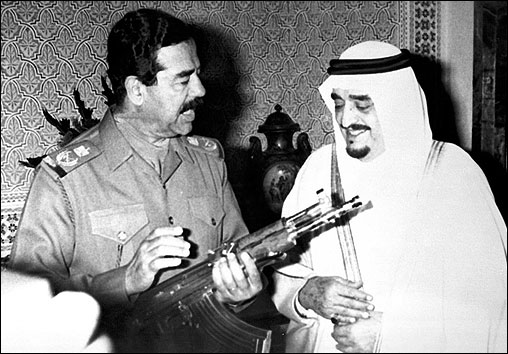
King Fahd presented Kalashnikov to another pervert Saddam Hussein [Fahd ordered Mutawwas to Issue Fatwa against the Same Saddam when Saddam fingered Wahabi Kuwait [Kuwait is even worst than Saudi Arabia] Enjoy the picture and after the pictutre read about the Debauch, Womanizer, Gambler Khadimul Haramian Sharifain.
Khadim ul Harmain Sharifain - Shah Fahad The Debauch - In reality, it was a test of the ebullient Fahd’s capacity to govern. The Crown Prince would have to live down his personal reputation as a reckless womanizer, drinker, and gambler. REFERENCE: King Fahd’s Saudi Arabia by Harvey Sicherman August 12, 2005
http://www.fpri.org/enotes/20050812.middleeast.sicherman.fahdsaudiarabia.htmlReal Face of King Fahd: There were stories of all night sessions at seedy clubs in Beirut, of affairs with belly dancers, and of the wife of a Lebanese businessman paid $100,000 a year to make herself available. Then in 1969, Fahd was said to have lost $1,000,000 in a single dusk-to-dawn marathon of Scotch-fuelled gambling at the tables of a MonteCarlo nightclub. He was summoned back to Riyadh by his brother, the then King Faisal Abdul Aziz ibn Saud. REFERENCE: Life and legacy of King Fahd By Paul Wood BBC defence correspondent Last Updated: Monday, 1 August 2005, 10:14 GMT 11:14 UK
http://news.bbc.co.uk/2/hi/4734505.stm
Saudi Arabia’s King Fahd: [The Mutawwa in Chief due to his fingering Streets of Pakistan are burning] Real Face: His visits with his retinue of 3,000 had earned the local tradesmen riches indeed. It is estimated that an extra €30,000 (£21,000) a day was spent just in Puerto Banus. As heir apparent, Fahd first visited Marbella in 1974 and stayed at the Incosol hotel and spa. He booked 100 rooms but some of the princesses didn’t like the decor so he ordered the dark carpets to be changed to white. As a reward, Fahd left the hotel a tip of $300,000 — enough for the entire staff to receive, in effect, an extra year’s salary. He told one Spanish journalist that he liked Marbella because “it was a land blessed by Allah”, referring to the Arab occupation of most of Spain from the 8th to the 13th century. In the early 1980s he started the construction of his Mar Mar Palace, a replica of the White House. Because of increasing ill health (he suffered a stroke 10 years ago), he last visited in August 2002, just after a £134m refurbishment of the palace. REFERENCE: Marbella mourns its own King Midas King Fahd’s epic spending enriched his favourite part of Spain, says Deirdre Fernand From The Sunday Times August 7, 2005
http://www.timesonline.co.uk/tol/news/article552402.ece

Vice-President George H. W. Bush returns from his trip to the Middle East, where he has passed along a message to Iraq to step up its air war against Iran (see July 23, 1986). The covert machinations nearly become public knowledge when US embassy officials in Saudi Arabia, learning of the Saudi transfer of US arms to Iraq earlier in the year (see February 1986), question the Saudi ambassador to the US, Prince Bandar. Bandar, fully aware of the arms transfer, tells the officials that the transfer was “accidental” and the amount of arms transferred was negligible. The State Department is also curious about the transfer, warns that the arms transfer violates the Arms Export Control Act, and says it must inform Congress of the transfer. Such a notification would endanger the entire process, and possibly short-circuit another arms deal in the works, a $3.5 billion transfer of five AWACS planes to Saudi Arabia, of which Congress has already been informed. But after the White House notifies the chairman of the Senate Foreign Relations Committee, Richard Lugar (R-IN), and mollifies Lugar by telling him the arms sales to Iraq were “inadvertent,” “unauthorized,” and involved only a “small quantity of unsophisticated weapons,” Lugar agrees to keep silent about the matter. Another senator later approaches Lugar about rumors that Saudi Arabia is sending US arms to Iraq, and recalls that “Dick Lugar told me there was nothing to it, and so I took his word.” [NEW YORKER, 11/2/1992] REFERENCE: August 5, 1986: Covert Arms Sales to Iraq Nearly Revealed
http://www.historycommons.org/context.jsp?item=us_iraq_80s_134#us_iraq_80s_134 Profile: Bandar bin Sultan a.k.a. "Bandar Bush", Prince Bandar
http://www.historycommons.org/entity.jsp?entity=bandar_bin_sultan

Shaking Hands: Iraqi President Saddam Hussein greets Donald Rumsfeld, then special envoy of President Ronald Reagan, in Baghdad on December 20, 1983. REFERENCE: US NATIONAL SECURITY ARCHIVE Shaking Hands with Saddam Hussein: The U.S. Tilts toward Iraq, 1980-1984 National Security Archive Electronic Briefing Book No. 82 Edited by Joyce Battle February 25, 2003
http://www.gwu.edu/~nsarchiv/NSAEBB/NSAEBB82/
The Bush Administration has chosen not to confront the Saudi leadership over its financial support of terror organizations and its refusal to help in the investigation. "As far as the Saudi Arabians go, they've been nothing but coöperative," President Bush said at a news conference on September 24th. The following day, the Saudis agreed to formally cut off diplomatic relations with the Taliban leadership in Afghanistan. Eight days later, at a news conference in Saudi Arabia with Prince Sultan, the defense minister, Donald Rumsfeld was asked if he had given the Saudis a list of the September 11th terrorist suspects for processing by their intelligence agencies. Rumsfeld, who is admired by many in the press for his bluntness, answered evasively: "I am, as I said, not involved with the Federal Bureau of Investigation that is conducting the investigation. . . . I have every reason to believe that that relationship between our two countries is as close, that any information I am sure has been made available to the Kingdom of Saudi Arabia." The Saudis gave Rumsfeld something in return—permission for U.S. forces to use a command-and- control center, built before the Gulf War, in the pending air war against the Taliban. Over the past few years, the Saudis have also allowed the United States to use forward bases on Saudi soil for special operations, as long as there was no public mention of the arrangements. While the intelligence- community members I spoke with praised the Air Force and the Navy for their performance in Afghanistan last week, which did much to boost morale in the military and among the American citizenry, they were crestfallen about an incident that occurred on the first night of the war—an incident that was emblematic, they believe, of the constraints placed by the government on the military's ability to wage war during the last decade. REFERENCE: ANNALS OF NATIONAL SECURITY King’s Ransom How vulnerable are the Saudi royals? by Seymour M. Hersh OCTOBER 22, 2001 Seymour M. Hersh, Annals of National Security, “King’s Ransom,” The New Yorker, October 22, 2001, p. 35 http://www.newyorker.com/archive/2001/10/22/011022fa_FACT1
Oil Wars The Kingdom Part 13
Really sometime "This Muslim Ummah" is so hypcortie that one wants to puke.

Secretary of Defense Dick Cheney, accompanied by senior aide Paul Wolfowitz and US CENTCOM commander-in-chief General Norman Schwarzkopf, visits Saudi Arabia just four days after Iraq invades Kuwait (see August 2, 1990). [SCHOOL OF INTERNATIONAL AND PUBLIC AFFAIRS OF COLUMBIA UNIVERSITY, 8/3/2000; DUBOSE AND BERNSTEIN, 2006, PP. 100] Cheney secures permission from King Fahd for US forces to use Saudi territory as a staging ground for an attack on Iraq. Cheney is polite, but forceful; the US will not accept any limits on the number of troops stationed in Saudi Arabia, and will not accept a fixed date of withdrawal (though they will withdraw if Fahd so requests). Cheney uses classified satellite intelligence to convince Fahd of Hussein’s belligerent intentions against not just Kuwait, but against Saudi Arabia as well. Fahd is convinced, saying that if there is a war between the US and Iraq, Saddam Hussein will “not get up again.” Fahd’s acceptance of Cheney’s proposal goes against the advice of Crown Prince Abdullah. [SCHOOL OF INTERNATIONAL AND PUBLIC AFFAIRS OF COLUMBIA UNIVERSITY, 8/3/2000; DUBOSE AND BERNSTEIN, 2006, PP. 100-101] With Prince Bandar bin Sultan translating, Cheney tells Abdullah, “After the danger is over, our forces will go home.” Abdullah says under his breath, “I would hope so.” Bandar does not translate this. [MIDDLE EAST REVIEW OF INTERNATIONAL AFFAIRS, 9/2002; HISTORY NEWS NETWORK, 1/13/2003] On the same trip, Cheney also visits Egypt’s Hosni Mubarak, who rejects Cheney’s request for US use of Egyptian military facilities. Mubarak tells Cheney that he opposes any foreign intervention against Iraq. [SCHOOL OF INTERNATIONAL AND PUBLIC AFFAIRS OF COLUMBIA UNIVERSITY, 8/3/2000] US forces will remain in Saudi Arabia for thirteen years (see April 30-August 26, 2003). REFERENCE: August 5, 1990 and After: Cheney Secures Permission for US Forces to Attack Iraq from Saudi Arabia
http://www.historycommons.org/context.jsp?item=a080590cheneysaudi#a080590cheneysaudi Profile: Bandar bin Sultan a.k.a. "Bandar Bush", Prince Bandar
http://www.historycommons.org/entity.jsp?entity=bandar_bin_sultan
That night, an unmanned Predator reconnaissance aircraft, under the control of the C.I.A., was surveilling the roads leading out of Kabul. The Predator, which costs forty million dollars and cruises at speeds as slow as eighty miles an hour, is equipped with imaging radar and an array of infrared and television cameras that are capable of beaming high-resolution images to ground stations around the world. The plane was equipped with two powerful Hellfire missiles, designed as antitank weapons. The Predator identified a group of cars and trucks fleeing the capital as a convoy carrying Mullah Omar, the Taliban leader. Under a previously worked-out agreement, one knowledgeable official said, the C.I.A. did not have the authority to "push the button." Nor did the nearby command-and- control suite of the Fifth Fleet, in Bahrain, where many of the war plans had been drawn up. Rather, the decision had to be made by the officers on duty at the headquarters of the United States Central Command, or CENTCOM, at MacDill Air Force Base, in Florida. The Predator tracked the convoy to a building where Omar, accompanied by a hundred or so guards and soldiers, took cover. The precise sequence of events could not be fully learned, but intelligence officials told me that there was an immediate request for a full-scale assault by fighter bombers. At that point, however, word came from General Tommy R. Franks, the CENTCOM commander, saying, as the officials put it, My JAG"—Judge Advocate General, a legal officer—"doesn' t like this, so we're not going to fire." Instead, the Predator was authorized to fire a missile in front of the building—"bounce it off the front door," one officer said, "and see who comes out, and take a picture." CENTCOM suggested that the Predator then continue to follow Omar. The Hellfire, however, could not target the area in front of the building—in military parlance, it could not "get a signature" on the dirt there—and it was then agreed that the missile would attack a group of cars parked in front, presumably those which had carried Omar and his retinue. The missile was fired, and it "obliterated the cars," an official said. "But no one came out." REFERENCE: ANNALS OF NATIONAL SECURITY King’s Ransom How vulnerable are the Saudi royals? by Seymour M. Hersh OCTOBER 22, 2001 Seymour M. Hersh, Annals of National Security, “King’s Ransom,” The New Yorker, October 22, 2001, p. 35 http://www.newyorker.com/archive/2001/10/22/011022fa_FACT1
Oil Wars The Kingdom Part 14
It was learned later from an operative on the ground that Omar and his guards had indeed been in the convoy and had assumed at the time that the firing came from rocket-propelled grenades launched by nearby troops from the Northern Alliance. A group of soldiers left the building and looked for the enemy. They found nothing, and Omar and his convoy departed. A short time later, the building was targeted and destroyed by F-18s. Mullah Omar survived. Days afterward, top Administration officials were still seething about the incident. "If it was a fuckup, I could live with it," one senior official said. "But it's not a fuckup—it's an outrage.This isn't like you're six years old and your mother calls you to come in for lunch and you say, 'Time out.' If anyone thinks otherwise, go look at the World Trade Center or the Pentagon." A senior military officer viewed the failure to strike immediately as a symptom of "a cultural issue"—"a slow degradation of the system due to political correctness: 'We want you to kill the guy, but not the guy next to him.' No collateral damage." Others saw the cultural problem as one of bureaucratic, rather than political, correctness. Either way, the failure to attack has left Defense Secretary Rumsfeld "kicking a lot of glass and breaking doors," the officer said. "But in the end I don't know if it'll mean any changes." A Pentagon planner also noted that some of the camps the bombers were hitting were empty. In fact, he added, it became evident even before the bombing that troops of the Northern Alliance had moved into many of the unused Taliban camps. The Alliance soldiers came up with a novel way of alerting American planners to their new location, the officer said: "They walked around holding up white sheets so when the satellites came by they're saying, 'Hey, we're the good guys.' " The American military response has triggered alarm in the international oil community and among intelligence officials who have been briefed on a still secret C.I.A. study, put together in the mid-eighties, of the vulnerability of the Saudi fields to terrorist attack. The report was "so sensitive," a former C.I.A. officer told me, "that it was put on typed paper," and not into the agency's computer system, meaning that distribution was limited to a select few. According to someone who saw the report, it concluded that with only a small amount of explosives terrorists could take the oil fields off line for two years. The concerns, both in America and in Saudi Arabia, about the security of the fields have become more urgent than ever since September 11th. A former high-level intelligence official depicted the Saudi rulers as nervously "sitting on a keg of dynamite"—that is, the oil reserves. "They're petrified that somebody's going to light the fuse." "The United States is hostage to the stability of the Saudi system," a prominent Middle Eastern oil man, who did not wish to be cited by name, told me in a recent interview. "It's time to start facing the truth. The war was declared by bin Laden, but there are thousands of bin Ladens. They are setting the game—the agenda. It's a new form of war. This fabulous military machine you have is completely useless." The oil man, who has worked closely with the Saudi leadership for three decades, added, "People like me have been deceiving you. We talk about how you don't understand Islam, but it's a vanilla analysis. We try to please you, but we've been aggrieved for years." The Saudi regime "will explode in time," he said. "It has been playing a delicate game." As for the terrorists responsible for the September 11th attacks, he said, "Now they decide the timing. If they do a similar operation in Saudi Arabia, the price of oil will go up to one hundred dollars a barrel"—more than four times what it is today. REFERENCE: ANNALS OF NATIONAL SECURITY King’s Ransom How vulnerable are the Saudi royals? by Seymour M. Hersh OCTOBER 22, 2001 Seymour M. Hersh, Annals of National Security, “King’s Ransom,” The New Yorker, October 22, 2001, p. 35 http://www.newyorker.com/archive/2001/10/22/011022fa_FACT1
In the nineteen-eighties, in an effort to relieve political pressure on the regime, the Saudi leadership relinquished some of its authority to the mutawwa'in and permitted them to have a greater role in day-to-day life. One U.S. government Saudi expert complained last week that religious leaders had been allowed to take control of the press and the educational system. "Today, two-thirds of the Saudi Ph.D.s are in Islamic studies," a former Presidential aide told me. There was little attempt over the years by American diplomats or the White House to moderate the increasingly harsh rhetoric about the U.S. "The United States was caught up in private agreements"—with the Saudi princes—"while this shit was spewing in the Saudi press," the former aide said. "That was a huge mistake." A senior American diplomat who served many years in Saudi Arabia recalled his foreboding upon attending a training exercise at the kingdom's most prestigious military academy, in Riyadh: "It was hot, and I watched the cadets doing drills. The officers were lounging inside a suradiq"—a large pavilion—"with cold drinks, calling out orders on loudspeakers. I thought to myself, How many of these young men would follow and die for these officers?" The diplomat said he came away from his most recent tour in Saudi Arabia convinced that "it wouldn't take too much for a group of twenty or thirty fundamentalist enlisted men to take charge. How would the kingdom deal with the shock of something ruthless, small, highly motivated, and of great velocity?" There is little that the United States can do now, the diplomat said. "The Saudis have been indulged for so many decades.They are so spoiled. They've always had it their way. There's hardly anything we could say that would impede the 'majestic instancy' of their progress. We're their janissaries. " He was referring to the captives who became élite troops of the Ottoman Empire. "The policy dilemma is this," a senior general told me. "How do we help the Saudis make a transition without throwing them over the side?" Referring to young fundamentalists who have been demonstrating in the Saudi streets, he said, "The kids are bigger than the Daddy." REFERENCE: ANNALS OF NATIONAL SECURITY King’s Ransom How vulnerable are the Saudi royals? by Seymour M. Hersh OCTOBER 22, 2001 Seymour M. Hersh, Annals of National Security, “King’s Ransom,” The New Yorker, October 22, 2001, p. 35 http://www.newyorker.com/archive/2001/10/22/011022fa_FACT1