RIYADH, April 11: A Saudi court sentenced a cleric who fiercely supports the segregation of the sexes to five years in prison on Wednesday for ‘incitement’ against rulers, media reported. Yussef al-Ahmad was also sentenced to a five-year travel ban and fined 100,000 Saudi riyals, said aleqt.com, the website of Al-Eqtesadiya daily. The cleric, who was arrested in July, had been charged with “disobedience to the rulers and incitement against them”, the website said. He called for destroying the Grand Mosque, home to the Holy Kaaba, and rebuilding it in a way that would make it impossible for men and women to mix during pilgrimages. Mr Ahmad was arrested after he posted a YouTube video in which he blamed King Abdullah and other officials for the lengthy periods that people in Saudi Arabia could be detained without trial. REFERENCE: Saudi cleric gets 5-year jail for ‘incitement’ http://dawn.com/2012/04/12/saudi-cleric-gets-5-year-jail-for-incitement/
Owners Of Saudi TV Channels Should Be Executed According To Islamic Law Daleel TV (Saudi Arabia) : Saudi University Professor Yousuf Al-Ahmad: Al-Walid bin Talal and Other Owners of Saudi TV Channels Should Be Executed According to Islamic Law http://www.liveleak.com/view?i=709_1251396906
Transcript: Saudi University Professor Yousuf Al-Ahmad: Al-Walid bin Talal and Other Owners of Saudi TV Channels Should Be Executed According to Islamic Law http://www.memritv.org/clip_transcript/en/2216.htm

Saad al-Faqih was a professor of surgery at King Saud University until March 1994. He was jailed for his heavy involvement in the country's reform movement. On his release from prison, he became director of the London office of the Committee for the Defense of Legitimate Rights (CDLR), then the leading Saudi opposition group. He left CDLR to form the Movement for Islamic Reform in Arabia (MIRA) in 1996. MIRA is centered in London and is widely recognized as the only serious opposition to the House of Saud. Aside from his role as head of MIRA, Saad al-Faqih is widely recognized as a leading expert on al-Qaeda and Salafi-jihadism. Reference: The face of Saudi opposition Interview by Mahan Abedin Middle East Apr 20, 2006 http://www.atimes.com/atimes/Middle_East/HD20Ak02.html
HARD TALK WITH Saad Al Fagih 1
http://www.youtube.com/watch?v=QBIbhT-cG4k
Osama Bin Laden, the world's most wanted man, has connections to a leading Saudi dissident based in London, BBC Radio's Five Live Report has revealed. The programme provides evidence that Saad Al-Fagih, a key figure in the London-based campaign opposed to the Saudi regime, bought a satellite phone that was later used by Osama Bin Laden's al-Qaeda organisation. On 30 July 1998 one of the suicide bombers who blew up the US embassy in Nairobi telephoned the satellite phone number: 00 873 682 505 331. Eight days later the suicide bombers struck in Nairobi and Dar-es-Salaam killing 247 people. The satellite phone was the very same one that had been bought by Saad Al-Fagih in November 1996. Al-Fagih was also involved in a campaign to stop the deportation of another Saudi dissident, Mohammed Al-Masari, from Britain. The campaign to stop Al-Masari's removal by then Conservative Home Secretary Michael Howard finally succeeded in early 1996. 'Same Cause' Al-Masari admits he has talked with and helped Osama Bin Laden in the past and would do so again, telling Five Live Report: "Yes, why not?" The programme asked Al-Masari why he had helped Osama Bin Laden in the past, he said: 'It's the same cause." When asked if he would still help him he replied: "Yeah, if we can help anything, why not?" Labour MP George Galloway was also part of the campaign to keep Al-Masari from being deported to the Caribbean island of Dominica in 1995. The MP - who had a blazing row at Westminster this week after he was called an apologist for Saddam Hussein by a government minister - told the programme: "I have never seen any evidence that either Al-Masari or Al-Fagih were in any way connected to violence and if you have uncovered any I will listen to your programme with interest.' "To attempt a smear by association with that widely supported campaign is disreputable," Mr Galloway said. There is no suggestion that the MP knew about the purchase of the satellite phone. Evidence that Saad Al-Fagih bought the satellite phone later rung by one of the men who blew up the US embassy in Nairobi emerged during a New York trial in 2000, when four al-Qaeda suspects were found guilty of the African embassy bombings. United States attorney Kenneth Karas told a grand jury what was in Exhibit 1623: an order form for an Exact-M 22 Satellite Telephone, dated 1 November 1996: "and for the record, payment portion, Saad Al-Fagih." The order was signed 'S. R. H. Al Fagih.' When asked about the purchase of the satellite phone, Al-Fagih said: "Go and ask anybody else. I do not confirm anything here. "I do not even confirm there have been any details about purchase or not purchase.....I have no comment on this." He told the programme: "Everybody knows that I am totally committed to peaceful agenda." In 1997 the Select Committee on Standards and Privileges investigated a complaint that George Galloway had not declared an interest when speaking on Saudi Arabia the year before. MPs threw out the complaint but looked more closely into the question of Galloway acting as a financial intermediary. Mr Galloway was paid £5,000 in cash by Al-Fagih in late 1995 to early 1996 to repay costs incurred on behalf of others during the campaign to prevent Al-Masari's deportation. He was also given £1800 in cash by Al-Fagih to pass on to academics to help with the same campaign. Mr Galloway has never identified the academics. Full record In the parliamentary committee's concluding report they found that: 'It is unacceptable for any member to be involved in recycling cash between third parties. "It is also highly undesirable for any member to act on behalf of any organisation where no full record is kept of all financial transactions with which the member is associated. "It is bound to be susceptible to misinterpretation and risks bringing the house into disrepute. We are particularly concerned that Mr Galloway's actions were on behalf of an overseas interest.' REFERENCE: Bin Laden connected to London dissident Sunday, 10 March, 2002, 23:22 GMT http://news.bbc.co.uk/2/hi/uk_news/1862579.stm
HARD TALK WITH Saad Al Fagih 2
http://www.youtube.com/watch?v=-Skaw_D8ynM
MA: You had previously warned that a "succession struggle" would ensue after King Fahd's demise. Do you now accept this is not likely to happen?
SF: No, I don't accept this. The main problem for the royals is that [Second Deputy Prime Minister] Prince Sultan wants to become king and does not want to wait for Abdullah to die naturally. So somehow Abdullah has to be removed. Moreover, [Interior Minister] Prince Nayif fears that people close to Abdullah want to get rid of him, mainly because of American pressure. Nayif is keen to exploit Abdullah's so-called "liberal" credentials, by turning the traditional religious establishment against him.
MA: When can we see some concrete manifestations of these divisions? Or are the royals going to keep it hidden from public view?
SF: If Abdullah decided to move against Nayif, then clearly the divisions will come to the fore. However, the real questions revolve around Sultan, since he is desperate to become king. And because Sultan has cancer and will probably die before Abdullah, he will want to make sure that Abdullah dies before him. REFERENCE: The face of Saudi opposition Interview by Mahan Abedin Middle East Apr 20, 2006 http://www.atimes.com/atimes/Middle_East/HD20Ak02.html
HARD TALK WITH Saad Al Fagih 3
http://www.youtube.com/watch?v=E71ODlJzJ8Q
Reformists from many different backgrounds are increasingly audible in society. Most are from the religious ranks – as has been the case in other Arab countries where upheavals occurred. It is these religious reformers themselves, not the liberals, who repeat Diderot's call for a settling of accounts with both princes and their tame religious hierarchy. It is this kind of apparent contradiction – along with the complexity of Arabia's geopolitical map – which makes many observers incapable of forecasting the kingdom's political future. The western media, where they notice the ferment in Arabia at all, focus on the Shia revolt and the position of women. It is true that the Shia are very active in protest – their demonstrations are massive. However, they are a minority and the regime links them with Iran, so their protests remain isolated and self-contained. The regime has so far successfully used these protests in its favour, by persuading the Sunni majority of a threat of a Shia "takeover" of the Eastern province. And within Arabia, where both sexes are deprived of their basic rights, the west's focus on women's rights has backfired, as it has become twinned with unpopular "western" values. Paying attention exclusively to these two questions suits the Saudi regime because it gives the impression that it is not facing other distracts from more far-reaching challenges that threaten itsvery existence. The regime is more concerned with its portrayal in the west as a stable and resilient regime than being seen as serving minority rights or encouraging western values. Any major internal challenge to its stability would result in western powers losing confidence in its ability to serve their interest. So why hasn't revolution yet reached Arabia? The traditional inhibitions are still there. Despite the widespread conviction that a comprehensive change of regime is necessary, reformers remain hesitant about declaring their views, let alone taking.
The official religious establishment, whose members are directly appointed by the king, continue to appease the regime in a country where religion is the main player in politics. People are bombarded with scaremongering in the media which associates change with chaos and bloodshed as in Yemen, Syria and Libya. More significant still is the level of distrust between activists, making any collective act of protest difficult. Political activism in Arabia has been almost nonexistent, while terms such as freedom of expression, power sharing, transparency and accountability are seen as alien. This does not mean change is impossible. Even the heir to the throne, Prince Nayef, (Crown Prince, deputy PM and Interior Minister) is regarded with so little reverence that there are calls from within the country to bring him to trial. One activist wrote an open letter to Nayef saying protests would erupt after his departure of the current king (the king is 90). Meanwhile official religious scholars are being rejected in favour of independent ones because the religious establishment is increasingly being seen as a partner in corruption. Scaremongering in the Saudi media – about a Shi'a takeover, for example – will continue to be effective until people reach the threshold where fear becomes irrelevant —as has proved to be the case in Syria and elsewhere in the region. As for the international support for the regime, from America and Europe, this is already backfiring as the people see Al-Saud selling the country to western "masters". The balance of factors in Arabia is clearly tipping in the direction of profound change. Change of such a scale is usually triggered either by an expected event – such as the death of the king – or an unexpected incident – as was the case with Bouazizi, whose self-immolation sparked Tunisia's revolt. Two weeks ago, a tribe in Taif, near Mecca, prevented the security forces enforcing a royal order confiscating their land. They forced the authorities to cancel the confiscation order by physical protest. Across the country, people are asking: if one small tribe can regain its land through peaceful protest, why shouldn't the entire nation reclaim its rights in a similar way? REFERENCE: Arabia awaits its spring Staggeringly corrupt and repressed, Saudi Arabia is ripe for revolution. But fear deters reformers from declaring their views Saad al-Faqih Monday 27 February 2012 20.15 GMT http://www.guardian.co.uk/commentisfree/2012/feb/27/saudi-arabia-protest-uprising-mujtahidd

Saad Rashed Mohammad al-Faqih was listed on 23 December 2004 pursuant to paragraphs 1 and 16 of resolution 1526 (2004) as being associated with Al-Qaida, Usama bin Laden or the Taliban for “participating in the financing, planning, facilitating, preparing or perpetrating of acts or activities by, in conjunction with, under the name of, on behalf or in support of” Usama bin Laden (QI.B.8.01) and Al-Qaida (QE.A.4.01). REFERENCE QI.A.181.04. SAAD RASHED MOHAMMAD AL-FAQIHSecurity Council Committee pursuant to resolutions 1267 (1999) and 1989 (2011) concerning Al-Qaida and associated individuals and entities http://www.un.org/sc/committees/1267/NSQI18104E.shtml

2006: WASHINGTON: Two imams recently arrested for visa violations and released on bail in Boston are related to Hafiz Mohammed Saeed, founder of the Lashkar-e-Taiba, now operating as Jamaat-ud-Dawa. The 33 arrests made last month were part of a wide swoop carried out by US Immigration and Customs Enforcement (ICE) agents in eight states and the district of Columbia in connection with an ongoing investigation into a specific visa fraud scheme that was designed to help large numbers of illegal aliens, primarily from Pakistan, fraudulently obtain religious worker visas to enter or remain in the United States. The two imams, Hafiz Muhammad Hannan and Hafiz Muhammad Masood are relations of Hafiz Muhammad Saeed, Masood being his brother and Hannan being his brother in law. Masood is an imam at the Islamic Centre of New England, Sharon, Massachusetts, while Hannan is an imam at the Islamic Society of Greater Lowell, Massachusetts. Hamid is an imam at the Islamic Society of Greater Worcester, Massachusetts. Masood’s son, Hassan was also arrested. Another member of the family, Imam Hafiz Mahmood Hamid is the brother of both Hafiz Saeed and Hafiz Masood. Hafiz Masood came on a student exchange visa to Boston University in 1988 and studied there till 1990, but stayed on, violating his visa status. Hafiz Hannan came to the US and applied for a religious worker visa which was granted. He made his application through one Muhammad Khalil of Brooklyn, New York. In 2994, Khalil was convicted of visa fraud and is currently in prison. REFERENCE: Hafiz Saeed’s relatives under check in US By Khalid Hasan Friday, December 08, 2006 http://www.dailytimes.com.pk/default.asp?page=2006\12\08\story_8-12-2006_pg1_5

2007: WASHINGTON: Hafiz Saeed’s brother, Imam Muhammad Masood, and his family will have to wait for five more months before they learn whether they are to be deported from the United States or allowed to stay. In Boston, Immigration Court judge Robin Feder has scheduled an Oct 11 deportation hearing for the former Sharon Islamic centre imam, his wife and their five adult children. Their attorney, William Joyce of Duxbury, asked for a July hearing but Oct 11 was the earliest date available for the full-day hearing that government attorney Douglas Ligor had requested. Immigration and Customs Enforcement (ICE) officials picked up the imam, his son Hassan and a Chelmsford imam in November 2006 as part of a multi-state sweep. According to the newspaper, Patriot Ledger, Imam Masood had no comment after Wednesday’s preliminary session at the John F Kennedy Federal Building, but Joyce was clearly frustrated about the delay. “My client is hanging out there in the wind,” Joyce said, adding that the imam has no work permit and no way to earn a living at the Islamic Centre of New England or anywhere else. Imam Masood had been at the Islamic Centre’s Sharon mosque since 1998. He applied for a Green Card in 2001. The status of his wife and five of their eight children hinges on the outcome of his case. The imam’s three youngest children are American-born and thus not affected. The newspaper reported that Imam Masood is charged with visa violations that date back to July 1991. The government claims that he never left the US as he was required to do in a student visa programme in which he studied economics at Boston University from 1988 to 1991. The government’s evidence includes a 1992 traffic ticket in Imam Masood’s name. ICE apparently will also call witnesses to place the imam in the country around that time. The imam says he did return to Pakistan, but re-entered the US illegally in 1993 and later paid an amnesty fine. He claims that someone else was using his driver’s licence in 1992 when the ticket was issued. The Patriot Ledger said that a “fresh wrinkle” in the case has come to light. The government’s amended charges say the imam returned to the US on his “J-1” student visa in July 1990 and was allowed to stay until July 1, 1991. Joyce confirmed Imam Masood’s 1990 overseas trip, which would have been legal. Joyce conceded it will be difficult for the imam to prove his case, if only because it may not be possible to gather witnesses and other evidence from overseas from 1991-93. “That was a long time ago, and anyone who could say he was over there is in Pakistan, not the US,” Joyce said. Since his troubles began, Masood has been supported by members of the congregation and money from the Boston-area Muslim community. His lawyer said Masood could regain his work permit while his case is pending. He added that the imam and his family would apply for political asylum if they’re ordered deported, on the grounds that it would be dangerous for them to live in Pakistan, partly because his brother, Hafiz Saeed, is the founder of a banned terrorist group that still holds widespread sympathy in Pakistan. Masood has denounced his brother’s violence and says he has not spoken to him for a long time. REFERENCE Hafiz Saeed’s brother’s fate hangs in the balance By Khalid Hasan Friday, May 11, 2007 http://www.dailytimes.com.pk/default.asp?page=2007\05\11\story_11-5-2007_pg7_48
2008: WASHINGTON: A United States federal judge said on Thursday that the admission by a Pakistani imam that he had lied repeatedly to obtain a green card could lead to his deportation. Under a tentative deal disclosed at a hearing in which Imam Muhammad Masood changed his plea to guilty, the former prayer leader of the Islamic Centre of New England, would be spared imprisonment, but he would have to serve three years on probation and pay a $1,000 fine. US District Judge Douglas P Woodlock said that he would decide at Masood’s sentencing on May 22 whether to accept the agreement or hand down a different punishment for five federal crimes of making false statements and committing fraud in an immigration application. “Regardless of the sentence, Masood’s guilty plea could lead to the expulsion of the 49-year-old imam, the judge said. Before Masood was indicted last August, he faced civil immigration charges, including overstaying his visa,” reported the Boston Globe. Masood is the brother of Hafiz Saeed, founder of the Lashkar-e-Tayyaba. He has said that he has nothing to do with his brother, nor does he share his outlook on religion and politics. Masood came to the United States in 1987 under a special visa for exchange students and enrolled at Vanderbilt University, transferring to Boston University the following year. He became the imam of the Sharon mosque around 1998. In December 2002, Masood admitted, he falsely told authorities in an application for permanent legal residency that he returned to Pakistan from 1991 to 1993 after ending his studies. Immigrants with the kind of visa Masood had are required to return to their country for two years before they can seek a green card. Masood faces a maximum of 10 years in prison on three of the federal charges and a maximum of five years in prison on the other two charges. The plea deal calls for the dismissal of four other federal charges. REFERENCE: Pakistani imam may be deported * US judge says Muhammad Masood lied to obtain Green Card By Khalid Hasan Saturday, March 01, 2008 http://www.dailytimes.com.pk/default.asp?page=2008\03\01\story_1-3-2008_pg7_17
2005: Although the ongoing peace talks between India and Pakistan are being taken as bad news by most of the militant outfits waging armed struggle against the Indian forces in J&K, the leadership of one of the most feared jihadi groups, the LeT, and its parent organization, Jamaat-ud-Dawa, are keeping their fingers crossed. Sources close to Jamaat-ud-Dawa chief Hafiz Mohammad Saeed say he has been persuaded by the establishment to go low key and to abstain from issuing statements criticizing the Indo-Pak peace parleys. In return, however, Saeed has been given assurance that no action would be taken against the Jamaat-ud-Dawa and its militant wing, the Lashkar-e-Toiba, and no restrictions on activities, including collection of funds, holding of public rallies or the recruitment of jihadi cadres and their training. The result is that, after a year of hibernation under official pressure, Saeed, who founded the Lashkar in 1988, is again active and making fiery speeches across Punjab. Saeed's close associates claim that young jihadis from various parts of the country continue to throng the Lashkar camps at Muzaffarabad in Azad (Free) Kashmir - Pakistan-administered Kashmir - before being pushed into J&K, though at a limited scale now. The Lashkar is the only jihadi group operating from Azad Kashmir that still keeps a comparatively large group of activists at its Khairati Bagh camp in the Lipa Valley. Another Lashkar camp is functional at Nala Shui in Muzaffarabad, from where young militants are launched after being given initial training at the Jamaat-ud-Dawa's Muridke headquarters in Punjab. Unlike the past strategy of launching large groups comprising of 25-50 militants on a regular basis from the camps located on the Line of Control (LoC) that separates the two sections of Kashmir, Lashkar sources disclose it has now decided to keep training militants in limited numbers to launch smaller groups of not more than five to 15 people; that too, at intervals. Despite the official ban, banners can easily be seen in the urban and rural areas of Punjab, urging young boys to enroll with the Lashkar for jihad. These banners usually carry telephone numbers of the area offices. Similarly, Lashkar and Dawa activists can be seen outside mosques after Friday prayers distributing pamphlets and periodicals preaching the virtues of jihad in Kashmir, Palestine, Chechnya, Kosovo and Eritrea, besides vowing that the Lashkar would plant the flag of Islam in Washington, Tel Aviv and New Delhi. The Lashkar leadership describes Hindus and Jews as the main enemies of Islam, claiming India and Israel to be the main enemies of Pakistan. The donation boxes of the Lashkar and the Dawa, which had initially disappeared after the January 2002 ban, have reappeared in public places, as well as mosques all over Punjab. After the US State Department included the Lashkar on the list of its officially designated terrorist groups in December 2001, apparently acting under the establishment's directives, the then Lashkar chief, Hafiz Saeed, addressed a press conference in Lahore (on December 24, 2001) and announced that Maulana Abdul Wahid, who hails from Poonch district in Jammu, would head the Lashkar. While stepping down as Lashkar chief, Saeed said he would lead the Jamaat-ud-Dawa, the new name for the Markaz Dawa Wal Irshad. During the news briefing, Saeed said the changes were aimed at countering intense Indian propaganda that Pakistan had been sponsoring the jihad in the Kashmir Valley, though he added, in the same breath, that his departure from the high office of amir of the Lashkar was not due to any internal or external pressures, be it Islamabad or Washington. A week later (on December 31, 2001), Saeed was placed under house arrest on flimsy charges of making inflammatory speeches and inciting people to violate law and order. He was then asked to evolve a new role for Jamaat-ud-Dawa, which would be more acceptable to the world. Over the following years, the Dawa successfully evaded many official restrictions, mainly because it had dissociated itself from the LeT. At the same time, to give an impression that the Kashmir insurgency was an indigenous freedom struggle - the Lashkar was made to announce in 2002 that it was formally shifting its base to "Indian-held Kashmir". Over the past two years, Hafiz Saeed has taken a number of steps to camouflage his jihadi agenda and to assume a role for the Dawa which could help evade the category of terrorism. The Dawa has increasingly shifted its focus on khidmat-e-khalq (social welfare), which is part of its dawat (Islamic mission), just like jihad. While giving more importance to taking its dawat to all sections of the populace, it has considerably expanded the base of its operations. Giving greater importance to college students as well, the Dawa leadership recently launched Tulaba Jamaatul Dawa, its student wing, which is working aggressively to take its dawat to youngsters across Punjab. Saeed's close circles say the changing focus of the Dawa activities, coupled with the caution exercised by him, have helped their organization survive the fresh ban Musharraf imposed on several extremist outfits in November 2003. However, explaining Musharraf's decision to spare Saeed's organization, well-informed intelligence sources say the Dawa chief was more amenable to the establishment's control than the leaders of any other jihadi outfit, as he can readily agree to wage a controlled jihad in the Valley whenever required to do so. Further, his vulnerability has increased manifold after a split in Jamaat-ud-Dawa over distribution of the group's assets, that gave birth to a breakaway faction - Khairun Naas (People's Welfare), led by Professor Zafar Iqbal. These circles are convinced that Musharraf will abandon neither the militants nor the military option until there is a formal resolution of the lingering Kashmir dispute. They pointed out that the last time Musharraf had made the promise of curbing militancy to the visiting US deputy secretary of state, Richard Armitage, in May 2003, the militants were held back for only a couple of months before being allowed to resume infiltration across the LoC. And should the Indo-Pak peace initiative fail; there are those in the military establishment who believe the Lashkar could once again be the frontline jihadi outfit in J&K, and Hafiz Saeed the new public face of the militancy there. REFERENCE: The jihad lives on By Amir Mir South Asia Mar 11, 2005 http://www.atimes.com/atimes/South_Asia/GC11Df07.html

2003: When will the Americans start begging the world to let them off the hook in Iraq? It seems that the Americans are not going to start begging any time soon. What seems imminent is massive casualties in Baghdad as the Americans try to quicken its fall. We want our army generals to win all kinds of wars for us. In normal times, however, we rail against them for killing democracy in Pakistan instead of killing our enemies. We complain about the growing burden of the defence budget and beef about too many army officers holding civilian posts. But when there is war, we pluck the generals out of their obscurity and want them to give us solace. They do an honest job, giving us hope that we will not lose the war, but they do it at the cost of reality. They also do it at the cost of professionalism and all the lessons they were made to imbibe as officers. Ex-army chief General Aslam beg said in “Nawa-e-Waqt” (3 April 2003) that an invading army normally should have five-to-one superiority but the Americans didn’t have it in Iraq. But if the Americans wanted to yield some corpses they would attack Baghdad. Such an act would be disastrous for the Americans and would bog them down. After that, they would beg the world to extricate them from the quagmire but no one would be able to help them. Aslam Beg has always been strong on predictions which usually don’t come to pass. He predicted an American defeat at the hands of Saddam Hussein in 1991 and was proved wrong. Since he was then chief of the army in Pakistan his “defiance”, while much admired by the Urdu press, destabilised Pakistan’s political system. He believed that Americans would not fight on land after the defeat in Vietnam, but now the Americans seem willing to fight on land and even take body bags. The progress of war in Iraq is quite rapid despite some miscalculations by Rumsfeld and his cohorts in Washington. When is an army bogged down? One month? Two months? Two years? When will the Americans start begging the world to let them off the hook in Iraq? It seems that the Americans are not going to start begging any time soon. In fact Baghdad has fallen more quickly than most had anticipated. Talking to “Khabrain” (3 April 2003), General (Retd) Zahid Ali Akbar said that if America bombed Pakistan then Pakistan should threaten the United States with a nuclear strike on their naval fleet nearest to Pakistan. He said if too many body bags reached America the public there would reject Bush and elect a Democrat president who may firmly take the US back to the United Nations. He said if he was in Saddam’s shoes he would have made chemical weapons. He said if he was General Musharraf he would prepare a missile with a 2000-mile range so as to reach Israel. Zahid Ali Akbar got out of hand as happens usually with generals when they face the public and try to hand them a virtual victory through the use of loose language. A Pakistani threat of a nuclear strike against America is highly unrealistic. America is thousands of miles away and we don’t have an ICBM. Targeting an American fleet passing near Pakistan is comic because that would be a moving target and could simply float out of range upon being threatened. The same would apply to the base at Diego Garcia in the Indian Ocean if we have a missile that can go that far. The target would be too small. As for our missiles, Zahid Ali Akbar should know that they are not as “smart” yet as we would like them to be. The good thing about the Indian cities is that if you miss by a few miles you still hit human targets, but in the sea even the best missiles may miss. It is shocking that Zahid Ali Akbar wants to hit Israel without looking into the consequences of such an aggression on an empty stomach. In talking loose he may have pleased the public but he has put paid to the India-specific national nuclear strategy frequently announced by Islamabad. Famous war expert Captain (Retd) Saeed Tiwana wrote in daily “Pakistan” (3 April 2003) that American troops in Iraq desert would get roasted in the heat of the coming summer. He said the American war-planners were at each other’s throat and that President Bush was taking strong pain-killers like his father, Saddam’s earlier victim. He said America would get “phainti” (great beating) in Iraq and President Bush would stand trial for war crimes. Tiwana is unleashed every time there is war. He is a poor man’s Ollie North. It is good to hear that son Bush is taking pain-killers like father Bush, but Tiwana should tell us what pill we should take to dispel the disrepute into which he brings the Pakistan army every time he opens his mouth. We are all with Tiwana but he should know that we can produce better fantasy on the Iraq war than he can. REFERENCE: Second opinion: Threatening America with a nuclear strike? Khaled Ahmed’s Urdu Press Review Friday, April 11, 2003 http://www.dailytimes.com.pk/default.asp?page=story_11-4-2003_pg3_6


US Democrat Charlie Wilson with Colonel Imam

ISLAMABAD: Hafiz Mohammad Saeed, the chief of Jamaat ud Dawa (JuD) a charity organisation accused by West and India for exporting terror from Pakistan, has confessed for the first time about his meeting with al Qaida founding father Osama Bin Laden and said that he studied from the same scholar who taught bin Laden and Ayman al-Zawahiri. “Yes once I had met Osama Bin Laden but that is an old story I met him probably in 1982 in Saudi Arabia and in that meeting we just waived at each other,” said Saeed in an interview with Dawn.com. Saeed’s organisation was banned by the United Nations Security Council days after the Mumbai attacks in November 2008 for its alleged involvement in the attacks and extremists activities. However local courts have allowed the organisation to work in Pakistan. Saeed, the most wanted man by India, is a holder of double master’s degree in Islamic Studies and also is a former teacher at Engineering University, Punjab. He said he was a proud student of Sheikh Bin Baz. Bin Baz was the grand mufti (scholar) of Saudi Arabia from 1993 to until his death in May 1999. AfPak head and a retired CIA officer, Bruce Riedel in his book titled “The Search for Al Qaeda” has described Bin Baz as one who “preached a very reactionary brand of Islam, proclaiming earth is flat, banning high heels for women as too sexually provocative, barring men from wearing Western suits and imposing other restrictions on behavior.” When asked is it not a coincidence that he studied under the same cleric who taught Osama Bin Laden and Aiman al al-Zawahiri? Saeed said it was the honour for both the students and the teacher. When asked about the reports regarding the financial help by Osama Bin Laden for establishing Lashkar-i-Taiba back in 1989-90, Saeed denied by calling it “baseless allegation.” Asked how it was possible that he could not have met Bin Laden in neighboring Afghanistan while he was waging Jihad next door in Indian administered Kashmir, Saeed brushed aside the question saying, “put this matter aside.” Saeed declared the killing of Osama Bin Laden as extra judicial act and in the same breath he said that it was yet to be verified if the al Qaeda chief was in the Abbotabad compound or not. He said that US was the biggest terrorist who did not prove anything against bin Laden in any court of law. When asked if his men or he himself were helping the jihad in Afghanistan, Saeed said that the Afghanis were doing well themselves and they did not need anybody’s help. “We are doing what we can do for them,” he added. Saeed who used to hide from cameras has started appearing on television screen these days, when asked about the reason behind this change of mind he said that he has taken this decision to counter the propaganda against himself and his organisation. REFERENCE: Osama, Zawahri and I had same teacher: Hafiz Saeed By Azaz Syed http://www.dawn.com/2012/02/07/bin-laden-zawahri-and-i-had-same-teacher-hafiz-saeed.html
Saudi Salafi Shiekh Ibn Baz Fatwa of Apostasy against Saddam Hussein
http://www.youtube.com/watch?v=FUor52ke7pE

Late. Abd al-Aziz ibn Abd Allah ibn Baaz [Saudi Grand Mufti who issued Fatwa against Saddam and then against Osama Bin Ladin] Let me be blunt and allow me to say that since the first day of arrival of First Oil Rich Pedophile/Pederast Arab Rascal Sheikh in Pakistan our Rulers from General Ayub to Zardari [Bhutto is included] played the Role of Pimps and Paddlers for them e.g. Wild Hunting Parties [with every kind of vice] in the most poor areas of Pakistan i.e. South Punjab – The Seraiki Belt – or you may say the HQ of Punjabi Taliban. They way these Rascals Treat Working Class [Educated Middle Class] from Pakistan, India and Bangladesh could only be called worst kind of slavery and cruelty because from Airport to Work Place these Arabs [from Executive to Citizen] insult them and violate every Law given in the book particularly the Labour Laws. And these very Arabs are Financing the Khawarijs in Pakistan, let me show all of you their real face:
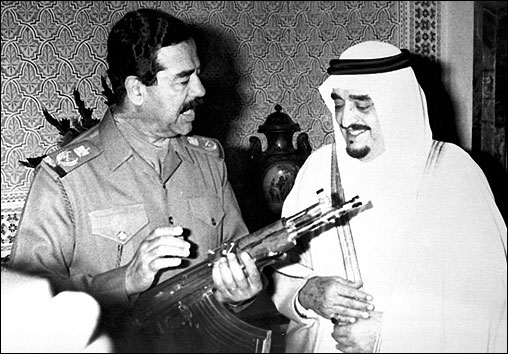
 King Fahd presented Kalashnikov to another pervert Saddam Hussein [Fahd ordered Mutawwas to Issue Fatwa against the Same Saddam when Saddam fingered Wahabi Kuwait [Kuwait is even worst than Saudi Arabia] Enjoy the picture and after the pictutre read about the Debauch, Womanizer, Gambler Khadimul Haramian Sharifain.
http://cache.boston.com/bonzai-fba/Third_Party_Photo/2006/12/29/1167409329_2813.jpg
Khadim ul Harmain Sharifain - Shah Fahad The Debauch - In reality, it was a test of the ebullient Fahd’s capacity to govern. The Crown Prince would have to live down his personal reputation as a reckless womanizer, drinker, and gambler. REFERENCE: King Fahd’s Saudi Arabia by Harvey Sicherman August 12, 2005 http://www.fpri.org/enotes/20050812.middleeast.sicherman.fahdsaudiarabia.html
Real Face of King Fahd: There were stories of all night sessions at seedy clubs in Beirut, of affairs with belly dancers, and of the wife of a Lebanese businessman paid $100,000 a year to make herself available. Then in 1969, Fahd was said to have lost $1,000,000 in a single dusk-to-dawn marathon of Scotch-fuelled gambling at the tables of a MonteCarlo nightclub. He was summoned back to Riyadh by his brother, the then King Faisal Abdul Aziz ibn Saud. REFERENCE: Life and legacy of King Fahd By Paul Wood BBC defence correspondent Last Updated: Monday, 1 August 2005, 10:14 GMT 11:14 UK http://news.bbc.co.uk/2/hi/4734505.stm
Saudi Arabia’s King Fahd: [The Mutawwa in Chief due to his fingering Streets of Pakistan are burning] Real Face: His visits with his retinue of 3,000 had earned the local tradesmen riches indeed. It is estimated that an extra €30,000 (£21,000) a day was spent just in Puerto Banus. As heir apparent, Fahd first visited Marbella in 1974 and stayed at the Incosol hotel and spa. He booked 100 rooms but some of the princesses didn’t like the decor so he ordered the dark carpets to be changed to white. As a reward, Fahd left the hotel a tip of $300,000 — enough for the entire staff to receive, in effect, an extra year’s salary. He told one Spanish journalist that he liked Marbella because “it was a land blessed by Allah”, referring to the Arab occupation of most of Spain from the 8th to the 13th century. In the early 1980s he started the construction of his Mar Mar Palace, a replica of the White House. Because of increasing ill health (he suffered a stroke 10 years ago), he last visited in August 2002, just after a £134m refurbishment of the palace. REFERENCE: Marbella mourns its own King Midas King Fahd’s epic spending enriched his favourite part of Spain, says Deirdre Fernand From The Sunday Times August 7, 2005 http://www.timesonline.co.uk/tol/news/article552402.ece
 Vice-President George H. W. Bush returns from his trip to the Middle East, where he has passed along a message to Iraq to step up its air war against Iran (see July 23, 1986). The covert machinations nearly become public knowledge when US embassy officials in Saudi Arabia, learning of the Saudi transfer of US arms to Iraq earlier in the year (see February 1986), question the Saudi ambassador to the US, Prince Bandar. Bandar, fully aware of the arms transfer, tells the officials that the transfer was “accidental” and the amount of arms transferred was negligible. The State Department is also curious about the transfer, warns that the arms transfer violates the Arms Export Control Act, and says it must inform Congress of the transfer. Such a notification would endanger the entire process, and possibly short-circuit another arms deal in the works, a $3.5 billion transfer of five AWACS planes to Saudi Arabia, of which Congress has already been informed. But after the White House notifies the chairman of the Senate Foreign Relations Committee, Richard Lugar (R-IN), and mollifies Lugar by telling him the arms sales to Iraq were “inadvertent,” “unauthorized,” and involved only a “small quantity of unsophisticated weapons,” Lugar agrees to keep silent about the matter. Another senator later approaches Lugar about rumors that Saudi Arabia is sending US arms to Iraq, and recalls that “Dick Lugar told me there was nothing to it, and so I took his word.” [NEW YORKER, 11/2/1992] REFERENCE: August 5, 1986: Covert Arms Sales to Iraq Nearly Revealed http://www.historycommons.org/context.jsp?item=us_iraq_80s_134#us_iraq_80s_134 Profile: Bandar bin Sultan a.k.a. "Bandar Bush", Prince Bandar http://www.historycommons.org/entity.jsp?entity=bandar_bin_sultan
 Shaking Hands: Iraqi President Saddam Hussein greets Donald Rumsfeld, then special envoy of President Ronald Reagan, in Baghdad on December 20, 1983. REFERENCE: US NATIONAL SECURITY ARCHIVE Shaking Hands with Saddam Hussein: The U.S. Tilts toward Iraq, 1980-1984 National Security Archive Electronic Briefing Book No. 82 Edited by Joyce Battle February 25, 2003 http://www.gwu.edu/~nsarchiv/NSAEBB/NSAEBB82/
What a joke that Aal-e--Saud and Saudi Muttawwa Abd-al-Aziz ibn Abd-Allah ibn Baaz issued a Fatwa of Takfeer [Apostasy] against Saddam Hussein [that too after he was no more of any use to Corrupt Aal-e-Saud and Wahhaabi Muttawwas whereas an Anarchist Pakistan Ahl-e-Hadith Scholar Late. Ehsan Elahi Zaheer [who was on the payroll of Aal-e-Saud and Saudi Muttawwas rather he was student of Salafi Islamic scholars such as Muhammad Nasiruddin al-Albani and Abd-al-Aziz ibn Abd-Allah ibn Baaz] had addressed Sddam Hussein and his Ba'ath Party Member [as per Saudi Fatwa "Apostate, Secular, Socialist i.e. KAAFIR] REFERENCE: Ehsan Elahi Zaheer http://en.wikipedia.org/wiki/Ehsan_Elahi_Zaheer
صدام حسين مع إحسان إلهي ظهير رحمه الله - فيديو نادر
URL: http://www.youtube.com/watch?v=P68GstP37go
Really sometime "This Muslim Ummah" is so hypcortie that one wants to puke.

 Secretary of Defense Dick Cheney, accompanied by senior aide Paul Wolfowitz and US CENTCOM commander-in-chief General Norman Schwarzkopf, visits Saudi Arabia just four days after Iraq invades Kuwait (see August 2, 1990). [SCHOOL OF INTERNATIONAL AND PUBLIC AFFAIRS OF COLUMBIA UNIVERSITY, 8/3/2000; DUBOSE AND BERNSTEIN, 2006, PP. 100] Cheney secures permission from King Fahd for US forces to use Saudi territory as a staging ground for an attack on Iraq. Cheney is polite, but forceful; the US will not accept any limits on the number of troops stationed in Saudi Arabia, and will not accept a fixed date of withdrawal (though they will withdraw if Fahd so requests). Cheney uses classified satellite intelligence to convince Fahd of Hussein’s belligerent intentions against not just Kuwait, but against Saudi Arabia as well. Fahd is convinced, saying that if there is a war between the US and Iraq, Saddam Hussein will “not get up again.” Fahd’s acceptance of Cheney’s proposal goes against the advice of Crown Prince Abdullah. [SCHOOL OF INTERNATIONAL AND PUBLIC AFFAIRS OF COLUMBIA UNIVERSITY, 8/3/2000; DUBOSE AND BERNSTEIN, 2006, PP. 100-101] With Prince Bandar bin Sultan translating, Cheney tells Abdullah, “After the danger is over, our forces will go home.” Abdullah says under his breath, “I would hope so.” Bandar does not translate this. [MIDDLE EAST REVIEW OF INTERNATIONAL AFFAIRS, 9/2002; HISTORY NEWS NETWORK, 1/13/2003] On the same trip, Cheney also visits Egypt’s Hosni Mubarak, who rejects Cheney’s request for US use of Egyptian military facilities. Mubarak tells Cheney that he opposes any foreign intervention against Iraq. [SCHOOL OF INTERNATIONAL AND PUBLIC AFFAIRS OF COLUMBIA UNIVERSITY, 8/3/2000] US forces will remain in Saudi Arabia for thirteen years (see April 30-August 26, 2003). REFERENCE: August 5, 1990 and After: Cheney Secures Permission for US Forces to Attack Iraq from Saudi Arabia http://www.historycommons.org/context.jsp?item=a080590cheneysaudi#a080590cheneysaudi Profile: Bandar bin Sultan a.k.a. "Bandar Bush", Prince Bandar http://www.historycommons.org/entity.jsp?entity=bandar_bin_sultan
USA/Great Britain/King Fahd financed Iraq Iran War but when Saddam Hussein entered Kuwait [Worst than Saudi Arabia] Fahd ordered Saudi Retard Toady Mutawwas to Issue Fatwa against the Same Saddam. Debauch Saudi Wahabi Somersault Fatwa of Takfeer against Saddam Hussein. In 1996 then-UN Ambassador Madeleine Albright was asked by 60 Minutes correspondent Lesley Stahl, in reference to years of U.S.-led economic sanctions against Iraq, “We have heard that half a million children have died. I mean, that is more children than died in Hiroshima. And, you know, is the price worth it?” To which Ambassador Albright responded, “I think that is a very hard choice, but the price, we think, the price is worth it.” - BAGHDAD, Oct. 10 — A team of American and Iraqi public health researchers has estimated that 600,000 civilians have died in violence across Iraq since the 2003 American invasion, the highest estimate ever for the toll of the war here. The figure breaks down to about 15,000 violent deaths a month, a number that is quadruple the one for July given by Iraqi government hospitals and the morgue in Baghdad and published last month in a United Nations report in Iraq. That month was the highest for Iraqi civilian deaths since the American invasion. But it is an estimate and not a precise count, and researchers acknowledged a margin of error that ranged from 426,369 to 793,663 deaths. It is the second study by researchers from the Johns Hopkins Bloomberg School of Public Health. It uses samples of casualties from Iraqi households to extrapolate an overall figure of 601,027 Iraqis dead from violence between March 2003 and July 2006. REFERENCE: Iraqi Dead May Total 600,000, Study Says By SABRINA TAVERNISE and DONALD G. McNEIL Jr. Published: October 11, 2006 http://www.nytimes.com/2006/10/11/world/middleeast/11casualties.html
Donald Rumsfeld meets Saddam Hussein 1983
URL: http://www.youtube.com/watch?v=zaP7ZrmkcuU

On the brink of war, both supporters and critics of United States policy on Iraq agree on the origins, at least, of the haunted relations that have brought us to this pass: America's dealings with Saddam Hussein, justifiable or not, began some two decades ago with its shadowy, expedient support of his regime in the Iraq-Iran war of the 1980's. Both sides are mistaken. Washington's policy traces an even longer, more shrouded and fateful history. Forty years ago, the Central Intelligence Agency, under President John F. Kennedy, conducted its own regime change in Baghdad, carried out in collaboration with Saddam Hussein. The Iraqi leader seen as a grave threat in 1963 was Abdel Karim Kassem, a general who five years earlier had deposed the Western-allied Iraqi monarchy. Washington's role in the coup went unreported at the time and has been little noted since. America's anti-Kassem intrigue has been widely substantiated, however, in disclosures by the Senate Committee on Intelligence and in the work of journalists and historians like David Wise, an authority on the C.I.A. From 1958 to 1960, despite Kassem's harsh repression, the Eisenhower administration abided him as a counter to Washington's Arab nemesis of the era, Gamal Abdel Nasser of Egypt -- much as Ronald Reagan and George H. W. Bush would aid Saddam Hussein in the 1980's against the common foe of Iran. By 1961, the Kassem regime had grown more assertive. Seeking new arms rivaling Israel's arsenal, threatening Western oil interests, resuming his country's old quarrel with Kuwait, talking openly of challenging the dominance of America in the Middle East -- all steps Saddam Hussein was to repeat in some form -- Kassem was regarded by Washington as a dangerous leader who must be removed. REFERENCE: A Tyrant 40 Years in the Making By Roger Morris Published: March 14, 2003 Roger Morris, author of ''Richard Milhous Nixon: The Rise of an American Politician,'' is completing a book about United States covert policy in Central and South Asia. http://www.nytimes.com/2003/03/14/opinion/a-tyrant-40-years-in-the-making.html

In 1963 Britain and Israel backed American intervention in Iraq, while other United States allies -- chiefly France and Germany -- resisted. But without significant opposition within the government, Kennedy, like President Bush today, pressed on. In Cairo, Damascus, Tehran and Baghdad, American agents marshaled opponents of the Iraqi regime. Washington set up a base of operations in Kuwait, intercepting Iraqi communications and radioing orders to rebels. The United States armed Kurdish insurgents. The C.I.A.'s ''Health Alteration Committee,'' as it was tactfully called, sent Kassem a monogrammed, poisoned handkerchief, though the potentially lethal gift either failed to work or never reached its victim.Then, on Feb. 8, 1963, the conspirators staged a coup in Baghdad. For a time the government held out, but eventually Kassem gave up, and after a swift trial was shot; his body was later shown on Baghdad television. Washington immediately befriended the successor regime. ''Almost certainly a gain for our side,'' Robert Komer, a National Security Council aide, wrote to Kennedy the day of the takeover. As its instrument the C.I.A. had chosen the authoritarian and anti-Communist Baath Party, in 1963 still a relatively small political faction influential in the Iraqi Army. According to the former Baathist leader Hani Fkaiki, among party members colluding with the C.I.A. in 1962 and 1963 was Saddam Hussein, then a 25-year-old who had fled to Cairo after taking part in a failed assassination of Kassem in 1958. According to Western scholars, as well as Iraqi refugees and a British human rights organization, the 1963 coup was accompanied by a bloodbath. Using lists of suspected Communists and other leftists provided by the C.I.A., the Baathists systematically murdered untold numbers of Iraq's educated elite -- killings in which Saddam Hussein himself is said to have participated. No one knows the exact toll, but accounts agree that the victims included hundreds of doctors, teachers, technicians, lawyers and other professionals as well as military and political figures. The United States also sent arms to the new regime, weapons later used against the same Kurdish insurgents the United States had backed against Kassem and then abandoned. Soon, Western corporations like Mobil, Bechtel and British Petroleum were doing business with Baghdad -- for American firms, their first major involvement in Iraq. REFERENCE: A Tyrant 40 Years in the Making By Roger Morris Published: March 14, 2003 Roger Morris, author of ''Richard Milhous Nixon: The Rise of an American Politician,'' is completing a book about United States covert policy in Central and South Asia. http://www.nytimes.com/2003/03/14/opinion/a-tyrant-40-years-in-the-making.html
+holding+hands+with+Saddam.jpg)
But it wasn't long before there was infighting among Iraq's new rulers. In 1968, after yet another coup, the Baathist general Ahmed Hassan al-Bakr seized control, bringing to the threshold of power his kinsman, Saddam Hussein. Again, this coup, amid more factional violence, came with C.I.A. backing. Serving on the staff of the National Security Council under Lyndon Johnson and Richard Nixon in the late 1960's, I often heard C.I.A. officers -- including Archibald Roosevelt, grandson of Theodore Roosevelt and a ranking C.I.A. official for the Near East and Africa at the time -- speak openly about their close relations with the Iraqi Baathists. This history is known to many in the Middle East and Europe, though few Americans are acquainted with it, much less understand it. Yet these interventions help explain why United States policy is viewed with some cynicism abroad. George W. Bush is not the first American president to seek regime change in Iraq. Mr. Bush and his advisers are following a familiar pattern. The Kassem episode raises questions about the war at hand. In the last half century, regime change in Iraq has been accompanied by bloody reprisals. How fierce, then, may be the resistance of hundreds of officers, scientists and others identified with Saddam Hussein's long rule? Why should they believe America and its latest Iraqi clients will act more wisely, or less vengefully, now than in the past? If a new war in Iraq seems fraught with danger and uncertainty, just wait for the peace. REFERENCE: A Tyrant 40 Years in the Making By Roger Morris Published: March 14, 2003 Roger Morris, author of ''Richard Milhous Nixon: The Rise of an American Politician,'' is completing a book about United States covert policy in Central and South Asia. http://www.nytimes.com/2003/03/14/opinion/a-tyrant-40-years-in-the-making.html
 Late. Abd al-Aziz ibn Abd Allah ibn Baaz [Saudi Grand Mufti who issued Fatwa against Saddam and then against Osama Bin Ladin] - When Saddam invaded Kuwait - [Immediately a Fatwa was issued against Saddam - "During the Iran-Iraq war, Saudi Arabia bankrolled the Saddam Hussein regime with the express approval of Washington DC which at that time saw Saddam Hussein as a bulwark against Shia fundamentalism. It came as a terrific shock to the Saudi Royals when Saddam Hussein turned his attention to Kuwait and Saudi Arabia. Again, the Royal family turned to the Ulema and obtained (with difficulty) a Fatwa, permitting the use of non-Muslim foreign troops on Saudi soil to defend Saudi Arabia against a foreign invader - one the Ulema regarded as a secular apostate. Thus the Saudi Royal family invited the USA to send it its troops for Operation Desert Storm- the operation to defend Saudi Arabia and liberate Kuwait - largely at Saudi expense." As per 9/11 Commission Report “In August 1990, Iraq invaded Kuwait. Bin Ladin, whose efforts in Afghanistan had earned him celebrity and respect, proposed to the Saudi monarchy that he summon mujahideen for a jihad to retake Kuwait. He was rebuffed, [Saudi Fatwa issued in 90s against Osama Bin Ladin - http://abdurrahman.org/jihad/binlaadin.pdf Usama Ibn Ladin Al-Kharijee (our position toward him and his likes) - By Abdul Aziz Ibn Abdullaah Ibn Baz [PDF] - Taken from http://www.troid.org/] and the Saudis joined the U.S.-led coalition. After the Saudis agreed to allow U.S. armed forces to be based in the Kingdom, Bin Ladin and a number of Islamic clerics began to publicly denounce the arrangement. The Saudi government exiled the clerics and undertook to silence Bin Ladin by, among other things, taking away his passport. With help from a dissident member of the royal family, he managed to get out of the country under the pretext of attending an Islamic gathering in Pakistan in April 1991.”
"QUOTE
URL: http://www.youtube.com/watch?v=zaP7ZrmkcuU

On the brink of war, both supporters and critics of United States policy on Iraq agree on the origins, at least, of the haunted relations that have brought us to this pass: America's dealings with Saddam Hussein, justifiable or not, began some two decades ago with its shadowy, expedient support of his regime in the Iraq-Iran war of the 1980's. Both sides are mistaken. Washington's policy traces an even longer, more shrouded and fateful history. Forty years ago, the Central Intelligence Agency, under President John F. Kennedy, conducted its own regime change in Baghdad, carried out in collaboration with Saddam Hussein. The Iraqi leader seen as a grave threat in 1963 was Abdel Karim Kassem, a general who five years earlier had deposed the Western-allied Iraqi monarchy. Washington's role in the coup went unreported at the time and has been little noted since. America's anti-Kassem intrigue has been widely substantiated, however, in disclosures by the Senate Committee on Intelligence and in the work of journalists and historians like David Wise, an authority on the C.I.A. From 1958 to 1960, despite Kassem's harsh repression, the Eisenhower administration abided him as a counter to Washington's Arab nemesis of the era, Gamal Abdel Nasser of Egypt -- much as Ronald Reagan and George H. W. Bush would aid Saddam Hussein in the 1980's against the common foe of Iran. By 1961, the Kassem regime had grown more assertive. Seeking new arms rivaling Israel's arsenal, threatening Western oil interests, resuming his country's old quarrel with Kuwait, talking openly of challenging the dominance of America in the Middle East -- all steps Saddam Hussein was to repeat in some form -- Kassem was regarded by Washington as a dangerous leader who must be removed. REFERENCE: A Tyrant 40 Years in the Making By Roger Morris Published: March 14, 2003 Roger Morris, author of ''Richard Milhous Nixon: The Rise of an American Politician,'' is completing a book about United States covert policy in Central and South Asia. http://www.nytimes.com/2003/03/14/opinion/a-tyrant-40-years-in-the-making.html

In 1963 Britain and Israel backed American intervention in Iraq, while other United States allies -- chiefly France and Germany -- resisted. But without significant opposition within the government, Kennedy, like President Bush today, pressed on. In Cairo, Damascus, Tehran and Baghdad, American agents marshaled opponents of the Iraqi regime. Washington set up a base of operations in Kuwait, intercepting Iraqi communications and radioing orders to rebels. The United States armed Kurdish insurgents. The C.I.A.'s ''Health Alteration Committee,'' as it was tactfully called, sent Kassem a monogrammed, poisoned handkerchief, though the potentially lethal gift either failed to work or never reached its victim.Then, on Feb. 8, 1963, the conspirators staged a coup in Baghdad. For a time the government held out, but eventually Kassem gave up, and after a swift trial was shot; his body was later shown on Baghdad television. Washington immediately befriended the successor regime. ''Almost certainly a gain for our side,'' Robert Komer, a National Security Council aide, wrote to Kennedy the day of the takeover. As its instrument the C.I.A. had chosen the authoritarian and anti-Communist Baath Party, in 1963 still a relatively small political faction influential in the Iraqi Army. According to the former Baathist leader Hani Fkaiki, among party members colluding with the C.I.A. in 1962 and 1963 was Saddam Hussein, then a 25-year-old who had fled to Cairo after taking part in a failed assassination of Kassem in 1958. According to Western scholars, as well as Iraqi refugees and a British human rights organization, the 1963 coup was accompanied by a bloodbath. Using lists of suspected Communists and other leftists provided by the C.I.A., the Baathists systematically murdered untold numbers of Iraq's educated elite -- killings in which Saddam Hussein himself is said to have participated. No one knows the exact toll, but accounts agree that the victims included hundreds of doctors, teachers, technicians, lawyers and other professionals as well as military and political figures. The United States also sent arms to the new regime, weapons later used against the same Kurdish insurgents the United States had backed against Kassem and then abandoned. Soon, Western corporations like Mobil, Bechtel and British Petroleum were doing business with Baghdad -- for American firms, their first major involvement in Iraq. REFERENCE: A Tyrant 40 Years in the Making By Roger Morris Published: March 14, 2003 Roger Morris, author of ''Richard Milhous Nixon: The Rise of an American Politician,'' is completing a book about United States covert policy in Central and South Asia. http://www.nytimes.com/2003/03/14/opinion/a-tyrant-40-years-in-the-making.html
+holding+hands+with+Saddam.jpg)
But it wasn't long before there was infighting among Iraq's new rulers. In 1968, after yet another coup, the Baathist general Ahmed Hassan al-Bakr seized control, bringing to the threshold of power his kinsman, Saddam Hussein. Again, this coup, amid more factional violence, came with C.I.A. backing. Serving on the staff of the National Security Council under Lyndon Johnson and Richard Nixon in the late 1960's, I often heard C.I.A. officers -- including Archibald Roosevelt, grandson of Theodore Roosevelt and a ranking C.I.A. official for the Near East and Africa at the time -- speak openly about their close relations with the Iraqi Baathists. This history is known to many in the Middle East and Europe, though few Americans are acquainted with it, much less understand it. Yet these interventions help explain why United States policy is viewed with some cynicism abroad. George W. Bush is not the first American president to seek regime change in Iraq. Mr. Bush and his advisers are following a familiar pattern. The Kassem episode raises questions about the war at hand. In the last half century, regime change in Iraq has been accompanied by bloody reprisals. How fierce, then, may be the resistance of hundreds of officers, scientists and others identified with Saddam Hussein's long rule? Why should they believe America and its latest Iraqi clients will act more wisely, or less vengefully, now than in the past? If a new war in Iraq seems fraught with danger and uncertainty, just wait for the peace. REFERENCE: A Tyrant 40 Years in the Making By Roger Morris Published: March 14, 2003 Roger Morris, author of ''Richard Milhous Nixon: The Rise of an American Politician,'' is completing a book about United States covert policy in Central and South Asia. http://www.nytimes.com/2003/03/14/opinion/a-tyrant-40-years-in-the-making.html
Late. Abd al-Aziz ibn Abd Allah ibn Baaz [Saudi Grand Mufti who issued Fatwa against Saddam and then against Osama Bin Ladin] - When Saddam invaded Kuwait - [Immediately a Fatwa was issued against Saddam - "During the Iran-Iraq war, Saudi Arabia bankrolled the Saddam Hussein regime with the express approval of Washington DC which at that time saw Saddam Hussein as a bulwark against Shia fundamentalism. It came as a terrific shock to the Saudi Royals when Saddam Hussein turned his attention to Kuwait and Saudi Arabia. Again, the Royal family turned to the Ulema and obtained (with difficulty) a Fatwa, permitting the use of non-Muslim foreign troops on Saudi soil to defend Saudi Arabia against a foreign invader - one the Ulema regarded as a secular apostate. Thus the Saudi Royal family invited the USA to send it its troops for Operation Desert Storm- the operation to defend Saudi Arabia and liberate Kuwait - largely at Saudi expense." As per 9/11 Commission Report “In August 1990, Iraq invaded Kuwait. Bin Ladin, whose efforts in Afghanistan had earned him celebrity and respect, proposed to the Saudi monarchy that he summon mujahideen for a jihad to retake Kuwait. He was rebuffed, [Saudi Fatwa issued in 90s against Osama Bin Ladin - http://abdurrahman.org/jihad/binlaadin.pdf Usama Ibn Ladin Al-Kharijee (our position toward him and his likes) - By Abdul Aziz Ibn Abdullaah Ibn Baz [PDF] - Taken from http://www.troid.org/] and the Saudis joined the U.S.-led coalition. After the Saudis agreed to allow U.S. armed forces to be based in the Kingdom, Bin Ladin and a number of Islamic clerics began to publicly denounce the arrangement. The Saudi government exiled the clerics and undertook to silence Bin Ladin by, among other things, taking away his passport. With help from a dissident member of the royal family, he managed to get out of the country under the pretext of attending an Islamic gathering in Pakistan in April 1991.”"QUOTE
Misconception: The Islaamic Threat
In recent years, a great deal of attention in the media have been given to the threat of "Islaamic Fundamentalism". Unfortunately, due to a twisted mixture of biased reporting in the Western media and the actions of some ignorant Muslims, the word "Islaam" has become almost synonymous with "terrorism". However, when one analyses the situation, the question that should come to mind is:
Do the teachings of Islaam encourage terrorism?
The answer: Certainly not!
Islaam totally forbids the terrorist acts that are carried out by some misguided people. It should be remembered that all religions have cults and misguided followers, so it is their teachings that should be looked at, not the actions of a few individuals. Unfortunately, in the media, whenever a Muslim commits a heinous act, he is labeled a "Muslim terrorist".
However, when Serbs murder and rape innocent women in Bosnia, they are not called "Christian terrorists", nor are the activities in Northern Ireland labeled "Christian terrorism". Also, when right-wing Christians in the U. S. bomb abortion clinics, they are not called "Christian terrorists". Reflecting on these facts, one could certainly conclude that there is a double-standard in the media! Although religious feelings play a significant role in the previously mentioned "Christian" conflicts, the media does not apply religious labels because they assume that such barbarous acts have nothing to do with the teachings of Christianity. However, when something happens involving a Muslim, they often try to put the blame on Islaam itself - and not the misguided individual.
Certainly, Islaamic Law (Sharee'ah) allows war - any religion or civilisation that did not would never survive - but it certainly does not condone attacks against innocent people, women or children. The Arabic word "jihaad", which is often translated as "Holy War", simply means "to struggle". The word for "war" in Arabic is "harb", not "jihaad". "Struggling", i.e. "making jihaad", to defend Islaam, Muslims or to liberate a land where Muslims are oppressed is certainly allowed (and even encouraged) in Islaam.
However, any such activities must be done according to the teachings of Islaam. Islaam also clearly forbids "taking the law into your own hands", which means that individual Muslims cannot go around deciding who they want to kill, punish or torture.
Trial and punishment must be carried out by a lawful authority and a knowledgeable judge. Also, when looking at events in the Muslim World, it should be kept in mind that a long period of colonialism ended fairly recently in most Muslim countries. During this time, the people in these countries were culturally, materially and religiously exploited - mostly by the so-called "Christian" nations of the West. This painful period has not really come to an end in many Muslim countries, where people are still under the control of foreign powers or puppet regimes supported by foreign powers.
Also, through the media, people in the West are made to believe that tyrants like Saddam Hussein in Iraq and Moamar Qaddafi in Libya are "Islaamic" leaders - when just the opposite is true. Neither of these rulers even profess Islaam as an ideology, but only use Islaamic slogans to manipulate their powerless populations. They have about as much to do with Islaam as Hitler had to do with Christianity! In reality, many Middle Eastern regimes which people think of as being "Islaamic" oppress the practice of Islaam in their countries. So suffice it to say that "terrorism" and killing innocent people directly contradicts the teachings of Islaam. .......... Prepared by: Abu 'Iyaad REFERENCE: Misconception: The Islaamic Threat http://www.fatwa-online.com/aboutislaam/0020221.htm http://www.fatwa-online.com/index.htm http://www.fatwa-online.com/worship/jihaad/jih009/index.htm
Question: O esteemed Shaykh, what is happening now (in Iraaq) so what is the position of the Muslim towards this trial, and is there a Jihaad, and are do those soldiers who are in the Gulf have the ruling of being mujaahideen, and may Allaah reward you.
Shaykh Ubayd al-Jaabiree: I dont know why this question (is asked) when, when we have just ended the speech with what I consider to comprise the answer to it and to its likes. However, despite this, just so that it is said, that Ubayd has neglected some of the questions.
So I say: Firstly, not all of the Iraaqi society is Muslim. Rather, amongst them is the Marxist, amongst them is the Ba'athist Heretic, and amongst them are numerous orientations. And there are Muslims amongst them...
And amongst them are the Raafidah. And the positions of the Scholars towards the Raafidah is well known, amongst them are those who declared them Disbelievers.
Secondly, we have Rulers and those who have authority, and it is obligatory to give them hearing and obedience, and around our rulers are those who have knowledge, and experience, and speciality in the political affairs. So we do not undermine them, and we have already mentioned previously that the general affairs are not for just any person. Rather, they are for whom? For those in authority.
And as it is appropriate, I also say that those who call to cutting off from the products of America and Britain and others, then those people have a resemblance to the Raafidah. Shaykh ul-Islaam Ibn Taymiyyah mentions in Minhaaj us-Sunnah, in the first volume, and I believe it is page 38, "From the stupidity of the Raafidah is that they do not drink from the river that was unearthed (i.e. dug out, like a well) by Yazeed". So those Harakiyyoon and Hizbiyyoon, have resembled the Raafidah. And what an evil model (that is). And the most repugnant for a person that his model, and way is that of the Raafidah.
Thirdly, the banner of fighting in Iraaq, who is carrying it? It is carried by Saddaam Hussain at-Takreetee, and he is the leader of the Ba'athi Party in his land...and the Ba'athi Party, is secularist, disbelieving, heretical. Its foundation is upon mixing and not differentiating between a Sunni Muslim, Guidance from the Scholars Concerning Iraaq and between the Jew, Christian, Communist, and others. They are all the same, equal. And for this reason, their slogan is, as their poet has said:
I believe in, -- (Shaykh Ubayd): I seek refuge in Allaah --
I believe in al-Ba'ath as the Lord which has no partner
And in Arabism as a religion, which has no other (religion)
This is their religion, qawmiyyah (nationalism) and shu'oobiyyah, and their religion is not Islaam. So built upon this, the one who fights under the banner of the Iraaqi government, then he is fighting under a banner of disbelief. And we do not dispute that the people of Iraaq have the right to defend themselves. They can defend themselves, their blood, their honour and their wealth, they can defend those who transgress upon them, whether America or Britain or other than them.
So it is obligatory upon us, the community of Muslims that we ask Allaah in our supplication that He delivers the Muslims amongst the people of Iraaq. So whoever said O Allaah save the [Iraaqi Society]1 , then he has erred. This supplication of his reaches even the Marxist and the Communist. And the Ba'ath Party is at the front of the [supplication of the] one who supplicates for the Iraaqi society (in general). No, but supplicate to Allaah that He delivers the Muslims amongst the people of Iraaq. And that he relieves them of their distress. This is what I can add now. .......... Translated by: Abu 'Iyaad REFERENCE: NEWS\ Monday 31 March 2003 Shaykh 'Ubayd al-Jaabiree on the Position Towards Iraq From a Paltalk Session today 31/03/2003 at 8:30pm UK Time http://www.fatwa-online.com/news/0030331.htm
"UNQUOTE"


Mawdudi’s works began to appear in Iran in the 1960s. They were translated into Persian from Arabic by Ayatollah Hadi Khusrawshahi and members of a translating team working with him. Articles on Mawdudi and excerpts from his works also appeared in various issues of Khusrawshahi’s journal Maktab-i Islam. Following the revolution of 1978–1979, a number of Mawdudi’s works were translated into Persian from Arabic by Ayatollah Sayyid Muhammad Khamana’i. Interestingly, the first Persian translation of a work of Mawdudi was done in Hyderabad, Deccan, by Mahmud Faruqi in 1946; RJI, vol. 4, 90. REFERENCES: The Vangaurd of the Islamic Revolution - The Jama‘at-i Islami of Pakistan Seyed Vali Reza Nasr UNIVERSITY OF CALIFORNIA PRESS Berkeley · Los Angeles · London © 1994 The Regents of the University of California - Should we just condemn only Khomeini and condone Mawdudi knowing well that Mawdudi was a close friend of Khomeini and was sympathetic to his course. In a book titled, 'Two brothers - Maududi and Khomeini' page 129, the following statement of Dr Ahmad Farouk Maududi (son of Abul-A'ala Maududi) was published in Roz Naame, Lahore - 29 September 1979, "Allama Khomeini had a very old and close relationship with Abba Jaan (father). Aayaatullah Khomeini translated his (fathers) books in Farsi and included it as a subject in Qum. Allama Khomeini met my father in 1963 during Hajj and my father's wish was to create a revolutionary in Pakistan similar to Iran. He was concerned about the success of the Iranian revolution till his last breath.'


+&+US+Nationality+(Kufr)+go+Together+Daily+Dawn+17+March+2012+Back+Page.jpg)