The truth is stranger than fiction. As a born again Muslim in the sufi tradition, Imran Khan is a deeply religious and superstitious type even if his antics as a notorious playboy are sometimes in conflict with that reality. This means he is susceptible to all sorts of manipulation and suggestion. For years now, his spiritual advisors have been telling him what to do and what not to do in order to become the Prime Minister of Pakistan. Bushra Manika, better known as Pinki Pirni, is the latest of these advisors. She was married to a civil servant Khawar Fareed Manika who had a bit of reputation when it came to corruption but he and his wife became devotees to the Sufi Saint Baba Farid Ganj Baksh. A couple of years ago, she is rumored to have tried to hitch up Imran Khan with her sister but that did not work out. Reham Khan, the dignified former wife of Khan who was married for precisely one year, swears by the fact that her marriage was sabotaged by Pinki Pirni. The dogged insistence by Imran Khan that he should both marry and divorce Reham on 31 October seems to lend credence to this. The story then goes, and it remains unchallenged by the Manikas, is that Pinki Pirni is said to have had a dream where the most holy personage in Islam told her that for Imran Khan to be Prime Minister, she must marry him and if she does, both Pakistan and Islam will truly prosper. Pinki Pirni then narrated this to her husband who agreed to give her a divorce for the sake of the cause of Islam in Pakistan. References: Imran Khan’s desire to seek signs to guide his life seems more like a mental illness 20 February, 2018 https://theprint.in/opinion/imran-khans-signs-to-guide-life-seems-like-mental-illness/36783/ Defending Imran Khan NOVEMBER 20, 2011 https://dailytimes.com.pk/110884/defending-imran-khan/ Imam Ghazali and the 2nd Amendment - Freedom of conscience cannot be denied under Islam and ijmah cannot be enforced on an individual FEBRUARY 12, 2018 https://dailytimes.com.pk/199973/imam-ghazali-2nd-amendment/
Imran Khan is Muhammad Ali Jinnah (Roedad Khan)
Just as he began as a cricketer, dismissed as without talent who would never bowl fast, in politics too Imran Khan was dismissed with nothing but prejudice and contempt. He took each humiliation, insult and used it as a stepping stone to that ultimate triumph that now is only a matter of time. History, dear readers, is replete with such examples of persistence and courage; Jinnah being the last example from our recent history. Reference: OP-ED Why progressives should support Khan NOVEMBER 6, 2011 (Daily Times) Not that Imran Khan needs me to defend him but the intemperate attacks on him by certain quarters leave me no choice but to attempt to set the record straight. I can assure you, dear readers, that the impression created by some writers is nothing but a warped caricature of the only person in politics who is not just incorruptible but a selfless first rate humanist, one that this country is lucky to have at this critical juncture in its fragile democratic evolution. Anyone familiar with my writings in this newspaper and other places knows that I stand for a secular liberal Pakistan as envisaged by Muhammad Ali Jinnah. I, therefore, do not quite agree with Imran Khan’s analysis of why Pakistan was created but I also understand that a debate about history is often lost in semantics. So is the case with politics. I support Imran Khan. Reference: OP-ED Defending Imran Khan NOVEMBER 20, 2011 Daily Times)
Mirza Ghulam Ahmad of Qadian was a Sufi said Javed Ahmad Ghamidi
In the last years of Iqbal’s life, just before his death in 1938, there was a series of fascinating interactions between him and Jinnah. Iqbal seemed to be drawing Jinnah into his world, and Jinnah seemed to be moving inexorably towards it. There seems to have formed between them a spiritual connection that resulted in the passing of the flame from one to the other. The eight letters Iqbal wrote to Jinnah between 1936 and 1937 and Jinnah’s foreword to them help us to understand the relationship. In his foreword Jinnah calls Iqbal “the sage, philosopher and national poet of Islam,” acknowledging his role as a spiritual mentor. In a letter written on 21 June 1937, shortly before he died, Iqbal identified Jinnah as the leader Muslims had been waiting for: “You are the only Muslim in India today to whom the community has a right to look up for safe guidance through the storm which is coming to North-West India, and perhaps to the whole of India.” References: The man who shaped Jinnah’s Islam - The question of the origins of Jinnah’s Islam is not merely a theoretical one, but one with practical implications for an entire nation by Akbar Ahmed DECEMBER 30, 2017 https://dailytimes.com.pk/170055/man-shaped-jinnahs-islam/ The author has discussed Allama Iqbal's Correspondence with Jinnah in his book "Jinnah, Pakistan and Islamic Identity: The Search for Saladin" https://www.amazon.com/Jinnah-Pakistan-Islamic-Identity-Saladin/dp/0415149665
Letters Of Eqbal To Jinnah
https://ia601601.us.archive.org/15/items/in.ernet.dli.2015.71796/2015.71796.Letters-Of-Eqbal-To-Jinnah.pdf (Foreword by Jinnah himself) --- EXCERPT: Iqbal’s letter to Jinnah September 11, 2011 https://www.dawn.com/news/658190 Two letters from Iqbal to Jinnah (1937) http://www.columbia.edu/itc/mealac/pritchett/00islamlinks/txt_iqbal_tojinnah_1937.html
Jinnah as a Spiritual Disciple of Spiritual Saint Allama Iqbal (as explained by Akbar Ahmed)
Jinnah calls Iqbal “the sage, philosopher and national poet of Islam
People often quote Islamic Scholars & Theologian Sufis of Classical Islamic Era to plead the case of Secularism and even if that was not enough they use those scholars e.g. Imam Ghazali and Hanafi School of thought to plead the case of the most marginalized and persecuted Ahmadi community in Pakistan and they are least bothered to at least conduct a proper enquiry into the original work of these Scholars. Imam Ghazali not only supported the Death Sentence for the Apostates but also supported the killing of Mansoor Al Hallaj for Blasphemy and that is not the end he also considered Avicenna, Farabi, Muʿtazila (Rationalists) , Qadariyah as Apostates and Death Deserving, and showered praise for Yazid bin Muawiya (References: Ihya' Ulum al-Din or Ihya'u Ulumiddin (The Revival of Religious Sciences) & Al-Munqidh Min Al-Dalal (Rescuer from Error) . Similarly Hanafi Law Declares that Apostasy is Punishable by Death and also consider Rationalists (Muʿtazila) and Qadariyah as Apostate & death deserving (Reference: Al-Fiqh Al-Akbar, a basic book on Hanafi School of Thought) and it is further mentioned here that those who suggest Abbasid's Rule and their System of Governance for the modern Muslim State , should know that Abbasid's persecuted Imam Abu Hanifa and some report suggest that Imam Abu Hanifa was poisoned by the Abbasid Caliph Al Mansoor (Reference: Biography of Abu Ḥanifa by Muhammad Abu Zahra (1898–1974) - Al-Hidayah by Burhanuddin Marghinani is an Authentic Hanafi Book according to it Apostasy is Punishable by Death (Page 40 Volume 7) - Fatawa-e-Alamgiri is an Authentic Hanafi Book of Jurisprudence & according to it Apostasy is Punishable by Death (Page 434 Volume 3) Radd al-Muhtar ala al-Dur al-Mukhtar (Muhammad Amin Ibn Abidin Ash-Shami) is a Hanafi book and according to the book, Apostasy is punishable by Death (Page 506 to 509 Volume 2) ! This is how our Liberal & Secular people are presenting the case of marginalized Ahmadi Community! What next? Imam Ibn Taymiyyah & the 2nd Amendment?
Imam Ghazali and Yazid bin Muawiya
The author below (in Daily Times Column) is quoting a Quote by labeling it as a Hadith (Tradition) to plead the case of Secularism via Hanafi Fiqh to rationalize Jinnah's Confusion on Islam and Democracy. Whereas the reality of this quote is "Quote" A baseless hadith "Disagreement among my ummah is a mercy" --> " Disagreement among my ummah is a mercy " (BASELESS) The muhadditheen have tried to find an isnaad for it but have not found one, to the extent that Suyooti said in his "al-Jaami' as-Sagheer" : " Perhaps it was collected in one of the books of the huffaadh which did not reach us " ! This suggestion is very far-fetched. since it would mean that some of the sayings of the Prophet (صلّى الله عليه وسلّم) have been lost to the ummah forever, something which is not permissable for a Muslim to believe . Manaawi quoted Subki as saying : "It (i.e. the saying) is not known to the muhadditheen, and I can not find any isnaad for it, whether authentic (saheeh), weak (da'eef) or fabricated (mawdoo) " , and this was endorsed by Sheikh Zakareeyah al-Ansaari in his notes on tafseer al-Baidaawi (92-2) . Further, the meaning of this hadith is also incorrect as shown by the verifying scholars, hence Ibn Hazm says in al-Ihkam fi Usool al-Ahkam (5-64) after indicating that it is not a hadith : " This is one of the most incorrect sayings possible, since if disagreement (ikhtilaf) was a mercy, then agreement would be punishment, something which no Muslim would say, because there can be only agreement or disagreement, and there can only be mercy or punishment " . This saying also contradicts the Quraan, which has condemned ikhtilaf in many places . "Un-Quote"
On the contrary he argues that the only way a religious society — especially one with deepseated divisions such as Muslim society and one with differences of opinion- blessing according to one Hadith albeit a weak one — can remain strong is if there is a secular state presiding over it. This is what makes secularism and Sharia perfectly compatible with each other and makes the pursuit a secular state a religious imperative for all Muslim majority countries. References: A secular state is a religious imperative - Why this nervousness that the future constitution shall be in conflict with Shariat laws — Mr Jinnah FEBRUARY 9, 2018 https://dailytimes.com.pk/198180/secular-state-religious-imperative/ Imam Ghazali and the 2nd Amendment Freedom of conscience cannot be denied under Islam and ijmah cannot be enforced on an individual FEBRUARY 12, 2018 https://dailytimes.com.pk/199973/imam-ghazali-2nd-amendment/
KARACHI: Leading Ulema of Jamaat Ahle Sunnat Pakistan (JASP) in a joint statement have asked Muslims not to offer Namaz-e-Janaza nor try to lead funeral prayers of Governor Punjab Salman Taseer. In a joint statement issued here they have also asked not to express regrets or sympathies over his assassination. Those issuing the statement include the JASP Central Ameer Prof Syed Mazhar Saeed Shah Kazmi, Allama Syed Riaz Hussain Shah, Shah Turab-ul-Haq Qadri, Allama Zamir Sajid, Pir Khalid Sultan, Pir Ghulam Siddiq Naqshbandi, Allama Syed Khizr Hussain Shah, Alhaj Amjad Chishti, Allama Ghulam Sarawar Hazarvi, Allama Syed Shamsuddin Bokhari, Pir Syed Ashiq Ali Shah Jilani, Mufti Muhammad Iqbal Chishti, Allama Fazal Jamil Rizvi, Agha Muhammad Ibrahim Naqshbandi Mujaddidi, Maulana Muhammad Riaz Qadri, Maulana Gulzar Naeemi, Allama Syed Ghulam Yaseen Shah, and over 500 other ulema and honorable muftis attached to the JASP. Those favouring the person indulged in blasphemy are themselves blasphemous, they announced. Paying glowing tributes to Malik Mumtaz Hussain, and his courage, who killed Governor Salman Taseer, they said he is lover of the Holy Prophet (PBUH) and is a ‘Ghazi’. Mumtaz had revived the 14-century-old tradition of Islam and put their head high in pride. It was only Prophet (PBUH) who could forgive any act of blasphemy but none other could ever do it.
Gustakh kon faisla ap karean Part 1 of 6 (By Sheikh Tauseef Ur Rehman).flv
URL: http://www.youtube.com/watch?v=FQwNHVui3Sw
They asked the rulers to save their faith by announcing that they would desist from attempting to amend the law of blasphemy. Asim Hussain adds from Lahore: Leaders of majority of religious parties desisted from expressing their views on the murder of Salman Taseer, while others gave a guarded response, saying the slain Punjab governor had been inviting such kind of reaction for quite some time. He had continuously been violating the constitution of Pakistan by supporting an amendment to the blasphemy laws and interfering in the judicial process of the blasphemy convict Aasia Bibi, though he knew well that Muslims were very touchy on the matter, they said while talking to The News. Some religious leaders like Jamiat Ahle Hadith President Prof Sajid Mir and Jamaat-e-Islami leader Dr Farid Piracha, however, condemned the murder saying Islam forbids people to punish even the criminals by taking the law into their hands.
Gustakh kon faisla ap karean Part 2 of 6 (By Sheikh Tauseef Ur Rehman).flv
URL: http://www.youtube.com/watch?v=UL9uDTQSrfI
Jamiat Ulema Pakistan (JUP) President Abdul Khair Mohammad Zubair said Islam strictly forbids taking the life of anyone without judicial or state order, but added that Salman Taseer had shown utter disregard for the religious sentiments of the entire nation. The mobile phone of Sahabzada Fazal Karim, chairman Sunni Ittehad Council, remained switched off throughout Tuesday evening. A spokesman for Jamaat-e-Islami Ameer Syed Munawwar Hasan said he was not feeling well and could not be available on phone. The spokesman also expressed his helplessness to obtain any formal statement on the issue saying that any statement on the matter would be issued on the next day after consultations. Other main leaders of the Sunni Ittehad Council - Haji Hanif Tayyeb, Dr Ashraf Asif Jalali, Sarwat Ijaz Qadri - were also not available. Tahaffuz-e-Namoos-e-Risalat Mahaz (TNRM) leaders held an emergency meeting after receiving the reports of murder of Salman Taseer. The meeting, chaired by Razaul Mustafa Naqshbandi, continued for two hours. Later, in a statement the TNRM said Taseer had been violating the laws of the land by supporting a blasphemy convict, Aasia Bibi, from day one. His irresponsible acts from the high office of the Governor of Punjab were inappropriate and offending 170 million Muslims of the country. Meanwhile, Sunni Tehrik Lahore President Mujahid Abdul Rasool said Muslims should not attend the funeral prayers of Salman Taseer since he had wilfully committed blasphemy and shown disrespect towards protecting the honour of the Holy Prophet (PBUH). REFERENCE: Ulema press not to offer Taseer’s funeral prayers Wednesday, January 05, 2011 http://www.thenews.com.pk/TodaysPrintDetail.aspx?ID=3126&Cat=13
Gustakh kon faisla ap karean Part 3 of 6 (By Sheikh Tauseef Ur Rehman).flv
URL: http://www.youtube.com/watch?v=Ds62zrawxxA
Dedicated to Shaheed Shahbaz Bhatti
URL: http://www.youtube.com/watch?v=cT4oGIWXfQ4
The legislator is MNA Asiya Nasir, elected on a reserved women's seat from Balochistan, the only minority female legislator in the National Assembly and speaking the day after the murder. She holds a Masters in English literature from the Government Girls College, Quetta and a certificate in Teachers' Training and is a member of the NGO Aurat Foundation. She has been a member of the House since 2002 when she was elected on a reserved seat for minorities. Remarkably, she is affiliated politically with the Jamiat-e-Ulema-e-Islam - Fazlur Rehman (JUI-F) and was elected in 2002 (as well as in 2008) on a ticket of the 'religious' parties alliance, the Muttaheda Majlis-e-Amal (MMA). REFERENCE: Speech of the Day Monday, March 7, 2011 http://cafepyala.blogspot.com/2011/03/speech-of-day.html
Religious parties have condemned the murder of Federal Minister for Minorities Shahbaz Bhatti, terming it a conspiracy to divert the public opinion from the Raymond Davis issue and increase pressure on Islamabad for the release of the US spy. Religious leaders said it was possible that the CIA and other foreign secret agencies were behind the murder, adding that the murder was a deep conspiracy to achieve multiple objectives ñ like discrediting the peaceful protest movement of the religious parties for the protection of blasphemy laws and igniting a renewed religious hatred in the country to achieve ulterior motives. Jamaat e Islami ameer Syed Munawar Hasan said the murder of Shahbaz Bhatti seemed to be a conspiracy to divert public opinion in Pakistan from Raymond David issue and to give it a new direction. He said there was strong possibility that the CIA was involved in the murder to intensify pressure on Islamabad for Raymond’s release.
Gustakh kon faisla ap karean Part 4 of 6 (By Sheikh Tauseef Ur Rehman).flv
URL: http://www.youtube.com/watch?v=GzobykTnWZM
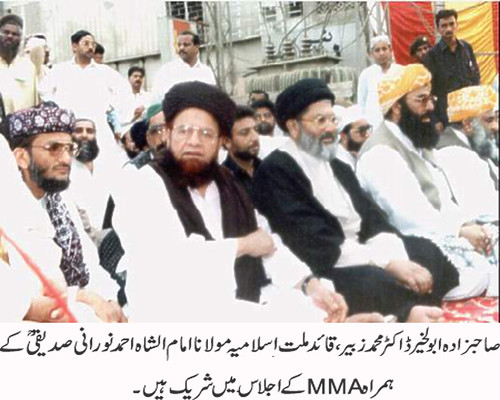
JUP president Dr Abul Khair Muhammad Zubair said the killers of Shahbaz Bhatti were those elements who were trying to bring into discredit the peaceful, successful movement of religious parties which had thwarted the western conspiracy aimed at amending the Blasphemy laws. Talking to The News, he termed the murder a grave conspiracy against Islam and Pakistan, saying the religious parties movement was aimed at averting such incidents of violence by enforcing the laws governing the blasphemy of sacred religious figures of all religions. Chairman Sunni Ittehad Council (SIC) Sahibzada Fazal Kareem suspected the involvement of both the foreign and domestic elements in the murder, calling for independent investigation into the incident. Terming it a conspiracy to destabilize the country for achieving ulterior motives, he insisted that the murder of Shahbaz Bhatti should not be linked to that of Salman Taseer. Position of Shahbaz Bhatti was quite different from that of the former Punjab governor, he said and added that there was no point in it (Bhattiís murder) after the success of the religious parties’ movement for the protection of Blasphemy laws. He said no religion except Islam has protected the rights of minorities.
Gustakh kon faisla ap karean Part 5 of 6 (By Sheikh Tauseef Ur Rehman).flv
URL: http://www.youtube.com/watch?v=jrdobLoRT3M
Tehreek-e-Hurmat-e-Rasool convener Maulana Ameer Hamza suspected that it was the work of hundreds of Black Water operatives roaming about freely in Pakistan in the garb of diplomats and foreign investors. He said it was part of a conspiracy to discredit and roll back the movement by religious parties which had halted the western conspiracies aimed at amending the Blasphemy laws, besides defaming Islam and Pakistan. Bishop of Lahore and Moderator Church of Pakistan, Dr. Alexander John Malik, said murder of Shahbaz Bhatti was not a loss to one family or minorities, it was a loss to the country and the society as a whole. Terming it a deep conspiracy against the country, he said the incident had added to the sense of insecurity among the minorities. REFERENCE: ‘It’s a plot to divert attention’ Asim Hussain Thursday, March 03, 2011 http://www.thenews.com.pk/TodaysPrintDetail.aspx?ID=33982&Cat=5&dt=3/3/2011
Administering Justice and awarding punishment is the responsibility of the Ruler/State [even in the harshest Islamic State] not of the Masses or Mullahs. A detail view is as under for kind perusal. I guarantee you that those who have done the above deed would also have been the most ignorant about Islam, Quran and Shariah.
"Killing" is the Right of "Judiciary" - Qazi, means Enforcement of Law and Administering "Punishment" is the Responsibility of State not the "Masses" and what Muslims in Pakistanis do is this "they violate very religion they claim to follow" - lets assume that Blasphemy Law is right and Guilty is to be punished through Death Sentence then that "sentence" would be implemented by the State not the "Public".It is not permissible for individuals to carry out this punishment themselves. Rather the matter must be referred to the ruler or his deputy to prove the crime and carry out the punishment, because if individuals carry out hadd punishments, that will lead to a great deal of corruption and evil. Ibn Muflih al-Hanbali (may Allaah have mercy on him) said in al-Furoo’ (6/53): It is haraam for anyone to carry out a hadd punishment except the ruler or his deputy. This is something on which the fuqaha’ of Islam are unanimously agreed, as was stated in al-Mawsoo’ah al-Fiqhiyyah (5/280): The fuqaha’ are unanimously agreed that the one who should carry out hadd punishments is the ruler or his deputy, whether the punishment is transgressing one of the limits of Allaah, may He be exalted, such as zina, or a transgression against another person, such as slander. {Further References: Durrul Al Behy by Shawkani, Baloogh Al Maram by Hajar Asqalani - both are in Arabic and available in English and Urdu as well]
Read the "Shahadat - Testimony of Late. Mr. Salman Taseer for proving that he was a Muslim" and do read News filed by the Ansar Abbasi of Jang Group, and Program Telecast against Mr. Salman Taseer on GEO TV to prove that he was not Muslim for inciting hate against him and read these Hadiths in the light of Salman Taseer's Testimony published by the very Jang Group after inciting masses for his murder.
"QUOTE"
Whoever offers prayers as we do and turns his face to our Qiblah and eats the animal slaughtered by us, he is a Muslim for whom is the covenant of Allah and the covenant of the Messenger of Allah; so do not violate Allah's covenant." [Sahih Bukhari]
``Ibn Umar related that the Holy Prophet said: If a Muslim calls another kafir, then if he is a kafir let it be so; otherwise, he [the caller] is himself a kafir.''(Sunnan Abu Dawood)
``Abu Zarr reported that the Holy Prophet said: No man accuses another man of being a sinner, or of being a kafir, but it reflects back on him if the other is not as he called him.''(Bukhari)
``Withhold [your tongues] from those who say `There is no god but Allah' --- do not call them kafir. Whoever calls a reciter of `There is no god but Allah' as a kafir, is nearer to being a kafir himself.'' (Tabarani, reported from Abdullah Ibn Omar)
If the above Hadiths do not satisfy then read this!
Usaamah bin Zaid reported,
“Allaah’s Messenger sent us towards Al-Huruqa, and in the morning we attacked them and defeated them. I and an Ansari man followed a man from among them and when we overwhelmed him, he said, “La ilaha illal-Lah.” On hearing that, the Ansari man stopped, but I killed him by stabbing him with my spear. When we returned, the Prophet (sal-Allaahu `alayhe wa sallam) came to know about that and he said:
"O Usaamah! Did you kill him after he had said “La ilaha ilal-Lah?” I said, “But he said so only to save himself.” He kept on repeating that so often that I wished I had not embraced Islaam before that day. [Agreed upon, and this is the wording of Bukhari]
and in another version in Sahih Muslim about the same incident:
``Did you tear open his heart to see what was in it?'' [Muslim]
Gustakh kon faisla ap karean Part 6 of 6 (By Sheikh Tauseef Ur Rehman).flv
Saudi daily calls Taseer a martyr, justice crusader????
That is demonstrably untrue. There is bigotry in Pakistan but then it exists in every society. Clearly the murder was an act of religious fanaticism. But it was individuals who were responsible, not a mass movement. Taseer was murdered by one or perhaps more bigots who believed that he wanted to repeal the country’s blasphemy law. But he was a Muslim, not his murderer or those who, sickeningly, celebrate this evil deed. He worked for the good of his country trying to promote tolerance and understanding and peace between its different communities. He stood up against extremism and violence. It cost him his life and that makes him a martyr and his heartless, grinning murderer an ignorant instrument of evil. But while Pakistan has lost a bold campaigner for truth and justice, there is comfort for it in the knowledge that Taseer was not alone. There is a host of other activists whose faith is generous and embracing and who refuse to be intimidated by the twisted advocates of hatred. Pakistan is deeply shocked by this murder. This could be a defining moment for its leaders to stand up and rally the country against the deviant forces that would bring darkness to it and Islam. As for those Islamophobes who would see in Taseer’s murder proof of fanaticism, they should look instead to the Islam he stood for — a faith that pursues justice, truth and respect, the real Islam. REFERENCE: Murder in Pakistan Leaders should stand up and rally the country against the forces of intolerance EDITORIAL
Jan 5, 2011 22:38 http://arabnews.com/opinion/article229917.ece
The barbaric murder of Jagdeesh Kumar, accused of blasphemy by some of his workmates at a garment factory in Karachi, brings out in sharp focus once again the exposed and vulnerable situation of non-Muslims in a Pakistan still wedded to the legacy of General Zia-ul-Haq.When the police finally intervened, the body of the 22-year-old victim had been mutilated and disfigured beyond recognition: among other things the eyes had been gouged out. The reports published indicate that he was a quiet man, from a poverty-stricken Hindu family belonging to some obscure village in the Sindh desert. People with such a depressed and vulnerable background come to factories to eek out a miserable living, not to engage in religious controversies. In the days and weeks ahead, we will learn that some petty personal quarrel or irrational hatred of a Hindu was the real reason for his murder.What happened in Karachi was reminiscent of the lynching of African-Americans by white racists in the southern states of the US as late as the early 20th century. Until those laws were changed, black men and women were killed for the flimsiest of reasons. I remember one story when a white shopkeeper took out his gun and shot dead an old black man, who for years had been delivering merchandise to him, when an altercation took place between that man and a white man who had come to the shop for the first time. The white shopkeeper sided with a complete stranger, because the race laws had conditioned him to react in that way. Anyone who follows the news from Pakistan and reads the reports published regularly by the Human Rights Commission of Pakistan would find that violence and brutality against non-Muslims increased exponentially after the blasphemy law was imposed in 1982 and reformulated in 1986. The connection between law and social behaviour is a well-established fact and, quite simply, bad, intolerant and violence-inducing laws produce malevolent behaviour among members of society. Let me quote both the relevant texts on blasphemy in Pakistan:
In 1982, Section 295-B was inserted in the Pakistan Penal Code. It reads: "Defiling, etc., of The Holy Quran: Whoever wilfully defiles, damages or desecrates a copy of the Holy Quran or of an extract therefrom, or uses it in any derogatory manner or for any unlawful purpose, shall be punishable with imprisonment for life."
In 1986, Section 295-C was added. It stated: "Use of derogatory remarks, etc., in respect of the Holy Prophet: Whoever by words, either spoken or written, or by visible representation, or by any imputation, innuendo, or insinuation, directly or indirectly, defiles the sacred name of the Holy Prophet Muhammad (peace be upon him) shall be punished with death, or imprisonment for life, and shall also be liable to fine."
Those who are familiar with legal expressions and jargon will have no difficulty in understanding that the wordings of the two laws furnish an easy excuse for accusing a person of blasphemy. What can be a matter of at most a spirited discussion on religion and religious icons among educated people can easily be interpreted by illiterates as blasphemy if they discuss religion.
More important, perhaps, is to figure out what purpose these laws are supposed to help realise. If the purpose is to make people, presumably non-Muslims, respect Islam and Prophet Muhammad (PBUH), then such an intention is premised on a singularly flawed psychological theory and approach.
Fear induces submission and despondency, not respect. In situations when fear and threats surround the lives of people, they resort to dissimulation and become hypocrites: thinking and believing one thing but saying and doing something else. On the other hand, respect and admiration for someone or some belief is gained voluntarily. It has to come from the heart and cannot be extracted under duress.
There are many non-Muslims who have written laudatory texts on Islam and the life of the Holy Prophet. Recently Karen Armstrong has written his biography which is highly sympathetic. She must have done this by studying his life and finding him praiseworthy. Fear would never have induced such writing.
On the other hand, if the purpose of the blasphemy laws is to terrorise non-Muslims to either convert to Islam or force them out of the country, then the question is: is such an objective compatible with the Constitution of Pakistan which guarantees that minorities shall live in peace and security in Pakistan?
One can argue that even if the intention of adopting the blasphemy laws was to establish respect for Islam and the Prophet and not to terrorise non-Muslims, the overwhelming and incontrovertible evidence abundantly shows that the unintended consequences of the law have been just the opposite. Time and again some Christian or Hindu accused of blasphemy has either been mercilessly killed by a fanatic or a bunch of such people – without ever being punished for breaking the law and committing murder – or subjected to a draconian legal process in which the lower courts almost invariably found him guilty; but the higher courts either acquitted him or commuted his punishment to a lighter sentence.
Now, when a civilian, democratic government is in power, it is time to begin a discussion on the Hudood and blasphemy laws. We must realise that as long as people have different religions and beliefs they are bound to discuss and debate them. In such circumstances the role of the government should be to provide people with a sound education so that they can develop the sensibilities to respect each others' identity and convictions while engaging in debate and controversy. It was very encouraging to read columns in the Pakistani English-language press against this latest manifestation of mob frenzy. It is important that our colleagues in the Urdu media also come out strongly against such brazen acts of inhumanity. Some petitions condemning Jagdeesh Kumar's murder have also been put up on the Internet for signatures. All this is indicative of another type of Pakistan.The writer is a professor of political science and a visiting senior research fellow at the Institute of South Asian Studies, National University of Singapore. REFERENCE: Blasphemy and persecution by Ishtiaq Ahmed Saturday, April 26, 2008 http://thenews.jang.com.pk/daily_detail.asp?id=108906
Jang Group is very "Fond Of" quoting Judges and Judiciary, now read what a Judge say about the Misuse of this Law.
NEED TO CHECK MISUSE OF BLASPHEMY LAW BY QAZI FAEZ ISA -"As it was the unanimous demand of the Ulema, Mashaikh and the people, therefore, I have decided to do away with the procedural change in registration of FIR under the blasphemy law" (General Musharraf, Dawn 17.5.2000).How was public opinion determined? No one asked me! Is the reference to ulema and mashaikh to the self-proclaimed ones or men and women of Islamic learning? And did populism prevail over Islam? Why was no attempt made to enter into a debate, or at least a learned Islamic discourse? What was the role of the two ministers (religious affairs and law) who are primarily concerned with this issue? One does not recollect any valuable contribution from these two sources.
Barelvi Mullah Ashraf Asif Jalali ISSUE FATWA OF KUFR on Zakir Naik
URL: http://www.youtube.com/watch?v=6RFZN6Vn_Ks
The sad fact is that deterioration has set in every aspect of national life. The most acute realization of this is felt whenever there is any interaction with the government. There is no substitute for learning and debate, and we are managing to do without either and consequently suffer. The government seems to have decided for all of us that in Pakistan 2000 our exposure to Islam is to be funnelled through the myopic, self-styled 'guides', whose principal contribution has been spreading hatred and attacking the foundations of the state. No attention is being paid to the true learned men and women of Islam, because unlike the camp which propagates violence in achieving their goals, these true Muslims do not make even a feeble attempt to be heard.
Pampering this group does not serve the cause of Islam, is contrary to shariat and departs from the methodology adopted by Jinnah and those who devotedly worked for attaining this homeland.
There is no substitute for knowledge, dialogue and niyat (intention). Let us learn a lesson from history. My father, Qazi Muhammad Isa, who was principally responsible for bringing Balochistan into the fold of Pakistan, was a member of the Balochistan Law Reform Commission. The other members included Balochistan's governor, Amir-ul-Mulk Mengal, and Mr Fazle Ghani Khan.These gentlemen informed me how my father had handled a potentially explosive situation.
Barelvi Shah Turabul Haq Issues Fatwa of Kufr against Imam Kaaba & Saudi Arabia.
The Balochistan Law Reform Commission made visits to a number of different places to gather public opinion. On a visit to a traditional-conservative Pathan area they were accosted by the elders and ulema who demanded the enforcement of shariat and objected to the work of the Commission, which was perceived by them to be anti-shariat. It transpired that the local Pathans had taken strong exception to recording the names of their womenfolk on the recently introduced national identity cards. This according to them was un-Islamic and therefore unacceptable. My father inquired whether the delegation would be kind enough to enlighten him about the names of Islam's first convert and wife of the Prophet (PBUH) and the Prophet's daughter married to Hazrat Ali.Hazrat Khadija and Hazrat Fatima was the prompt answer. Upon hearing this, my father inquired whether the names of these distinguished ladies could be taken if Islam was against this practice. The delegation fell silent and abandoned their objection to the name insertion in the identity cards.
They then said "zhumz shariat ghoaru" ('we want shariat') and not "Angrezi qanoon" (English law). My father responded that the Commission could report this desire and wanted the delegation to help them. He suggested that this could be done if the delegation was prepared to abandon certain prevailing but un-Islamic practices. He advised that they should waive accumulated usury which was due to them (Pathans being notorious and usurious moneylenders), stop the cultivation and trade in intoxicants (opium and hashish) and recognize the shares of mothers, widows and daughters in inheritance. (Men divide the ladies' shares among themselves and the revenue records of these and many rural areas of the country, reveal the virtual absence of a female population). The delegation immediately backtracked saying that this was not possible because these were their established tribal practices and had been validated by jirga.
Ahl-e-Hadith Scholar Issues Fatwa of Kufr against Imam Abu Hanifa - Part -1
URL: http://www.youtube.com/watch?v=dM7THxNCeAI
On being asked whether they wanted the endorsement of jirga practices contrary to shariat, the delegation beat a hasty retreat never to be seen or heard of again.
Knowledge and reason were subsequently to prevail upon superstition and exploitation. The light of enlightenment vanquished the darkness of ignorance. Men of peace achieved this, men who adhered to Quaid's ideals and men who did not command armies.
In contrast, an all-powerful government, having been granted by the Supreme Court the power to amend the Constitution, failed to effect, what from a legal perspective was an insignificant amendment in the law. The amendment which the government wanted to bring about was that any report of an offence of blasphemy should in the future be made to the district magistrate and not at the police station.
A practice of settling personal vendettas by lodging false reports of offence of blasphemy (Section 295-C of the Pakistan Penal Code) against a person or persons intended to be harmed has developed. The fact that in Pakistan lodging of such FIRs has become matter of frequent occurrence confirms the misuse of this provision of the law. Needless to stress that in a predominantly Muslim country any derogatory or disrespectful remark about the Prophet (PBUH) is unthinkable. Only one bereft of any reason or sense could risk inviting society's wrath and possibly worse by indulging in any such sacrilegious utterances.
Ahl-e-Hadith Scholar ISSUES Fatwa of Kufr on Deobandis & Barelvis
URL: http://www.youtube.com/watch?v=ze74hcdxYkI
To check false allegations of blasphemy from being made and Islam wrongly exploited for vendetta or for settling personal scores, which is anathema to a (true) Muslim, it was essential that the power of the police to entertain an FIR be curtailed. In advocating such a change General Musharraf was not acting against the interest of Islam. Undoubtedly, he was well intentioned but perhaps did not have the requisite support from his team to counteract the agitators. Occupying ministerial positions but bereft of vision and knowledge they could only advise an expedient retreat.
The action could only encourage the tendency to use religion to harass and persecute one's enemies and rivals.
The insistence on retaining the jurisdiction of the police in preference to that of the district magistrate, who is a more senior member of the administration, is incomprehensible. Unless those agitating against the proposed amendment were doing so because they considered police stations more malleable and amenable to pressure and inducement and, therefore, were ideally suited to their questionable purpose and interests. Is our government so out of touch that it does not realize that the poor, the rich, the Muslim, the Christian, the literate, the illiterate, citizens of Pakistan, if they are united in a view, it is that Pakistani police stations are dens of inequity, and not citadels which best preserve Islamic values.
Fareed Paracha & Jamat-e-Islami Misquote/Distort Quran on Samaa TV & Commit Blasphemy
URL: http://www.youtube.com/watch?v=M5l-ux1RB_w
The maximum punishment for blasphemy in Pakistan is death, or imprisonment for life, and also fine. There is no discretion for imposing a lesser sentence. The process which may result in the passing of this sentence commences upon the lodging of an FIR in a police station, often on payment of a bribe, and in many cases without a shred of evidence, except the word of a self-described alim. There is no punishment prescribed for lodging a false report.
Eminent ulema have over the centuries written copiously on the subject. They have deliberated on whether blasphemy (insulting the Holy Prophet, sabb al-Rasool) without an element of apostasy (repudiation of Islam, sabb Allah, riddah) is an offence in Islam. They have considered the significance of the Prophet (PBUH) not acting against those who renounced Islam and vilified and defamed him. Included among these were Abd Allah b. Abi Sarh, Ikramah b. Abi Jahl, Safwan b. Umayyah, and Hinda, the wife of Abu Sufyan. A writer on the subject states that, "some Jews also addressed the Prophet with the words, 'death be upon you, (al-sam alaykum), but, in none of the reports did the Prophet order any punishment." They have thus determined that the offence is not hadd (ordained by God) but tazir. Imam Abu Hanifah maintained that a dhimmi (non-Muslim) is not liable to the death punishment for the offence of blasphemy.
Barelvi Shah Turab ul Haq Qadri says Ashraf Ali Thanvi & Wahabis are Kaafir.
URL: http://www.youtube.com/watch?v=iab5Fm0PqzQ
Islam is a religion which stands for peace and insists on justice. God almighty advised the Holy Prophet and early believers to develop their inner resources through patience and resilience. "Quite a number of the people of the Book wish they could turn you back to infidelity after ye have believed - from (their) selfish envy, after the Truth hath become manifest unto them, but forgive and overlook" (surah Al-Baqarah, verse 109). A commentator on this verse says: "It teaches that the success of Islam had naturally made the un-believers insecure and envious, and that under such circumstances a punitive approach would not produce the desired result". "And ye shall certainly hear much that will grieve you, from those who received the Book before you and from those who worship partners besides Allah. But if ye persevere patiently, and guard against evil - then that indeed is a matter of great resolution (the best course with which to determine your affairs)" (surah Al-Imran, verse 186).
Barelvi Mullah Shah Turabul Haq says that Deobandi and Wahabi are Kaafir
URL: http://www.youtube.com/watch?v=zj5Z7yzzgpI
Barelvi Scholar declares that "Dobandis & Wahabis" are KAFIR.
URL: http://www.youtube.com/watch?v=klZK3qQM76o
It is noteworthy that the law in its present form does not consider the question of repentance. Is this Islamic? "The Hanafis and the majority of the Shafis consider blasphemy to be in the same category as apostasy and have ruled that repentance is admissible in both cases. Thus, the blasphemer, like the apostate, is to be asked for repentance on three consecutive days, which will be counted from the time of conviction" (Freedom of Expression in Islam by Dr Mohammad Hashim Kamali).
MULTAN, Jan 11: A court has jailed a prayer leader and his 20-year-old son for life on blasphemy charges in the rural heartland of the country, court officials said on Tuesday. The case follows the assassination of Punjab governor Salman Taseer by his bodyguard last week, after he called for reform of the blasphemy law under which a Christian woman was sentenced to death. Mohammad Shafi, 45, and his son Mohammad Aslam, 20, were arrested in April last year for removing a poster outside their grocery shop promoting a religious event in a nearby village. The poster allegedly carried Quranic verses. Judge Mohammad Ayub, heading an anti-terrorism court in Muzaffargarh, handed down a life sentence to the pair on Monday, his assistant Faisal Karim said by telephone. According to the prosecution, the organisers of the event marking the birth anniversary of Prophet Muhammad (PBUH) said the pair had “pulled the poster down, tore it and trampled it under their feet,” Mr Karim said. “The judge sentenced them to life imprisonment on charges of blasphemy and ordered them to pay a fine of Rs200,000 each,” he said. Defence counsel Arif Gurmani vowed to challenge the verdict in the high court because “it has been given in haste” and was the result of inter-sect rivalries, he said. “Both are Muslims. The case is the result of differences between Deobandi and Barelvi sects of Sunni Muslims,” he said. “Shafi is a practising Muslim, he is the imam of a mosque and he had recently returned from a pilgrimage to Saudi Arabia… I am defending them because I am convinced they are not guilty of blasphemy,” he said. Nobody has been executed in Pakistan for blasphemy and those given the death penalty have so far had their sentences overturned or commuted on appeal.—AFP REFERENCE: Court jails imam and son for blasphemy From the Newspaper Yesterdayhttp://www.dawn.com/2011/01/12/court-jails-imam-and-son-for-blasphemy.html
Barelvi Mullah says Every Pakistani is KAFIR.
URL: http://www.youtube.com/watch?v=FTANZusPICU
BAHAWALPUR, June 15: A mosque Imam was killed while a religious leader sustained critical injuries in violence caused reportedly by sectarian tension between two Sunni sects in Choonawala Mandi near Hasilpur, about 90km from here, on Thursday. According to reports reaching here, the trouble started when Hafiz Qamar Javed, prayer leader at local Masjid Ahl-e-Hadith, burnt some trash near his mosque. The fire attracted neighbours, including people from the rival sect, who propagated that Javed was burning pages from Quran. Within no time a huge mob turned up at the scene and attacked Javed. When Ahl-e-Hadith’s local leader Master Muhammad Sadiq came to his rescue, he was also beaten up severely. The assailants left the scene when the two fell unconscious. Police rushed to the scene after getting information. In a hurry, a police vehicle hit and injured Muhammad Nadeem (13). The mob then damaged the van and thrashed ASI Muhammad Nawaz, who also sustained injuries. Later, the Hasilpur DSP and tehsil nazim reached Choonawala and managed to disperse the mob. The injured were rushed to the Bahawal Victoria Hospital, Bahawalpur, where Hafiz Qamar Javed succumbed to injuries while Master Muhammad Sadiq was in precarious condition. Following an appeal, Choonawala traders’ president, shopkeepers pulled down their shutters to protest the ‘blasphemous act’. Meanwhile, it was learnt that a case under the Blasphemy Act had been registered against deceased Hafiz Qamar Javed and injured Muhammad Sadiq while no case was registered against the assailants. DPO Arif Nawaz was not available for comments. REFERENCE: Imam lynched by mob for ‘blasphemy’ By Majeed Gill June 16, 2006 Friday Jumadi-ul-Awwal 19, 1427http://archives.dawn.com/2006/06/16/nat10.htm
Pakistani minister for Minority Affairs Shahbaz Bhatti with Ashif Masih, right, husband of Christian woman Asia Bibi who had been sentenced to death. – AP (File Photo)
ISLAMABAD: Gunmen shot and killed Pakistan’s government minister for religious minorities on Wednesday, the latest attack on a high-profile Pakistani figure who had urged reforming harsh blasphemy laws that impose the death penalty for insulting Islam. Shahbaz Bhatti was on his way to work in the Pakistani capital, Islamabad, when unknown gunmen riddled his car with bullets, police officer Mohmmad Iqbal said. The minister arrived dead at Shifa Hospital and his driver was also wounded badly, hospital spokesman Asmatullah Qureshi said. No group immediately claimed responsibility for the attack, but private Pakistani TV channels showed pamphlets at the scene of the killing that were attributed to the Pakistani Taliban warning of the same fate for anyone opposing the blasphemy laws. Gulam Rahim was coming from a nearby market when he saw Bhatti’s car drive out of his house. Three men standing nearby with guns suddenly began firing at the vehicle, a dark-colored Toyota. Two of the men opened the door and tried to pull Bhatti out, Rahim said, while a third man fired his Kalashnikov rifle repeatedly into the car. The three gunmen then sped away in a white Suzuki Mehran car, said Rahim who took shelter behind a tree.
Why Shahbaz Bhatti was Assassinated?
URL: http://www.youtube.com/watch?v=lqoxQNktbRY
Courtesy: BBC Pakistan Minorities Minister Shahbaz Bhatti shot dead 2 March 2011 Last updated at 13:35 GMT http://www.bbc.co.uk/news/world-south-asia-12617562
Pakistani TV channels showed Bhatti’s vehicle afterward, its windows shattered with bullet holes all over. It was not immediately clear why Bhatti, a member of the ruling Pakistani People’s Party, did not have bodyguards with him.
Pakistani government leaders condemned the attack. “This is concerted campaign to slaughter every liberal, progressive and humanist voice in Pakistan,” said Farahnaz Ispahani, an aide to President Asif Ali Zardari. “The time has come for the federal government and provincial governments to speak out and to take a strong stand against these murderers to save the very essence of Pakistan.” Bhatti’s friend Robinson Asghar said the slain minister had received threats following the death of the Punjab governor. Asghar said he had asked Bhatti to leave Pakistan for a while because of the threats, but that Bhatti had refused. Pakistan’s information minister, Firdous Ashiq Awan, said Bhatti had played a key role in promoting interfaith harmony, and he was a great asset. We are sad over his tragic death,” she said, adding that the government would investigate why he did not have a security escort. REFERENCE: Minorities minister Shahbaz Bhatti assassinated AP http://www.dawn.com/2011/03/02/minorities-minister-attacked-in-islamabad.html
Muslim Persecution of Christians in Pakistan
URL: http://www.youtube.com/watch?v=HMslaw_tt-Q
Shahbaz Bhatti, Pakistan Minister for Minorities, is receiving death threats for pursuing justice for Gojra victims
By Dan Wooding and Sheraz Khurram Khan
Special to ASSIST News Service ISLAMABAD, PAKISTAN (ANS) -- Pakistan’s Federal Minister for Minorities, Mr. Shahbaz Bhatti, has received death threats from members of banned militant organizations for pursuing justice for victims of Gojra violence, ANS has learnt from well-placed sources.
Gojra, a small town in province Punjab of Pakistan, exploded into the
Mr. Shahbaz Bhatti
international limelight when Muslims set on fire over fifty houses on August 1, following rumors that Christians had committed blasphemy. Some seven Christians lost their lives as a result of the incident and the brutal attack left scores of Christians injured. Most of Christian residents of the area have fled the town fearing more trouble from extremists.
What has alerted Mr. Bhatti is that Pakistan's religious affairs minister, Hamid Syed Kazmir, was wounded and his driver killed in a drive-by shooting in the capital Islamabad on September 2, 2009. ANS has learned that Mr. Bhatti has received written letters and messages from militants, warning him to stop campaigning against misuse of blasphemy laws and pursuing justice for victims of Gojra. On September 4, 2009 the Bhatti testified before the Inquiry Commission which was set up to look into the Gojra tragedy.
ANS has also learnt that statements of some militant elements have also been published in some sections of Pakistani print media in which they have warned that they would not allow anyone to touch the country’s controversial blasphemy laws.
Shahbaz Bhatti, who is also the chairman of the All Pakistan Minorities Alliance (APMA), an umbrella organization of minorities, has been campaigning for the protection of minority rights, religious freedom and the repeal of all discriminatory laws against minorities in Pakistan since 1985. In the past, Mr. Bhatti has faced an assassination attempt, torture and victimization for raising a voice against Pakistan Sharia Laws and injustices against minorities. He has been a vocal voice against the defunct militant groups, who are involved in violence and terrorism in Pakistan. Mr. Bhatti has vehemently condemned violence against the Christians of Korian and Gojra and stood with the victims in their difficult time.
On August 2, 2009, when the victims of Gojra violence had blocked the railway track and were demanding registration of Police First Information Report (FIR) against the culprits of the attacks, the local government did not heed to their demand and instead started employing dilly-dallying tactics which further dampened their hope of the Christians ever getting justice.
The Federal Minister joined the protesting victims and staged a sit-in along with the victims who were protesting by laying bodies of the Christians, who had lost their lives in the wake of Gojra violence. Mr. Bhatti on that occasion had announced that he would not go from the scene until the FIR was lodged. This statement had the desired effect and prompted the authorities to lodge FIR against the culprits. Expressing solidarity with them, the Federal Minister also asked the protesting victims to remain peaceful.
The Federal Minister also accompanied Pakistan Prime Minister, Syed Yousaf Raza Gilani, Governor of Punjab, Salman Taseer, Chief Minister of Punjab, Mian Shahbaz Sharif, and other members of parliament during the visit to Gojra. Pakistan Federal Minister for Interior Rehman Malik has said that the government would not allow anyone to destabilize Pakistan and the country’s President, Asif Ali Zardari, and Prime Minister, Syed Yousaf Raza Gilani, have vowed that Pakistan would continue to fight against terrorism. Several minority leaders in Pakistan have expressed concern over Mr. Bhatti’s safety in the wake of the death threats to him by militants. They have appealed to Christian brethren across the world to pray for him at this difficult time. http://www.assistnews.net/Stories/2009/s09090035.htm
ISLAMABAD: Chief Justice of Pakistan (CJP) Iftikhar Muhammad Chaudhry remarked that it was a criminal negligence to bring changes in the documents like Objectives Resolution as former president General (retd) Zia ul Haq tampered with the Constitution in 1985 however, the sitting parliament had done a good job by undoing this tampering. At one point Chief Justice Iftikhar Muhammad Chaudhry observed that the word ‘freely’ was omitted from the Objectives Resolution in 1985 by a dictator, which was an act of criminal negligence, but the then parliament surprisingly didn’t take notice of it. He said the Constitution is a sacred document and no person can tamper with it. The chief justice said credit must go to the present parliament, which after 25 years took notice of the brazen act of removing the word relating to the minorities’ rights, and restored the word ‘freely’ in the Objectives Resolution, which had always been part of the Constitution. The chief justice further said that the court is protecting the fundamental rights of the minorities and the government after the Gojra incident has provided full protection to the minorities. “We are bound to protect their rights as a nation but there are some individual who create trouble.” - DAILY TIMES - ISLAMABAD: Heading a 17-member larger bench of the Supreme Court on Tuesday, Chief Justice Iftikhar Muhammad Chaudhry termed as criminal negligence the deletion of a word about the rights of minorities from the Objectives Resolution during the regime of General Ziaul Haq in 1985. Ziaul Haq had omitted the word “freely” from the Objectives Resolution, which was made substantive part of the 1973 Constitution under the Revival of Constitutional Order No. 14. The clause of Objectives Resolution before deletion of the word ‘freely’ read, “Wherein adequate provision shall be made for the minorities to ‘freely’ profess and practice their religions and develop their culture.” DAILY DAWN - ISLAMABAD: Chief Justice Iftikhar Mohammad Chaudhry on Tuesday praised the parliament for undoing a wrong done by the legislature in 1985 (through a constitutional amendment) when it removed the word ‘freely’ from a clause of the Objectives Resolution that upheld the minorities’ right to practise their religion. The word “freely” was deleted from the Objectives Resolution when parliament passed the 8th Amendment after indemnifying all orders introduced through the President’s Order No 14 of 1985 and actions, including the July 1977 military takeover by Gen Zia-ul-Haq and extending discretion of dissolving the National Assembly, by invoking Article 58(2)b of the Constitution. After the passage of the 18th Amendment, the Objectives Resolution now reads: “Wherein adequate provision shall be made for the minorities freely to profess and practise their religions and develop their culture.” The CJ said: “Credit goes to the sitting parliament that they reinserted the word back to the Objectives Resolution.” He said that nobody realised the blunder right from 1985 till the 18th Amendment was passed, even though the Objectives Resolution was a preamble to the Constitution even at the time when RCO (Revival of Constitution Order) was promulgated. REFERENCES: CJ lauds parliament for correcting historic wrong By Nasir Iqbal Wednesday, 09 Jun, 2010 http://www.dawn.com/wps/wcm/connect/dawn-content-library/dawn/the-newspaper/front-page/ziaera-deletion-from-objectives-resolution-criticised-cj-lauds-parliament-for-correcting-historic-wrong-960 - CJP raps change in Objectives Resolution * Justice Iftikhar Muhammad Chaudhry says deletion of clause on rights of minorities was ‘criminal negligence’ * Appreciates incumbent parliament for taking notice of removal of clause by Gen Zia’s govt in 1985 By Masood Rehman Wednesday, June 09, 2010 http://www.dailytimes.com.pk/default.asp?page=201069\story_9-6-2010_pg1_1 CJ lauds parliament for undoing changes in Objectives Resolution Wednesday, June 09, 2010 Says minorities’ rights have to be protected; Hamid says parliament should have no role in judges’ appointment By Sohail Khan http://thenews.jang.com.pk/top_story_detail.asp?Id=29367
Christian persecution in Pakistan-Incident in Gojra
1 - A JUDGMENT by the High Court in Lahore is worrying Pakistan's Christians. The court decided recently that Pakistan's blasphemy laws are applicable to all the phrophets of Islam. Jesus is a prophet in Islamic teaching. By worshipping Jesus as the son of God, Christians are, it could be argued, committing a blasphemy. The Bible itself, which Islamic scholars regard as not strictly factual, might be reckoned to contain blasphemies against Abraham, Noah, David and Jacob, all of whom are in the Islamic canon. Blasphemy carries the death sentence in Pakistan. Reference: Prophet and loss: Pakistan. (blasphemy law) The Economist (US) May 7, 1994. http://www.encyclopedia.com/The+Economist+(US)/publications.aspx?pageNumber=1
2 - The two cleaners from Jhang district, 300 miles south of Islamabad, were jailed by a Faisalabad court in 1999 under Pakistan's draconian blasphemy laws, having been wrongly accused of burning a copy of the Koran. Because the law can be invoked on the word of just one witness, it is frequently manipulated by Muslims to settle scores or rouse religious tensions. Reference: Pakistan's blasphemy laws used to persecute non-Muslims Massoud Ansari in Lahore and Michael Hirst Published: 12:01AM BST 25 Jun 2006 http://www.telegraph.co.uk/news/1522285/Pakistans-blasphemy-laws-used-to-persecute-non-Muslims.html
GOJRA Christians massacre was due to hate announcements from Mosques A Shocking Report
3 - Lahore: March 2, 2009. (SLMP report) Two Christians named Wallayat Masih son of Saraina Masih alias Sala resident of village Maloki District Kasur and Mushtaq Masih son of Sooba Masih resident of Kareem Park Bank Stop Lahore have been charged under blasphemy law vide case registered vide First Information Report (FIR) No. 33 dated 1st March 2009, under section 295 B & C with police station Theh Shaikham District Kasur, both have been arrested and presently detained in the local police station. 7 team members from CLAAS and SLMP visited village Maloki for fact finding today on 2nd March 2009. Mr. Joseph Francis the National Director Center for Legal Aid Assistance & Settlement (CLAAS) and Chief Coordinator Sharing Life Ministry Pakistan (SLMP) led the team. Reference: Two Christians Charged Under Blasphemy Law in Kasur, Punjab. July 6, 2009, 2:36 pm http://www.pakistanchristianpost.com/headlinenewsd.php?hnewsid=1003
4 - Pakistan's human rights commission has reacted strongly after the country's military ruler gave up plans to change the way in which a controversial blasphemy law is implemented. A number of Islamic organisations had threatened to hold demonstrations on Friday to protest against the proposed changes. But General Musharraf has said that he now plans to leave the laws completely unchanged. Bishop John Joseph killed himself in protest at the blasphemy laws. Reference: Pakistan's blasphemy law U-turn Wednesday, 17 May, 2000 http://news.bbc.co.uk/2/hi/south_asia/751803.stm
5 - Faisalabad (AsiaNews) – Bishop John Joseph, who committed suicide in 1998 to protest the blasphemy law, was recalled today in a mass in the Cathedral of St Peter and St Paul in Faisalabad. Mgr Andrew Francis of Multan and Mgr Joseph Coutts of Faisalabad participated in the celebration, together with dozens of priests. In his homily, the bishop of Multan described Mgr Joseph as a "perennial voice of ecumenical and inter-faith dialogue", who "preached the words of the Gospel with all his life". Reference: Mgr John Joseph, blasphemy martyr, remembered by Qaiser Felix 05/06/2006 17:59 http://www.asianews.it/index.php?l=en&art=6099 - Analysis: Pakistan's Christian minority Monday, 29 October, 2001 - http://news.bbc.co.uk/2/hi/south_asia/1625976.stm
سلمان تاثیر کے قتل اور میڈیا میں ان کے قاتل کی کوریج پر سینیئر صحافی اور ایکسپریس اخبار کے ایڈیٹر عباس اطہر سے گفتگو
6 - "As it was the unanimous demand of the Ulema, Mashaikh and the people, therefore, I have decided to do away with the procedural change in registration of FIR under the blasphemy law" (General Musharraf, Dawn 17.5.2000). How was public opinion determined? No one asked me! Is the reference to ulema and mashaikh to the self-proclaimed ones or men and women of Islamic learning? And did populism prevail over Islam? Why was no attempt made to enter into a debate, or at least a learned Islamic discourse? What was the role of the two ministers (religious affairs and law) who are primarily concerned with this issue? One does not recollect any valuable contribution from these two sources. Reference: NEED TO CHECK MISUSE OF BLASPHEMY LAW (28 May 2000) EDITOR'S NOTE: An article entitled "Need to Check Misuse of Blasphemy Law" by Qazi Faez Isa, was published in DAWN, Karachi, on Sunday, May 28, 2000 http://ecumene.org/INRFVVP/blasphemy.htm
8 - The barbaric murder of Jagdeesh Kumar, accused of blasphemy by some of his workmates at a garment factory in Karachi, brings out in sharp focus once again the exposed and vulnerable situation of non-Muslims in a Pakistan still wedded to the legacy of General Zia-ul-Haq. When the police finally intervened, the body of the 22-year-old victim had been mutilated and disfigured beyond recognition: among other things the eyes had been gouged out. The reports published indicate that he was a quiet man, from a poverty-stricken Hindu family belonging to some obscure village in the Sindh desert. People with such a depressed and vulnerable background come to factories to seek out a miserable living, not to engage in religious controversies. In the days and weeks ahead, we will learn that some petty personal quarrel or irrational hatred of a Hindu was the real reason for his murder. Reference: Blasphemy and persecution by Ishtiaq Ahmed Saturday, April 26, 2008 http://thenews.jang.com.pk/daily_detail.asp?id=108906
Dunya TV - DUNYA INVESTIGATION CELL - 08-08-09 -3
URL: http://www.youtube.com/watch?v=ddRh4c5IWgs
Human Rights Commission of Pakistan Text/Report to support questions.
... It is the will of the people of Pakistan to establish an order ... wherein shall be guaranteed fundamental rights, including equality of status, of opportunity and before law, social, economic and political justice, and freedom of thought, expression, belief, faith, worship and association, subject to law and public morality.
Constitution of Pakistan
Preamble
Subject to law, public order and morality (a) every citizen shall have the right to profess, practise and propagate his religion; and (b) every religious denomination and every sect thereof shall have the right to establish, maintain and manage its religious institutions.
Article 20
All human beings are born free and equal in dignity and rights. They are endowed with reason and conscience and should act towards one another in a spirit of brotherhood.
Universal Declaration of Human Rights
Article 1
Everyone has the right to freedom of thought, conscience and religion; this right includes freedom to change his religion or belief, and freedom, either alone or in community with others and in public or private, to manifest his religion or belief in teaching, practice, worship and observance.
Article 18
No one shall be subject to coercion which would impair his freedom to have a religion or belief of his choice. No one shall be subject to discrimination by any state, institution, group of persons, or person on the grounds of religion or other belief.
Reserved seats for minorities in parliament
The system of reserved seats for minorities and women introduced by President Musharraf in 2002 failed to fulfil the required objective of giving a political voice to minorities. The minorities’ representatives in the assemblies usually followed the line of the party that got them elected and not the interest of their communities. In early February, the World Minorities’ Alliance Convener, Mr. J. Salik, said the current system did not allow any minority person to contest elections independently on the minorities’ seat. He had challenged that process in the Supreme Court in 2002 but to date no hearing had been set. (N, Feb 6) A minority representative said: “When the Hasba Bill was approved in the NWFP, two persons elected by the MMA on reserved seats also voted for it. This instance showed that representatives of religious minorities elected on reserved seats were not free to pursue private agendas”. (DT, Feb 24)
Freedom of Religion
Ahmadis
As in previous years, the spread of hatred against the Ahmadis continued. At least six Ahmadis were murdered because of their faith during 2008.
An anchorperson of a popular TV channel held a prime-hour discussion commemorating the 1974 amendment to the Constitution declaring Ahmadis as “not Muslims”. The programme ended with a verdict by a participating mufti, of an extremist school, that the Ahmadis deserved to be murdered for deviating from the view of the finality of the prophethood of the Holy Prophet (PBUH). Neither the TV channel nor the anchorperson was chastised by the government for the virulent broadcast. Following the TV discussion, three Ahmadis were shot dead in early September – Dr. Abdul Mannan Siddiqui in Mirpurkhas, Seth Yusuf, a Nawabshah trader, and Sheikh Saeed at his pharmacy in Karachi. (D, Sep 21)
In Lahore in late May the International Khatm-e-Nabuwwat Movement (IKNM) announced a moot to be held at the Aiwan-e-Iqbal. IKMN Ameer MPA Maulana Ilyas Chinoti added the moot would mark a hundred years of successfully countering Qadiyaniat. (N, May 23)
In Faisalabad in early June, a mob of 300 college students barged into the rooms of Ahmadi students, beat them up and threw their belongings out of their rooms. The boarders also stole valuables from the Ahmadi students. The Punjab Medical College (PMC) through a notification rusticated 23 Ahmadi students on the report of the disciplinary committee. It was alleged that they were preaching and distributing Ahmadi literature. (DT, Sep 9) The students suffered harassment and interruption in their studies for months before they were allowed to resume their studies. In Shabqadar, Charsadda district, local clerics refused to lead the funeral prayers for a man believed to be an Ahmadi. The local clerics issued a fatwa (decree) that the deceased had become an Ahmadi and, therefore, no one would lead his funeral prayers. (DT, Sep 23)
Christians
The Christian community was discriminated against and the marginalisation of an already poor and disenfranchised community continued with the State offering virtually no protection. In early January, dozens of Christians held a protest outside the Lahore Press Club against the occupation of their homes in Bakar Mandi by influential people with the support of the government. The protesters said they had been living on the government property since pre-partition time but now they were being forced out. They said that the residents were very poor and had no means to buy houses; they had no shelter and had been left with no option but to commit suicide along with their children. (N, Jan 7)
In late February, the Christian residents of Chananpura, Bakar Mandi, claimed that they were under siege by “land grabbers” who continued to harass and threaten them despite an ongoing civil lawsuit to decide ownership of the disputed land. The residents claimed that armed men, acting on behalf of the alleged land-grabbers, stripped and beat one of their young men, Faqirah Masih. They also hurled threats at him of bulldozers demolishing their prepartition homes. (D, Feb 23)
In Lahore, two minority councillors were injured during a scuffle in a meeting of the Lahore district council when they had attempted to move a resolution against a blast that damaged a church and also draw attention to the Freedom of thought, conscience and religion 7 7
illegal occupation of the Church of Christ in Garden Town by land grabbers. (D, Mar 17)
In late May, Christians protested against the Defence Housing Society, Lahore, for desecration and bulldozing of the graves in a Christian graveyard situated on Walton Road. The Christians alleged that they were being stopped from burying their dead in the graveyard. In June, 20 minority members of the Christian community, in Peshawar, were kidnapped and beaten up at a charity dinner for the members. The attackers, who came in land cruisers and pick-up trucks, attacked the Christians who were in the middle of their prayers. The attackers threatened them of similar attacks in the future if the “Christian community did not mend its ways”. (D, Jun 22)
Hindus
The Hindus of the scheduled class were neglected and ignored in every walk of life. At a conference at the Lahore Press Club, the Haray Rama Foundation and Guru Gorakh Naath Sewa Mandal director protested that there was no lower caste Hindu or other caste MPA or MNA representing the non-Muslims in Punjab. He stated that the lower caste was given no representation in the 10 national assembly and 23 provincial assembly seats. (N, Jan 5) In Hyderabad, the low caste Hindus staged a demonstration outside the press club protesting discrimination towards them by successive governments. They said that the lower caste constituted 95 percent of the Hindu population; the 5 percent upper caste Hindus became MPAs and MNAs and patronised only their own class. (D, Oct 26)
Sikhs
The Sikhs had no representation in parliament and could not hope to have their issues taken up. In Lahore, Dr. Swaran Singh of the Pakistan Sikh Gurdwara stated Sikhs in the country (about 12,000 in number) faced social and political problems because of a lack of direct access to the government. While Christians and Hindus had representations in the government, Sikhs had none. Many Sikh youths were deprived of quality higher education because there was no scholarship quota in the Higher Education Commission. Further, the poor Sikhs did not receive financial relief from the government. Christian and Hindu widows received Rs 5, 000 per month but the Sikh widows were deprived. (DT, May 3)
Blasphemy laws and their victims
In Karachi, a Hindu factory worker, Jagdeesh Kumar, was killed outside his workplace by a mob, which comprised of many of his colleagues. He was allegedly accused of blasphemy. The law enforcement agencies did nothing to save the young man. (D, Apr 26, May 11) In early May, Dr Robin, of Hafizabad, who had lived and served in that town for thirty years was booked under Section 295- C of the Pakistan Penal Code. The doctor was charged with blasphemy when he joked with a patient about the latter’s unruly beard. After incitement by a local Imam, hundreds of residents marched to Dr. Robin’s residence threatening to kill him and his family. While the mob encircled Dr. Robin’s house, law enforcers stood by and watched the whole episode silently. A Christian welfare organisation rescued the doctor and Jagdeesh Kumar: Done to death by his co-workers. State 7 8 ate of Human Rights in 2008 his family from likely death. Dr. Robin was put in jail and the uprooted Robin family had to go into hiding to escape the anger of religious extremists.
Demolition of places of worship
In Lahore, members of the Christian community protested against the demolition of a church in Garden Town, desecration of the holy Bible and illegally occupation of the land. The Church of Christ was constructed in 1963 and had been a place of worship since then. (DT, Jan 25). In protest, Sunday prayers were offered on the road in front of the demolished church. The participants said the police and d i s t r i c t administration had remained silent spectators despite the desecration. (D, Feb 15)
Recommendations
1. The blasphemy law was promulgated in 1985 and in 1990 the punishment under this law, which sought topenalise irreverence towards the Holy Quran and insulting the Holy Prophet (PBUH), was life imprisonment. In1992, the government introduced death penalty for a person guilty of blasphemy. Immediate abolition of ‘blasphemy’laws is needed as these provisions are often used against non-Muslims as well as Muslims to settle personal scores.
2. School curriculum has to be sensitised toward non-Muslim Pakistanis so that children feel safe, secure and equal.
3. The Ahmadis have been denied the benefit of the joint electorate system which was revived in 2002. The discrimination should be ended.
4. The Commission on Minorities should be made functional by reinforcing its independent status and providing it with the necessary resources, human as well as financial.Christians demand end to occupation of a church by the land mafia.

Just as he began as a cricketer, dismissed as without talent who would never bowl fast, in politics too Imran Khan was dismissed with nothing but prejudice and contempt. He took each humiliation, insult and used it as a stepping stone to that ultimate triumph that now is only a matter of time. History, dear readers, is replete with such examples of persistence and courage; Jinnah being the last example from our recent history. Reference: OP-ED Why progressives should support Khan NOVEMBER 6, 2011 (Daily Times) Not that Imran Khan needs me to defend him but the intemperate attacks on him by certain quarters leave me no choice but to attempt to set the record straight. I can assure you, dear readers, that the impression created by some writers is nothing but a warped caricature of the only person in politics who is not just incorruptible but a selfless first rate humanist, one that this country is lucky to have at this critical juncture in its fragile democratic evolution. Anyone familiar with my writings in this newspaper and other places knows that I stand for a secular liberal Pakistan as envisaged by Muhammad Ali Jinnah. I, therefore, do not quite agree with Imran Khan’s analysis of why Pakistan was created but I also understand that a debate about history is often lost in semantics. So is the case with politics. I support Imran Khan. Reference: OP-ED Defending Imran Khan NOVEMBER 20, 2011 Daily Times)


 On the contrary he argues that the only way a religious society — especially one with deepseated divisions such as Muslim society and one with differences of opinion- blessing according to one Hadith albeit a weak one — can remain strong is if there is a secular state presiding over it. This is what makes secularism and Sharia perfectly compatible with each other and makes the pursuit a secular state a religious imperative for all Muslim majority countries. References: A secular state is a religious imperative - Why this nervousness that the future constitution shall be in conflict with Shariat laws — Mr Jinnah FEBRUARY 9, 2018 https://dailytimes.com.pk/198180/secular-state-religious-imperative/ Imam Ghazali and the 2nd Amendment Freedom of conscience cannot be denied under Islam and ijmah cannot be enforced on an individual FEBRUARY 12, 2018 https://dailytimes.com.pk/199973/imam-ghazali-2nd-amendment/