Showing posts with label General Mahmud Ahmed. Show all posts

Monday, November 19, 2012

Jaswant Singh, General (R) Pervez Musharraf & LIES.


The spark of tensions never dies on the frontiers of the countries involved in decade long disputes over territories and is always surrounded with animosity and suspicion. The feelings are almost reciprocated in all areas of activities the countries are involved into. What follow is inconclusive debates, skewed remarks, and fresh controversies. Indulged in such strain relationship for decades now are India – Pakistan, with the history of having fought four wars already. Their relationship has seen all shades of grey as well as pink over the years. The various attempts of restoring normalization have stumbled across many roadblocks. So when the representatives of these countries are given a platform to discuss and not debate their version of insight into issues, we are exposed to altogether different ideas. Speaking from the Indian version is the former Foreign Minister of India, Jaswant Singh, who held the position during the National Democratic Alliance rule from 1998 to 2004. Representing the Pakistan’s point of view is the Former President, General Pervez Musharaff, in power from 1999 to 2008. What makes the discussion more interesting is the fact that they both held the most controversial positions at a time when the countries were at tiff during the ongoing 1999 Kargil war. Then chief of Pakistan Army during the Kargil war, General Pervez Musharaff, affirms that for peace, both the countries needs to move from their stated position and solutions may differ but was certainly sought by the Pakistan Government. Involved in resolving the Indo- Pak Kargil War as a foreign minister then, Jaswant Singh believes that sensitivity of both the countries relationship is unmatched and despite the odds they have bright future ahead. Both the counterparts have strong arguments on the human right violation from their respective ends and blame the west for heir hypocrisies on these issues. Discussing these and many other issues straining their relationship in the most candid way are the speakers of the Outsider show, spilling in some exclusive thoughts. REFERENCE: Discussing the differences out – India & Pakistan Posted on November 7, 2012 by theoutsider http://www.theoutsider.tv/blog/discussing-the-differences-out-india-pakistan/


 ISLAMABAD Eleven years after the fateful night that put an end to his military career, General (retd) Ziauddin Butt disclosed that General (retd) Pervez Musharraf had plans to topple the elected government since his inception as Chief of the Army Staff (COAS) in 1998. “I do know personally that he had some such plans since October 1998 when he assumed the office of the COAS,” said General (retired) Ziauddin in an exclusive but informal chat with Dawn at his residence in Lahore. General Ziauddin was “appointed” army chief by then prime minister Mian Nawaz Sharif on October 12, 1999, which triggered the series of events that led to the military coup later that night. The night proved to be no less tumultuous for Ziauddin; stripped of his military rank, he was kept in solitary confinement for two years at the headquarters of the 111 Brigade. In perhaps what is his first extensive interaction with the media, the military officer claimed that Musharraf was a “friend of mine”. At the same time, when pressed to talk further about the “plans” to carry out a coup, which dated back to 1998, the general refused to reveal anything else. He did, however, claim that the plan to topple the elected government was not a secret in the days leading up to October 12. “We were aware that General Musharraf and his cronies would take over.” Ziauddin told Dawn that armed with this knowledge the prime minister too had decided to remove General Musharraf though he (Ziauddin) was not aware of the details of what Nawaz Sharif had in mind. REFERENCE: Sharif removed Musharraf after a phone call: Gen Butt By Azaz Syed http://archives.dawn.com/archives/35099


Jaswant Singh Vs Pervez Musharraf India-Pakistan Relations - 1

The Outsider Special India-Pakistan Relations - 1 by SalimJanMazari


The government, he said, sprang into action when on October 12 Mr Sharif was about to proceed on a scheduled visit to Shujaabad, Multan. Shortly before he was about to leave the prime minister received a telephone call from a “reliable source”. This prompted the prime minister to remove General Musharraf. “To date Mian Nawaz Sharif has not disclosed who the caller on the other end was.” Ziauddin also said that despite heading the ISI, he was kept out of the loop by the rest of the military in the run-up to the coup. He explained that one of his junior officers, Major General Ghulam Ahmed, widely known as GA, was secretly reporting to Musharraf. He said that in the ISI, most of the postings were done by GHQ and hence if the DG ISI did not enjoy the confidence of the chief of army staff, he was not just ineffective but also helpless despite heading one of the strongest intelligence agencies in the country. He also disclosed that on the night of October 12, 1999, after the military had taken over, General Mahmud Ahmed visited him and suggested that he denounce the removal of Pervez Musharraf. Ziauddin refused and ended up in solitary confinement. “I refused to become party to the unconstitutional act carried out by the fellow Generals,” said Ziauddin. He held General Musharraf; then corps commander General Mahmud Ahmed; chief of general staff General Aziz Khan; vice chief of general staff Maj-Gen Ali Mohammad Jan Orakzai; DG MO Maj-Gen Shahid Aziz and others responsible for the coup. Clad in a blue t-shirt with white trousers, General (retired) Ziauddin said that the differences between the PML-N and the military emerged after the Kargil war. Siding with Sharif, he too claimed that Musharraf started the Kargil conflict without the prior approval and knowledge of the elected government. “Even the corps commanders and principal staff officers were kept in the dark.” After the conflict, the relations deteriorated rapidly; according to Ziauddin, Musharraf began abusing Sharif in private gatherings. Sharif learnt this because he was given an audio tape in which the chief of army staff was using insulting language against the prime minister. The tape was given to Sharif by the Intelligence Bureau (IB). REFERENCE: Sharif removed Musharraf after a phone call: Gen Butt By Azaz Syed http://archives.dawn.com/archives/35099

Jaswant Singh Vs Pervez Musharraf India-Pakistan Relations - 2

The Outsider Special India-Pakistan Relations - 2 by SalimJanMazari


When asked about his reported close relations with the father of Sharif which is said to have led to his appointment as army chief in October 1999, Ziauddin could not help smiling before he answered that he had never met Sharif senior. Ziauddin also claimed that his name as the successor to Musharraf was suggested by secretary defence; Sharif had asked the secretary as to who was the senior most general after Musharraf and this is when Ziauddin`s name came up. “On October 12 when I went to PM house I was taken by surprise when I was given the letter appointing me as COAS.” He said that he was the senior most military officer on October 12, 1999. When asked about the reports which claimed that Ziauddin had no experience of commanding a corps, he said that he had commanded an infantry brigade and had been awarded the highest grade in the war course and that he had been personnel staff officer of COAS Aslam Baig for which the best brigadier of the army is selected. Besides this, he had also served as the Gujranwala corps commander. These reports about his previous military experience had surfaced after the coup, in a bid to highlight that Sharif`s choice for COAS had been inappropriate also because Ziauddin lacked the requisite experience. However, he claimed that this was not the first time his name had been considered for COAS. Even when General Jahangir Karamat`s replacement was to be finalised in October 1998, Ziauddin`s name was proposed along with those of Lt. General Ali Quli Khan and General Musharraf. “But at that time then secretary defence, Lt. General (retired) Iftikhar Ahmed Khan supported Musharraf for the post.” Ziauddin also claimed that Musharraf was all set to be removed by the former army chief General Jahangir Karamat because the latter had received some pictures and evidence implicating Musharraf in some immoral activities but for some reasons this did not happen. Talking about his arrest, General (retired) Ziauddin said he was kept in custody for two years. He said that he was told by a junior officer that he (Ziauddin) had been removed from service. Later, he added, he was given a hand-written order that he was removed under section 16 of the Pakistan Military Law and Manual of Pakistan Military Law but he was never court martialled. According to Ziauddin, the removal orders of any senior officer are to be signed by the prime minister or the president. But his dismissal orders, which were sent to the then president, Rafiq Tarar, were not signed by the latter. Evidently, the dismissal orders must have been backdated and signed by Pervez Musharraf once he took over as president, he conjectured. Ziauddin said that Musharraf confiscated his property and deprived him of his retirement benefits. The retired ISI chief today lives in a one-canal house owned by his wife. He claimed that for most of Musharraf`s tenure he lived under strict observation and surveillance and most of his former colleagues avoided meeting him. REFERENCE: Sharif removed Musharraf after a phone call: Gen Butt By Azaz Syed http://archives.dawn.com/archives/35099


Jaswant Singh Vs Pervez Musharraf India-Pakistan Relations - 3
The Outsider Special India-Pakistan Relations - 3 by SalimJanMazari


In 2008 Lieutenant General Jamshed Gulzar Kiani's forthright revelations on a TV channel about Kargil prove what this scribe stated more than 5 years ago.Lieut General Jamshed Gulzar Kiani called Kargil a debacle:-- The Kargil Conspiracy The Nation 29 May 2003 A.H Amin - There is general consensus on the fact that military juntas are convenient agents of change employed by larger powers to bring desired policy changes in smaller countries.This is more true for Pakistan where the USA has had a record of using the military juntas as agents of change . Ayub was cultivated in the 1950s and proved his worth as USA’s collaborator par excellence in destroying democracy in Pakistan . The Zia coup was US inspired and had complete US blessings since the USA viewed Mr Z.A Bhutto as a dangerously charismatic leader capable of uniting the Islamic/Third World ! Thus Operation Foul Play of 5th July 1977 ! When Liaquat Ali Khan the then prime minister of Pakistan warned the US Ambassador to Pakistan that the Graham Report on Kashmir must be presented in the UN by 15th October 1951 he was assassinated on 16th October 1951 ! Raja Ghazanfar Ali then Pakistan’s ambassador to Iran noted that Liaquat had planned an Islamic conference to discuss Kashmir , Anglo Iranian Oil Company and Palestine ! Keeping this background in mind the fact that a deliberate conspiracy with a design to control and manipulate Pakistan’s geopolitical future with Kargil as the key point cannot be ruled out.It is possible that Kargil may have been designed as the catalyst to create a civil-military political conflict in Pakistan and as a future launching pad of a military coup. In 1998 Nawaz Sharif often criticized as a man with limited IQ took one of Pakistan’s most decisive strategic command decisions defying USA , not appeasing it as Musharraf took in September 2001 ! It is on record that Nawaz Sharif did not surrender on one telephone call from US president like General Musharraf did and defied US threats not to go on with the nuclear tests despite four telephone call threats from US president Clinton and resolutely went on with Pakistan’s Nuclear blasts ! REFERENCES: Kargil-A Military Analysis 15 June 2003 A.H Amin - Debacle-As per Pakistani ex Corps Commander Posted: Jun 2, 2008 Mon 11:04 http://www.chowk.com/ilogs/67171/47736 Courtesy: Agha H. Amin http://low-intensity-conflict-review.blogspot.com/


Recently Dr Qadeer Khan speaking at a function in Karachi on 3rd April 2003 stated that Nawaz even refused an offer of bribe from Clinton wherein Clinton had offered to deposite 100 Million USD in Nawaz Sharif’s personal bank account ! All evidence proves that Nawaz Sharif’s decision to go on with the Nuclear blast was a political decision and the role of the armed forces was merely that of a technocrat consultant ! It appears that from May 1998 the US policy makers came to the conclusion that Nawaz was an irresponsible man and must be taken to task.. By September 1998 it appears that the Americans had succeeded in their manipulations . The then Army chief General Karamat at this stage started pressurizing the political leadership to include the army in the political decision making . Nawaz had done his homework well.With the ISI firmly under the prime ministers command under Lieutenant General Ziauddin one senior officer Zulfiqar presently chairman WAPDA had been sent to Ukraine to find details of kick backs given to General Jahangir Karamat in the Ukraianian tank deal with Pakistan.Full evidence was prepared of Jahangirs complicity in taking kick backs.Once Karamat asserted his political ambitions Nawaz threatened him with prosecution for taking kick backs ! Thus Jahangir Karamat’s unceremonial exit from power ! USA’s likely agent of change had been removed ! Now comes Kargil. With the appointment of Musharraf as army chief the more Machiavellian geopolitical moves were planned ! Major general Javed Hassan Khan previously military attaché to Washington where many military attaches are successfully cultivated by US intelligence was posted as Commander FCNA incharge of the forces in Gilgit ,Northern Areas including Kargil.The readers may note that this officer presently the commandant of the Pakistan Army’s National Defence College , back in early 1990s made Mughal Emperor Humayun fight in Second Battle of Panipat in his book “India- A Study in Profile�? ! The fact is that Humayun was dead while Panipat was fought and Humayun had no connection with Second Battle of Panipat ! REFERENCES: Kargil-A Military Analysis 15 June 2003 A.H Amin - Debacle-As per Pakistani ex Corps Commander Posted: Jun 2, 2008 Mon 11:04 http://www.chowk.com/ilogs/67171/47736 Courtesy: Agha H. Amin http://low-intensity-conflict-review.blogspot.com/


Jaswant Singh Vs Pervez Musharraf India-Pakistan Relations - 4
The Outsider Special India-Pakistan Relations - 4 by SalimJanMazari


The men who planned Kargil military operation using Pakistan’s 80 Brigade to infiltrate Indian positions in Kargil Sector were instruments of a grand conspiracy to destabilize Pakistans political government which had defied the USA and wanted to make peace with India without US involvement ! Ambition of General Musharraf and his team while planning Kargil had infected the entire military thought process ! The Kargil plan was adventurist,superpower manipulated and its intrinsic violence penetrated and cut open the very arteries of the Pakistani state, spurting out in civil military strife and finally a military coup ! The heroes of those rocky pinnacles are all dead ! Sacrificed in vain ! Diabolically launched into the valleys of death by men who now are dead earnest to make peace with India but propelled by promiscuous and unadulterated ambition wanted to sabotage Nawaz Sharif’s Lahore Peace move in 1999 ! Once Vajpayee came to Lahore on Nawaz’s initiatiave in 1999 he was a vampire but once Musharraf went to Agra later Vajpayee was an angel ! At the super power level Kargil was planned with a view to ridicule Pakistan’s political leadership , embarrass the Pakistani prime minister and to create a civil military divide aimed at a military coup in Pakistan ! Why ! Someone may ask naievely ! Because the USA views the military junta in Third World countries as a more reliable collaborator agent of change than a prime minister who repeatedly defies US threats of retaliation and a 100 Million USD bribery offer ! Thus Kargil operation was launched with an ulterior motive to divide Pakistan’s political and military leaderships ! It is an unfortunate fact of history that Nawaz Sharif was mot aided by a good defence analyst team ! Those who were with him and supposedly considered defence experts were either in secret league with Nawaz’s handpicked military man or too naieve to understand the military intricacies of Kargil ! Kargil in the final analysis stands out as the meticulously planned conspiracy catalyst employed to trigger a chain of events that led to the primacy of the military junta on 12 October 1999 ! So far the Americans have succeeded ! The Pakistani Nuclear programme is in safe hands ! Pakistan , the beautiful woman in words of General Habibullah has sold herself to , not the highest bidder , but the only bidder at a relatively low price ! The military junta has divided the society ! Bought the pillars of state ! Balkanised the political parties ! Marginalised the society introducing unjust ethnic domination in the army , reduced the Sindhis into a political minority , pitched Punjab against Sindh by Machaievellian agreement to Thal Canal and is all set to strike a deal with India which would ensure that Pakistan’s military junta is given a permanent share in the political hierarchy simply because it is USA’s best and most reliable agent of change ! Life goes on ! Kargil stands as perhaps the final military effort on Pakistans part to settle the Kashmir dispute by military means. Analysis has mostly centred around political aspects of the operation while the military aspects have been largely left to the imagination of the public.Lately it has been claimed that Kargil was launched to bail out Mujahideen as a last resort ! This is an insult to the memory of the Pakistani armed forces "Volunteers" who died in that Himalayan wasteland without a funeral and in circumstances of unimaginable misery ! Kargil operation cannot be understood unless the personalities and motives of the principal characters are examined ! Every action in history is the final culmination of a personality's self perception,ambition and subconscious as well as conscious urges.  REFERENCES: Kargil-A Military Analysis 15 June 2003 A.H Amin - Debacle-As per Pakistani ex Corps Commander Posted: Jun 2, 2008 Mon 11:04 http://www.chowk.com/ilogs/67171/47736 Courtesy: Agha H. Amin http://low-intensity-conflict-review.blogspot.com/


 In this context the Kargil operation was born out of two key factors ! One was the personality of general Pervez Musharraf and the second was the unceremonial manner in which Nawaz Sharif ousted General Jahangir Karamat Musharraf's predecessor army chief of Pakistan Army. Musharraf as those who have served with him know which includes this scribe also has always been an intensely ambitious man ! One hallmark of his personality is that he wants to stand out as a great military commander ! Propelled by an enormous ego wherever he served he endeavoured to do something extraordinary ! However fate did not allow him the glory in battle which his other coursemates like shabbir sharif achieved ! In 1965 Musharraf was a subaltern in an artillery unit which saw little action apart from supporting operatiions by indirect fire ! The 16 SP unlike 3 SP which fired on Indian tanks with direct gunsights at Chawinda stayed in conventional artillery role ! In 1971 Musharrafs commando company was not involved in action ! Nevertheless Musharraf compensated for this lack of combat laurels by achieving laurels in army courses and in various command assignments ! His final opportunity came when he ascended to the post of army chief in a situation when the army was in a subservient position vis a vis the civilian head of state , something which was regarded by the military herarchy as worse than blasphemy ! The forced retirement of General Karamat by prime minister Nawaz Sharif was regarded as a personal defeat by the Pakistani military brass and by Musharraf who felt that he would be a far weaker army chief under a strong prime minister who had asserted civilian control over the military machine ! These two factors were the fathers of the Kargil operation ! Ambition accompanied by a perception that the Pakistani public must be convinced that the soldiers were better than politicians. Kargil at the military level was the brainchild of three men i.e General Musharraf the army chief ,Aziz the then army Chief of general Staff and Mahmud the then corps commander 10 Corps ! Musharraf and Mahmud were motivated by intense ambition to achieve military glory and Aziz was motivated by his Kashmiri ancestry plus military ambition.The person they selected to execute the operation was again one distinguished by out of proportion ambition i.e Major General Javed Hassan , author of a book in 1990s that claimed that India was on its way to disintegration and in which mughal king Humayun was resurrected from the grave to fight at Second Battle of Panipat ! In November December 1998 just one month after Musharraf's elevation to the post of army chief volunteers were asked for at the army level for an operation in Kashmir ! Many thousand volunteered including both officers and men from various units ! At no stage did any Mujahideen enter Kargil ! This is a piece of fiction and has no veracity ! These were attached to NLI units in the 80 Brigade sector for training.The principal idea of the plan was to infiltrate four battalions of NLI (Northern light Infantry) stationed in 80 Brigade Sector into Kargil Heights overlooking and dominating the Srinagar Ladakh road the lone Indian link with the Siachen and Leh Sectors ! The idea being to cut the lifeline of Indian supplies to Leh and Siachen Sectors ! Indian held heights in Kargil were to be occupied in February 1999 while Indian infantry had abandoned these heights at the approach of winter snow as an annual routine since 1948.In occupying the heights no fighting was involved ! The real issue was that of supplying Pakistani troops holding these heights which was far more difficult from the Pakistani side than from the Indian side ! REFERENCES: Kargil-A Military Analysis 15 June 2003 A.H Amin - Debacle-As per Pakistani ex Corps Commander Posted: Jun 2, 2008 Mon 11:04 http://www.chowk.com/ilogs/67171/47736 Courtesy: Agha H. Amin http://low-intensity-conflict-review.blogspot.com/


 Plans were kept secret and even the Commander 10 Corps Engineers of was not allowed to enter the Operations Room in 10 Corps Pindi. The distance involved in reaching the heights varied from 15 to 35 kilometres from Pakistan side over mountains as high as 13 to 19,000 feet .To do this each battalion was divided into two parts , one acting as porters taking supplies forward and one half occupying the heights . The heights were occupied as per the plan but the four units while doing so were severly exhausted ! In March-April the Indians discovered the Pakistani presence and reacted severely ! Severe fighting continued till July once the Indians finally re-captured the heights after Pakistani troops had been left to the mercy of Indian artillery and overwhelming troop concentrations as a result of the Blair House Accord ! A brief military examination of the plan reveals following weaknesses.(1) Failure to assess strategic repercussions of the operation at geopolitic and national strategic level .(2) Logistic failure in incorrect appreciation of supplying the troops . (3) Failure to understand that by occupying the heights the Indians were driven into a corner and had no choice but to retaliate , not for glory as was the Pakistani military's case but for pure military survival . (4) At a more subtle level the use of the Chora-Batalik Sector as a future spring board for Pakistani operations against India was sealed since Indians heavily fortified this sector for any future war. The Pakistani planners failed to assess that war as an instrument of policy is no longer in vogue at the international level and their temporary military success would only bring greater international censure and a negative war mongering image without any corresponding military gain at the strategic level. This scribe interviewed a former commander of FCNA and 10 Corps about logistics and General Imtiaz Warraich replied as following :-- " REFERENCES: Kargil-A Military Analysis 15 June 2003 A.H Amin - Debacle-As per Pakistani ex Corps Commander Posted: Jun 2, 2008 Mon 11:04 http://www.chowk.com/ilogs/67171/47736 Courtesy: Agha H. Amin http://low-intensity-conflict-review.blogspot.com/


We initiated this operation but failed to support it with comprehensive operational planning and above all buildup for essential logistic support without which no operation can succeed"......'" the principal reason for our heavy casualties and lack of progress was unimaginative and callous logistic operations to support the units". At one point the sepoys who had volunteered to fight and had come from many other infantry units to the NLI units refused to act as porters carrying supplies over 15 kilometres and were so exasperated that they defied Javed Hassan's personal orders in unit durbars to carry supplies and when Javed Hassn threw his cap on the ground threatened to march over it unless they were not employed as porters ! One such volunteer told this scribe that we had volunteered to fight ,not to act as porters ! The same fact was also mentioned in ISI chief Ziauddin Butt's secret report to Nawaz Sharif prepared by an Engineer officer on Zia's staff in ISI ! The failure to assess the "Enemy" factor was another strategic planning failure at the highest level .I asked General Warraich this question and he stated " Capture of Kargil Heights would totally stop all Indian movement to Leh and Ladakh Sectors unlike Pakistan in Siachen and Indians had no option but to do and die " ! Lust for glory and honour in battle are perfectly reasonable aspirations as long as they are accompanied by commensurate military talent in the generals who are at the helm of affairs ! This was sadly lacking in the Musharraf team who planned the operation. Their egos were many times larger than their real military talent ! By promoting an intensely ambitious man to the rank of army chief Nawaz did a favour which could only be repaid by betrayal ! The plan was based not on sound military reasoning but on burning ambition and an unrealistic desire for glory by men far away from the heat of battle ! No one above major level died , yet in a report to the military secretarys branch Javed Hassan recommended retiring 75 % of officers involved in the operation below colonel level ! The prime minister was not fully briefed because of ulterior motives ! Had the operation succeeded it would have been projected as a proof of Musharraf's Napoleonic brilliance and if it failed as it did Nawaz Sharif would have been made the scapegoat ! The operations planners were distinguished neither by loftiness of thought,nor audacity in the conduct of battle athe operational or strategic level.Thus boldness at tactiacl level was sacrificed because of operational and tactical timidity at the highest level. No one appreciated that the army men who were employed , and it is a fiction that there was a single Mujahid in Kargil , had flesha nd blood ! These men mourned by a few hundred families were sons husbands fathers and brothers ! The Kargil operation at the military level is a watershed ! Idealism that propelled many hundred to die in those Himalayan wastes is buried for good ! Now there is a new breed which dominates the army ! The ones who aim at going on lush UN secondments or to KESC,WAPDA or as well paid consulatants ! What can one conclude ! It was the human heart that failed in Kargil and this heart which failed was housed in the ribcage of men sitting in the GHQ and not on the rocky pinnacles of Kargil ! Once the supply lines were closed under Indian threat of a counter attack , these brave men all Pakistan Army regulars were abandoned to die , pounded by artillery fire , bayoneted by overwhelming numbers , weakened by starvation ! Who can hear their cries ! Our ears are covered with heaps of lies ! Truth died at Kargil ! What remains is a body guard of lies! REFERENCES: Kargil-A Military Analysis 15 June 2003 A.H Amin - Debacle-As per Pakistani ex Corps Commander Posted: Jun 2, 2008 Mon 11:04 http://www.chowk.com/ilogs/67171/47736 Courtesy: Agha H. Amin http://low-intensity-conflict-review.blogspot.com/

Wednesday, March 14, 2012

Kaafir Secular & Fantasies of Dr. Israr Ahmed - 1

The weekly "Urdu Times," New York, dated Oct 6th, 1999 has published a detailed interview of Dr. Israr Ahmed. The respected doctor is a sincere and renowned scholar of Islam. One great thing is that he does not prefix his name with "Maulana". He knows that according to the Qur'an, "Maulana" or the "Master" of us all is no one but Allah (9/51). More than 3 decades ago, the daily "Jang" Karachi prominently published the news that Dr. Israr Ahmed had quit Jamat-e-Islami. The chief of Jamat-e-Islami was called Maulana Syed Abul A'Ala Maudoodi. Dr. Israr and others who quit with him maintained that "Al-A'ALA" is the name of God, meaning the most Glorious the most High. Abu means father. Therefore Abul A'Ala would mean "THE FATHER OF GOD". Hence, Maulana Syed Abul A'Ala Maudoodi translates "our master, owner, Father of God Maudoodi" (Syed means owner). Instead of acknowledging the truth, Mr. Maudoodi became furious and fired Dr. Israr from the Jamaat. In turn, Maudoodi came under fire that he had been a dire opponent of the Pakistan Movement. Also that Allama Iqbal was a great benefactor of Maudoodi since he brought the jobless Maudoodi from Deccan to Pathan Kot and assigned him to do Qur'anic research. But, the daily "Jang" exclaimed that, for some ulterior reason Maudoodi carefully avoided citing the verses of Iqbal in his writings. No doubt Allama Iqbal enjoys such a high station in Urdu and Persian literature that any scholar writing in these two languages without referring to the Allama will reflect his own ignorance and incompetence. In an interview with Urdu Times, answering a question, Dr. Israr said, "Tableeghi Jamaat" accomplished nothing in 70 years, Jamaate-Islami brought no change in 60 years. Why wonder that I and my Tanzeem-e-Islami have created no dent in 40 years? (The weight of Dr. Israr's logic should be scaled by our reader). Dr. Israr Ahmed has his admirers world-wide. Shabbir Ahmed is one of them. But the answer to the Urdu Times' journalist is something else. It is hidden from the truth-seeking eyes of the doctor sahib. There is a word in Arabic, "Taghreez". When a vehicle gets stuck so that it's wheels keep spinning in the sand but the vehicle stays put, this is called "Taghreez". The truth of the matter is that whether it is Tableeghi Jamaat or Jamaat-e-Islami or any other Islamic movement in the world, their engines are screaming while the vehicles remain stuck in the sand of tradition. "Movements" which do not move! Allama Iqbal very aptly identifies the situation for us: The Truth is lost in non-sense This nation is lost in legend Look at the magic of these legends and traditions. A mullah of the caliber of Dr. Israr Ahmed states in his interview that "Imam Mehdi" has been born in Arabia in 1962. The authority he has referred to about his startling discovery is the late Jane Dixon of the U.S. Jane Dixon, the self-proclaimed diviner who gained fame for "foreseeing" the assassination of J.F.K. (but could not predict her own demise!) REFERENCE: When is the Messiah Coming? Dr. Shabbir Ahmed 2007 http://www.ourbeacon.com/wp-content/uploads/admin2/2007/08/messiah.pdf


Deobandi Fatwa on Dr. Israr Ahmed


Dr. Israr Ahmed & Taliban


http://www.youtube.com/watch?v=N1wpAXtXN-w


A senior delegation from the Taleban movement in Afghanistan is in the United States for talks with an international energy company that wants to construct a gas pipeline from Turkmenistan across Afghanistan to Pakistan. A spokesman for the company, Unocal, said the Taleban were expected to spend several days at the company's headquarters in Sugarland, Texas. Unocal says it has agreements both with Turkmenistan to sell its gas and with Pakistan to buy it. But, despite the civil war in Afghanistan, Unocal has been in competition with an Argentinian firm, Bridas, to actually construct the pipeline. Last month, the Argentinian firm, Bridas, announced that it was close to signing a two-billion dollar deal to build the pipeline, which would carry gas 1,300 kilometres from Turkmenistan to Pakistan, across Afghanistan. In May, Taleban-controlled radio in Kabul said a visiting delegation from an Argentinian company had announced that pipeline construction would start "soon". The radio has reported several visits to Kabul by Unocal and Bridas company officials over the past few months. A BBC regional correspondent says the proposal to build a pipeline across Afghanistan is part of an international scramble to profit from developing the rich energy resources of the Caspian Sea. With the various Afghan factions still at war, the project has looked from the outside distinctly unpromising. Last month the Taleban Minister of Information and Culture, Amir Khan Muttaqi, said the Taleban had held talks with both American and Argentine-led consortia over transit rights but that no final agreement had yet been reached. He said an official team from Afghanistan, Pakistan and Turkmenistan should meet to ensure each country benefited from any deal. However, Unocal clearly believes it is still in with a chance - to the extent that it has already begun training potential staff. It has commissioned the University of Nebraska to teach Afghan men the technical skills needed for pipeline construction. Nearly 140 people were enrolled last month in Kandahar and Unocal also plans to hold training courses for women in administrative skills. Although the Taleban authorities only allow women to work in the health sector, organisers of the training say they haven't so far raised any objections. The BBC regional correspondent says the Afghan economy has been devastated by 20 years of civil war. A deal to go ahead with the pipeline project could give it a desperately-needed boost. But peace must be established first -- and that for the moment still seems a distant prospect. REFERENCE: World: West Asia Taleban in Texas for talks on gas pipeline Thursday, December 4, 1997 Published at 19:27 GMT http://news.bbc.co.uk/2/hi/world/west_asia/37021.stm AFGHANISTAN: http://www.hrw.org/legacy/reports98/afghan/ AFGHANISTAN MASSACRES OF HAZARAS IN AFGHANISTAN February 2001 Vol. 13, No 1(C) http://www.hrw.org/reports/2001/afghanistan/ Afghanistan: Massacres of Hazaras in Afghanistan Last Updated: Tuesday, 04 October 2011, 12:43 GMT http://www.unhcr.org/refworld/docid/3ae6a87c4.html Eyewitness Testimonies conducted by our Hazara Sources of the Killings in Mazar Sharif, Afghanistan August 8, 1998 http://www.hazara.net/persecution/mazar2.html 
Dr. Israr Ahmed & General Pervez Musharraf


http://www.youtube.com/watch?v=7mkIvV-jcko

Why the Pakistani Military used to Support Taliban, Several Sectarian Outfits and Lashkar-e-Tayyaba before 911? And while the Sipah-e-Sahaba Pakistan and the Lashkar-e-Jhangvi stand officially disbanded, their most militant son and leader, Maulana Azam Tariq, an accused in several cases of sectarian killing, contested elections from jail - albeit as an independent candidate - won his seat, and was released on bail shortly thereafter. Musharraf rewrote election rules to disqualify former Prime Ministers Mohammed Nawaz Sharif and Benazir Bhutto, and threatened to toss them in jail if they returned from abroad, which badly undermined both Nawaz Sharif's Pakistan Muslim League and Bhutto's Pakistan People's Party (PPP). Musharraf has plainly given the religious groups more free rein in the campaign than he has allowed the two big parties that were his main rivals. In Jhang city, in Punjab province, Maulana Azam Tariq, leader of an outlawed extremist group called Sipah-e-Sahaba, which has been linked to numerous sectarian killings, is being allowed to run as an independent despite election laws that disqualify any candidate who has criminal charges pending, or even those who did not earn a college degree. "It makes no sense that Benazir can't run in the election," says one Islamabad-based diplomat, "and this nasty guy can."

References: And this takes me back to Pervez Musharraf’s first visit to the US after his coup. At a meeting with a group of journalists among whom I was present, my dear and much lamented friend Tahir Mirza, then the Dawn correspondent, asked Musharraf why he was not acting against Lashkar-e Tayba and Jaish-e Muhammad. Musharraf went red in the face and shot back, “They are not doing anything in Pakistan. They are doing jihad outside.” Pakistani neocons and UN sanctions Khalid Hasan This entry was posted on Sunday, December 28th, 2008 at 6:00 pm. http://www.khalidhasan.net/2008/12/28/pakistani-neocons-and-un-sanctions/ For The 'General' Good By Sairah Irshad Khan Monthly Newsline January 2003 http://www.newsline.com.pk/newsJan2003/cover1jan2003.htm - General's Election By TIM MCGIRK / KHANA-KHEL Monday, Oct. 07, 2002 http://www.time.com/time/magazine/article/0,9171,361788,00.html - MORE DETAILS: General Musharraf, Colonel Muammar Gaddafi, Brigadier [R] Usman Khalid & Deobandi Taliban. http://chagataikhan.blogspot.com/2009/02/general-musharraf-colonel-muammar.html 

Pakistan’s chief spy Lt. General Mahmoud Ahmad “was in the US when the attacks occurred.” He arrived in the US on the 4th of September, a full week before the attacks. He had meetings at the State Department “after” the attacks on the WTC. But he also had “a regular visit of consultations” with his US counterparts at the CIA and the Pentagon during the week prior to September 11. REFERENCE: Cover-up or Complicity of the Bush Administration? The Role of Pakistan’s Military Intelligence (ISI) in the September 11 Attacks by Michel Chossudovsky Professor of Economics, University of Ottawa Centre for Research on Globalisation (CRG), Montréal Posted at globalresearch.ca 2 November 2001 http://www.globalresearch.ca/articles/CHO111A.html


Michel Chossudovsky is Professor of Economics at the University of Ottawa. TFF Associates http://www.transnational.org/SAJT/tff/people/m_chossudovsky.html

AFTER 9/11.

In the afternoon, Mahmood was invited to CIA headquarters at Langley, Virginia, where he told George Tenet, the CIA director, that in his view Mullah Omar, the Taliban chief, was a religious man with humanitarian instincts and not a man of violence! This was a bit difficult for the CIA officials to digest and rightly so as the Taliban’s track record, especially in the realm of human rights, was no secret. General Mahmood was told politely but firmly that Mullah Omar and the Taliban would have to face US Military might if Osama Bin Laden along with other Al-Qaeda leaders were not handed over without delay. To send the message across clearly, Richard Armitage held a second meeting with Mahmood the same day, informing him that he would soon be handed specific American demands, to which Mahmood reiterated that Pakistan would cooperate. {Bush at War by Bob Woodward, published by Simon & Schuster, 2002, New York}, p 32. {Pakistan: Eye of the Storm by Owen Bennett Jones, published by New Haven, CT: Yale University Press, 2002}, p. 2.

General Mahmood on September 13, 2001, was handed a formal list of the US demands by Mr. Armitage and was asked to convey these to Musharraf and was also duly informed, for the sake of emphasis, that these were “not negotiable.” Colin Powell, Richard Armitage, and the assisstant secretary of state, Christina Rocca, had drafted the list in the shape of a “non-paper”. It categorically asked Pakistan:

Stop Al-Qaeda operatives coming from Afghanistan to Pakistan, intercept arms shipments through Pakistan, and end ALL logistical support for Osama Bin Laden.

Give blanket overflight and landing rights to US aircraft.

Give the US access to Pakistani Naval and Air Bases and to the border areas betweeen Pakistan and Afghanistan.

Turn over all the intelligence and immigration information.

Condemn the September 11 attacks and curb all domestic expressions of support for terrorism.

Cut off all shipments of fuel to the Talibans, and stop Pakistani volunteers from going into Afghanistan to join the Taliban. Note that, should the evidence strongly implicate Osama Bin Laden and the Al-Qaeda Network in Afghanistan, and should the Taliban continue to harbour him and his accomplices, Pakistan will break diplomatic relations with the Taliban regime, end support for the Taliban, and assist the US in the aforementioned ways to destroy Osama and his network.

Having gone through the list, Mahmood declared that he was quite clear on the subject and that “he knew how the President thought, and the President would accept these points.” {Bush at War by Bob Woodward, published by Simon & Schuster, 2002, New York}, p 58-59. Interview: Richard Armitage, “Campaign Against Terror,” PBS (Frontline), April 19, 2002}

Mahmood then faxed the document to Musharraf. While the latter was going through it and in the process of weighing the pros and cons of each demand, his aide de camp that Colin Powell was on the line. Musharraf liked and respected Powell, and the conversation was not going to be a problem. He told him that he understood and appreciated the US position, but he would respond to the US demands after having discussed these with his associates. Powell was far too polite to remind him that he in fact was the government, but did inform him that his General in Washington had already assured them that these demands would be acceptable to the government of Pakistan. {Pakistan’s Drift into Extremism : Allah, the Army, and America’s War on Terror by Hassan Abbas, published by An East Gate Book , M.E. Sharpe Armonk, New York. London, England.}. NOTES/REFERENCES - Pakistan: Eye of the Storm by Owen Bennett Jones, published by New Haven, CT: Yale University Press, 2002. Interview: Richard Armitage, “Campaign Against Terror,” PBS (Frontline), April 19, 2002; last accessed June 2, 2003, at http://www.pbs.org/wgbh/pages/frontline/shows/campaign/interviews/armitage.htm Bush at War by Bob Woodward, published by Simon & Schuster, 2002, New York. Pakistan’s Drift into Extremism : Allah, the Army, and America’s War on Terror by Hassan Abbas, published by An East Gate Book , M.E. Sharpe Armonk, New York. London, England

Tuesday, May 10, 2011

GEO TV-Musharraf-Osama Nexus & Harsh Truth.


“BY golly some of our great anchors are something to behold after the springing of Master Raymond Davis from jail … foaming at the mouth; trembling with white rage …” — yours truly in this same space in March, writing about the reaction of our mindlessly jingoistic and very loud talk-show hosts. Our revered anchors are once again a sight to behold in the wake of the helicopter-borne commando raid in Abbottabad Cantonment in which the Americans killed Osama bin Laden and took away his body. This time around it seemed that the earth had opened up under their very feet: pale, their sarcasm falling flat, these commanders of the Ghairat Brigades seemed completely out of their depth. I will not stick my tongue out at our Rommels and Guderians, and say ‘I told you so’, but I will say, ‘They didn’t listen, did they?’ We were astounded to hear and see the talk shows begin to ask, quite bizarrely, why parliament was silent (!); why parliamentary committees were not becoming active in the matter of the American action in Abbottabad. I ask you.


What should parliament do? Senators and MNAs should get military training and mount guard on the army’s sensitive locations? What poppycock is this? Indeed, when has the army allowed ‘bloody civilians’ to interfere in matters of security and foreign affairs? Then, trotting out old allegations to hide its own incompetence suggestions are being planted by the Deep State’s propagandists: various retired officers and the bright young things run by the Mother of All Agencies that what happened in Abbottabad happened because the Pakistan embassy in Washington issued too many unauthorised visas, the alleged number jumping from 3,000 to 7,000! I ask you! One should have thought the visa question was long settled. Numerous arguments were advanced, some in this space, of how the Mother of All Agencies which now finds its face caked with layers of egg, always knew just who had been issued visas and when. It is also said by the Ghairat Brigades that Pakistan’s sovereignty was violated because of these visas. Might one ask who issued visas to the thousands of Uzbeks, Kazakhs, Chechens, Uighurs and Arabs who are fighting our own troops in Fata? Might one ask who issued visas (and ‘permission to remain’ in Pakistan!) to Osama bin Laden? According to news in our Ghairatmand press, they are even asking for the names of officers of ISI’s feared ‘S’ Directorate. (I can only hope that the Sahib Bahadurs know the implications of this demand!). REFERENCE: Clean bowled Kamran Shafi Yesterday http://www.dawn.com/2011/05/10/clean-bowled.html

Saudi Intelligence chief seeks Pervez Musharraf 's Safe Exit (Courtesy: AAJ TV/Dawn 2008)


Saudi intelligence chief dashed to Islamabad on Friday to broker a deal between the embattled President Pervez Musharraf who is facing impeachment and possible trial, sources said. Muqrin ibn Abdul Aziz met President Musharraf and leaders of the ruling coalition to discuss a 'safe exit' for the President, the sources said. There was no official word and also the Saudi embassy did not comment. - S. Arabia steps in to seek safe exit for Musharraf By Amir Wasim and Syed Irfan Raza August 16, 2008 Saturday Sha'aban 13, 1429 http://archives.dawn.com/2008/08/16/top1.htm
Seymour Hersh on Bin Laden and Al 'Qaeda's -escape- from Afghanistan


In Afghanistan last November, the Northern Alliance, supported by American Special Forces troops and emboldened by the highly accurate American bombing, forced thousands of Taliban and Al Qaeda fighters to retreat inside the northern hill town of Kunduz. Trapped with them were Pakistani Army officers, intelligence advisers, and volunteers who were fighting alongside the Taliban. (Pakistan had been the Taliban’s staunchest military and economic supporter in its long-running war against the Northern Alliance.) Many of the fighters had fled earlier defeats at Mazar-i-Sharif, to the west; Taloqan, to the east; and Pul-i-Khumri, to the south. The road to Kabul, a potential point of retreat, was blocked and was targeted by American bombers. Kunduz offered safety from the bombs and a chance to negotiate painless surrender terms, as Afghan tribes often do. Surrender negotiations began immediately, but the Bush Administration heatedly—and successfully—opposed them. On November 25th, the Northern Alliance took Kunduz, capturing some four thousand of the Taliban and Al Qaeda fighters. The next day, President Bush said, “We’re smoking them out. They’re running, and now we’re going to bring them to justice.” Even before the siege ended, however, a puzzling series of reports appeared in the Times and in other publications, quoting Northern Alliance officials who claimed that Pakistani airplanes had flown into Kunduz to evacuate the Pakistanis there. American and Pakistani officials refused to confirm the reports. On November 16th, when journalists asked Secretary of Defense Donald Rumsfeld about the reports of rescue aircraft, he was dismissive. “Well, if we see them, we shoot them down,” he said. Five days later, Rumsfeld declared, “Any idea that those people should be let loose on any basis at all to leave that country and to go bring terror to other countries and destabilize other countries is unacceptable.” At a Pentagon news conference on Monday, November 26th, the day after Kunduz fell, General Richard B. Myers, of the Air Force, who is the chairman of the Joint Chiefs of Staff, was asked about the reports. The General did not directly answer the question but stated, “The runway there is not usable. I mean, there are segments of it that are usable. They’re too short for your standard transport aircraft. So we’re not sure where the reports are coming from.” Pakistani officials also debunked the rescue reports, and continued to insist, as they had throughout the Afghanistan war, that no Pakistani military personnel were in the country. Anwar Mehmood, the government spokesman, told newsmen at the time that reports of a Pakistani airlift were “total rubbish. Hogwash.” In interviews, however, American intelligence officials and high-ranking military officers said that Pakistanis were indeed flown to safety, in a series of nighttime airlifts that were approved by the Bush Administration. The Americans also said that what was supposed to be a limited evacuation apparently slipped out of control, and, as an unintended consequence, an unknown number of Taliban and Al Qaeda fighters managed to join in the exodus. “Dirt got through the screen,” a senior intelligence official told me. Last week, Secretary of Defense Rumsfeld did not respond to a request for comment. Pakistan’s leader, General Pervez Musharraf, who seized power in a 1999 coup, had risked his standing with the religious fundamentalists—and perhaps his life—by endorsing the American attack on Afghanistan and the American support of the Northern Alliance. At the time of Kunduz, his decision looked like an especially dangerous one. The initial American aim in Afghanistan had been not to eliminate the Taliban’s presence there entirely but to undermine the regime and Al Qaeda while leaving intact so-called moderate Taliban elements that would play a role in a new postwar government. This would insure that Pakistan would not end up with a regime on its border dominated by the Northern Alliance. By mid-November, it was clear that the Northern Alliance would quickly sweep through Afghanistan. There were fears that once the Northern Alliance took Kunduz, there would be wholesale killings of the defeated fighters, especially the foreigners. Musharraf won American support for the airlift by warning that the humiliation of losing hundreds—and perhaps thousands—of Pakistani Army men and intelligence operatives would jeopardize his political survival. “Clearly, there is a great willingness to help Musharraf,” an American intelligence official told me. A C.I.A. analyst said that it was his understanding that the decision to permit the airlift was made by the White House and was indeed driven by a desire to protect the Pakistani leader. The airlift “made sense at the time,” the C.I.A. analyst said. “Many of the people they spirited away were the Taliban leadership”—who Pakistan hoped could play a role in a postwar Afghan government. According to this person, “Musharraf wanted to have these people to put another card on the table” in future political negotiations. “We were supposed to have access to them,” he said, but “it didn’t happen,” and the rescued Taliban remain unavailable to American intelligence. According to a former high-level American defense official, the airlift was approved because of representations by the Pakistanis that “there were guys— intelligence agents and underground guys—who needed to get out.” Once under way, a senior American defense adviser said, the airlift became chaotic. “Everyone brought their friends with them,” he said, referring to the Afghans with whom the Pakistanis had worked, and whom they had trained or had used to run intelligence operations. “You’re not going to leave them behind to get their throats cut.” Recalling the last-minute American evacuation at the end of the Vietnam War, in 1975, the adviser added, “When we came out of Saigon, we brought our boys with us.” He meant South Vietnamese nationals. “ ‘How many does that helicopter hold? Ten? We’re bringing fourteen.’ REFERENCE: The Getaway Questions surround a secret Pakistani airlift. by Seymour M. Hersh January 28, 2002 http://www.newyorker.com/archive/2002/01/28/020128fa_FACT#ixzz1LwazuS9F

Seymour Hersh on JSOC - Americas Assassination Division


President Bush last month signed an intelligence order directing the CIA to undertake its most sweeping and lethal covert action since the founding of the agency in 1947, explicitly calling for the destruction of Osama bin Laden and his worldwide al Qaeda network, according to senior government officials. The president also added more than $1 billion to the agency's war on terrorism, most of it for the new covert action. The operation will include what officials said is "unprecedented" coordination between the CIA and commando and other military units. Officials said that the president, operating through his "war cabinet," has pledged to dispatch military units to take advantage of the CIA's latest and best intelligence.


Bush's order, called an intelligence "finding," instructs the agency to attack bin Laden's communications, security apparatus and infrastructure, senior government officials said. U.S. intelligence has identified new and important specific weaknesses in the bin Laden organization that are not publicly known, and these vulnerabilities will be the focus of the lethal covert action, sources said. "The gloves are off," one senior official said. "The president has given the agency the green light to do whatever is necessary. Lethal operations that were unthinkable pre-September 11 are now underway." The CIA's covert action is a key part of the president's offensive against terrorism, but the agency is also playing a critical role in the defense against future terrorist attacks. For example, each day a CIA document called the "Threat Matrix," which has the highest security classification ("Top Secret/Codeword"), lands on the desks of the top national security and intelligence officials in the Bush administration. It presents the freshest and most sensitive raw intelligence on dozens of threatened bombings, hijackings or poisonings. Only threats deemed to have some credibility are included in the document.


One day last week, the Threat Matrix contained 100 threats to U.S. facilities in the United States and around the world -- shopping complexes, specific cities, places where thousands gather, embassies. Though nearly all the listed threats have passed without incident and 99 percent turned out to be groundless, dozens more take their place in the matrix each day. It was the matrix that generated the national alert of impending terrorist action issued by the FBI on Oct. 11. The goal of the matrix is simple: Look for patterns and specific details that might prevent another Sept. 11. "I don't think there has been such risk to the country since the Cuban missile crisis," a senior official said. During an interview in his West Wing office Friday morning, Vice President Cheney spoke of the new war on terrorism as much more problematic and protracted than the Persian Gulf War of 1991, when Cheney served as secretary of defense to Bush's father. The vice president bluntly said: "It is different than the Gulf War was, in the sense that it may never end. At least, not in our lifetime."


Pushing the Envelope


In issuing the finding that targets bin Laden, the president has said he wants the CIA to undertake high-risk operations. He has stated to his advisers that he is willing to risk failure in the pursuit of ultimate victory, even if the results are some embarrassing public setbacks in individual operations. The overall military and covert plan is intended to be massive and decisive, officials said. "If you are going to push the envelope some things will go wrong, and [President Bush] sees that and understands risk-taking," one senior official said. In the interview, Cheney said, "I think it's fair to say you can't predict a straight line to victory. You know, there'll be good days and bad days along the way." The new determination among Bush officials to go after bin Laden and his network is informed by their pained knowledge that U.S. intelligence last spring obtained high quality video of bin Laden himself but were unable to act on it. The video showed bin Laden with his distinctive beard and white robes surrounded by a large entourage at one of his known locations in Afghanistan. But neither the CIA nor the U.S. military had the means to shoot a missile or another weapon at him while he was being photographed.


Since then, the CIA-operated Predator unmanned drone with high-resolution cameras has been equipped with Hellfire antitank missiles that can be fired at targets of opportunity. The technology was not operational at the time bin Laden was caught on video. The weapons capability, which was revealed last week in the New Yorker magazine, was developed specifically to attack bin Laden, the officials said. In addition, with the U.S. military heavily deployed in some nations around Afghanistan, commando and other units are now available to move quickly on bin Laden or his key associates as intelligence becomes available. U.S. law enforcement and intelligence agencies recently received an important break in the effort to track down terrorist leaders overseas, according to officials. The FBI and CIA have been given limited access in the last several weeks to a top bin Laden lieutenant who was arrested after Sept. 11 and is being held in a foreign country. The person, whose various aliases include "Abu Ahmed," is "a significant player," in the words of one senior Bush official. Ahmed was arrested with five other members of al Qaeda. He is believed by several senior officials to be the highest-ranking member of al Qaeda ever held for systematic interrogation. Though Ahmed has not given information about future terrorist operations, he has provided some details about the October 2000 attack on the USS Cole in a Yemeni port, when 17 sailors were killed. One source said he also has information about the planned terrorist attacks in the United States that were disrupted before the millennium celebrations in December 1999.


The New Normalcy


When specific facilities or locations are threatened, as they have been repeatedly in the last month, the FBI informs local law enforcement authorities or foreign intelligence services that are supposed to increase security and take protective measures. The Threat Matrix lists where the intelligence comes from -- intercepted communications, walk-in sources, e-mails, friendly foreign intelligence services, telephone threats, and FBI or CIA human sources. The public is not informed except when the threat is considered highly credible or specific, as it was on Oct. 11 when the FBI issued its nationwide alert. In the interview, Cheney said that deciding when to go public and when to withhold threat information is one of the most difficult tasks the administration faces. "You have to avoid falling into the trap of letting it be a cover-your-ass exercise," Cheney said. "If you scare the hell out of people too often, and nothing happens, that can also create problems. Then when you do finally get a valid threat and warn people and they don't pay attention, that's equally damaging."

He also noted, "If you create panic, the terrorist wins without ever doing anything. So these are tough calls." Making details from the Threat Matrix public could result in chaos, several officials said. Literally hundreds of places, institutions and cities from across the country have been on the list. "It could destroy the livelihood of all those organizations and places without a bomb being thrown or a spore of anthrax being released," another senior Bush official said. The official was asked what would happen if there was a major terrorist incident and many were killed at one of the facilities or places on the Threat Matrix and no public warning had been issued.

"Then they would have our heads," the official said.

Intelligence and law enforcement agencies attempt to run every threat to ground to see if it is genuine, officials said. The results at times have been unexpected. In early October, a woman called authorities to say it was her patriotic duty to report that her husband, who is from the Middle East, was planning an attack with eight or nine friends on Chicago's Sears Tower. The woman sounded credible and her allegations were reported in the Threat Matrix. The FBI then detained her husband and friends. On the next Threat Matrix the CIA reported that the FBI might have broken up an al Qaeda cell. Upon further investigation, the FBI learned that the woman was furious with her husband, who had a second wife. Her allegations had no merit, but the bureau discovered that some of the people were involved in an arranged-marriage scheme. "Instead of terrorism," one official said, "we found an angry wife." Another senior official said, "There can be a problem in a marriage and it results in, you know, an allegation that shows up in the Threat Matrix." During the interview in his West Wing office, Cheney, with a large map of Afghanistan on an easel near his desk, spoke of life post-Sept. 11. "The way I think of it is, it's a new normalcy," he said. "We're going to have to take steps, and are taking steps, that'll become a permanent part of the way we live. In terms of security, in terms of the way we deal with travel and airlines, all of those measures that we end up having to adopt in order to sort of harden the target, make it tougher for the terrorists to get at us. And I think those will become permanent features in our kind of way of life."

New War, Old Problems

Though the new intelligence war presents the CIA with an opportunity to excel, several officials noted that the campaign is also fraught with risk. The agency is being assigned a monumental task for which it is not fully equipped or trained, said one CIA veteran who knows the agency from many perspectives. Human, on-the-ground sources are scarce in the region and in the Muslim world in general. Since the end of the Cold War more than a decade ago, the Directorate of Operations (DO), which runs covert activity, has been out of the business of funding and managing major lethal covert action. The CIA has a history of bungling such operations going back to the 1950s and 1960s, most notably when the agency unsuccessfully plotted to assassinate Fidel Castro. In one of the celebrated anti-Castro plots, a CIA agent code-named AM/LASH planned to use Blackleaf-40, a high-grade poison, with a ballpoint-hypodermic needle on the Cuban leader. The device was delivered on Nov. 22, 1963, and a later CIA inspector general's report noted it was likely "at the very moment President Kennedy was shot." Though no connections were ever established between the Castro plots and the Kennedy assassination, the CIA's reputation was severely tarnished. The covert war in Nicaragua in the 1980s was another source of negative publicity, as the CIA mined harbors without adequate notification to Congress and published a 90-page guerrilla-warfare manual on the "selective use of violence" against targets such as judges, police and state security officials. It became known as the "assassination manual."

William J. Casey, President Ronald Reagan's CIA director from 1981 to early 1987, was mired in the disastrous outcome of the "off-the-books" operations of the Iran-contra scandal. That scandal involved secret arms sales to Iran and the illegal diversion of profits from those sales to the contra rebels supported by the CIA in Nicaragua. Reagan and Casey had trouble when they sought to punish covertly the terrorists responsible for the 1983 truck bombing of the U.S. Marine compound in Lebanon, which killed 241 American servicemen in the deadliest terrorist attack on Americans before Sept. 11. Casey worked personally and secretly with Saudi Arabia to plan the assassination of Muslim leader Sheikh Fadlallah, the head of the Party of God or Hezbollah, who was connected to the Marine bombing. The method of retaliation was a massive car bomb that was exploded 50 yards from Fadlallah's residence in Beirut, killing 80 people and wounding 200 in 1985. But Fadlallah escaped without injury.

Since the Ford administration, all presidents have signed an executive order banning the CIA or any other U.S. government agency from involvement in political assassination. Generally speaking, lawyers for the White House and the CIA have said that the ban does not apply to wartime when the military is striking the enemy's command and control or leadership targets. The United States can also legally invoke the right of self-defense as justification for striking terrorists or their leaders planning attacks on the United States.

Bush's new presidential finding differs from past findings against the terrorists in a number of significant ways. First, it puts more military muscle behind the clandestine effort to crush al Qaeda. Second, it is far better funded. Third, senior officials said, it has the highest possible priority and will involve better coordination within the entire national security structure: the White House, the president's national security adviser, the CIA, the chairman of the Joint Chiefs of Staff and the departments of State, Defense and Justice. On Friday, Cheney said the country had a sense of confidence in Bush's team, which includes an experienced trio of advisers -- Defense Secretary Donald H. Rumsfeld, Secretary of State Colin L. Powell and Cheney himself. CIA Director George J. Tenet has developed an unusually close relationship with the new president, becoming a regular during Camp David weekends and briefing the chief executive most days. "There's a lot of tough decisions that are involved here, and some of them very close calls," Cheney said. "But if I had to go out and design a team of people . . . this is it."

The vice president added that the war on bin Laden and terrorists in general is going to be particularly difficult. "They have nothing to defend," he said. "You know, for 50 years we deterred the Soviets by threatening the utter destruction of the Soviet Union. What does bin Laden value? "There's no piece of real estate. It's not like a state or a country. The notion of deterrence doesn't really apply here. There's no treaty to be negotiated, there's no arms control agreement that's going to guarantee our safety and security. The only way you can deal with them is to destroy them."

'Smoke Them Out'

Six days after the Sept. 11 attacks, Bush publicly declared the intentions of his administration with the statement that bin Laden was "Wanted: Dead or Alive." In those remarks at the Pentagon, he said that the new enemy, bin Laden and other terrorists, liked "to hide and burrow in" and conceal themselves in caves. He first mentioned "a different type of war" that would "require a new thought process." Two days later, Sept. 19, Bush made his first public mention of "covert activities," noting that some foreign governments would be "comfortable" supporting such action. He added a broad outline of the goal: "Clearly, one of our focuses is to get people out of their caves, smoke them out and get them moving and get them. That's about as plainly as I can put it." Bush sounded this theme again during his nationally televised address to a joint session of Congress on Sept. 20, when he spoke of "covert activities, secret even in success." In public remarks to CIA employees at the agency's headquarters in Langley a week later, the president dropped more hints: "You see, the enemy is sometimes hard to find; they like to hide. They think they can hide, but we know better."

Officials said that the covert activities approved by the president include a wide range of traditional CIA operations, such as close cooperation with friendly foreign intelligence services and covert and overt assistance to the Afghan rebels fighting to overthrow the Taliban leadership that harbors bin Laden. The CIA has studied bin Laden and his al Qaeda network for years. A special unit or "Bin Laden station," created in 1996, works round the clock at headquarters. When Cheney gave a speech Thursday night in New York City, he noticed a sea change. As his motorcade went through Manhattan, people stopped their cars, got out and applauded. During his short speech before the 56th Annual Alfred E. Smith Memorial Foundation Dinner, he was interrupted by applause 15 times. On Friday morning, while sitting in his comfortable, well-lit West Wing office, he said with a smile, "There wasn't a dove in the room." Researcher Jeff Himmelman contributed to this report. REFERENCE: CIA Told to Do 'Whatever Necessary' to Kill Bin Laden Agency and Military Collaborating at 'Unprecedented' Level; Cheney Says War Against Terror 'May Never End' By Bob Woodward Washington Post Staff Writer Sunday, October 21, 2001; Page A01 http://www.washingtonpost.com/ac2/wp-dyn/A27452-2001Oct20?language=printer


For the Alleged Ghairat Brigade (Honour Brigade) in Pakistani Media 
"QUOTE"

I give below verbatim (parenthesis mine) an exact copy, but slightly abbreviated, of a Top Secret but now declassified (vide NND 959417 14/1/93) letter written by Gen Mohammad Ayub Khan, C-in-C of the Pakistan Army, to Admiral Arthur Radford, Chairman Joint Chiefs of Staff, Pentagon [sic], Washington D.C. (Please read athttp://www.icdc.com/~paulwolf/pakistan/ayubkhan27sept1955.htm)

‘General Headquarters
Rawalpindi
[Pakistan]
27th Sep ‘55.
D.O. No. 7/36/C-in-C.

My dear Admiral Radford,
Considering that you have been such a good friend, I thought you would be interested to know how the affairs of military aid stand looked at from our angle … which to say the least is gloomy.

2. In early 1954, we were informed that Meyer’s Mission was coming out to Pakistan to negotiate details of military aid with us. In order to prepare our appreciation and plan for presentation to this Mission, we made several approaches to Pentagon [sic] to give us an indication of the scope of the aid. On failing to get any reply we prepared our case on the following basis.

In the event of major aggression against Pakistan, determine the forces required to:-

(a) Defend it.

(b) Launch a counter-offensive from it.

The result of appreciation on the above basis gave us an estimate of the additional effort to be put in by USA. [sic] after deducting our maximum effort on one or both scores, depending on how far America was prepared to go. It was not till the end of our briefing we were told [sic] that … the Mission had come out to find out our deficiencies in nuts and bolts and no more.

3. Then came our meeting in Washington in October ‘54. On it [sic] we were told that America would be prepared to complete one ½ Division of our Armour and four Divisions of Infantry, and as we were spending the maximum we could on Armed Forces, apart from weapons etc required our additional internal expense [salaries, staff cars?] would also be covered for these Formations. The programme was to take three years to complete. Thereafter our dealings began with the USMAAG.

4 .Now that the target was set, I thought the things will move smoothly so long as a sound working arrangement was evolved between the American Staff and our Staff. So, I issued a directive to my staff that they will work in close collaboration with the Americans, who were also asked to work more or less on a joint staff basis with our fellows. Unfortunately I failed to obtain American cooperation on this with the result that when our staff presented our requirements list it was objected to on the ground that our Divisional strength was in excess of theirs, which could not be supported. In any case no more than 40,000 additional men could be catered for. Our figure was 56,000 men. When asked for the working of the figure of 40,000 men, no satisfactory answer could be given.

5. Thereupon the whole thing was put in the melting pot and our staff went to work again. We reduced our establishments to remain within 40,000 men additional permissible limit with the following effect:-

(a) Reducing of officer strength by 20per cent.

(b) Reduction of JCO and OR strength by 10per cent.

(c) Conversion of A/Tk units to Fd Arty Units.

(d) Conversion of two 5.5’ gun units to 155 mm How units.

(e) Non-activation of certain units.

(f) Deletion of expansion in Schools & Centers [sic].

6. Our requirements based on above [sic] were then worked out and submitted to USMAAG and presumably accepted by the Department of the Army, who allotted certain amount of funds for internal use for the fiscal year 1954-55. Incidentally the allotment for a certain set of accommodation [!] estimated to cost 16.64 crores [sic] rupees was 7.40 crores and so on. Meanwhile, the whole of Pakistan Army [sic] in general and especially the five ½ Divisions earmarked for completion are being churned up and re-organised to conform as far as practicable to American establishments.

7. Then came the bomb-shell in the form of the message from the Head of the USMAAG … shorn of its verbiage it reads that as far as the Army is concerned the ceiling of military aid is 75.5 million dollars and that all talk of balancing five ½ Division [sic] is revoked.

8. Forgive me for being frank, but I would be failing in my duty if I did not tell you that our people are completely frustrated. They think they have been given an enormous amount of work unnecessarily and that they have been let down. They are in a mood not to accept an American word however solemnly given. This is sad in that it does not augur well for our future good relationship which was one of the things I had been hoping to develop.

9. What the political repercussions be [sic] when this news gets known, and after all you cannot conceal facts indefinitely in a Democracy [this is really rich coming from the grand-daddy of coups d’état in the Land of the Pure!], I do not know. But one thing I do know that [sic] this government will come under tremendous pressure and fire from within and without.

Hope you are in very good health.

With best wishes,

Yours sincerely,

M.A. Khan’

Bullying ‘bloody civilians’ By Kamran Shafi Tuesday, 13 Oct, 2009 (Dawn) http://archives.dawn.com/archives/152189 A gentle reminder...By Kamran Shafi Published: November 19, 2011 http://tribune.com.pk/story/294441/a-gentle-reminder/


"UNQUOTE"

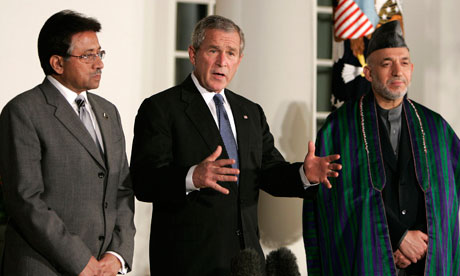
Pervez Musharraf and George Bush, Osama bin Laden death
The US and Pakistan struck a secret deal almost a decade ago permitting a US operation against Osama bin Laden on Pakistani soil similar to last week's raid that killed the al-Qaida leader, the Guardian has learned. The deal was struck between the military leader General Pervez Musharraf and President George Bush after Bin Laden escaped US forces in the mountains of Tora Bora in late 2001, according to serving and retired Pakistani and US officials. Under its terms, Pakistan would allow US forces to conduct a unilateral raid inside Pakistan in search of Bin Laden, his deputy, Ayman al-Zawahiri, and the al-Qaida No3. Afterwards, both sides agreed, Pakistan would vociferously protest the incursion. "There was an agreement between Bush and Musharraf that if we knew where Osama was, we were going to come and get him," said a former senior US official with knowledge of counterterrorism operations. "The Pakistanis would put up a hue and cry, but they wouldn't stop us." REFERENCE: Osama bin Laden mission agreed in secret 10 years ago by US and Pakistan US forces were given permission to conduct unilateral raid inside Pakistan if they knew where Bin Laden was hiding, officials say Declan Walsh in Islamabad guardian.co.uk, Monday 9 May 2011 19.06 BST http://www.guardian.co.uk/world/2011/may/09/osama-bin-laden-us-pakistan-deal


GEO TV/JANG Group Conveniently “forgot” to mention this type of Bob Woodward.


Kessler cites confirmation from William Donnelly, head of CIA administration, that “Woodward probably found a way to sneak in,” as well as Britt Snider, general counsel to the Senate Select Committee on Intelligence, whose formal investigation found that Woodward had 43 meetings or phone calls with Casey, including at the director’s home. Veil is the story of the covert wars that were waged in a secretive atmosphere and became the centerpieces and eventual time bombs of American foreign policy in the 1980’s. REFERENCE: Veil: The Secret Wars of the CIA, 1981-1987 Bob Woodward (Author) http://bobwoodward.com/books/veil http://www.amazon.com/Veil-Secret-Wars-CIA-1981-1987/dp/0743274032/sr=1-7/qid=1159985645/ref=sr_1_7?ie=UTF8

Why don’t Shaheen Sehbai mention “Bush At War” by Bob Woodward.


Pakistan’s chief spy Lt. General Mahmoud Ahmad “was in the US when the attacks occurred.” He arrived in the US on the 4th of September, a full week before the attacks. He had meetings at the State Department “after” the attacks on the WTC. But he also had “a regular visit of consultations” with his US counterparts at the CIA and the Pentagon during the week prior to September 11. REFERENCE: Cover-up or Complicity of the Bush Administration? The Role of Pakistan’s Military Intelligence (ISI) in the September 11 Attacks by Michel Chossudovsky Professor of Economics, University of Ottawa Centre for Research on Globalisation (CRG), Montréal Posted at globalresearch.ca 2 November 2001


Why don’t Shaheen Sehbai mention “Bush At War” by Bob Woodward.


Pakistan’s declaration exonerated the U.S from any demand for legal or moral justification for their attacks on the poor Afghans. By this rescue mission, Pakistan might have improved its credentials as a front-line state but it did spell death and destruction for the poor Afghans. This was not the all that Musharraf did to prove his loyalties to the Bush administration. As we would come to see later, he even dismissed General Mahmood, Director ISI and several of his key – lieutenants, a step highly lauded and appreciated by C.I.A chief. The new chief of ISI was advised to remove whatever Pro-Taliban elements were left in the intelligence department of Pakistan. (P. 214) Bush At War Author: Bob Woodward Publishers: Simon & Schuster Rockefeller Center New York Year of publication: 2002

Incidentally General Mahmood (Director ISI) was already in Washington. Jim Pavitt got hold of him and apparently talked bitterly about Mullah Omar. General Mahmood felt obliged to defend Mullah Omar. He said that in his opinion Mullah Omar was religious, a man of humanitarian instincts, not a man of violence, but one who had suffered greatly under Afghan war-lords. (p. 47). Bush At War Author: Bob Woodward Publishers: Simon & Schuster Rockefeller Center New York Year of publication: 2002

“Stop”, Jim Pavitt interrupted rudely and arrogantly asked General Mahmood: “Spare Me….” (p. 47). Bush At War Author: Bob Woodward Publishers: Simon & Schuster Rockefeller Center New York Year of publication: 2002

Then Armitage invited Gen.Mahmood to the state department. He began by saying it was not clear yet what the U.S would ask of Pakistan but the request would force “deep introspection. Pakistan faces a stark choice, either it is with us or it is not. This is a black & white choice with no gray”. (p. 47). Bush At War Author: Bob Woodward Publishers: Simon & Schuster Rockefeller Center New York Year of publication: 2002

Mahmood said that his country had faced tough choices in the past but Pakistan, he pointed out, was not a big or mighty power. “Pakistan is an important country”, Armitage cut in. Mahmood returned to the past [& probably referred to some of the instances where Pakistan was used by the U.S and then abandoned in an un-ceremonial manner]. “The future begins to-day”,3 Armitage said. Pass the word to General Musharraf, the President of Pakistan. “With us or against us.” (p. 47). Bush At War Author: Bob Woodward Publishers: Simon & Schuster Rockefeller Center New York Year of publication: 2002

Powell & Armitage later drew a list of seven demands4 with a view to presenting them to Musharraf. These demands were:

• “Stop Al-Qaeda operatives at your border intercept arms shipments through Pakistan and end all logistical support for bin Ladin.”

• “Give the US Blanket over flight and landing rights for all types of operation”

• “Access to Pakistan, naval bases, air bases and borders.”

• “Immediate intelligence and immigration information.”

• “Condemn the September 11 attacks and “curb all domestic expressions of support for terrorism against the [United States], its friends or allies.” Powell and Armitage knew that was something they couldn’t even do in the United States.”

• “Cut off all shipments of fuel to Taliban and stop Pakistani volunteers from going into Afghanistan to join the Taliban.”

• “The seventh demand was the one that Powell would trip up the Pakistanis or cause Musharraf to balk: “should the evidence strongly implicate Osama bin Ladin and the Al-Qaeda network in Afghanistan AND should Afghanistan and the Taliban continue to harbor him and his network, Pakistan will break diplomatic relations with the Taliban government, end support for Taliban and assist us in the aforementioned ways to destroy Osama bin Ladin and his Al-Qaeda network.” (p. 58-59).

In a way, the U.S directed Pakistan to take a U-turn on Afghanistan and destroy with their own hands whatever they had created and maintained, that is, the Taliban. Armitage called General Mahmood again and handed over the list of demands to him by saying; “this is not negotiable… you must accept all seven demands”. (p. 59).

At 1:30 P.M. Powell called Musharraf “as one General to another. He said, “We need someone on our flank fighting with us. Speaking candidly, the American people wouldn’t understand if Pakistan was not in this fight with the United States.” (p. 59).

Musharraf to Powell’s utter surprise said that Pakistan would support the United States with each of the seven actions. (p. 59). Later Powell read out these demands to President Bush and proudly reported that Musharraf had already accepted them all. On hearing this Bush said gleefully, “it looks like you got it all”. (p. 61). Bush thought it was the State Department at its best. He later recalled that “Powell was very good with Musharraf. He single-handedly got Musharraf on board”, and was able to put a coalition together. (p. 342).


Pakistan’s chief spy Lt. General Mahmoud Ahmad “was in the US when the attacks occurred.” He arrived in the US on the 4th of September, a full week before the attacks. He had meetings at the State Department “after” the attacks on the WTC. But he also had “a regular visit of consultations” with his US counterparts at the CIA and the Pentagon during the week prior to September 11. REFERENCE: Cover-up or Complicity of the Bush Administration? The Role of Pakistan’s Military Intelligence (ISI) in the September 11 Attacks by Michel Chossudovsky Professor of Economics, University of Ottawa Centre for Research on Globalisation (CRG), Montréal Posted at globalresearch.ca 2 November 2001 http://www.globalresearch.ca/articles/CHO111A.html


Michel Chossudovsky is Professor of Economics at the University of Ottawa. TFF Associates http://www.transnational.org/SAJT/tff/people/m_chossudovsky.html


"UNQUOTE"

There must be a difference between Interviews and Press Conference and now watch as to how soft GEO TV Anchors were with General Pervez Musharraf, these shouldn't be called Interviews rather these are "Press Conference Coverage for a Military Dictator i.e. Pervez Musharraf and compare these very same Anchors while interviewing any Civilian Politicians, watch these interviews because this "Alleged Honour Brigade" never raised a Serious Questions for Pervez Musharraf's Cooperation with the USA on War on Terror. 

President Musharraf interview GEO TV with Kamran Khan Part 1

URL: http://youtu.be/tvbM1mwrQdo

http://newsimg.bbc.co.uk/media/images/41402000/jpg/_41402660_bush_mush_apportbody.jpgISLAMABAD: US President George W. Bush’s 26-hour visit to Pakistan was marked by a thick veil of secrecy and security. Throughout his stay a tense calm prevailed in the capital with the country’s entire security apparatus, civilian and military, mobilised in top gear. Added to this was the battalion of American security personnel that created their own sophisticated security web at all sensitive points from Chaklala airbase to the Aiwan-i-Sadr to the US embassy. For the Pakistani media it was a long wait for Bush’s arrival at Chaklala that looked more like a US military base with Americans all over the place. Their large presence made Pakistani citizens feel like aliens. We were even frisked for security clearance by Americans in the open air. Also, one saw a shocking display of what one had hitherto heard of branded as American arrogance and insolence. Chewing-gum-chomping US security men barged in and out of the arrival lounge, as if walking into their private workspace. Even the daunting American sniffer dogs, with high-ranking titles like Sergeant and Major, specially flown in from Washington, felt quite at home. The usually all-pervasive Pakistani military men at the airbase were pushed into the backseat by the US security team headed by a highly-charged man called Mark.

Terse exchanges were also witnessed between the US security head and Pakistani military officers present there. On seeing a 35-member Pakistani media team arrive in a coaster at the airbase, four hours ahead of Bush’s arrival, Mark told the ISPR officer accompanying them: “I don’t need this bunch of people.” It was only after a little argument that the team was ‘allowed’ in. Later, he was furious because apparently at the main gate he had been held back by some Pakistani guard. Getting down from his car in a huff he said in a raised and threatening tone: “This is bullshit, I’ll talk to the general.” Probably his reference was to ISPR chief Maj-Gen Shaukat Sultan. The ISPR officers on duty were visibly irked by the high-handed American attitude and one of them had a showdown with Mark earlier in the day and had told him not to dictate terms but that had no effect. Amid all the security salsa with hi-tech American gadgetry, a s****y BMW outside the airbase terminal suddenly alarmed the American secret service agents when it started billowing smoke. The BMW was part of the elaborate US president’s Washington-imported cavalcade that had just lined up in the parking lot. It later transpired that the car radiator had heated up.

President Musharraf interview GEO TV with Kamran Khan Part 2

URL: http://youtu.be/29yz69tENiQ

President Bush and First Lady Laura Bush commuted in Cobra and Black Hawk gunship helicopters during their brief stay in the capital. Land and aerial security cover were provided by heavily-armed vehicles and choppers that also included Chinooks. US secret service men and women were visible at entry points and on rooftops during the Musharraf-Bush summit at the Aiwan-i-Sadr. They looked rather suspiciously at every person and vehicle entering the premises. Helicopters hovered above the presidency while Mr Bush was there. Even as the two leaders emerged from their summit meeting and walked towards the majestic courtyard of the Aiwan-i-Sadr, there was a feeling perhaps their body language did not emanate the kind of cordiality witnessed at their two earlier summit meetings, at the White House in February 2002 and at Camp David in June 2003. As expected the questions from the American media were on war on terror and democracy while those from the Pakistani media focussed Kashmir, civilian nuclear technology and beef in the strategic relations.

General (R) Pervez Musharraf in Jawab Deyh - 1 (GEO TV 2006)

URL: http://youtu.be/8Jvkmrh0BC4

General (R) Pervez Musharraf in Jawab Deyh - 2 (GEO TV 2006)

URL: http://youtu.be/vbZAJOwt-VE

General (R) Pervez Musharraf in Jawab Deyh - 3 (GEO TV 2006)

URL: http://youtu.be/uLDWHJ7O7Wg

General (R) Pervez Musharraf in Jawab Deyh - 4 (GEO TV 2006)

URL: http://youtu.be/bOwShdTwAEs

General (R) Pervez Musharraf in Jawab Deyh - 5 (GEO TV 2006)

URL: http://youtu.be/Wn0XFxmwXG0

Even in the seating arrangement there was a clear division, with the American media on one side and the Pakistani media on the other. Both in front of their respective leaders and both well controlled. There was a telling statement by a senior American journalist who covers the White House and was in the media team accompanying the US president: “There is no such thing as independent media in the US any more, particularly after 9/11. It is now all corporate driven and any one who challenges the US administration’s national security policies, his or her patriotism is challenged by the White House.” An interesting observation made by him was that the White House had tried to project Mr Bush’s visit to Pakistan as an assurance to Americans of his resolve to fight terrorism, that as commander-in-chief of America he was braving the high-risk ‘terrorist zones’ so he could engage with leaders there to strengthen US national security. The subtext of Mr Bush’s remarks at the press stakeout made that amply clear.

Yet another intriguing comment by this candid journalist was that the US media was being fed by some members of the Bush administration that if free and fair elections were held in Pakistan, there would be a danger of fundamentalists taking over the reins of power. His hunch was that this was perhaps an attempt by the White House to justify the Bush-Musharraf relationship. All took a sigh of relief when Air Force One flew off with Mr Bush and his delegation late on Saturday night at around 11pm. Life was finally back to normal. REFERENCE: Covering the Bush visit By Qudssia Akhlaque http://www.dawn.com/2006/03/08/fea.htm#1

Pervez Musharraf's interview in Kal Tak with Javed Chaudhry (Part 01)

URL: http://youtu.be/kdS-cimnzdo

Pervez Musharraf's interview in Kal Tak with Javed Chaudhry (Part 02)

URL: http://youtu.be/fp2UBwTW1Lw

http://newsimg.bbc.co.uk/media/images/41402000/jpg/_41402660_bush_mush_apportbody.jpgAs I left my office this evening I saw with apprehension three sinister dark helicopter gunships patrolling low over Islamabad. I wondered who they were protecting. Then I realised that a murderer, in fact a mass murderer, will be in town tomorrow. But the helicopters were not there to protect the people of Islamabad from this murderer but they were there to protect the murderer from the wrath of the people of the world. Tomorrow the most hated man in the world will be in town and will be welcomed by our President. Mush and Bush make a fine pair. Before Bush left Washington he said that he would ask Musharraf to close down terrorist camps in Pakistan. I wonder if our general will ask Bush to close down the biggest terror camp of them all, Guantanomo, where the terrorists are the US Army personnel who perform torture on the inmates. But why should he? He is after all implicated in these crimes against humanity. He and his Foreign Minister proudly proclaim that they are in the frontlines of the war against terror and that they have handed over more than 700 suspected Al-Qaeda terrorists to the US which incarcerates them illegally without trial and without recourse to any legal system in Guantanomo.

By their own words they admit that they have done illegal actions; midnight arrests of Pakistanis and foreigners and bundling into secret CIA flights without due process of law in front of Pakistani courts. So how can they protest? They are themselves complicit in these crimes against humanity, let alone the violation of the Pakistani constitution and Pakistani laws. But when did violation of the constitution or the law ever matter to the various generals who have run the country? Why should our good general protest about people illegally locked away in far Guantanomo? We have our own mini-Guantanomos right here in our own backyard. We have our own illegalities. According to the Human Rights Commission of Pakistan hundreds of Pakistanis have disappeared in the last few years. They have been picked up by intelligence agencies and never heard of again. Are they being tortured? Are they dead? No answers are forthcoming. In the name of fighting Al-Qaeda Pakistani villages have been bombed not only by the Pakistan army but by the US and many Pakistani civilians, including women and children, have been killed. Tomorrow there will be in Islamabad a man whose hands are covered in the blood of the innocents massacred in Afghanistan, in Rafah, Jenin, Jabaliya, Gaza, Najaf, Fallujah, Samarrah, etc. The killing in Iraq continues. Not content with creating chaos in Iraq with a daily death toll of more than a hundred, Bush is now intent on attacking Iran. He is not only a murderer but a pyrotechnician. Nero does not hold a candle to him Nero was content to see Rome burn but this madman wants to see the whole of the Middle East burn.

Arundhati Roy in an excellent article in the Guardian today (1 March) said that Bush is not welcome in India. Equally he is not welcome in Pakistan. If it wasn't for the complete security blockade of Islamabad and if there was democracy (that so much abused concept) and freedom of assembly in Pakistan, Bush would be welcomed by demonstrations against his policies in the US and worldwide. There is no country in the world, outside the United States, where he can move freely and where he will not face demonstrations. However much his security detail and his ever-obliging hosts try to shield him, he knows that he is an unwelcome guest wherever he goes. REFERENCE: Faheem Hussain is a Pakistani physicist. He can be reached at: hussainf@ictp.it http://www.countercurrents.org/