
ISLAMABAD: Cracks in the ranks of the Pakistan Muslim League-Q widened on Sunday when president of the party’s Khyber Pakhtunkhwa chapter Amir Muqam who had taken oath on May 2 as minister of production submitted his resignation from the cabinet to the chief of his party, Chaudhry Shujaat Hussain. Talking to journalists, Mr Muqam said he had taken the extreme step in line with a decision of the party’s provincial general council taken last week because of the failure of the party leadership to meet the promise of sharing with them the written agreement signed with the Pakistan People’s Party. The PML-Q leader said when negotiations were being held with PPP the party leadership had assured him that their demands for creation of Hazara province and introduction of political reforms in tribal areas would be made part of the agreement with the PPP. However, he said, the party leadership had not shown him the agreement, forcing him to submit the resignation. He said he had also informed the leadership about his reservations on other issues. But, he added, he would continue to abide by party decisions and discipline. The PML-Q leader said that President Asif Ali Zardari had called him earlier in the day and asked him to withdraw his resignation. Talking to a group of reporters later in the day, PML-Q chief Chaudhry Shujaat Hussain claimed there was no rift within the party and that Mr Muqam’s reservations would soon be redressed. REFERENCE: Cracks in ‘Q’ widen as Muqam quits cabinet By Amir Wasim | From the Newspaper Yesterday http://www.dawn.com/2011/05/16/cracks-in-q-widen-as-muqam-quits-cabinet.html
General (R) Mirza Aslam Beg on AAJ TV - 1 (27 Apr 2010)
URL: http://www.youtube.com/watch?v=HebY6teSblk
General (R) Mirza Aslam Beg on AAJ TV - 2 (27 Apr 2010)
http://www.youtube.com/watch?v=O-0cTJwyD_Q
General (R) Mirza Aslam Beg on AAJ TV - 3 (27 Apr 2010)
http://www.youtube.com/watch?v=kQcjSehFmMA
Benazir Bhutto on AAJ TV - 1General (R) Mirza Aslam Beg on AAJ TV - 1 (27 Apr 2010)
URL: http://www.youtube.com/watch?v=HebY6teSblk
General (R) Mirza Aslam Beg on AAJ TV - 2 (27 Apr 2010)
http://www.youtube.com/watch?v=O-0cTJwyD_Q
General (R) Mirza Aslam Beg on AAJ TV - 3 (27 Apr 2010)
http://www.youtube.com/watch?v=kQcjSehFmMA
Lies of Lt. Gen [R] Hamid Gul & Murder of Benazir Bhutto. http://chagataikhan.blogspot.com/2010/04/lies-of-lt-gen-r-hamid-gul-murder-of.html
URL: http://youtu.be/ouZsENkOoVE
Benazir has not yet named the three persons, but PPP insiders disclosed their identity to Outlook. It's an illustrious list: Brig (retd) Ejaz Hussain Shah, DG, Intelligence Bureau; Chaudhry Pervaiz Elahi, chief minister of Punjab; and Hassan Waseem Afzal, a former official of the National Accountability Bureau (NAB). A fourth, familiar name pops up in the concluding part of the letter—that of former isi chief, Lt Gen Hameed Gul, who's a vocal supporter of the Taliban and Al Qaeda. PPP insiders believe the quartet's motive in organising the assassination attempt on Benazir was to check the burgeoning moderate political alliance between her and Musharraf. As such, the Musharraf camp was bitterly divided over his deal with Benazir. One group led by the secretary of the National Security Council, Tariq Aziz Warraich, was in favour of Musharraf sharing power with the PPP. Shah's group opposed the deal with Benazir, believing it would be at the cost of the ruling Pakistan Muslim League (Qaid-e-Azam). Ejaz Shah is close to the powerful Chaudhry brothers—Elahi and Shujaat Hussain—whose party the ruling PML-Q is, besides sharing their fundamentalist worldview. Indeed, it was Shah who had 'arranged' the surrender of Sheikh Ahmed Omar Saeed, the killer of American journalist Daniel Pearl, on February 5, 2005, in Lahore. Then, Shah was the home secretary of Punjab. Shah knows Omar's family well as both of them belong to the Nankana Sahib area of Punjab. The relationship between Shah and Omar was really one of a handler and his agent. In an interview with Daily Times, August 13, 2007, Benazir Bhutto said, "Brig Shah and the isi recruited Omar Sheikh, who killed Danny Pearl. So I would feel very uncomfortable to have the Intelligence Bureau, which has more than 1,00,000 people under it, run by a man who worked so closely with militants and extremists." Links with militants apart, Shah was instrumental, say PPP insiders, in splitting PML (Nawaz) and weaning away 20 PPP members in the National Assembly, to form the PML-Q. It's Shah on whom the PML-Q depends to manipulate the impending general election to its advantage. For the Chaudhry brothers, the general election is a do-or-die battle: a defeat could well spell political oblivion for them. The third person named in Benazir's letter, Hassan Waseem Afzal, is currently secretary to the governor of Punjab. He was appointed to this post after he was removed as NAB's deputy chairman on Benazir's insistence a few months before her Abu Dhabi meeting with Musharraf in July this year. It was one step Benazir had wanted Musharraf to take as a confidence-building measure with her. Afzal had incurred her wrath because he had made it his personal mission to pursue corruption cases against her in the United Kingdom, Spain and Switzerland. It was on his order that the Interpol issued a red alert notice against her. The fourth conspirator PPP names is Gul, a retired, dyed-in-the-wool Pakistani general who headed the isi following the jehad against the Soviets in Afghanistan and was responsible for fomenting the Kashmir insurgency in 1989. Gul worked in tandem with the Americans against the Soviet occupation of Afghanistan, but began to oppose America post-9/11. In 2003, Gul declared, "God will destroy America." Government sources, however, say a high-level meeting presided over by Musharraf dismissed Benazir's accusations as "childish". They also say her insistence on implicating Musharraf's close associates in the Karachi carnage could even threaten her equation with the president. (The FIR filed by Benazir in Karachi states as suspects "those whose names were given to Gen Musharraf".) They claim the suicide attack bore the signature of Al Qaeda, arguing that she has incurred its wrath because of her support for military operation against the Red Mosque fanatics in Islamabad in July and for declaring that she would allow the International Atomic Energy Agency to question Dr Abdul Qadeer Khan about his nuclear proliferation activities. Her emergence as an ally of Musharraf, government sources say, explains the fury of militants who had targeted him as well earlier. But, are Benazir's claims as ridiculous as government sources are making them out to be? Why, even Musharraf in his book, In the Line of Fire, wrote that militants roped in Pakistani air force personnel in the conspiracy to kill him in 2003. In another abortive attempt the same year, Musharraf implicated personnel of the Special Services Group charged with vip security. What was accepted as true in Musharraf's case cannot prime facie be falsified in Benazir's. Nothing is impossible in Pakistan's cloak-and-dagger politics. REFERENCE: ATTACK ON BENAZIR Scenes From A Wreckage The imprint, Al Qaeda's. Blessed by? Establishment Islamists? AMIR MIR MAGAZINE | NOV 05, 2007 http://www.outlookindia.com/article.aspx?235926

Benazir Bhutto on AAJ TV - 2
URL: http://youtu.be/WrBko9sYySY
During its brief history Pakistan has been used as a stage for many a charade, sometimes in the name of religion, sometimes in the name of democracy but always in national interest and for the people! The latest farce is a deal between Gen Pervez Musharraf and Benazir Bhutto. As usual on such occasions the people do not know whether to laugh or curse their stars. Quite a few people believe that on the fourth of October, in the year 2007, Zulfikar Ali Bhutto’s party was stabbed in the back by none other than his daughter and that the injury may prove fatal. Did the 40-year-old party that had begun by holding up the promise of people’s empowerment deserve to spend its adult years as the bonded maid of a praetorian consul? While the country was going through a convulsion on whose outcome depended the future of its young ones, the PPP had three concerns on the top of its agenda: the people’s right to democracy, the party’s prospects in the coming general election, and the possibility of its chairperson’s rehabilitation in active politics — in that order. The chairperson seems to have chosen to read the priorities upside down. As she bargained for reprieve for herself, she rendered the party more vulnerable than before and the prospect for democratic revival bleaker. Many in the party had hoped that the chairperson would give the organisation a new lease of life and democracy a chance by stepping out of the power race and letting the Young Turks lead what is left of the great party. Frustrated, they do not know how to defend an indefensible deal.

There were also many, inside the party and outside, who had, at the very first reports of the deal, warned of a kiss of death. During the weeks that the deal took to materialise this warning was justified many times over. Those who have persuaded themselves to believe that the deal will benefit Pakistan or the PPP may be in for early shocks. The ordinance that is being hailed for reconciliation between Gen Musharraf and Benazir Bhutto is most likely to further alienate the people from both. Besides, the General’s team will ensure that his promises to BB — removal of bar to a third bid for premiership, etc. — are put on hold till after the electoral contest, which the PPP will enter with a thin force of bedraggled soldiers. If it does not do well enough at the polls, the General is likely to renege on his pledges to BB as comfortably as he had abandoned MMA after the pact leading to the 17th amendment. The party faithful will then be left to ponder what Ghalib had said over a century ago:
Kia woh Namrud ki khudai thi/Bandagi mein mera bhala na huwa.
Benazir Bhutto was right when she identified quasi-religious militancy as the most serious threat to Pakistan and argued that the country could be saved only by the people, backed by civilian democratic government. But the regime with which she has pawned her soul is capable neither of preventing Pakistan’s Talibanisation nor of establishing a popular democracy. The threat to the state has increased. The other party to the deal is unlikely to fare any better than the PPP. The General’s victory is as pyrrhic as pyrrhic can be. He will not be as strong and as free a ruler as he has so far been. Attempts to run the country as before will make the going much tougher. At the same time the events of the past few weeks will give rise to new political forces and the next round between democrats and autocrats may take place sooner than expected and may not end the way the last one has. However, the fate of the deal-makers will matter to the people less than their own ordeal. The people’s disappointments over the past few weeks will severely affect their activism that the lawyers’ agitation had engendered. Between March 9 and September 29 Pakistan politics went through a cycle that has certain basic lessons for the hardy democrats.
The lawyers’ courage out in the open helped them win people’s support and by July 20 the regime seemed to have been routed. But then the streets were emptied of the democrats and the gendarmes moved in. They had a dry run on September 10 when Nawaz Sharif was cheated out of his birthright, contrary to everything contained in the Constitution, laws and rules of decency, and the people watched passively while their half-baked leaders sulked under detention. Assured that the people were not returning to the streets, the regime showed its hideous face on September 29, one of the blackest days in the history of Pakistani people. The opposition fell back on the rhetoric of its leaders and a strategy of blocking General Musharraf’s election by resigning from legislatures. This manoeuvre was a non-starter to begin with and the delay in carrying it out made its defeat certain. In the process the experts found the Constitution silent on the effect on the presidential election if a provincial assembly stood dissolved. The Indians had been alive to this eventuality and therefore they made it clear in the constitution that the dissolution of a state (provincial) assembly would not affect the election of the president. But this provision offers little help to Sher Afgan. A state in India represents only 1/17th of the provincial part of the electoral college whereas a province in Pakistan represents 1/4th of the provincial component of the electoral college. All this constitutional and legal quibble apart, the essential fact is that the battle for the people’s right to self-rule will be won neither in courts nor in assemblies of doubtful origins; this battle will be won by people’s mobilisation alone. The democrats are on the verge of another defeat because they have been looking for short-cuts to democracy where none are available. It’s time to return to the basics of mass mobilisation through serious political work. REFERENCE: The people again done in? By I.A. Rehman October 06, 2007 Saturday Ramazan 23, 1428 http://archives.dawn.com/2007/10/06/top9.htm
Benazir Bhutto on AAJ TV - 3
URL: http://youtu.be/RbE8Vg1Qt4U
Now note the somersault on Nawaz Sharif and Judiciary
LONDON, May 15: The following is the text of the Charter of Democracy signed by former prime ministers Benazir Bhutto and Nawaz Sharif here on Sunday: We the elected leaders of Pakistan have deliberated on the political crisis in our beloved homeland, the threats to its survival, the erosion of the federation's unity, the military's subordination of all state institutions, the marginalisation of civil society, the mockery of the Constitution and representative institutions, growing poverty, unemployment and inequality, brutalisation of society, breakdown of rule of law and, the unprecedented hardships facing our people under a military dictatorship, which has pushed our beloved country to the brink of a total disaster; Noting the most devastating and traumatic experiences that our nation experienced under military dictatorships that played havoc with the nation's destiny and created conditions disallowing the progress of our people and the flowering of democracy. Even after removal from office they undermined the people’s mandate and the sovereign will of the people; Drawing history’s lesson that the military dictatorship and the nation cannot co-exist – as military involvement adversely affect the economy and the democratic institutions as well as the defence capabilities, and the integrity of the country - the nation needs a new direction different from a militaristic and regimental approach of the Bonapartist regimes, as the current one;

32. The ISI, MI and other security agencies shall be accountable to the elected government through Prime Minister Sectt, Ministry of Defence, and Cabinet Division respectively. Their budgets will be approved by DCC after recommendations are prepared by the respective ministry. The political wings of all intelligence agencies will be disbanded. A committee will be formed to cut waste and bloat in the armed forces and security agencies in the interest of the defence and security of the country. All senior postings in these agencies shall be made with the approval of the government through respective ministry. REFERENCE: Text of the Charter of Democracy May 16, 2006 Tuesday Rabi-us-Sani 17, 1427 http://archives.dawn.com/2006/05/16/local23.htm http://archives.dawn.com/2006/05/16/local23.htm Benazir & Nawaz sign Charter of Democracy By Ashraf Mumtaz May 15, 2006 Monday Rabi-us-Sani 16, 1427 http://archives.dawn.com/2006/05/15/top1.htm
Benazir Bhutto Criticised Pakistani Judiciary for being Ethnically Biased.
http://www.youtube.com/watch?v=y_YcV-ZvOQU
Benazir Bhutto supported "Judiciary"
November [10-12-2007] after the imposition of emergency by General Musharraf [now Il Presidente] Police in Islamabad stopped Chairperson Pakistan Peoples Party (PPP) and Former Prime Minister Benazir Bhutto from meeting with deposed Chief Justice of Pakistan Justice Iftikhar Muhammad Chaudhary Benazir Bhutto tired to approach disposed Chief Justice Iftikhar Chaudhry homes where he is in detention but Police parked truck on road blocked her path. Despite repeated announcement of Chairperson PPP through megaphone to Police and Magistrate to allow her to meet with deposed Chief Justice of Pakistan who was prime victim of Provincial Constitutional Ordinance, she was not allowed. Later, rangers were also called in. Addressing the Party workers outside the Judges colony via megaphone, the Former Prime Minister Benazir Bhutto said Iftikhar Muhammad Chaudhry is real Chief Justice of Pakistan. BB’s bid to meet deposed CJ foiled, PPP workers police clash Saturday November 10, 2007 (2124 PST) http://www.paktribune.com/news/index.shtml?194273

Benazir Bhutto on AAJ TV - 4
URL: http://youtu.be/vMkXVZwAT_0

"The marriage is over. Both have decided to move on... there has even been a distribution of assets." A prominent Pakistani close to both Benazir and Zardari - "Had Benazir married someone else, PPP would be different. Bhutto was anything but corrupt. Asif put a blot on the record." A PML(Q) politician linked to intelligence agencies. When the generals in Pakistan were mulling the option of releasing Asif Zardari from prison, a close confidant of President Pervez Musharraf weighed in with this quip about ex-premier Benazir Bhutto's husband, "Mr President, it's about time we release him. He'll prove more damaging to the Pakistan People's Party (PPP) outside jail than inside." Accordingly, Zardari was released in November 2004 to rapturous receptions, prompting many swooning admirers to see in his long years of separation from Benazir—and their imminent coming together—a dramatic real-life parallel to Veer-Zara, the Bollywood film then immensely popular in Pakistan. The inveterate romantic here even began to describe the two as Pakistan's Veer-Zara. A little over two years from that heady, emotional November, as we settle into 2007, a chill seems to have seeped into the romantic saga that the Benazir-Zardari matrimony has always been for this country. The fizz has gone out of the love story, Benazir and Zardari don't live together, their marriage is an empty shell, a partnership of pretences, a form they must maintain because Pakistan, like much of South Asia, can't accept a woman politician divorced from her husband. You could say it's a separation that's still dressed as marriage, you could say Musharraf's confidant, in a way, has been proved prescient.
For months now, the souring of the Benazir-Zardari saga has been the staple of whispers in PPP circles. The buzz attained credibility in November last year when Pakistan's English daily Observer led its front page with the bruising header: 'Benazir desperately trying to save her marriage'. The PPP didn't issue any denials. Last year too, in a money-laundering case filed by the earlier Nawaz Sharif government, Benazir told a Swiss court that she wasn't associated with offshore companies being investigated for their links to Zardari. The statement was perceived as an attempt on her part to distance herself from her husband. A prominent Pakistani close to both Zardari and Benazir, who too now lives abroad, told Outlook, "The marriage is over. Both have decided to get on with life and live in countries of their own choosing. There has even been a distribution of assets; that's why her statement last year to the Swiss court." But this doesn't mean Benazir will legally formalise the split—and it isn't only because of the political factor. As a lady friend of Benazir's told Outlook, "Benazir is too conservative to go in for a divorce. Once, till late in the night, she kept advising me against seeking divorce." There are, however, incontrovertible signs of their marriage being on the rocks if not totally kaput. For one, Benazir lives in Dubai, Zardari in a New York apartment with his dogs. His friends there invite sneers from the extremely class-conscious Pakistanis. As a former foreign secretary told this correspondent, "We were having dinner at this posh restaurant and in walked Asif with a group of men who would never be seen in polite company." Influential expat Pakistanis say Benazir did not stay with her husband when she visited the Big Apple last September, choosing instead to reside with a friend there. The PPP explained it saying she needed a larger space for party work.
Cold vibes between the Zardaris and the Bhuttos aren't a fact of recent vintage. When Asif was undergoing a heart operation in Dubai in 2005, his parents flew down to the desert emirate to see him. Instead of staying in the plush villa of their daughter-in- law, they were booked in a hotel. A Pakistani who was there then narrates, "I think it was in June 2005. Dubai then witnessed its biggest power blackout. I was staying in the same hotel as Asif's father, Hakim. I asked him why he wasn't staying with Benazir, he kept silent. Hakim's wife (Asif's stepmother) clearly said that they did not want to stay there." So, why did the Benazir-Zardari marriage turn so sour? One way of answering the question is to look at the marital fate of other women prime ministers (or presidents) and summarise, perhaps simplistically: marriages of powerful women leaders are doomed to fail. When she visited NY last September, Benazir stayed with a friend, not with Zardari who lives there in an apartment with his dogs.
From Sirimavo Bandaranaike to Golda Meir to Indira Gandhi in the earlier generation, and now Benazir Bhutto, Tansu Ciller and Gloria Macapagal Arroyo—their marital going has been stormy; the discord most often arising from a husband reluctant to live in the shadow of his wife. Most often, cracks developed in relationships because of the husband's insatiable appetite for power and pelf—definitely true of Benazir-Zardari' s life together. What's also true, though, is that both Benazir and Zardari were a terrible mismatch in a Pakistani society that is extremely class-conscious, and chauvinistic. To the manor born, cosmopolitan, Oxford-educated, princess of Pakistan's "only political dynasty", many found it intriguing why Benazir chose to marry Zardari at all. Theories abound. One, she didn't have a boyfriend, never even went out with boys—a fact testified to by Hussain Haqqani's failed efforts to dig up dirt on her university days in the months before the 1988 elections. (Haqqani later joined her government). It was considered impractical, perhaps inconceivable, for a single woman to jump into politics. A husband had to be found. Simultaneously, Pakistan was also witnessing cataclysmic changes: Zia was in power; he had hanged Zulfiqar Ali To the manor born, Oxford-educated, princess of Pakistan's "only political dynasty", many wonder why she married Zardari at all. Bhutto, even thrown Benazir in the dungeon for months; subsequently, in 1984, her brother Shahnawaz died under mysterious circumstances abroad; the other brother—Mir Murtaza—nursed ambitions about usurping the Bhutto legacy. Worse, mother Nusrat, in the eastern tradition of anointing males as heirs, was more supportive of Murtaza than Benazir. "Benazir needed a friend and a man by her side. Asif needed power, authority and wealth. She also wanted a Sindhi as then she could play her father's Sindhi card," says an old PPP member.
It was Zardari's stepmother who played matchmaker, says the PPP source, getting the two to meet each other. Back then, the Zardaris' most important asset was the Bambino cinema theatre in Karachi. Though younger to her by two years, Zardari swept Benazir off her feet. No other man had been so close to her. There were quiet moments in London's Hyde Park: she said she was attracted to his sense of humour; impressed by his 'chivalry' (he saved her from a bee which attacked her). Says the PPP member, "There were flowers and presents. Asif at his best was macho whom she could not resist. Had I been Benazir, I too would have said 'yes'." Perhaps the Bhutto gameplan was different from what it eventually turned out to be. Zia-ul-Haq died in a plane crash in 1987, elections were called in 1988, and Benazir spectacularly rode to power. About this twist in the script Nusrat was to comment after Benazir was ousted from power the second time (1996), "How did we know that Zia would die so soon? We thought that by the time her turn to (govern) would come, they would have had a couple of kids and he would have settled down." Zardari did settle down in the prime ministerial house—but not as a quiet husband willing to stay in the background. He became the 10 per cent man, allegedly cutting deals, amassing property abroad and stashing funds in Swiss banks (though nothing has been proved against him even after he spent eight years in jail). When Benazir was in Opposition, then prime minister Nawaz Sharif claimed a prohibitively expensive diamond necklace belonging to Benazir had been unearthed from a Swiss bank locker. Photographs of the necklace were flashed in newspapers. Sitting in the chambers of the Leader of Opposition, surrounded by visitors, she passed a note to this correspondent on the necklace controversy: "Do you think I would have such horrible taste?" People now say she didn't know about the necklace because Zardari never told her about it. Says a PML(Q) politician closely linked to intelligence agencies, "If Benazir had married someone else, the story of the PPP would've been entirely different. "How did we know Zia would die so soon? We thought by the time her turn came, they'd have had kids and he'd have settled down." You could blame Zulfiqar Ali Bhutto for everything but corruption. Zardari managed to blot that record of the PPP."
Another irritant in the relationship could be the murder of Benazir's brother Murtaza. Then living in exile, Murtaza was persuaded to return to Pakistan and develop a stake in Pakistan politics. Among those who sponsored the move was mother Nusrat. Benazir was opposed to the idea, fearing the establishment didn't want a Bhutto man to be alive, that the time wasn't appropriate for his return. Nevertheless, Murtaza returned. Soon differences between Murtaza and Zardari surfaced. The last occasion he met his sister in the prime minister's house there was a terrible row between Murtaza and Zardari. Murtaza accused Zardari of destroying his father's legacy. Thereafter, in 1996, a posse of policemen pumped bullets into Murtaza's vehicle. People still remember the heart-rending scenes of Prime Minister Benazir rushing barefoot across hospital floors in Karachi to be with her dying brother. No one knows who killed him. But a PPP member points out, "Don't forget, there's a legal suit pending (filed soon after Benazir was ousted for the second time) against Zardari for his alleged involvement in the murder of his brother-in-law. " There are also stories about Zardari two-timing her. Former president Farooq Leghari, a founder-member of the PPP, apparently once stooped low enough to even record Zardari's steamy extra-marital encounters on tape. There have been eyewitness accounts of some truly ugly encounters between the couple. The PPP, of course, attributes it to propaganda by the government.
TAIL PIECEThere is, however, an irony to their soured relationship: it's Asif who spent three years in prison bearing the brunt of the Sharif government's vindictiveness, thanks to promptings from Leghari; he languished behind bars for another five years until Musharraf freed him in 2004. On his release, he became a symbol of PPP resistance, his example often invoked to boost the morale of party workers. A PPP worker sums it up thus, "While in jail, his impact on the PPP was very positive as workers said, 'Asif nay dilayarna jail katee hai (he braved it all).' But he has had a very negative impact on Benazir while she was in government." Does the relationship still have a future? It's unlikely the two will divorce each other—for the sake of their children, and political expediency. For the time being, it'll be status quo. As a PPP member points out, "Zardari can't fly down to Dubai because he expressed his inability to appear in the Swiss court as his doctors have prohibited him from taking long flights. A flight to Dubai means he must depose before the Swiss court. Would he want to do that?" Should Zardari go to Dubai at a later date, or come down to Pakistan when Benazir returns, he can at best hope to get a few PPP tickets for his followers."There will be no impact on the PPP if he stays in New York," a party leader adds sarcastically. REFERENCE: The End Of The Affair [Courtesy: OUTLOOK INDIA MAGAZINE] Has Asif Zardari become too much of a liability—personal and political—for Benazir Bhutto to continue her marriage with him? MARIANA BAABAR MAGAZINE | FEB 05, 2007 http://www.outlookindia.com/article.aspx?233781
 The late President Anwar El-Sadat of Egypt was assassinated in 1981 by a faction of Egypt`s leading Islamist organisation, the Muslim Brotherhood. The irony is that this was the same organisation that Sadat had purposefully patronised. He had replaced the charismatic Egyptian leader, Gamal Abdul Nasser as the President of Egypt after Nasser died in 1970. Nasser had ruled the country as a popular president between 1952 and 1970, leaving behind a legacy of staunch secular/socialist Arab nationalism. Though Nasser remained popular till his death, the glow of his influence across assorted Muslim and Third World countries was somewhat dimmed when Egyptian and Syrian armed forces backed by the Soviet Union were decimated in the 1967 war against Israel. Though Sadat had helped Nasser in toppling the Egyptian monarchy in 1952, and was also an integral part of Nasser`s socialist/secular policies, he initiated a shift. In Sadat`s view, Nasser`s socialist model could not sustain the new sombre realities that had surfaced after the 1967 war. Sadat`s move towards the western economic model was welcomed by the country`s urban bourgeoisie, but it was vehemently challenged by the pro-Nasser and left-wing student groups and the Arab media. To neutralise the pro-Nasser and left-wing challenge to his shifting policies on campuses and in the print media, Sadat brought back to life one of the staunchest anti-Nasser and anti-left forces in Egypt the Muslim Brotherhood. REFERENCE: Secular blunders Nadeem F. Paracha July 5, 2009 http://archives.dawn.com/archives/19738
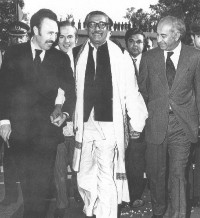 The Brotherhood had been greatly radicalised by its second generation leadership led by the teachings of Syed Qutb. He had posed the biggest challenge to Nasser`s socialism and the regime`s pro-Soviet and secular make-up. However, after Nasser`s death, Sadat tactfully let loose the Brotherhood, using state power to help the organisation infiltrate campuses and the media. To appease the organisation, Sadat instructed the state-owned radio and TV channels to not only start regular religious programmes, but to also show as many images as possible of him saying his prayers at a mosque. Sadat also lifted the ban on various Muslim Brotherhood magazines and newspapers. All this was done to soften Egypt`s pro-Soviet and Nasserite image and to mollify concerns of the West and Egypt`s new allies such as the oil-rich Saudi Arabia. REFERENCE: Secular blunders Nadeem F. Paracha July 5, 2009 http://archives.dawn.com/archives/19738
URL: http://youtu.be/GgFy_VTIsMA
By the late 1980s, while religion had begun to play a major role in the soldiers’ lives, and the revised historicity first introduced in the late 1970s became the new mainstream historical narrative in Pakistan, one now saw senior officers with even the most liberal and secular habits, spouting Islamist rhetoric. But this too was about to give in to even more Puritanism. In the early 1990s, the influential Islamic evangelical movement, the Tableeghi Jamaat, began making its way into the military. Though an apolitical movement that emphasised on ‘correct’ Islamic ritualism and attire, its entry into the barracks produced a surreal mix when it came into contact with the highly political philosophy of Maududi that had by then deeply entrenched itself in the army. Interestingly, this episode was another example of how an Islamic experiment that was first conducted in the Pakistani army soon seeped out to become a phenomenon in the society in general as well. The Tableeghi Jamaat which was formed in 1929 had, until the 1980s, been more associated with working/peasant-class Muslims from the Deobandi sect and (in the 1980s) became popular with the trader classes. A move was seen by the Jamaat from the early 1990s onwards in which a conscious attempt was made to attract upper-middle and middle-class Muslims, and this was achieved when various senior Pakistan Army officers joined the Jamaat. The army’s influence on the Pakistani society and politics meant that the Jamaat not only began to bag recruits from well-to-do urban classes, but for the first time it also managed to attract a number of celebrities such as TV actors, pop musicians and cricketers. What I saw at that ‘party’ was actually the socio-political outcome of the above elaborated process. A process that saw a secular army going through an experiment in political Islam that then was dissipated across the society and consolidated itself as a mainstream phenomenon. This phenomenon was then fused (in the army) with ritual Puritanism of the Tableeghi Jamaat and this fusion too became a mainstream sociological mainstay amongst various urban classes. Thus the schizophrenic happenings at the ‘party’ were a modern, upper-middle-class expression of the said process. Interestingly it is the mindset emerging from this fusion and process that also dictates the choice of the kind of political leaders that the classes embroiled in this phenomenon would like to see.The choices too have increasingly become equally schizophrenic. For example, these classes whose politics are a fusion of classical political Islam, Tableeghi Jamaat ritualism and modern-day consumerist capitalism want their leaders to be professional white-collared men, urban in outlook, educated, good to look at, but at the same time, religious, anti-West, anti-India and highly tolerant of Islamic exhibitionism, even sometimes to the point of being apologetic about those who take this exhibitionism to a more violent levels. REFERENCE: Like army, like nation BY NADEEM F. PARACHA ON APRIL 21ST, 2011 http://www.dawn.com/2011/04/21/like-army-like-nation.html

 Immediately after Egypt`s 1973 war with Israel — in which Sadat (falsely) claimed to have defeated the enemy — he completely pulled Egypt out from the Soviet camp. However, in 1977 when Sadat, in an unprecedented move, agreed to make formal peace with Israel, the Brotherhood became Sadat`s biggest enemy. Eventually, in 1981, he was assassinated by members of the Brotherhood — ironically the very organisation he had encouraged to nullify the perceived communist threat to his regime. Something similar happened in Pakistan as well. In the 1970 elections, Zulfikar Ali Bhutto`s Pakistan People`s Party had routed the Islamic parties. But by 1973 Bhutto was under pressure from the PPP`s leading ideologues, asking him to hasten the regime`s socialist agenda. In response, Bhutto purged the PPP of its radical founding members. He then came under the influence of the party`s `conservative wing` that encouraged him to appease his staunchest opponents, the Islamists, (especially the Jamat-i-Islami), which had declared the PPP`s socialism as un-Islamic. REFERENCE: Secular blunders Nadeem F. Paracha July 5, 2009 http://archives.dawn.com/archives/19738
General (R) Mirza Aslam Beg - 2 (Frontline 30 May 2010)
URL: http://youtu.be/ssUyqseoL20
General (R) Mirza Aslam Beg - 3 (Frontline 30 May 2010)
URL: http://youtu.be/1_ABmQTIpHw
General (R) Mirza Aslam Beg - 4 (Frontline 30 May 2010)
URL: http://youtu.be/hUM6Mmdymzc
By the late 1980s, while religion had begun to play a major role in the soldiers’ lives, and the revised historicity first introduced in the late 1970s became the new mainstream historical narrative in Pakistan, one now saw senior officers with even the most liberal and secular habits, spouting Islamist rhetoric. But this too was about to give in to even more Puritanism. In the early 1990s, the influential Islamic evangelical movement, the Tableeghi Jamaat, began making its way into the military. Though an apolitical movement that emphasised on ‘correct’ Islamic ritualism and attire, its entry into the barracks produced a surreal mix when it came into contact with the highly political philosophy of Maududi that had by then deeply entrenched itself in the army. Interestingly, this episode was another example of how an Islamic experiment that was first conducted in the Pakistani army soon seeped out to become a phenomenon in the society in general as well. The Tableeghi Jamaat which was formed in 1929 had, until the 1980s, been more associated with working/peasant-class Muslims from the Deobandi sect and (in the 1980s) became popular with the trader classes. A move was seen by the Jamaat from the early 1990s onwards in which a conscious attempt was made to attract upper-middle and middle-class Muslims, and this was achieved when various senior Pakistan Army officers joined the Jamaat. The army’s influence on the Pakistani society and politics meant that the Jamaat not only began to bag recruits from well-to-do urban classes, but for the first time it also managed to attract a number of celebrities such as TV actors, pop musicians and cricketers. What I saw at that ‘party’ was actually the socio-political outcome of the above elaborated process. A process that saw a secular army going through an experiment in political Islam that then was dissipated across the society and consolidated itself as a mainstream phenomenon. This phenomenon was then fused (in the army) with ritual Puritanism of the Tableeghi Jamaat and this fusion too became a mainstream sociological mainstay amongst various urban classes. Thus the schizophrenic happenings at the ‘party’ were a modern, upper-middle-class expression of the said process. Interestingly it is the mindset emerging from this fusion and process that also dictates the choice of the kind of political leaders that the classes embroiled in this phenomenon would like to see.The choices too have increasingly become equally schizophrenic. For example, these classes whose politics are a fusion of classical political Islam, Tableeghi Jamaat ritualism and modern-day consumerist capitalism want their leaders to be professional white-collared men, urban in outlook, educated, good to look at, but at the same time, religious, anti-West, anti-India and highly tolerant of Islamic exhibitionism, even sometimes to the point of being apologetic about those who take this exhibitionism to a more violent levels. REFERENCE: Like army, like nation BY NADEEM F. PARACHA ON APRIL 21ST, 2011 http://www.dawn.com/2011/04/21/like-army-like-nation.html

Though in private, Bhutto accused the Islamic parties of being anti-socialist American stooges, in public he went along with some of his advisers` counsel and declared the Ahmaddiyya community non-Muslim, naively believing this concession would appease and contain his Islamist opponents. The truth is, the Islamists were only emboldened by this gesture. Also, while purging the left-wing radicals in the PPP (from 1974 onwards), Bhutto is also said to have `allowed` the student-wing of the Jamat, the IJT, to establish a strong foothold on campuses which, till then, were mostly dominated by radical left-wing student groups such as the NSF. Bhutto, like Sadat, had ignored the Islamist challenge to his regime, and seemed more concerned about imaginary Soviet/ Indian-backed groups. His pragmatic indulgence in this regard had the reverse effect. Instead of containing the Islamist parties, his constitutional concessions only emboldened them. Not surprisingly, he was toppled by a reactionary general whom he had handpicked himself, shortly after the Islamist parties unleashed a countrywide movement against the PPP regime in 1976, calling for Sharia rule. These are just two brief examples of the blunders committed by certain leading secular Muslim leaders that annihilated the over-blown left-wing and secular challenges by regenerating and using Islamist forces against them. This created daunting political and ideological vacuums in societies that were eventually filled by reactionary military regimes, rejuvenated Islamist forces and, eventually, a new breed of extremism — the sort that now worked towards grabbing state power and carving out a theological hegemony, based on mythical and Utopian illusions about an eternal `Islamic State.` Pakistan and Egypt are prime examples; two of the many Muslim republics now desperately trying to reinvigorate moderate and secular forces to open a consensual front against extremism that was once state-sanctioned, to bludgeon opposing secular forces. One wonders if it is already too late to do that; or if there are any worthwhile progressive sections in society today, in these countries, who can once again demonstrate the same boldness and imagination that they exhibited in the construction of their respective countries` nationalism before their downfall. REFERENCE: Secular blunders Nadeem F. Paracha July 5, 2009 http://archives.dawn.com/archives/19738


