ISLAMABAD: Facebook has blocked the popular page of a liberal Pakistani rock band and others that criticise the Taliban, allegedly at the request of the government. Rock band “Laal” was formed in 2007 and their Facebook page has more than 400,000 likes, with users frequently joining debates on issues ranging from feminism to the role of the army in politics. But it has been inaccessible to users from inside Pakistan since Wednesday. Other pages like “Pakistani.meem” which describes itself as pro-democracy and secularism and “Taalibansarezalimans” have similarly been blocked in recent days. “Facebook didn’t even inform us. I realised when I noticed no activity on our page,” Taimur Rahman, Laal’s lead guitarist, said. Facebook confirmed the move on Friday, saying Laal’s page had been blocked inside Pakistan at Islamabad’s request, under an agreement to limit access to “material that violates local laws”. A Facebook spokeswoman said: “While we never remove this type of content from the site entirely, like most internet services, we may restrict people from accessing it in the countries where it is determined to be illegal. “Before we restrict the content, we take significant steps to investigate each unique claim, consult with local counsel and other experts in the country, and will only remove content in the most limited way possible,” she added. According to a page on Facebook that deals with government requests, 162 pieces of content were restricted for viewership inside Pakistan between July and December 2013.
“We restricted access in Pakistan to a number of pieces of content primarily reported by the Pakistan Telecommunication Authority and the Ministry of Information Technology under local laws prohibiting blasphemy and criticism of the state,” the page says.
Pakistan blocked YouTube in 2012 following the release of a film that was critical of Islam. Websites for Baloch separatist movements are also banned. Shahzad Ahmad, director of the Bytes For All organisation that campaigns for free speech, said: “The is a mass murder of free speech in Pakistan.” Yasser Latif Hamdani, a lawyer, added: “This is a grave mistake by Facebook. Also for the Pakistani government to make such requests is illegal and unconstitutional.” Pakistan’s agreement with Facebook came to light last year when a senior official from the PTA was summoned by the Lahore High Court in a case concerning the YouTube ban, but its terms have not been made public. Reference: Rock band’s Facebook page blocked at govt request By AFP https://www.dawn.com/news/1111163/rock-bands-facebook-page-blocked-at-govt-request
Banning Dr. Taimur Rahman and Others in Pakistan (Awaam - 7th June 2014)
LAHORE: Information Minister Pervaiz Rashid said here on Sunday that the ban on YouTube would be lifted soon because a software had been developed for blocking content that hurt people’s sentiments. The video sharing website was blocked in September 2012 after its administration and Google Incorporation refused to comply with a request by Pakistan and some other Muslim countries to remove a blasphemous video from the site. About the demand for checking broadcast of foreign content by some private TV channels, Mr Rashid asked civil society, owners of media houses and professionals to come up with proposals for resolving the issue because any step taken by the government could be construed as an attempt to gag the media. He said that he feared that discretionary powers could open the door to misuse of authority by officials. REFERENCE: YouTube ban to be lifted soon By The Newspaper's Staff Reporter Published Mar 17, 2014 http://www.dawn.com/news/1093717
Recently the Media Regulatory Authority in Pakistan PEMRA has slapped a ban on GEO TV and subsequently the GEO TV sued Ministry of Defence and ISI http://www.dawn.com/news/1110985/geo-news-sues-isi-for-defamation , Only in Pakistan that Journalists and Media Houses Obstruct Access to Information and not only that they hurl command as to what should Pakistanis read, watch and listen and the same Media Group raise hue and cry when they are at receiving end . 2012 On Saturday, the Pakistan Telecommunication Authority directed local Internet service providers to make YouTube accessible. But by the afternoon, Geo, a private television news network that wields immense influence, reported that anti-Islam and blasphemous material was still available on YouTube. The criticism was led by Ansar Abbasi, a right-leaning journalist who often speaks out on morality and religion. Yielding to the criticism, Prime Minister Raja Pervez Ashraf then ordered providers to again block access to the video-sharing site. The flip-flop drew an immediate rebuke from users and led to a flurry of jokes on Twitter about the government’s dithering and backtracking. “YouTube is a huge convenience for users, who benefit from it for educational as well as entertainment purposes,” Zubair Kasuri, the editor of Flare, a Karachi-based telecommunications magazine, said in a telephone interview. Mr. Kasuri expressed surprise over the government’s failure to install an effective firewall mechanism despite having months to do so. http://www.nytimes.com/2012/12/30/world/asia/youtube-ban-lifted-in-pakistan-for-3-minutes.html?_r=0
Quite an Irony that Pakistan Telecommunication Authority doesn't object on several venom spitting sectarian websites in Pakistan but suggest rather arbitrary ban Harmless Laal , Taimur Rahman and many other and even more amazing that Fedral IT Minister Ms Anusha Rahman suggestion that Council Of Islamic Ideology must be consulted on You Tube Ban whereas the same Council also encourages Child Marriage and if we accept Anusha's argument then we must also follow CII on Child Marriage in letter and spirit http://www.dawn.com/news/1107849
Several activists questioned why Facebook had not blocked other Pakistani pages that incite sectarian violence, religious extremism or hatred against minorities. As examples, they pointed to pages administrated by supporters of Ahle Sunnat Wal Jamaat, a notorious sectarian groups that has supported attacks on Shiites; the sectarian militant group Lashkar e Jhangvi;and the Red Mosque, where a violent stand-off between extremists and government forces in 2007 left over 100 people dead, and where a recently opened library is named for Osama bin Laden. “These pro-Taliban pages are spewing hatred, and we are the people they shut down,” said Mr. Taimur Rahman , the singer. “It’s insanity.” REFERENCE: Facebook Under Fire for Temporarily Blocking Pages in Pakistan By DECLAN WALSH and SALMAN MASOODJUNE 6, 2014 http://www.nytimes.com/2014/06/07/world/asia/pakistan-facebook-blocked-users-from-political-pages-and-outspoken-rock-band-laal-against-taliban-.html
How Dr Aamir Liaquat Hussain AND GEO TV Incited Masses (BBC Urdu)
Karachi, June 07, 2014: The uncontrolled spread of hate speech on the Internet and social media is reaching dangerous levels, threatening society on many levels. The first detailed research into online hate speech in the Pakistan context – “Hate speech: A study of Pakistan’s cyberspace” – was launched today at Avari Towers, in Karachi. Jahanzaib Haque, Editor, Dawn.com and author of the 63-page study presented the principle findings and recommendations, which consisted of two independent phases of research - an online survey on hate speech responded to by 559 Pakistani Internet users, as well as a detailed content analysis of published material and comments – both textual and iconographic – on high impact, high reach Facebook pages and Twitter accounts frequented by local audiences. [Key findings can be found on page 2 below]. Haque says “The need for such a study was paramount, given the real world impact online hate speech is having in Pakistan, whether that be the well-organized anti-Malala campaign online, how social media fueled sectarian divides during the Rawalpindi riots, the arrest of a professor on grounds of alleged blasphemy for posts run on Facebook, and even the most recent online campaign of hate against media persons. Clearly the issue needs to be addressed, but without regressive action such as state-led censorship and bans.” The event was attended by parliamentarians, leading media practitioners, journalists, human rights activists, civil society, researchers and major stakeholders in the online space. A panel discussion on the issue included Ch. Muhammad Sarfaraz, Deputy Director FIA, Cyber Crime Circle Lahore, Senator Saeed Ghani, Pakistan People's Party Parliamentarian (PPP-P), Faisal Sherjan, Director Strategy and Planning at Jang Group, Barrister Salahuddin Ahmed, President, Karachi Bar Association, and Gul Bukhari, B4A Gender Programme Manager. “We at Bytes for All hold Freedom of Expression very dear as an inviolable fundamental human right, but often see it being fettered in false paradigms of morality, security, national interest or even hate speech,” says Shahzad Ahmad, Country Director, Bytes for All Pakistan. “For the reason that speech is regularly gagged in Pakistan under these guises, and the fact that hate speech is the only real threat to Freedom of Expression, we felt it important to study online hate speech in Pakistan, to define it using the best standards, and obtain some idea of its incidence in the country. This is important to ensure hate speech becomes clearly defined, and not confused with national security, religious sentiment, morality or decency.” Ahmad further adds that, “We are proud to say this study is the first of its kind in Pakistan, and will form the basis for many more such studies to take this important work further. Much work in the coming years has to be done in this area to ensure that this threat does not impinge upon the freedoms we hold so dear.” REFERENCE: Press Release: Bytes For All launches Hate Speech: A study of Pakistan’s cyberspace posted by Admin on Sat, 06/07/2014 - 14:19 http://content.bytesforall.pk/node/134
Knowing Pakistan- A dialogue with Yasser Latif Hamdani - http://www.theanalystworld.com/knowing-pakistan/ Yasser Latif Hamdani (“YLH”) is a lawyer and an author based in Lahore, Pakistan. He is a regular columnist for Daily Times and is also the author of the upcoming book “Jinnah; Myth and Reality”. He co-edits pakteahouse.net, a leading blogzine in Pakistan and also blogs about legal issues on YLH & Co, Advocates and Solicitors http://globallegalforum.blogspot.com/
هونئن ته پاڪستان ۾ تمام گهڻيون ننڍيون وڏيون سياسي جماعتون آهن، پر قومي سطح تي جيڪي جماعتون نمايان آهن، انهن ۾ جميعت علماءِ اسلام، جماعت اسلامي ۽ پاڪستان پيپلز پارٽي سرفهرست آهن. جميعت علماءِ اسلام ۽ جماعت اسلامي پاڪستان ٺهڻ کان پهرين وجود ۾ آيون، ۽ انهن جا حامي سڄي ننڍي کنڊ ۾ پکڙيل آهن. خاص طور تي جماعت اسلامي ته پاڪستان کان علاوه ڀارت ۽ بنگلاديش ۾ به متحرڪ آهي. انهن جماعتن جا ”نفاذِِ شريعت“ جا نعرا ۽ دعوائون پنهنجي جاءِ تي، پر عملي ڪارڪردگيءَ جي لحاظ کان ڏٺو وڃي ته، انهن مان ڪابه جماعت پ پ جي برابريءَ جي دعويٰ نٿي ڪري سگهي.
پ پ مذهبي نعرا ڀلي کڻي گهٽ ئي هنيا هجن، پر عملي ڪم سڀني کان گهڻو ڪيو آهي. پ پ جي هميشه ڪوشش اها رهي ته، قومي سطح تي سڀ کان وڌيڪ مذهبي سياسي جماعت هجڻ جي ناتي اها باقي مذهبي سياسي جماعتن کي به انهن جي اوڻائين جي باوجود گڏ وٺي هلي ته جيئن شريعت جي نفاد جي باري ۾ جيڪي به فيصلا ٿين، اهي وسيع تر مفاهمت جي جذبي سان متفقه طور تي ٿين، جيڪڏهن توهان جو خيال آهي ته آئون ڪا ڪاميڊي ڪري رهيو آهيان ته پنهنجي تسليءَ لاءِ پ پ جي 40 سالن جو رڪارڊ پاڻ ملا خطه فرمايو.
پ پ جن چئن نعرن جي بنياد تي وجود ۾ آئي، انهن مان پهريون نعرو هو ته اسلام اسان جو دين آهي. توهان ڪنهن ٻي مذهبي سياسي جماعت جو منشور کڻي ڏسو، ڪٿي به توهانکي اهو نعرو سڀ کان مٿي نه ملندو. صرف اهو ئي نه، بلڪه اسلامي سوشلزم جو نظريو به پ پ ڏنو ۽ ان جو ترجمو ”مساوات محمدي“ به پارٽيءَ ئي ڪيو. 1973ع جي آئين کي ان ڪري متفقه مڃيو وڃي ٿو، ڇو ته پ پ حڪومت چونڊيل ۽ اڻ چونڊيل عالمن جي راءِ جي احترام ۾ 11 آگسٽ 1947ع جي قائد اعظم جي تقرير کي نظر انداز ڪندي نه صرف پاڪستان کي هڪ اسلامي نظرياتي رياست قرار ڏيڻ واري ”قرارداد مقاصد“ کي آئيني دستاويز جو ”مهاڳ“ بڻايو، بلڪه اسلامي نظرياتي ڪائونسل جو آئيني ادارو قائم ڪيو. جنهن جو مقصد اهو هو ته، ايندڙ ڏهن سالن جي دوران (1983ع تائين) شريعت سان ٽڪراءَ ۾ ايندڙ سمورا قانون مرحليوار تبديل ڪيا وڃن. 1947ع کان 1973ع تائين پاڪستان ۾ اقليتن جي معاملن واري وزارت هوندي هئي، پر اهو اعزاز پ پ جي پهرين حڪومت کي حاصل آهي ته ان مذهبي معاملن جي وزارت قائم ڪئي ۽ اقليتي معاملن کي به ان وزارت ۾ شامل ڪري ڇڏيو.
1974ع ۾ پ پ حڪومت اهو تاريخي قدم کنيو، جنهن جي توفيق قائد اعظم ۽ لياقت علي خان کان يحيٰ خان تائين پاڪستان جي ڪنهن به فوجي ۽ غير فوجي حڪمران کي نه ٿي سگهي، يعني احمدين کي اقليت قرار ڏيئي شيعه، سني سميت سمورن فرقن جي عالمن ۽ مذهبي سياسي جماعتن جون دليون کٽي ورتيون.1974ع ۾ پ پ عالمِ اسلام کي هڪ پليٽ فارم تي آڻڻ لاءِ اسلامي سربراهه ڪانفرنس منعقد ڪئي، ۽ سڄي مسلم دنيا ۾ پاڪستان جي ميزباني ۽ جذبي جي ايتري ساراهه ٿي جو مراڪش کان انڊونيشيا تائين هڪ هڪ مسلمان کي خبر پئجي ويئي ته پاڪستان جي جاگرافي ڇا آهي! تنهنڪري چئن سالن کانپوءِ 1978ع ۾ ڪميونسٽ ملحدن ۽ روسي ايجنٽن خلاف سڄي مسلم دنيا مان جوشيلا نوجوان ڪجهه ڪري ڏيکارن جو جذبو کڻي پاڪستان اچڻ شروع ٿي ويا ۽ وقت گذرڻ سان گڏوگڏ اهو سلسلو ايترو بابرڪت ٿيندو ويو، جو اڄ انهن نوجوانن جي طفيل مسلم دنيا ته ڇڏيو، غير مسلم دنيا ۾ به پاڪستان جي نالي جو نغارو پيو وڄي.
اپريل 1977ع ۾ جڏهن ڀٽو حڪومت اندرين ۽ ٻاهرين دشمنن جي مڪمل گهيري ۾ هئي، ۽ پوين پساهن ۾ هئي، تڏهن به شريعت جي ڪم کي پوئتي نه رکيو ويو. ڀُٽي جا مخالف ته ”نظامِ مصطفيٰ“ جو نعرو ئي لڳائيندا رهجي ويا، پر ڀٽو حڪومت ويندي ويندي به آچر جي بدران جمعي جي موڪل ۽ شراب تي پابنديءَ جو اهو ڪارنامو ڪري ڏيکاريو، جنهن کي ڪوبه وساري نٿو سگهي. اِهي ئي اُهي قدم هئا، جن مان اتساهه ۽ حوصلو وٺي ضياءُ الحق کي هڪ شاندار اسلامي آئيني ۽ قانوني عمارت جوڙڻ جي همت پيدا ٿي.ڪجهه ماڻهو چون ٿا ته افغان جهاد جو بنياد جنرل ضياءَ رکيو، پر ماڻهو اهو ڀلجي ٿا وڃن ته، جيڪڏهن ڀٽو حڪومت افغان جهاد شروع ٿيڻ کان 3 سال پهرين (1975ع) سردار دائود جي سيڪيولر حڪومت جي مذهبي سوچ رکڻ وارن مخالفن گلبدين حڪمت يار ۽ برهان الدين رباني وغيره جي پاڪستان ۾ ميزباني نه ڪري ها ۽ عملي سهولتون فراهم نه ڪري ها ته جنرل ضياءُ کي افغان جهاد جو عمل هڪ مختصر وقت ۾ موثر نموني ۽ تيز رفتاريءَ سان اڳتي وڌائڻ ۾ ڏکيائي پيش اچي ها.
1988ع ۾ جڏهن محترمه بينظير ڀٽو آزمائشن جي بٺيءَ مان گذري اقتدار ۾ آئي ته ان ديني خدمت جو ڪم اڳتي وڌايو، مولانا فضل الرحمان جهڙي جيد عالم ۽ زيرڪ سياستدان کي مخلوط حڪومت جي حمايت تي راضي ڪيو ويو، مولانا کي محترمه جو جذبو ڏسي قائل ٿيڻو پيو ته، اسلام ۾ عورت جي حڪمراني جي گنجائش موجود آهي. پهرين مولانا کي پرڏيهي معاملن جي ڪاميٽيءَ جو چيئرمين مقرر ڪيو ويو ۽ بعد ۾ پارليامينٽ جي ڪشمير ڪاميٽيءَ جو به نگران بڻايو ويو. محترمه وزير اعظم مٿي تي مستقل رئو ۽ پوتي پائي مُلن جي ان پروپيگنڊه کي به غلط ثابت ڪري ڇڏيو ته، مغربي تعليم يافته ماڻهو پڪا مسلمان ڪونه هوندا آهن. جڏهن محترمه پنهنجي ٻئي حڪومتي دور ۾ وزير داخلا نصير الله بابر، مولانا فضل الرحمان ۽ سعودي تائيد ۽ حمايت سان افغان طالبان جي سرپرستي شروع ڪئي ته محترمه تي سيڪيولر هجڻ جو الزام لڳائڻ وارا سڪتي ۾ اچي ويا. اهڙي ريت ڪشمير ۾ جهاد جي شروعات به محترمه جي پهرئين دور ۾ ٿي ۽ ٻئي دور ۾ اها جهاد عروج تي پهچي ويئي. صرف اهو ئي نه، پر ملڪ اندر به ننڍن مذهبي گروپن کي مرڪزي جمهوري ڌارا ۾ آڻڻ لاءِ به پ پ گهڻي جاکوڙ ڪئي. مثال طور: جڏهن 1993ع وارين چونڊن کانپوءِ پ پ جي ساٿ ۽ سهڪار سان پنجاب ۾ پهرين منظور وٽو ۽ پوءِ عارف نڪئيءَ جي وڏ وزارت قائم ٿي ته صوبائي مخلوط حڪومت ۾ سپاهه صحابه جا ٻه وزير به شامل ڪيا ويا. انهن قدمن سبب صوبي ۾ مذهبي رواداريءَ جي چڱي موچاري اوسر ٿي ۽ گهڻن جمهوريت پسندن بينظير حڪومت جي فرقيواراڻي فراخدليءَ کي ساراهيو. اهو ڪريڊٽ پڻ محترمه کي وڃي ٿو ته، هن سيڪيولر حلقن جي مطالبن باوجود شاهدي ۽ حدود وارن قانونن سميت ضياءَ جي لاڳو ڪيل ڪنهن شرعي ضابطي ۾ معمولي ڦير ڦار به نه ڪئي، ڇو ته محترمه ڄاتو ٿي ته ضياءَ الحق جي ويڙهه سياسي ۽ ذاتي ٿي سگهي ٿي، مذهبي نه. بعد ۾ حدود ۽ توهين رسالت جي قانونن جي نفاذ جي طريقيڪار ۾جيڪا به معمولي ڦير ڦار ٿي، ان جو ثواب ۽ عذاب پرويز مشرف ڏانهن وڃي ٿو.
شايد ان لاءِ ئي قدرت انعام طور پ پ کي محترمه جي شهادت کانپوءِ ڇوٿون ڀيرو پاڪستان جي حڪمراني عطا ڪئي. ماڻهو چون ٿا ته موجوده پ پ اصل ۾ نظرياتي پ پ جي ڀيٽ ۾ هڪ بدليل پارٽي آهي. پر ديني خدمتن جي معاملي ۾ اها بدليل پارٽي به ڪنهن کان پوئتي نه آهي. مولانا فضل الرحمان جي ذات بابرڪت ڊگهي عرصي کان حڪومت ۾ به شامل رهي ۽ پوءِ مخالف ڌر ۾ ويهڻ جي باوجود مولانا ايتري مهرباني ضرور ڪئي جو اسلامي نظرياتي ڪائونسل جي واڳ پنهنجي هٿ ۾ رکي، ته جيئن پ پ حڪومت جو قبلو درست رخ ۾ رهي. توهان ڏسو ته جڏهن گورنر سلمان تاثير توهين مذهب جي قانون ۾ ترميم جي گهر ڪئي ته پ پ ان کان لاتعلقيءَ جو اظهار ڪيو. ايتريقدر جو ان جي قتل تي ڪو واضح موقف اختيار نه ڪري شريعت سان پنهنجي محبت تي حرف اچڻ نه ڏنو. اهڙي ريت پ پ جي برک رڪن شيري رحمان اسيمبليءَ ۾ توهين مذهب جي قانون ۾ ترميم جو خانگي بل پيش ڪيو، ته پارٽيءَ ان جي اهڙي حرڪت کان مڪمل اجنبيت ظاهر ڪئي. جڏهن شيري پنهنجي گستاخيءَ تي ندامت جو اظهار ڪيو ته، کيس ان جو سفارتي انعام ملي ويو. تاريخ ۾ ارڙهين ترميم جي متفقه منظوريءَ ذريعي جناب رضا رباني 1973ع جي آئين ۾ ڪيل سموريون غير جمهوري ترميمون بدلائڻ ۾ سوڀارو ٿي ويو. ايتريقدر جو ضياءَ جي نالي سان گڏ صدر جي عهدي کي به حذف ڪرايو ويو، پر جنرل ضياءَ کان پهرين ۽ ان جي دور ۾ نافذ ڪيل ڪنهن به شرعي قانون کي ارڙهين ترميم جي آڱر سان به نه لوڏيو ويو. تنهنڪري دشمنن جي ڪوشش باوجود موجوده حڪومت کي ان جي نيت جو ڦل پنج سال مڪمل ڪرڻ جي صورت ۾ ملي رهيو آهي.
پ پ جي حڪومت کي تازه ترين اعزاز اهو مليو آهي ته پ پ ملڪي تاريخ ۾ پهريون ڀيرو يومِ عشق رسول صه ملهائڻ جي ڪامياب روايت وڌي ويئي، ان موقعي تي جيڪي ڪجهه ٿيو، سو ٿيو، پر مخلوط حڪومت جي هڪ وفاقي وزير شرانگيز فلم ٺاهڻ وارن جي سر جي قيمت هڪ لک ڊالر لڳائيندي اتحاد بين المسلمين جي جذبي کان سرشار ٿي طالبان ۽ القاعده کي به ان خير جي ڪم ۾ حصو وٺڻ جي دعوت ڏني. ڪجهه گمراهه کي ماڻهو اها توقع ڪري رهيا هئا ته، ان وزير کي ڪابينا مان ئي نيڪالي ڏني ويندي، پر اڄ به اهو معزز وزير پنهنجي بيان ۽ قلمدان تي ڄمي بيٺل آهي ۽ ڪوبه راجا ان جو وار به ونگو نٿو ڪري سگهي. هاڻي ته ماشاءَ الله طالبان به وزير موصوف جون اڳيون پويون خطائون معاف ڪري ان سان دشمني ختم ڪرڻ جو اعلان ڪيو آهي. جنهن کي الله رکي، تنهن کي ڪير چکي.
انهن گذارشن کانپوءِ مونکي اميد آهي ته هاڻي جيڪڏهن ڪنهن حاسد پ پ جهڙي مقبول ۽ ملڪ گير مذهبي سياسي جماعت تي هڪ جديد سيڪيولر جماعت هجڻ جو الزام هنيو ته توهان سڀ پ پ جو ديني جوش ۽ جذبي سان ڀرپور دفاع ضرور ڪندا. هن جماعت 1973ع کان جيڪا ڦلواڙي لڳائي، هاڻ اها الحمد الله هڪ گهاٽو باغ بڻجي ويئي آهي. ان باغ ۾ طرح طرح جا ديسي بديسي ٻوٽا اسري رهيا آهن ۽ انهن جي ڇانوَ، ميوي ۽ خوشبوءَ سان اسلامي جمهوريه پاڪستان سميت سڄي دنيا ڀرپور فائدو وٺي رهي آهي.
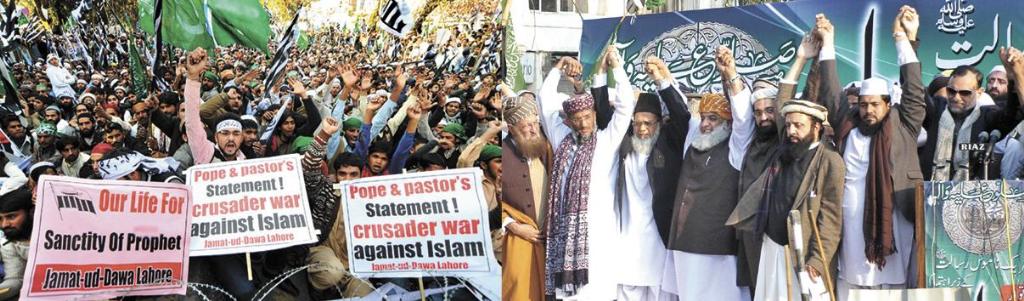
LAHORE: Thousands of people on Sunday rallied in Lahore against any proposed amendment to the blasphemy laws and unanimously vowed to defend the “Namoos-e-Risalat” (sanctity of the Holy Prophet PBUH) at any cost. The leaders threatened to stage a long march if any change was made to the blasphemy laws. The rally started from Nasser Bagh and concluded near the Faisal Chowk, a few yards away from the Punjab Assembly building. Carrying banners, flags and placards, participants of the rally chanted vociferous slogans against the government’s alleged plan to amend the blasphemy laws, and demanded death penalty for the blasphemy convicts.
Is fiqah Hanafi the real islam by Shaikh Talib ur Rehman Shah 1
URL: http://www.youtube.com/watch?v=19xOEgQ46JQ
Leaders of almost all the mainstream political and religious parties, except the Pakistan People’s Party and the Muttahida Qaumi Movement, participated in the rally. Prominent among them were: Jamiat Ulema-e-Islam-F Ameer Maulana Fazlur Rehman, Jamaat-i-Islami Ameer Syed Manawwar Hasan, Pakistan Muslim League-Q leader Ch Pervaiz Elahi, PML-N central leader MNA Khwaja Saad Rafique, Jamatud Dawa Ameer Hafiz Muhammad Saeed, Maulana Sami Ullah, Allama Ibtisam Elahi Zaheer, Azam Swati, Qari Zawar Bahadur, Hafiz Mohammed Daud Abul Khair, Ameer Hamza, PML-Z chief Ejazul Haq, Maulana Mohammed Ilyas Ghumman, MPA Maulana Ilyas Chinoti, Maulana Samiul Haq, Hafiz Akif Saeed, Hafiz Hussain Ahmad, Maulana Ataul Memon, Qari Hanif Jalandhri, Allama Sajid Mir, Maulana Amjad, Maulana Abdul Ghafoor Haidery, Sahibzada Pir Abdur Raheem, Allama Syed Sajid Naqvi, Maulana Ajmal Qadri, Hafiz Abdul Gaffoor Roparri and others.
Is fiqah Hanafi the real islam by Shaikh Talib ur Rehman Shah 2
The brothers of two young men killed by an American consulate employee, Raymond Davis, also participated in the rally. They addressed the gathering and demanded the trial of the accused under the Pakistani laws. Addressing the rally, JUI-F chief Maulana Fazlur Rehman urged the government to clarify its position on the issue of Namoos-e-Risalat without any delay. He termed the government an American agent and warned it of Tunisia and Egypt like revolts in the country. He cautioned the ‘extremist forces’ of the West that if they did not stop their war against Islam, they would have to face its consequences. He advised the newly appointed Punjab governor to visit Mumtaz Qadri in jail to show solidarity with the Muslims of Pakistan. He announced holding a public gathering in Peshawar on Feb 20.
Is fiqah Hanafi the real islam by Shaikh Talib ur Rehman Shah 3
Jamaat-i-Islami Ameer Syed Munawwar Hasan said on the occasion if the blasphemy laws were amended, neither parliament nor the rulers would survive. He said the revolutionary wave sweeping the Islamic world currently could not be kept away from Pakistan, as situation here was also ripe for a change. The JI chief said after the 9/11 incident, the US had been planning to impose a new world order all-over the world, but the Islamic movements had frustrated its designs. The US wanted to disband madrassas and religious education, but its plans have been frustrated by the religious parties in Pakistan, he added. Munawwar said it was only because of cowardice of the Pakistani rulers that the Americans were killing innocent Pakistanis in our streets. Jamaatud Dawa leader Hafiz Muhammad Saeed said he would like to ask the European Parliament and Pope Benedict the reasons for abolishing the blasphemous laws. He said laws are made to maintain law and order in society. How the abolition the Namoos-e-Risalat act will help maintain law and order in Pakistan, he asked. He called for making an international law for protecting the sanctity of all prophets of God. He asked the government to expel the ambassadors of those countries from Pakistan which were involved in blasphemy acts. Hafiz Saeed believed that Afghanistan, Kashmir and Palestine would be freed soon from the clutches of oppressed forces. PML-N leader Ch Pervaiz Elahi promised that his party would not sit in the assemblies if the government tried to pass any bill against Namoos-e-Risalat. “We curse the assembly that dares amend the Namoos-e-Risalat (PBUH) law, and our party will be the first to quit such an assembly,” added Pervaiz Elahi. PML-N leader Khwaja Saad Rafique, addressing the rally, said his party assured the religious community that Tahaffuz-e-Namoos-e-Risalat was not aimed at victimising any particular community but protecting the sanctity of Holy Prophet (PBUH). He asked the PPP leadership to join hands with the Tehreek-e-Tahaffuz-e-Namoos-e- Risalat. He said Nawaz Sharif told the American ambassador that the issue of Raymond Davis would be decided by the courts when he called on the PML-N leader. Quaid-e-Millat-e-Jafferiya Allama Sajid Naqvi said all schools of thought agreed on the Namoos-e-Risalat Act. He advised the government to accept the demands, put forward by the Tehreek-e-Tahaffuz-e-Namoos-e-Risalat. He asked the government to clear its stance whether they wanted to amend the law or not.
Fareed Paracha & Jamat-e-Islami Misquote/Distort Quran on Samaa TV & Commit Blasphemy
PML-Z leader Ejazul Haq said on the occasion the rally was a proof that nobody could repeal the Namoos-e-Risalat act. Tanzeem-e-Islami Ameer Hafiz Akif Saeed said foreign authorities were working on an agenda of maligning the Islamic identity of the country by abolishing the Islamic laws. “They succeeded in repealing the Hadood Ordinance. Now they are trying to abolish the Namoos-e-Risalat act and after this they would go for removal of constitutional clause regarding non-Muslims,” he added. Ataul Memon asked the parliamentarians and lawyers of the country to pass resolutions in their respective bar associations against the efforts made by government to make changes in the Namoos-e-Risalat act. JUI-F central leader Hafiz Hussain Ahmad warned the leaders if American Consulate employee was released, people would besiege the American Embassy and the Aiwan-e-Sadr. Allama Ibtisam Elahi Zaheer said some liberal and secular scholars, on behalf of the government, were trying to create an impression that Islam would not be affected by abolishing this act. He warned these elements of staying away from commenting on these issues. Wafaqul Madaris President Qari Muhammad Hanif termed the Namoos-e-Risalat act the jugular vein of the Muslims. Allama Sajid Mir believed death was the only punishment for the blasphemers. Maulana Abdul Gaffoor Haidery asked MNA Sherry Rehman to seek Allah forgiveness for speaking against the blasphemy laws. Maulana Samiul Haq advised the party workers to launch a movement for ‘independence’ of Pakistan from American oppression as the country had been turned into an American state. Maulana Ilyas Chinioti, Maulana Ilyas Ghumman, Ameer Hamza, Sahibzada Pir Abdur Rahim, Qari Zawar Bahadur, Maulana Amjad, Maulana Ajmal Qadri, Hafiz Abdul Gaffar Roparri and Abul Khair also asked the government to clear its position on the proposed amendments to the blasphemy laws. Agencies add: About 40,000 people rallied in Lahore in the latest protest against the proposed reforms of the blasphemy laws, police said. REFERENCE: Blasphemy law: long march to counter any change By Adnan Rashid Monday, January 31, 2011 http://www.thenews.com.pk/TodaysPrintDetail.aspx?ID=3662&Cat=13&dt=1/31/2011
Imran Khan & Dunya TV also committed Blasphemy.
URL: http://www.youtube.com/watch?v=W2B3oLxXnKI
Need to prevent misuse of Blasphemy Law Chaudhry Shujaat Hussain
LAHORE: Police as well as the Joint Investigation Team set up by the federal government to investigate January 4 assassination of governor Salman Taseer are in a sticky situation how to quiz the two clerics who had allegedly instigated the self-confessed assassin to commit the murder. The Rawalpindi trial court has already granted them pre-arrest bails besides rejecting the investigators’ plea for their custody. Mumtaz Qadri had admitted in his confessional statement that he was actually provoked for the murder by the fiery speeches of two Rawalpindi-based clerics Mufti Hanif Qureshi Qadri and Imtiaz Hussain Shah. According to Qadri’s confessional statement, Mufti Hanif Qureshi, the ameer of a Rawalpindi-based Barelvi religious outfit, Shabab-e-Islami Pakistan and Imtiaz Hussain Shah, the imam of a Rawalpindi-based Amna Masjid, had described Salmaan Taseer a “Yazeedi governor” in their December 31, 2010 speeches at a public meeting in Rawalpindi organised by the Shabab-e-Islami .
Barelvi Scholar declares that "Dobandis & Wahabis" are KAFIR.
Ashraf Ali Thanvi Deobandi Soor (Khanzeer) Pandat Thanvi ka Iqrar by Mufti Haneef Qureshi
The clerics were trying to convince the listeners, while citing certain verses of the Holy Quraan that Taseer was worth killing (Wajibul Qatal) for having committed blasphemy by labeling the blasphemy law a black law. During their speeches, the clerics narrated an event of blasphemy committed by a woman during the rule of Hazrat Abu Bakar Siddiq, the first Caliph of Islam, saying, “The governor of the area where the woman lived awarded punishment to her over the act of blasphemy. As she approached the Caliph, seeking mercy, the latter decided against her and ordered that her teeth to be broken and fingers and tongue be cut for having committed blasphemy”. As the Rawalpindi-based investigators were flexing their muscles to detain the two clerics for interrogation, Hanif Qureshi and Imtiaz Shah launched a preemptive offensive to counter any move against them. While resorting to street agitation, the two clerics staged a demonstration in Rawalpindi on January 7, to ‘pay homage’ to the assassin of Taseer. The rally culminated at the Muslim Town residence of Malik Mumtaz Qadri. The participants of the rally were chanting slogans and carrying banners and placards, inscribing pro-Qadri slogans and describing him a “Ghazi”.
Hanif Qureshi against Ameer Muaviya
Condemning the government for Qadri’s arrest, Hanif Qureshi, who also leads Friday prayers at the Jamia Rizvia Zial Uloom in Rawalpindi, praised the killer for having killed a ‘blasphemer’. He further said: “Ghazi Malik Mumtaz Qadri did this for the love of our beloved Prophet Mohammad (Peace Be upon Him). The man who called the Blasphemy Law a black law was bound to meet this end and he should not be called a martyr but a blasphemer. And Mumtaz Qadri should not be called a killer but a “Ghazi” (one who leaves the battle victorious).” Keeping in view the street power shown by Hanif Qureshi and Mumtaz Shah, the investigating agencies became defensive and decided to seek court orders for the arrest of the two clerics instead of detaining them on their own. The investigators were of the view that the arrest of the two fanatic mullahs without seeking court orders could trigger nationwide protests by their followers.
Response To Deobandi Mulla Mehmood Madni By Mufti Muhammad Hanif Qureshi
However, on January 17, 2011, an Anti Terrorism Court (ATC) in Rawalpindi refused to issue warrants for the arrest of the two clerics for the purpose of interrogation about their speeches during which they had reportedly justified killing of any blasphemer. Having heard arguments from both the sides, ATC Judge Malik Akram Awan, refused to issue the warrants on grounds of incomplete evidence. Two days later, on January 20, the ATC judge granted pre-arrest bails to Hanif Qureshi and Imtiaz Shah against surety bonds worth Rs200, 000 each. The counsel for the clerics argued before the ATC judge that his clients were not at all involved in motivating Qadri and the FIR also did not mention their names. Under these circumstances, the Rawalpindi police as well as the Joint Investigation Team are simply unable to question the suspects who have refused to cooperate in investigations of the case. The authorities will have to wait for the expiry of their pre-arrest bails before proceedings against them any further. REFERENCE: Agencies probing Taseer murder in a fix By Amir Mir Monday, January 24, 2011 http://www.thenews.com.pk/TodaysPrintDetail.aspx?ID=27431&Cat=2&dt=1/24/2011
“The judgement of apostasy and expelling someone from the religion is only appropriate for the people of knowledge who are firmly grounded in knowledge, and they are the judges in the various Sharee’ah law courts, and those who are able of giving legal verdicts. And this is just like the other matters, and it is not the right of every person, or from the right of those who are learning, or those who ascribe themselves to knowledge, but who have deficiency in understanding. It is not appropriate for them to make judgements of apostasy (upon others). Since, mischief will arise from this, and sometimes a Muslim might be judged as an apostate but he is not actually so. And the takfir of a Muslim who has not committed one of the nullifications of Islaam contains great danger. Whoever says to his brother “O Kaafir” or “O Faasiq”, and he is not like that, then the words will fall back upon the one who said them. Hence, the ones who actually judge with apostasy are the legislative judges and those who are able and fit for giving legal verdicts. And as for those who enforce the judgements they are the leaders of the Muslims (wullaat al-amr). As for whatever is other than this, then it is mere confusion.”
Barelvi Mufti Muneeb ur Rehman's Fatwa against Saudi Arabia & Deobandis.
URL: http://www.youtube.com/watch?v=6ttHNLcF8Q0
“Meting out the punishments is only appropriate for the leader of the Muslims and it is not for every person to establish the punishment, since confusion, and corruption necessarily follows from this, and also the cutting off of the society, tribulations and provocations occur. Establishing the punishments is appropriate (i.e. befits only) to the Muslim leader. The Prophet (sallallaahu alaihi wasallam) said, “Pardon each other for the punishments that are between you, but when the execution of the punishment reaches the [authority of the] Sultaan, then Allaah curses both the one who seeks intercession and the one who grants the intercession [i.e. to revoke the punishment]”. And from the responsibilities of the Sultaan in Islaam, and from those matters that befit him is the establishment of the punishments after they have been established legislatively, via the Sharee’ah law courts, upon the one who fell into the crime for which the legislator has designated a specific punishment, such as for stealing. So what has been said is that establishing the punishments (i.e. meting them out) is from the rights of the Sultaan, and when the Muslims do not have a Sultaan amongst them, then they should just suffice with commanding the good and forbidding the evil, and calling to Allaah, the Might and Majestic, with wisdom, good admonition and arguing with that which is best. And it is not permissible for individuals (in the society) to establish the hudood, since that, as we have mentioned, will bring about chaos, and also provocations, and tribulations will arise, and this contains greater corruption than it contains rectification. And from amongst the Sharee’ah principles that are submitted to is, “Repelling the harmful things takes precedence over bringing about the beneficial things”. FURTHER REFERENCES/READING: The Takfiris make unlicensed Takfeer of Governments and scholars and call the common-folk to bloody revolution as a way to remove such governments and establish Islaamic Law. http://www.salafipublications.com/sps/downloads/pdf/MSC060006.pdf
LAHORE, Jan 30: A big rally here on Sunday warned of a long march to Islamabad if the government attempted to amend the blasphemy law. A large number of charged activists of religious parties representing all schools of thought amid tight security marched from Nasser Bagh to Charing Cross on The Mall where leaders of mainstream parties like PML-N, PML-Q, PML-Z and Pakistan Tehrik-i-Insaaf also joined them. They were carrying flags of their respective parties as well as placards and banners inscribed with slogans in favour of blasphemy law and against Pope Benedict, American Congress and European Parliament. Many of them coming from adjoining areas of the provincial metropolis were also chanting slogans seeking release of Mumtaz Qadri, who had killed Punjab governor Salmaan Taseer.
Under the umbrella of Namoos-e-Risalat Tehrik, the religious parties under had been campaigning in the city for the last many days to mobilise the masses. Religious leaders visited various seminaries and some school chains run by religious schools and distributed leaflets to motivate them for joining the rally. Police made tight security arrangements to avoid any untoward incident as all routes leading to The Mall were closed to traffic and pedestrians, causing traffic jams on many city arteries, especially in the downtown area. The people willing to join the rally could enter from the Nasser Bagh or Masjid Shuhada side only after a thorough frisking and moving from walkthrough gates. Security staff was deployed on buildings along both sides of the route from Nasser Bagh to the Charing Cross.
Speaking to the participants, JUI-F chief Maulana Fazlur Rehman announced another rally in Peshawar on Feb 20. He also announced that demonstrations would be held on Fridays to maintain the momentum of the movement till Feb 20. He said the nation could put up with price hike, load-shedding and joblessness but not change in the blasphemy law. He demanded that the government take a clear stance on blasphemy law instead of making vague clarifications. Referring to the incident of killing of three people by a US citizen, he warned the rulers against setting Raymond Davis free without judicial trial, saying the people would take the law into their own hands if the government resorted to any illegal course. He advised Governor Latif Khosa to call on Mumtaz Qadri in prison as he (Khosa) was holding the office because of Qadri.
Jamaat-i-Islami chief Syed Munawar Hasan said the assemblies as well as the rulers would cease to exist if attempts were made to amend the blasphemy law. PML-Q senior leader Chaudhry Pervaiz Elahi said his party would be the first to quit the parliament if it dared to amend the law. The Q League has 50 representatives in the 342-seat National Assembly. Jamaatud Dawa amir Prof Saeed urged the rulers to work for an international legislation to curb desecration of Prophets all over the world. He said the rulers who had taken oath on the Holy Quran should decide to sever diplomatic relations with the countries where blasphemous caricatures had been published. JUP chief Sahibzada Abul Khair Zubair urged the political parties having representation in the parliament to take up the issue of protecting blasphemy law at the highest platform. Tehrik-i-Insaaf vice-president Ijaz Chaudhry pledged that his party would not allow any change in the law. He demanded public execution of Raymond Davis. MJAH chief Senator Sajid Mir said the nation had registered a strong protest against any amendment to blasphemy law. “The Ummah is unanimous that blasphemer(s) deserves only death.” Islami Tehrik chief Allama Sajid Naqvi regretted that the government was not taking a clear stance on blasphemy law only because of US pressure. PML-Z chief Ijazul Haq suggested giving a deadline to the government and if it failed to address reservations of the nation about the law, then a long march should be launched. PML-N MNA Khwaja Saad Rafiq said: “My party is very clear that blasphemy law should not be amended and efforts should be made to stop its misuse.” Ashraf Jalali, Abdul Qadri Ropri, Ibtesam Elahi Zaheer and others also spoke. REFERENCE: Blasphemy law: rally threatens long march From the Newspaper By Our Staff Reporter Yesterday http://www.dawn.com/2011/01/31/blasphemy-law-rally-threatens-long-march.html
Barelvi Shah Turabul Haq Issues Fatwa of Kufr against Imam Kaaba & Saudi Arabia.
ISLAMABAD: Top leaders of an organisation representing Deobandi madrassas across the country have reprimanded PML-N chief Nawaz Sharif for calling members of the Ahmadiyya community as “brothers” of Muslims.“Sharif should be ashamed of calling them brothers of Muslims,” said a statement issued by the Wafaqul Madaris al Arabia (WMA).Sharif said in Lahore on Saturday that Ahmadis were as important citizens of Pakistan as people from other religions and called them an asset.He made the statement to express solidarity with the Ahmadiyya community following last month’s two synchronised attacks on their places of worship in Lahore which claimed more than 80 lives with many more injured.In a statement issued here on Sunday, leaders of the Wafaqul Madaris al Arabia – an umbrella organisation of more than 12,000 Deobandi madrassas – called Ahmadis “traitors”. WMA leaders Maulana Salimullah Khan and Qari Hafeez Jahalindri urged Sharif to retract his statement and advised him not to “defy religion for petty political gains.” The statement termed the Ahmadis as “infidels” and said that they could not be brothers of Muslims until they convert to Islam again. Ahmadis were declared a minority under the 1973 constitution – a move that some people believe intensified hatred against Ahmadis. REFERENCE: Sharif’s statement on Ahmadis angers clerics Published in the Express Tribune, June 7th, 2010.http://tribune.com.pk/story/19379/sharif%E2%80%99s-statement-on-ahmadis-angers-clerics/
Barelvi Mullah Shah Turabul Haq says that Deobandi and Wahabi are Kaafir
URL: http://www.youtube.com/watch?v=zj5Z7yzzgpI
Barelvi Shah Turab ul Haq Qadri says Ashraf Ali Thanvi & Wahabis are Kaafir.
URL: http://www.youtube.com/watch?v=iab5Fm0PqzQ
“The judgement of apostasy and expelling someone from the religion is only appropriate for the people of knowledge who are firmly grounded in knowledge, and they are the judges in the various Sharee’ah law courts, and those who are able of giving legal verdicts. And this is just like the other matters, and it is not the right of every person, or from the right of those who are learning, or those who ascribe themselves to knowledge, but who have deficiency in understanding. It is not appropriate for them to make judgements of apostasy (upon others). Since, mischief will arise from this, and sometimes a Muslim might be judged as an apostate but he is not actually so. And the takfir of a Muslim who has not committed one of the nullifications of Islaam contains great danger. Whoever says to his brother “O Kaafir” or “O Faasiq”, and he is not like that, then the words will fall back upon the one who said them. Hence, the ones who actually judge with apostasy are the legislative judges and those who are able and fit for giving legal verdicts. And as for those who enforce the judgements they are the leaders of the Muslims (wullaat al-amr). As for whatever is other than this, then it is mere confusion.”
Barelvi Mufti Muneeb ur Rehman's Fatwa against Saudi Arabia & Deobandis.
“Meting out the punishments is only appropriate for the leader of the Muslims and it is not for every person to establish the punishment, since confusion, and corruption necessarily follows from this, and also the cutting off of the society, tribulations and provocations occur. Establishing the punishments is appropriate (i.e. befits only) to the Muslim leader. The Prophet (sallallaahu alaihi wasallam) said, “Pardon each other for the punishments that are between you, but when the execution of the punishment reaches the [authority of the] Sultaan, then Allaah curses both the one who seeks intercession and the one who grants the intercession [i.e. to revoke the punishment]”. And from the responsibilities of the Sultaan in Islaam, and from those matters that befit him is the establishment of the punishments after they have been established legislatively, via the Sharee’ah law courts, upon the one who fell into the crime for which the legislator has designated a specific punishment, such as for stealing. So what has been said is that establishing the punishments (i.e. meting them out) is from the rights of the Sultaan, and when the Muslims do not have a Sultaan amongst them, then they should just suffice with commanding the good and forbidding the evil, and calling to Allaah, the Might and Majestic, with wisdom, good admonition and arguing with that which is best. And it is not permissible for individuals (in the society) to establish the hudood, since that, as we have mentioned, will bring about chaos, and also provocations, and tribulations will arise, and this contains greater corruption than it contains rectification. And from amongst the Sharee’ah principles that are submitted to is, “Repelling the harmful things takes precedence over bringing about the beneficial things”. FURTHER REFERENCES/READING: The Takfiris make unlicensed Takfeer of Governments and scholars and call the common-folk to bloody revolution as a way to remove such governments and establish Islaamic Law. http://www.salafipublications.com/sps/downloads/pdf/MSC060006.pdf
“The judgement of apostasy and expelling someone from the religion is only appropriate for the people of knowledge who are firmly grounded in knowledge, and they are the judges in the various Sharee’ah law courts, and those who are able of giving legal verdicts. And this is just like the other matters, and it is not the right of every person, or from the right of those who are learning, or those who ascribe themselves to knowledge, but who have deficiency in understanding. It is not appropriate for them to make judgements of apostasy (upon others). Since, mischief will arise from this, and sometimes a Muslim might be judged as an apostate but he is not actually so. And the takfir of a Muslim who has not committed one of the nullifications of Islaam contains great danger. Whoever says to his brother “O Kaafir” or “O Faasiq”, and he is not like that, then the words will fall back upon the one who said them. Hence, the ones who actually judge with apostasy are the legislative judges and those who are able and fit for giving legal verdicts. And as for those who enforce the judgements they are the leaders of the Muslims (wullaat al-amr). As for whatever is other than this, then it is mere confusion.”
Barelvi Mufti Muneeb ur Rehman's Fatwa against Saudi Arabia & Deobandis.
URL: http://www.youtube.com/watch?v=6ttHNLcF8Q0
“Meting out the punishments is only appropriate for the leader of the Muslims and it is not for every person to establish the punishment, since confusion, and corruption necessarily follows from this, and also the cutting off of the society, tribulations and provocations occur. Establishing the punishments is appropriate (i.e. befits only) to the Muslim leader. The Prophet (sallallaahu alaihi wasallam) said, “Pardon each other for the punishments that are between you, but when the execution of the punishment reaches the [authority of the] Sultaan, then Allaah curses both the one who seeks intercession and the one who grants the intercession [i.e. to revoke the punishment]”. And from the responsibilities of the Sultaan in Islaam, and from those matters that befit him is the establishment of the punishments after they have been established legislatively, via the Sharee’ah law courts, upon the one who fell into the crime for which the legislator has designated a specific punishment, such as for stealing. So what has been said is that establishing the punishments (i.e. meting them out) is from the rights of the Sultaan, and when the Muslims do not have a Sultaan amongst them, then they should just suffice with commanding the good and forbidding the evil, and calling to Allaah, the Might and Majestic, with wisdom, good admonition and arguing with that which is best. And it is not permissible for individuals (in the society) to establish the hudood, since that, as we have mentioned, will bring about chaos, and also provocations, and tribulations will arise, and this contains greater corruption than it contains rectification. And from amongst the Sharee’ah principles that are submitted to is, “Repelling the harmful things takes precedence over bringing about the beneficial things”. FURTHER REFERENCES/READING: The Takfiris make unlicensed Takfeer of Governments and scholars and call the common-folk to bloody revolution as a way to remove such governments and establish Islaamic Law. http://www.salafipublications.com/sps/downloads/pdf/MSC060006.pdf
Excerpts from "Barailwiyyah" Late. Allama Ahsaan Ellahi Zaheer(1945–1987)
Mullahs Calling Kafir to others - Samaa TV Discussion 1/2
BAHAWALPUR, June 15: A mosque Imam was killed while a religious leader sustained critical injuries in violence caused reportedly by sectarian tension between two Sunni sects in Choonawala Mandi near Hasilpur, about 90km from here, on Thursday. According to reports reaching here, the trouble started when Hafiz Qamar Javed, prayer leader at local Masjid Ahl-e-Hadith, burnt some trash near his mosque. The fire attracted neighbours, including people from the rival sect, who propagated that Javed was burning pages from Quran. Within no time a huge mob turned up at the scene and attacked Javed. When Ahl-e-Hadith’s local leader Master Muhammad Sadiq came to his rescue, he was also beaten up severely. The assailants left the scene when the two fell unconscious. Police rushed to the scene after getting information. In a hurry, a police vehicle hit and injured Muhammad Nadeem (13). The mob then damaged the van and thrashed ASI Muhammad Nawaz, who also sustained injuries. Later, the Hasilpur DSP and tehsil nazim reached Choonawala and managed to disperse the mob. The injured were rushed to the Bahawal Victoria Hospital, Bahawalpur, where Hafiz Qamar Javed succumbed to injuries while Master Muhammad Sadiq was in precarious condition. Following an appeal, Choonawala traders’ president, shopkeepers pulled down their shutters to protest the ‘blasphemous act’. Meanwhile, it was learnt that a case under the Blasphemy Act had been registered against deceased Hafiz Qamar Javed and injured Muhammad Sadiq while no case was registered against the assailants. DPO Arif Nawaz was not available for comments. REFERENCE: Imam lynched by mob for ‘blasphemy’ By Majeed Gill http://www.dawn.com/2006/06/16/nat10.htm
Mullahs Calling Kafir to others - Samaa TV Discussion 2/2
URL: http://www.youtube.com/watch?v=YjXEat3XGFk
The Munir Commission Report (Lahore, 1954) states:
“Keeping in view the several definitions given by the ulema, need we make any comment except that no two learned divines are agreed on this fundamental? If we attempt our own definition, as each learned divine has, and that definition differs from all others, we all leave Islam’s fold. If we adopt the definition given by any one of the ulema, we remain Muslims according to the view of that alim, but kafirs according to everyone else’s definition.” The report elaborated on the point by explaining that the Deobandis would label the Barelvis as kafirs if they are empowered and vice versa, and the same would happen among the other sects. The point of the report was that if left to such religious ‘scholars’, the country would become an open battlefield. Therefore, it was suggested that Pakistan remain a democratic, secular state and steer clear of the theological path. Unfortunately, this suggestion was not heeded and, consequently, the exact opposite happened. Pakistan became hostage to the mullahs and is now paying a heavy price. Our politicians played into the hands of these fanatics for expedient political reasons and overlooked the diminishing returns from such an unwise overture.
Barelvi Shah Turab ul Haq Qadri says Ashraf Ali Thanvi & Wahabis are Kaafir.
The journey of politicising Islam began with the Objectives Resolution. Jinnah envisioned a secular Pakistan, but Liaquat Ali Khan made the mistake of adopting the Objectives Resolution in 1949 that stated, “Sovereignty belongs to Allah alone but He has delegated it to the State of Pakistan through its people for being exercised within the limits prescribed by Him as a sacred trust.” This stipulation gave the mullahs the chance they were looking for, a chance to flash their religious card and put fear in the heart of the ignorant masses. After moving the Objectives Resolution in the Constituent Assembly, Liaquat Ali Khan said, “As I have just said, the people are the real recipients of power. This naturally eliminates any danger of the establishment of a theocracy.” Although he believed in the power of the people and aimed for a secular, democratic rule, yet by bringing the name of religion into the Objectives Resolution, he gave an edge to the
mullahs who later claimed it as their licence to impose the Shariah. And so began the rise of the fanatics.
Barelvi Mullah Shah Turabul Haq says that Deobandi and Wahabi are Kaafir
URL: http://www.youtube.com/watch?v=zj5Z7yzzgpI
Ulema did not wait long to demand their share of power in running the new state. Soon after independence, Jamat-i-Islami made the achievement of an Islamic constitution its central goal. Maulana Maududi, after the creation of Pakistan, revised the conception of his mission and that of the rationale of the Pakistan movement, arguing that its sole object had been the establishment of an Islamic state and that his party alone possessed the understanding and commitment needed to bring that about. Jamat-i-Islami soon evolved into a political party, demanding the establishment of an Islamic state in Pakistan. It declared that Pakistan was a Muslim state and not an Islamic state since a Muslim State is any state which is ruled by Muslims while an Islamic State is one which opts to conduct its affairs in accordance with the revealed guidance of Islam and accepts the sovereignty of Allah and the supremacy of His Law, and which devotes its resources to achieve this end. According to this definition, Pakistan was a Muslim state ruled by secular minded Muslims. Hence the Jamat-i-Islami and other religious leaders channeled their efforts to make Pakistan an "Islamic State."
Sufi Muhammad says Pakistanis are Kaafir
URL: http://www.youtube.com/watch?v=jIdlolpTqyo
Syed Munawar Hasan says Sufi Muhammad is Kaafir
URL: http://www.youtube.com/watch?v=Gf0SNuMj8GY
Maulana Maududi argued that from the beginning of the struggle for Pakistan, Moslems had an understanding that the center of their aspirations, Pakistan, would be an Islamic state, in which Islamic law would be enforced and Islamic culture would be revived. Muslim League leaders, in their speeches, were giving this impression. Above all, Quaid-i-Azam himself assured the Muslims that the constitution of Pakistan would be based on the Quran. This contrasts to his views about the Muslim League leaders before independence: Not a single leader of the Muslim League, from Quad-i-Azam, downwards, has Islamic mentality and Islamic thinking or they see the things from Islamic point of view. To declare such people legible for Muslim leadership, because they are expert in western politics or western organization system and have concern for the nation, is definitely ignorance from Islam and amounts to an un-Islamic mentality. On another occasion, Maulana Maududi said it was not clear either from any resolution of the Muslim League or from the speeches of any responsible League leaders, that the ultimate aim of Pakistan is the establishment of an Islamic government.....Those people are wrong who think that if the Muslim majority regions are emancipated from the Hindu domination and a democratic system is established, it would be a government of God. As a matter of fact, in this way, whatever would be achieved, it would be only a non-believers government of the Muslims or may be more deplorable than that.
JI Ameer Syed Munawar Hassan has no sense of History & Facts.
URL: http://www.youtube.com/watch?v=G281EOM2r54
Blasphemy & KUFR in Deobandi Books
URL: http://www.youtube.com/watch?v=SVZLIZbv31M
When the question of constitution-making came to the forefront, the Ulema, inside and outside the Constitutional Assembly and outside demanded that the Islamic Shariah shall form the only source for all legislature in Pakistan.
In February 1948, Maulana Maududi, while addressing the Law College, Lahore, demanded that the Constitutional Assembly should unequivocally declare:
1. That the sovereignty of the state of Pakistan vests in God Almighty and that the government of Pakistan shall be only an agent to execute the Sovereign's Will.
2. That the Islamic Shariah shall form the inviolable basic code for all legislation in Pakistan.
3. That all existing or future legislation which may contravene, whether in letter or in spirit, the Islamic Shariah shall be null and void and be considered ultra vires of the constitution; and
4. That the powers of the government of Pakistan shall be derived from, circumscribed by and exercised within the limits of the Islamic Shariah alone. On January 13, 1948, Jamiat-al-Ulema-i-Islam, led by Maulana Shabbir Ahmad Usmani, passed a resolution in Karachi demanding that the government appoint a leading Alim to the office of Shaikh al Islam, with appropriate ministerial and executive powers over the qadis throughout the country. The Jamiat submitted a complete table of a ministry of religious affairs with names suggested for each post. It was proposed that this ministry be immune to ordinary changes of government. It is well known that Quaid-i-Azam was the head of state at this time and that no action was taken on Ulema's demand. On February 9, 1948, Maulana Shabbir Ahmad Usmani, addressing the Ulema-i-Islam conference in Dacca, demanded that the Constituent Assembly "should set up a committee consisting of eminent ulema and thinkers... to prepare a draft ... and present it to the Assembly.
Barelvi Scholar Irfan Shah Declare s Deobandi & Qadiyani are both Kaafir
URL: http://www.youtube.com/watch?v=pslHFO27vsY
It was in this background that Prime Minister Liaquat Ali Khan, on March 7, 1949, moved the Objectives Resolution in the Constituent Assembly, according to which the future constitution of Pakistan was to be based on " the principles of democracy, freedom, equality, tolerance and social justice as enunciated by Islam."
While moving the Resolution, he said: "Sir, I consider this to be a most important occasion in the life of this country, next in importance only to the achievement of independence, because by achieving independence we only won an opportunity of building up a country and its polity in accordance with our ideals. I would like to remind the house that the Father of the Nation, Quaid-i-Azam, gave expression of his feelings on this matter on many an occasion, and his views were endorsed by the nation in unmistakable terms, Pakistan was founded because the Muslims of this sub-continent wanted to build up their lives in accordance with the teachings and traditions of Islam, because they wanted to demonstrate to the world that Islam provides a panacea to the many diseases which have crept into the life of humanity today."
The resolution was debated for five days. The leading members of the government and a large number of non-Muslim members, especially from East Bengal, took a prominent part. Non-Muslim members expressed grave apprehensions about their position and role in the new policy.
Hindu members of the Constitutional Assembly argued that the Objectives Resolution differed with Jinnah's view in all the basic points. Sris Chandra Chattopadhyaya said: "What I hear in this (Objectives) Resolution is not the voice of the great creator of Pakistan - the Quaid-i-Azam, nor even that of the Prime Minister of Pakistan the Honorable Mr. Liaquat Ali Khan, but of the Ulema of the land." Birat Chandra Mandal declared that Jinnah had "unequivocally said that Pakistan will be a secular state." Bhupendra Kumar Datta went a step further: ...were this resolution to come before this house within the life-time of the Great Creator of Pakistan, the Quaid-i-Azam, it would not have come in its present shape...."
The leading members of the government in their speeches not only reassured the non-Muslims that their position was quite safe and their rights were not being impaired but also gave clarifications with regard to the import of the Resolution. Sardar Abdur Rab Nishtar, the Deputy Leader of the House, while defending the Resolution said: "It was remarked by some honorable members that the interpretation which the mover of this Resolution has given is satisfactory and quite good, but Mr. B.C. Mandal says: "Well tomorrow you may die, I may die, and the posterity may misinterpret it." First of all, I may tell him and those who have got some wrong notions about the interpretation of this resolution that this resolution itself is not a constitution. It is a direction to the committee that will have to prepare the draft keeping in view these main features. The matter will again come to the House in a concrete form, and all of us will get an opportunity to discuss it."
In his elucidation of the implications of the Objectives Resolution in terms of the distribution of power between God and the people, Omar Hayat Malik argued: "The principles of Islam and the laws of Islam as laid down in the Quran are binding on the State. The people or the state cannot change these principles or these laws...but there is a vast field besides these principles and laws in which people will have free play...it might be called by the name of 'theo-cracy', that is democracy limited by word of God, but as the word 'theo' is not in vogue so we call it by the name of Islamic democracy.
Barelvi Scholar Irfan Shah declares that Dr Tahir ul Qadri is Kaafir
URL: http://www.youtube.com/watch?v=cEtDNkHFjkg
Ishtiaq Hussain Qureshi further elaborated the concept of Islamic democracy: Since Islam admits of no priest craft, and since the dictionary meaning of the term "secular" is non-monastic -- that is, "anything which is not dependent upon the sweet will of the priests," Islamic democracy, far from being theocracy, could in a sense be characterized as being "secular." However, he believed that if the word "secular" means that the ideals of Islam, that the fundamental principles of religion, that the ethical outlook which religion inculcates in our people should not be observed, then, I am afraid,...that kind of secular democracy can never be acceptable to us in Pakistan.
During the heated debate, Liaquat Ali Khan stressed:
the Muslim League has only fulfilled half of its mission (and that) the other half of its mission is to convert Pakistan into a laboratory where we could experiment upon the principles of Islam to enable us to make a contribution to the peace and progress of mankind. He was hopeful that even if the body of the constitution had to be mounted in the chassis of Islam, the vehicle would go in the direction he had already chosen. Thus he seemed quite sure that Islam was on the side of democracy. "As a matter of fact it has been recognized by non-Muslims throughout the world that Islam is the only society where there is real democracy." In this approach he was supported by Maulana Shabbir Ahmad Usmani: " The Islamic state is the first political institution in the world which stood against imperialism, enunciated the principle of referendum and installed a Caliph (head of State) elected by the people in place of the king."
Barelvi Aalim Irfan Shah Declares everybody Kaafir
URL: http://www.youtube.com/watch?v=1426w9LpA9c
The opposite conclusion, however, was reached by the authors of the Munir Report (1954) who said that the form of government in Pakistan cannot be described as democratic, if that clause of the Objectives Resolution reads as follows: " Whereas sovereignty over the entire Universe belongs to Allah Almighty alone, and the authority which He has delegated to the state of Pakistan through its people for being exercised within the limits prescribed by Him is a sacred trust." Popular sovereignty, in the sense that the majority of the people has the right to shape the nation's institutions and policy in accordance with their personal views without regard to any higher law, cannot exist in an Islamic state, they added.
The learned authors of the Munir Report felt that the Objectives Resolution was against the concept of a sovereign nation state. Corroboration of this viewpoint came from the Ulema themselves, (whom the Munir Committee interviewed) "including the Ahrar" and erstwhile Congressites with whom before the partition this conception of a modern national state as against an Islamic state was almost a part of their faith. The Ulema claimed that the Quaid-i-Azam's conception of a modern national state....became obsolete with the passing of the Objectives Resolution on 12th March 1949.
Justice Mohammad Munir, who chaired the committee, says that "if during Quaid-i-Azam's life, Liaquat Ali Khan, Prime Minister had even attempted to introduce the Objectives resolution of the kind that he got through the Assembly, the Quaid-i-Azam would never have given his assent to it.
In an obvious attempt to correct the erroneous notion that the Objectives Resolution envisaged a theocratic state in Pakistan, Liaquat Ali Khan repeatedly returned to the subject during his tour of the United States (May-June 1950). In a series of persuasive and eloquent speeches, he argued that "We have pledged that the State shall exercise its power and authority through the chosen representatives of the people. In this we have kept steadily before us the principles of democracy, freedom equality, tolerance and social justice as enunciated by Islam. There is no room here for theocracy, for Islam stands for freedom of conscience, condemns coercion, has no priesthood and abhors the caste system. It believes in equality of all men and in the right of each individual to enjoy the fruit of his or her efforts, enterprise, capacity and skill -- provided these be honestly employed."
Barelvi Mullah attacks Debandis
URL: http://www.youtube.com/watch?v=fuDfAAj4Myg
Barelvi Scholar says Namaz is not allowed behind Wahabi/Deoabndi Kafir
URL: http://www.youtube.com/watch?v=7uyZiXIcT1w
Barelvi Scholar declares that "Dobandis & Wahabis" are KAFIR.
The Objectives Resolution was approved on March 12, 1949. Its only Muslim critic was Mian Iftikhar-ud-din, leader of the Azad Pakistan Party, although he believed that "the Islamic conception of a state is, perhaps as progressive, as revolutionary, as democratic and as dynamic as that of any other state or ideology."
According to Munir, the terms of the Objectives Resolution differ in all the basic points of the Quaid-i-Azam's views e.g:
1. The Quaid-i-Azam has said that in the new state sovereignty would rest with the people. The Resolution starts with the statement that sovereignty rests with Allah. This concept negates the basic idea of modern democracy that there are no limits on the legislative power of a representative assembly.
2. There is a reference to the protection of the minorities of their right to worship and practice their religion, whereas the Quaid-i-Azam had stated that there would be no minorities on the basis of religion.
3. The distinction between religious majorities and minorities takes away from the minority, the right of equality, which again is a basic idea of modern democracy.
4. The provision relating to Muslims being enabled to lead their life according to Islam is opposed to the conception of a secular state.
It was natural that with the terms of the Resolution, the Ulema should acquire considerable influence in the state. On the strength of the Objectives Resolution they made the Ahmadis as their first target and demanded them to be declared a minority.
After the adoption of Objectives Resolution, Liaquat Ali Khan moved a motion for the appointment of a Basic Principles Committee consisting of 24 members, including himself and two non-Muslim members, to report the house on the main principles on which the constitution of Pakistan is to be framed. A Board of Islamic Teaching was set up to advise the Committee on the Islamic aspects of the constitution.
In the course of constitutional debates, a number of very crucial issues were raised that caused much controversy, both inside and outside the Constituent Assembly over specific questions such as the following:
1) The nature of the Islamic state: the manner in which the basic principles of Islam concerning state, economy, and society were to be incorporated into the constitution.
2) The nature of federalism: questions of provincial autonomy vis-a-vis federal authority with emphasis on the problems of representation on the basis of population and the equality of the federating units; the structure of the federal legislature -- unicameral or bicameral.
3) The form of government: whether it was to be modeled on the British or the U.S. pattern -- parliamentary or presidential.
4) The problem of the electorate: serious questions of joint (all confessional groups vote in one election) versus separate (each confessional group votes separately for its own candidates) electorate.
5) The question of languageboth national and regional. These very fundamental issues divided the political elites of Pakistan into warring factions that impeded the process of constitution-making.
Mullah says they are "United" for Islamic System in Pakistan and now watch the Fatwa of Kufr (apostasy) issued by Tahirul Qadri against a group of Muslims:) -
URL: http://www.youtube.com/watch?v=v1oR0Q4QjEU
Deobandis & Barelvis also commit Blasphemy Part - 1
URL: http://www.youtube.com/watch?v=PO09RLEzefc
Deobandis & Barelvis also commit Blasphemy Part - 2