Showing posts with label Gulf War. Show all posts

Friday, September 13, 2013

Saudi Arabia, Syria, Chemical Weapons & Paid Salafi Mullahs.


Since the start of this Syrian Crisis, the Mullahs in Pakistan particularly the Saudi Arabian paid and backed Salafi-Ahl-e-Hadith or Wahhabi Mullahs are trying their best to justify US Attack on Syria. One should listen to their demented logic wherein they bring in the Scripture to justify such attacks on Syria while completely forgetting that the same Syria was once an ally of the same Saudi Arabia under USA during the First Gulf War in 1990. Even more tragic is the fact that these Mullah attack the Prrint and Electronic Media for narrating the facts regarding Saudi role in the recent crisis in the Middle East. They say that people should not pay heed to the Media who is after maligning the Kingdom of Saudi Arabia whereas the same Mullahs quote the Western Media against the Syrian Government. Quite a tragedy! Muslim in general and South Asian Muslim in particular praise the Kingdom of Saudi Arabia and Revival of Ottoman Caliphate in the same breath, whereas it was the House of Saud and Hanbali Cleric Sheikh Muhammad Bin Abdel Wahab who revolted against Ottoman Caliphate around 200 years ago. When Saddam invaded Kuwait - [Immediately a Fatwa was issued against Saddam - "During the Iran-Iraq war, Saudi Arabia bankrolled the Saddam Hussein regime with the express approval of Washington DC which at that time saw Saddam Hussein as a bulwark against Shia fundamentalism. It came as a terrific shock to the Saudi Royals when Saddam Hussein turned his attention to Kuwait and Saudi Arabia. Again, the Royal family turned to the Ulema and obtained (with difficulty) a Fatwa, permitting the use of non-Muslim foreign troops on Saudi soil to defend Saudi Arabia against a foreign invader - one the Ulema regarded as a secular apostate. Thus the Saudi Royal family invited the USA to send it its troops for Operation Desert Storm- the operation to defend Saudi Arabia and liberate Kuwait - largely at Saudi expense." As per 9/11 Commission Report “In August 1990, Iraq invaded Kuwait. Bin Ladin, whose efforts in Afghanistan had earned him celebrity and respect, proposed to the Saudi monarchy that he summon mujahideen for a jihad to retake Kuwait. He was rebuffed, [Saudi Fatwa issued in 90s against Osama Bin Ladin - http://www.scribd.com/doc/98399399/Saudi-Fatwa-on-Usaamah-Ibn-Laadin-Al-Khaarijee Usama Ibn Ladin Al-Kharijee (our position toward him and his likes) - By Abdul Aziz Ibn Abdullaah Ibn Baz ] and the Saudis joined the U.S.-led coalition. After the Saudis agreed to allow U.S. armed forces to be based in the Kingdom, Bin Ladin and a number of Islamic clerics began to publicly denounce the arrangement. The Saudi government exiled the clerics and undertook to silence Bin Ladin by, among other things, taking away his passport. With help from a dissident member of the royal family, he managed to get out of the country under the pretext of attending an Islamic gathering in Pakistan in April 1991.” The most Funny thing is the fact that Saudi Backed/Paid Pakistani Mullahs praise Saudi Arabia and Osama Bin Laden in the same breath and never ever quote what the Saudi Mullahs said on Osama Bin Laden. Please do note how the Saddam Hussein was supported by the same Saudi Arabia during Iran Iraq War in the 80s.


PBS Frontline - The House Of Saud (Feb 2005) from Spike1138 on Vimeo.

Saudi Arabian Fatwa of Apostasy against Saddam Hussein


"QUOTE"

 Misconception: The Islaamic Threat In recent years, a great deal of attention in the media have been given to the threat of "Islaamic Fundamentalism". Unfortunately, due to a twisted mixture of biased reporting in the Western media and the actions of some ignorant Muslims, the word "Islaam" has become almost synonymous with "terrorism". However, when one analyses the situation, the question that should come to mind is: Do the teachings of Islaam encourage terrorism? The answer: Certainly not! Islaam totally forbids the terrorist acts that are carried out by some misguided people. It should be remembered that all religions have cults and misguided followers, so it is their teachings that should be looked at, not the actions of a few individuals. Unfortunately, in the media, whenever a Muslim commits a heinous act, he is labeled a "Muslim terrorist". However, when Serbs murder and rape innocent women in Bosnia, they are not called "Christian terrorists", nor are the activities in Northern Ireland labeled "Christian terrorism". Also, when right-wing Christians in the U. S. bomb abortion clinics, they are not called "Christian terrorists". Reflecting on these facts, one could certainly conclude that there is a double-standard in the media! Although religious feelings play a significant role in the previously mentioned "Christian" conflicts, the media does not apply religious labels because they assume that such barbarous acts have nothing to do with the teachings of Christianity. However, when something happens involving a Muslim, they often try to put the blame on Islaam itself - and not the misguided individual.

 Certainly, Islaamic Law (Sharee'ah) allows war - any religion or civilisation that did not would never survive - but it certainly does not condone attacks against innocent people, women or children. The Arabic word "jihaad", which is often translated as "Holy War", simply means "to struggle". The word for "war" in Arabic is "harb", not "jihaad". "Struggling", i.e. "making jihaad", to defend Islaam, Muslims or to liberate a land where Muslims are oppressed is certainly allowed (and even encouraged) in Islaam. However, any such activities must be done according to the teachings of Islaam. Islaam also clearly forbids "taking the law into your own hands", which means that individual Muslims cannot go around deciding who they want to kill, punish or torture. Trial and punishment must be carried out by a lawful authority and a knowledgeable judge. Also, when looking at events in the Muslim World, it should be kept in mind that a long period of colonialism ended fairly recently in most Muslim countries. During this time, the people in these countries were culturally, materially and religiously exploited - mostly by the so-called "Christian" nations of the West. This painful period has not really come to an end in many Muslim countries, where people are still under the control of foreign powers or puppet regimes supported by foreign powers. Also, through the media, people in the West are made to believe that tyrants like Saddam Hussein in Iraq and Moamar Qaddafi in Libya are "Islaamic" leaders - when just the opposite is true. Neither of these rulers even profess Islaam as an ideology, but only use Islaamic slogans to manipulate their powerless populations. They have about as much to do with Islaam as Hitler had to do with Christianity! In reality, many Middle Eastern regimes which people think of as being "Islaamic" oppress the practice of Islaam in their countries. So suffice it to say that "terrorism" and killing innocent people directly contradicts the teachings of Islaam. .......... Prepared by: Abu 'Iyaad REFERENCE: Misconception: The Islaamic Threat http://www.fatwa-online.com/aboutislaam/0020221.htm http://www.fatwa-online.com/index.htm http://www.fatwa-online.com/worship/jihaad/jih009/index.htm

Question: O esteemed Shaykh, what is happening now (in Iraaq) so what is the position of the Muslim towards this trial, and is there a Jihaad, and are do those soldiers who are in the Gulf have the ruling of being mujaahideen, and may Allaah reward you. Shaykh Ubayd al-Jaabiree: I dont know why this question (is asked) when, when we have just ended the speech with what I consider to comprise the answer to it and to its likes. However, despite this, just so that it is said, that Ubayd has neglected some of the questions. So I say: Firstly, not all of the Iraaqi society is Muslim. Rather, amongst them is the Marxist, amongst them is the Ba'athist Heretic, and amongst them are numerous orientations. And there are Muslims amongst them... And amongst them are the Raafidah. And the positions of the Scholars towards the Raafidah is well known, amongst them are those who declared them Disbelievers.

 Secondly, we have Rulers and those who have authority, and it is obligatory to give them hearing and obedience, and around our rulers are those who have knowledge, and experience, and speciality in the political affairs. So we do not undermine them, and we have already mentioned previously that the general affairs are not for just any person. Rather, they are for whom? For those in authority. And as it is appropriate, I also say that those who call to cutting off from the products of America and Britain and others, then those people have a resemblance to the Raafidah. Shaykh ul-Islaam Ibn Taymiyyah mentions in Minhaaj us-Sunnah, in the first volume, and I believe it is page 38, "From the stupidity of the Raafidah is that they do not drink from the river that was unearthed (i.e. dug out, like a well) by Yazeed".


So those Harakiyyoon and Hizbiyyoon, have resembled the Raafidah. And what an evil model (that is). And the most repugnant for a person that his model, and way is that of the Raafidah. Thirdly, the banner of fighting in Iraaq, who is carrying it? It is carried by Saddaam Hussain at-Takreetee, and he is the leader of the Ba'athi Party in his land...and the Ba'athi Party, is secularist, disbelieving, heretical. Its foundation is upon mixing and not differentiating between a Sunni Muslim, Guidance from the Scholars Concerning Iraaq and between the Jew, Christian, Communist, and others. They are all the same, equal. And for this reason, their slogan is, as their poet has said: I believe in, -- (Shaykh Ubayd): I seek refuge in Allaah -- I believe in al-Ba'ath as the Lord which has no partner And in Arabism as a religion, which has no other (religion) This is their religion, qawmiyyah (nationalism) and shu'oobiyyah, and their religion is not Islaam. So built upon this, the one who fights under the banner of the Iraaqi government, then he is fighting under a banner of disbelief. And we do not dispute that the people of Iraaq have the right to defend themselves. They can defend themselves, their blood, their honour and their wealth, they can defend those who transgress upon them, whether America or Britain or other than them. So it is obligatory upon us, the community of Muslims that we ask Allaah in our supplication that He delivers the Muslims amongst the people of Iraaq. So whoever said O Allaah save the [Iraaqi Society]1 , then he has erred. This supplication of his reaches even the Marxist and the Communist. And the Ba'ath Party is at the front of the [supplication of the] one who supplicates for the Iraaqi society (in general). No, but supplicate to Allaah that He delivers the Muslims amongst the people of Iraaq. And that he relieves them of their distress. This is what I can add now. .......... Translated by: Abu 'Iyaad REFERENCE: NEWS\ Monday 31 March 2003 Shaykh 'Ubayd al-Jaabiree on the Position Towards Iraq From a Paltalk Session today 31/03/2003 at 8:30pm UK Time http://www.fatwa-online.com/news/0030331.htm

 "UNQUOTE"


Arundhatti Roy -- Never mind that forty years ago, the CIA, under President John F Kennedy, orchestrated a regime change in Baghdad. In 1963, after a successful coup, the Ba'ath party came to power in Iraq. Using lists provided by the CIA, the new Ba'ath regime systematically eliminated hundreds of doctors, teachers, lawyers and political figures known to be leftists. An entire intellectual community was slaughtered. (The same technique was used to massacre hundreds of thousands of people in Indonesia and East Timor.) The young Saddam Hussein was said to have had a hand in supervising the bloodbath. In 1979, after factional infighting within the Ba'ath Party, Saddam Hussein became the President of Iraq. In April 1980, while he was massacring Shias, the US National Security Advisor Zbigniew Brzezinksi declared, "We see no fundamental incompatibility of interests between the United States and Iraq." Washington and London overtly and covertly supported Saddam Hussein. They financed him, equipped him, armed him and provided him with dual-use materials to manufacture weapons of mass destruction. They supported his worst excesses financially, materially and morally. They supported the eight-year war against Iran and the 1988 gassing of Kurdish people in Halabja, crimes which 14 years later were re-heated and served up as reasons to justify invading Iraq. After the first Gulf War, the 'Allies' fomented an uprising of Shias in Basra and then looked away while Saddam Hussein crushed the revolt and slaughtered thousands in an act of vengeful reprisal. REFERENCE: Instant-Mix Imperial Democracy. Buy One, Get One Free ARUNDHATI ROY MAGAZINE | MAY 26, 2003 http://www.outlookindia.com/article.aspx?220224


Shaking Hands: Iraqi President Saddam Hussein greets Donald Rumsfeld, then special envoy of President Ronald Reagan, in Baghdad on December 20, 1983. -- A Saddam Chronology By Stephen Shalom: Despite the fact that Iraq had been the aggressor in this war and that Iraq was the first to use chemical weapons, the first to launch air attacks on cities, and the initiator of the tanker war, the United States tilted toward Iraq. The U.S. removed Iraq from its list of terrorist states in 1982, sent Donald Rumsfeld to Baghdad as Reagan’s envoy to meet with Saddam Hussein in 1983 and 1984 to discuss economic cooperation, re-established diplomatic relations in November 1984, made available extensive loans and subsidies, provided intelligence information, encouraged its allies to arm Iraq, and engaged in military actions in the Persian Gulf against Iran. The United States also provided dual-use equipment that it knew Iraq was using for military purposes. (Joyce Battle, ed., “Shaking Hands with Saddam Hussein: The U.S. Tilts toward Iraq, 1980-1984,” National Security Archive Electronic Briefing Book No. 82, Feb. 25, 2003, http://www2.gwu.edu/~nsarchiv/NSAEBB/NSAEBB82/ .Reference: A Saddam Chronology Setting the record straight about the U.S. and Saddam Hussein By Stephen Shalom http://www.zcommunications.org/a-saddam-chronology-by-stephen-shalom.html


Donald Rumsfeld and Saddam Hussein by 0110110x


2013 Saudis press Kerry for hard line on Syria: JEDDAH, June 25: Saudi Arabia on Tuesday pressed for global action to end Syrian President Bashar al Assad’s government, telling US Secretary of State John Kerry that the civil war had turned into “genocide”. Kerry met Saudi leaders as part of a regional tour in which he has called for greater support for Syria’s rebels, but stressed that the United States ultimately wanted a political solution that includes all sides. Saudi Foreign Minister Prince Saud al Faisal told Kerry that Assad has waged “unprecedented genocide” through the more than two-year conflict that has claimed nearly 100,000 lives. “The kingdom demands a clear, unequivocal international resolution that bans any sort of weapons support for the Syrian regime and declares null and void the legitimacy of that regime,” Prince Faisal said at a joint news conference. “The regime’s illegitimacy eliminates any possibility of it being part of any arrangement or playing any role whatsoever in shaping the present and future,” he said. Faisal also voiced dismay at the role of Iran, which has poured assistance to Assad to save its main Arab ally. Hezbollah, the Lebanese group backed by Iran, has increasingly fought alongside government forces in Syria. “Along with the regime’s genocide against its own people, this adds an even deadlier element in the form of an all-out foreign invasion,” Prince Faisal said of Iran’s role. President Barack Obama has vowed to step up support for the rebels after concluding that Assad defied warnings and used chemical weapons. But Obama is cautious about deeper involvement in an increasingly sectarian conflict. US policymakers have privately voiced concern that Saudi Arabia and Qatar could embrace hardline Sunni guerillas in strategically placed Syria if Western powers leave a vacuum. Despite the Saudi foreign minister’s stance, Kerry said that the United States supported an agreement last year in Geneva that would create a transitional government that includes both the rebels and regime, although not Assad himself. “We believe that the best solution is a political solution in which the people of Syria have an opportunity to be able to make a choice about their future,” Kerry said. “We believe that every minority can be respected, there can be diversity and pluralism and that the people can do so in a climate of peace,” he said. Kerry also paid his day trip to Jeddah to compare notes on the Middle East peace process — one of his key priorities — and on the chaotic politics of Egypt, where Saudi Arabia is considered to hold key influence.—AFP Saudis press Kerry for hard line on Syria http://x.dawn.com/2013/06/26/saudis-press-kerry-for-hard-line-on-syria/


The Persian Gulf War 1990 to 1991 (Operation Desert Storm) - 1


The Persian Gulf War 1990 to 1991 (Operation... by SalimJanMazari


1990 Syria`s Support Of U.s. In Gulf War Paying Dividends -- DAMASCUS, SYRIA — When Syria joined its old foe, the United States, in going to war against Iraq, the public here was shocked and outraged. Iraqi President Saddam Hussein was highly popular in Syria, and a group of Syrian writers and other intellectuals took the almost unprecedented step of issuing a public protest over Syria`s involvement in the war. Any dissent from government policies has been a distinctly unhealthy activity since President Hafez Assad came to power 21 years ago and established one of the most ruthless regimes in the Middle East. The intellectuals apparently escaped arrest-and worse-but their protest was a measure of the depth of public feeling. The resentment has not entirely died down, according to Western diplomats, but it has moderated: Syrians are beginning to realize that the war has paid dividends. A year ago Syria, which always has aspired to a leadership role in Arab affairs, was isolated and resented by most of its neighbors. Now it has forged an alliance with Egypt and Saudi Arabia, and has joined with Egypt in providing the bulk of the troops for a new Arab peacekeeping force in the Persian Gulf region. It has received about $2.5 billion in assistance from the gulf states and Japan, and its role in the peacekeeping force promises another sizable windfall. Although serious concerns about Syria`s record on terrorism and human rights continue to trouble the relationship with Washington, Assad finds himself courted by the Bush administration. President Bush met with him in Geneva in November, and Secretary of State James A. Baker III arrives Wednesday in Damascus for his third visit since the gulf crisis erupted in August. The Bush administration credits Syria with helping to restrain terrorist groups that might have targeted U.S. and other Western interests during the war with Iraq. The newly forged relationship with the U.S. provides a balance in Syrian foreign policy that had been lacking. For years Assad maintained a hostile view of the U.S. and put all his eggs in the Soviet basket. The Soviet Union was his principal arms supplier and closest ally. As one Western diplomat observed, superpower relations with Syria were a zero-sum game: Any gain for Syria was a Soviet gain, and any gain for Israel was an American gain. But Soviet President Mikhail Gorbachev`s refusal to supply Syria with sophisticated weaponry, and his decision to allow a mass migration of Soviet Jews to Israel, caused Assad to rethink his position and to begin cultivating the West-especially the U.S. REFERENCE: Syria`s Support Of U.s. In Gulf War Paying Dividends March 12, 1991|By Ray Moseley, Chicago Tribune. http://articles.chicagotribune.com/1991-03-12/news/9101220963_1_syria-president-hafez-assad-peacekeeping-force


The Persian Gulf War 1990 to 1991 (Operation Desert Storm) - 2


The Persian Gulf War 1990 to 1991 (Operation... by SalimJanMazari


King Abdullah of Saudi Arabia has repeatedly urged the United States to attack Iran to destroy its nuclear programme, according to leaked US diplomatic cables that describe how other Arab allies have secretly agitated for military action against Tehran. The revelations, in secret memos from US embassies across the Middle East, expose behind-the-scenes pressures in the scramble to contain the Islamic Republic, which the US, Arab states and Israel suspect is close to acquiring nuclear weapons. Bombing Iranian nuclear facilities has hitherto been viewed as a desperate last resort that could ignite a far wider war. The Saudi king was recorded as having "frequently exhorted the US to attack Iran to put an end to its nuclear weapons programme", one cable stated. "He told you [Americans] to cut off the head of the snake," the Saudi ambassador to Washington, Adel al-Jubeir said, according to a report on Abdullah's meeting with the US general David Petraeus in April 2008. The cables also highlight Israel's anxiety to preserve its regional nuclear monopoly, its readiness to go it alone against Iran – and its unstinting attempts to influence American policy. The defence minister, Ehud Barak, estimated in June 2009 that there was a window of "between six and 18 months from now in which stopping Iran from acquiring nuclear weapons might still be viable". After that, Barak said, "any military solution would result in unacceptable collateral damage." REFERENCE: Saudi Arabia urges US attack on Iran to stop nuclear programme BY Ian Black and Simon Tisdall The Guardian, Sunday 28 November 2010 20.54 GMT http://www.theguardian.com/world/2010/nov/28/us-embassy-cables-saudis-iran


Prince Bandar, Osama Bin Laden, Saudi Arabia and Syria


Prince Bandar, Osama Bin Laden, Saudi Arabia... by SalimJanMazari


Saudi Arabia, UAE financing extremism in south Punjab: Department stated that “financial support estimated at nearly 100 million USD annually was making its way to Deobandi and Ahl-i-Hadith clerics in south Punjab from organisations in Saudi Arabia and the United Arab Emirates ostensibly with the direct support of those governments.” The cable sent in November 2008 by Bryan Hunt, the then Principal Officer at the US Consulate in Lahore, was based on information from discussions with local government and non-governmental sources during his trips to the cities of Multan and Bahawalpur. Quoting local interlocutors, Hunt attempts to explain how the “sophisticated jihadi recruitment network” operated in a region dominated by the Barelvi sect, which, according to the cable, made south Punjab “traditionally hostile” to Deobandi and Ahl-i-Hadith schools of thought. Hunt refers to a “network of Deobandi and Ahl-i-Hadith mosques and madrassahs” being strengthened through an influx of “charity” which originally reached organisations “such as Jamaat-ud-Dawa and Al-Khidmat foundation”. Portions of these funds would then be given away to clerics “in order to expand these sects’ presence” in a relatively inhospitable yet “potentially fruitful recruiting ground”. Outlining the process of recruitment for militancy, the cable describes how “families with multiple children” and “severe financial difficulties” were generally being exploited for recruitment purposes. Families first approached by “ostensibly ‘charitable’” organisations would later be introduced to a “local Deobandi or Ahl-i-Hadith maulana” who would offer to educate the children at his madrassah and “find them employment in the service of Islam”. “Martyrdom” was also “often discussed”, with a final cash payment to the parents. “Local sources claim that the current average rate is approximately Rs 500,000 (approximately USD 6,500) per son,” the cable states. Children recruited would be given age-specific indoctrination and would eventually be trained according to the madrassah teachers’ assessment of their inclination “to engage in violence and acceptance of jihadi culture” versus their value as promoters of Deobandi or Ahl-i-Hadith sects or recruiters, the cable states. Recruits “chosen for jihad” would then be taken to “more sophisticated indoctrination camps”. “Locals identified three centres reportedly used for this purpose”. Two of the centres were stated to be in the Bahawalpur district, whereas one was reported as situated “on the outskirts of Dera Ghazi Khan city”. These centres “were primarily used for indoctrination”, after which “youths were generally sent on to more established training camps in the Federally Administered Tribal Areas and then on to jihad either in FATA, NWFP, or as suicide bombers in settled areas”. The cable goes on to quote local officials criticising the PML-N-led provincial and the PPP-led federal governments for their “failure to act” against “extremist madrassas, or known prominent leaders such as Jaish-i-Mohammad’s Masood Azhar”. The Bahawalpur district nazim at the time told Hunt that despite repeatedly highlighting the threat posed by extremist groups and indoctrination centres to the provincial and federal governments, he had received “no support” in dealing with the issue unless he was ready to change his political loyalties. The nazim, who at the time was with the PML-Q, “blamed politics, stating that unless he was willing to switch parties…neither the Pakistan Muslim League - Nawaz provincial nor the Pakistan People’s Party federal governments would take his requests seriously”. REFERENCE: Saudi Arabia, UAE financing extremism in south Punjab 2011-05-21 20:30:07 http://beta.dawn.com/news/630599/saudi-arabia-uae-financing-extremism-in-south-punjab WikiLeak Cable Cable referenced: WikiLeaks # 178082. http://beta.dawn.com/news/630656/2008-extremist-recruitment-on-the-rise-in-south-punjab-madrassahs

Saturday, March 17, 2012

Salafi Mufti, Church & Memory Loss on Kuwait.

The Grand Mufti of Saudi Arabia has said it is “necessary to destroy all the churches of the region,” following Kuwait’s moves to ban their construction. Speaking to a delegation in Kuwait, Sheikh Abdul Aziz bin Abdullah, stressed that since the tiny Gulf state was a part of the Arabian Peninsula, it was necessary to destroy all of the churches in the country, Arabic media have reported. Saudi Arabia’s top cleric made the comment in view of an age-old rule that only Islam can be practiced in the region. The Grand Mufti of Saudi Arabia is the highest official of religious law in the Sunni Muslim kingdom. He is also the head of the Supreme Council of Ulema (Islamic scholars) and of the Standing Committee for Scientific Research and Issuing of Fatwas. A Kuwaiti parliamentarian said last month he wanted to ban the construction of churches and non-Islamic places of worship in the Gulf state. MP Osama Al-Munawer announced on Twitter he planned to submit a draft law calling for the removal of all churches in the country. He later clarified that existing churches should remain but the construction of new non-Islamic places of worship should be banned. REFERENCE: Destroy all churches in Gulf, says Saudi Grand Mufti By Elizabeth Broomhall Thursday, 15 March 2012 10:20 AM http://www.arabianbusiness.com/destroy-all-churches-in-gulf-says-saudi-grand-mufti-450002.html Destroy all churches in the Arabian Peninsula – Saudi Grand Mufti Published: 16 March, 2012, 06:30 http://rt.com/news/peninsula-saudi-grand-mufti-701/

King 'Abdullaah - Interfaith Conference (July 2008, Madrid)


King Abdullah of Saudi Arabia had a good idea in convening an interfaith conference in the Spanish capital, Madrid, earlier this month. The meeting brought together some 200 representatives of the three monotheistic faiths - Christianity, Islam and Judaism. Representatives of several Asian religions also came, including Sikhs, Hindus and Taoists, as well as a swami who said he did not belong to any organized faith and asserted that religion divides rather than unites people. King Abdullah's initiative was not without its detractors, who accused the Saudis of monopolizing the debate. One American newspaper described the interfaith dialogue at the conference as a "Saudi monologue." And more than one observer questioned why the conference was held in Spain and not Saudi Arabia. Those who ask such questions clearly do not understand the intricate workings of a country like Saudi Arabia. While there is no doubt that an interfaith conference on that scale would have had far greater impact if it were held in Saudi Arabia, the reality is that to have done so would have been somewhat premature.

If nothing else, the mere fact that rabbis would be openly invited to the kingdom, a country where in principle Jews are not permitted to visit, would have constituted a turning point in relations between Judaism and Islam. It must be remembered that King Abdullah's initiative to seek rapprochement among Muslims and Christians and Jews is not a sentiment necessarily shared by all of his countrymen. As it stands, the Saudi monarch took a double gamble. On a personal level, he met for the first time with representatives of the Jewish faith, including an Israeli, (although one who holds dual citizenship and was registered at the conference as an American). King Abdullah is certain to come under heavy criticism from the hard-core Wahabi orthodoxy back home who are unlikely to welcome any rapprochement with those they consider to be "nonbelievers." Indeed, the Saudi king is putting more than his reputation on the line. Given the kingdom's history, King Abdullah may be gambling with his life. Al Qaeda's campaign of violence, which largely caught Saudi security forces off guard, remains fresh in the minds of many people, not least among members of the Saudi royal family who were targeted by the extremists. Osama bin Laden, who has had his Saudi Arabian citizenship revoked, was highly critical of what he called the decadent lifestyle of the Saudi royal family. The breaking point between bin Laden and the House of Saud apparently came after Saddam Hussein's troops invaded Kuwait in 1990. Fearing the Iraqis would continue their drive south and capture Saudi Arabia's oil wells, the Saudis turned to the United States for protection.

President George H.W. Bush wasted no time in dispatching U.S. Marines to establish a foothold in Saudi Arabia and gradually build a multinational force that months later would expel Iraqi forces from Kuwait. According to Saudi sources, bin Laden was infuriated by the presence of foreign troops on Saudi soil. He sought an audience with the king and asked him to order the withdrawal of U.S. forces. Bin Laden said that he and his fellow veterans from the fighting in Afghanistan would defend the kingdom against any attack by Saddam's troops. According to one official who was present, bin Laden's suggestion that he could take on the Arab world's most powerful army was met with laughter. It was at this point that bin Laden decided that he had to take on the royal family. The rest, as they say, is history. Al Qaeda unleashed a campaign of terror throughout the kingdom. After an initial setback, the Saudi authorities managed to gain the upper hand.

With technical assistance from the United States, Britain, France and Germany, the Saudis put together a highly trained anti-terrorist unit that has proven its worth. After being on the defensive for several long, violent months, the Saudi authorities moved to the offensive, tracking down terrorist cells and arresting scores of extremists and their supporters. Now, the Saudi king is looking forward. His interfaith conference takes Saudi Arabia into the next stage - past the defensive, beyond the offensive and into the pre-emptive. In addressing the issue of religion as a source and motivation for today's violence, the king is moving in the right direction. The time may come when religious conferences like the one in Spain can take place in Saudi Arabia, but now is too early. The clash of religions dates back several centuries; it would be a mistake to even imagine that such a thorny issue can be resolved in a matter of days, months, or even years. REFERENCE: MEETING IN MADRID King Abdullah's experiment By Claude Salhani http://www.nytimes.com/2008/07/29/opinion/29iht-edsalhani.1.14860643.html


Destroy all churches in the Arabian Peninsula – Saudi Grand Mufti


Now note the somersault in the below mentioned News 


KARACHI, March 4: Demanding formation of a world forum of all religions on the pattern of the United Nations, the World Council of Religions termed it the need of the hour to promote peace by sorting out interfaith disputes and safeguarding rights of religious minorities through negotiations. This demand was made at a seminar held under the auspices of the WCR on ‘Challenge of peace — our religious and social responsibilities’ held on Sunday at a hotel. Speakers from different faiths and sects participated in the programme. Father Pervez Gulzar, Bishop Sadiq Daniel and Michael Javed from the Christian community, Maulana Altaf-ur-Rehman Rehmani of the Jamiat Ulema-i-Islam, Pandit Chamandas from Hinduseva, Maulana Muhammad Sulfi of Jamia Sattaria, Qari Zamir Akhtar Mansoori of the Jamaat-i-Islami, Sardar Ramesh Singh of the Sikh Council, Qazi Ahmad Noorani of the Jamiat Ulema-i-Pakistan and others spoke at the seminar. The speakers were of the opinion that with the disintegration of the Soviet Union and present crises in the capitalist world, it had become clear that the man-made system of governance had failed to deliver and the only system that could end sufferings and worries of the people was the one bestowed upon us by God through His message. Describing the council’s objective as a ‘peaceful co-existence’ of people from all religions, Qari Mohammad Hanif Jalandhry, chairman of the WCR Pakistan chapter, said vested interests were the cause of all wars and riots in the world. The arms industry was based on wars, he said, adding that people faced insecurity because of international politics. Peace is the need of everyone regardless of which religion they follow, he said. “Arms can never be a guarantee of peace but a cause of death and destruction,” said Mr Jalandhry, adding that all issues, including the one related to Balochistan, should be resolved through talks. “The solution lies in bringing all parties and groups to the negotiation table.” Father Pervez Gulzar, Bishop Sadiq Daniel, Michael Javed, Pandit Chamandas and Sardar Ramesh Singh were of the opinion that no religion preached hatred against humanity. Every religion in the world taught its followers to work for peace and love among human beings, they said. Maulana Muhammad Sulfi of Jamia Sattaria, Qari Zamir Akhtar Mansoori of the JI, Maulana Altaf-ur-Rehman Rehmani of the JUI, Qazi Ahmad Noorani of the JUP said terrorism could not be associated with Muslims, as Islam did not preach it. They said even after wars, all issues were resolved through talks. REFERENCE: Interfaith harmony through dialogue stressed Habib Khan Ghori http://www.dawn.com/2012/03/05/interfaith-harmony-through-dialogue-stressed.html

20th Anniversary of the Liberation of Kuwait

http://www.youtube.com/watch?v=DO9A2ItTpYw


On August 2, 1990, Iraq invaded and occupied Kuwait. Through U.S. efforts, a multinational coalition was assembled, and, under UN auspices, initiated military action against Iraq to liberate Kuwait. Arab states, especially the other five members of the Gulf Cooperation Council (Saudi Arabia, Bahrain, Qatar, Oman, and the United Arab Emirates), Egypt, and Syria, supported Kuwait by sending troops to fight with the coalition. Many European and East Asian states sent troops, equipment, and/or financial support. After liberation, Kuwait concentrated its foreign policy efforts on development of ties to states which had participated in the multinational coalition. Notably, these states were given the lead role in Kuwait's reconstruction. Kuwait's relations with those nations that supported Iraq, among them Jordan, Sudan, Yemen, and Cuba, were slow to recover. Palestine Liberation Organization (PLO) Chairman Yasir Arafat's support for Saddam Hussein during the war also affected Kuwait's attitudes toward the PLO, though Kuwait supports the Arab-Israeli peace process. The Government of Kuwait has abandoned its previous policy of limiting the entry of workers from nations whose leaders had supported Iraq during the Gulf War. In August 2001, the Interior Minister announced that there were no longer any special restrictions or permits required for Palestinian workers wishing to return to the country. At the end of 2009, there were approximately 30,000 Palestinians, 48,000 Jordanians, and 5,000 Yemenis resident in Kuwait. Since liberation from Iraq, Kuwait has made efforts to secure allies throughout the world, particularly UN Security Council members. In addition to the United States, defense arrangements have been concluded with the United Kingdom, Russia, and France. Ties to other key Arab members of the Gulf War coalition--Egypt and Syria--also have been sustained. During the 2002-2003 buildup to and execution of Operation Iraqi Freedom (OIF), Kuwait was a vital coalition partner, reserving a full 60% of its total land mass for use by coalition forces and donating significant assistance in kind to the effort. Kuwait continued to provide generous assistance in kind to coalition operations in Iraq. Kuwait has been consistently involved in reconstruction efforts in Iraq, pledging $1.5 billion at the October 2003 international donors' conference in Madrid, and consulting closely with Iraqi officials, including former Prime Minister Ibrahim Jaffari, who visited Kuwait in late October 2005, and Prime Minister Nouri al-Maliki, who visited in July 2006 and again in April 2007. Kuwait has been an active and vocal public supporter of the political process in Iraq, welcoming the January 2005 elections and praising Iraq's October 2005 successful constitutional referendum. In April 2008 Kuwait hosted the Iraq Neighbors’ Conference, which was attended by Secretary of State Condoleezza Rice, Iraqi Prime Minister Al-Maliki, and foreign ministers from throughout the region. In October 2008, Lieutenant General (retired) Ali Al-Mou’min presented his credentials as Kuwait’s Ambassador to Baghdad to Iraqi President Jalal Talabani. Two years later, in 2010, Iraq nominated Muhammad Al-Ulum to become the first Iraqi Ambassador to Kuwait since 1990. Kuwait is a member of the UN and some of its specialized and related agencies, including the World Bank (IBRD), International Monetary Fund (IMF), World Trade Organization (WTO), African Development Bank (AFDB), Arab Fund for Economic and Social Development (AFESD), Arab League, Arab Monetary Fund (AMF), Council of Arab Economic Unity (CAEU), Economic and Social Commission for Western Asia (ESCWA), Group of 77 (G-77), Gulf Cooperation Council (GCC), INMARSAT, International Development Association (IDA), International Finance Corporation, International Fund for Agricultural Development, International Labor Organization (ILO), International Maritime Organization, Interpol, International Olympic Committee, Islamic Development Bank (IDB), International Federation of Red Cross and Red Crescent Societies, Non-Aligned Movement, Organization of Arab Petroleum Exporting Countries (OAPEC), Organization of Islamic Cooperation (OIC), Organization of Petroleum Exporting Countries (OPEC), and the International Atomic Energy Agency (IAEA). REFERENCE: Background Note: Kuwait March 13, 2012 Bureau of Near Eastern Affairs http://www.state.gov/r/pa/ei/bgn/35876.htm

Liberation and independence days of Kuwait - the Myth story


Kuwait has been pivotal to two decades of U.S. efforts to end a strategic threat posed by Iraq and then to stabilize that country in its transition to democracy. Because of its close cooperation with the United States, Kuwait is central to U.S. efforts to remain engaged in the northern Persian Gulf region following the completion of the withdrawal of U.S. forces from Iraq at the end of 2011. However, the fragility of Kuwait’s government could complicate U.S. efforts to use it as a centerpiece of post-withdrawal strategy for the Gulf. A further complication is that Kuwait’s relations with the current government of Iraq are hampered, in part, by long-standing territorial, economic, and political issues unresolved from the 1990 Iraqi invasion of Kuwait. Kuwait is increasingly suspicious of Iranian intentions in the Gulf, which aligns Kuwait with U.S. efforts to contain Iranian power in the Gulf and prevent Iran from exerting undue influence in postwithdrawal Iraq. Still, Kuwait maintains relatively normal economic and political relations with Iran so as not to provoke Iran to try to empower pro-Iranian elements in Kuwait. Kuwait’s ruling elites have been in a continuous power struggle for nearly six years, but Kuwait has not faced the mass popular unrest that other governments throughout the Middle East have faced in 2011. The disputes in Kuwait have taken the form of infighting between oppositionists in the elected National Assembly and the ruling Al Sabah family, primarily over the political and economic dominance of the Al Sabah. In March 2009, the infighting led to the second constitutional dissolution of the National Assembly in one year, setting up new parliamentary elections on May 16, 2009. That produced an Assembly that was considered more progovernment and included four women, the first to be elected to the Assembly in Kuwait since women were given the vote in 2005. However, over the subsequent two years, oppositionists in the Assembly continued to challenge the ruling family, producing two unsuccessful attempts to vote no confidence in Prime Minister Shaykh Nasser al-Muhammad al-Ahmad Al Sabah and forcing him to dismiss and rename a cabinet seven times since 2006. The cabinet formed on May 10, 2011, lasted less than one year before opposition allegations of official corruption fueled by popular protests forced the resignation of the government in late November 2011 and the constitutional suspension of the Assembly on December 6, 2011. Mandatory new Assembly elections were held on February 2, 2012, producing a body that is generally adversarial to the government and has strong Islamist influence. Despite the infighting, and in contrast with Libya, Egypt, Tunisia, Syria, and other Middle East countries in 2011, Kuwait is a relatively wealthy society where most citizens apparently do not want to risk their economic well-being to bring about the complete downfall of Al Sabah rule. At the popular level, demonstrations by opposition groups over official corruption, security force brutality, citizenship eligibility, and other issues have been relatively small and their demands limited to the formation of a constitutional monarchy in which the Assembly names a prime minister. The Assembly passage of national budget in late June 2011—a budget loaded with subsidies and salary increases—appeared intended to quiet the unrest. The government also has used a measure of repression, including beatings and imprisonments. On other regional issues, in part because of its leadership turmoil, Kuwait tends to defer to consensus positions within the Gulf Cooperation Council; this deference is evident in Kuwait’s stances on the Israel-Palestinian dispute as well as on the uprisings in Yemen, Syria, and Bahrain. On Bahrain, in March 2011, Kuwait joined a Gulf Cooperation Council intervention on the side of the government, but unlike Saudi Arabia and UAE, Kuwait sent naval and not ground forces. REFERENCE: Kuwait: Security, Reform, and U.S. Policy Kenneth Katzman Specialist in Middle Eastern Affairs February 8, 2012 Congressional Research Service 7-5700 www.crs.gov RS21513 http://www.fas.org/sgp/crs/mideast/RS21513.pdf

Dar-us-Salam International Branches (Saudi Arabian Publishing House) - Only Muslim are allowed to Preach even in Kaafir Land & Muslim Also Complain a Lot


Hijab (Islam) & US Nationality (Kufr) go Together Daily Dawn 17 March 2012 Back Page


Inside the Saudi Kingdom


ISLAMABAD: Hafiz Mohammad Saeed, the chief of Jamaat ud Dawa (JuD) a charity organisation accused by West and India for exporting terror from Pakistan, has confessed for the first time about his meeting with al Qaida founding father Osama Bin Laden and said that he studied from the same scholar who taught bin Laden and Ayman al-Zawahiri. “Yes once I had met Osama Bin Laden but that is an old story I met him probably in 1982 in Saudi Arabia and in that meeting we just waived at each other,” said Saeed in an interview with Dawn.com. Saeed’s organisation was banned by the United Nations Security Council days after the Mumbai attacks in November 2008 for its alleged involvement in the attacks and extremists activities. However local courts have allowed the organisation to work in Pakistan. Saeed, the most wanted man by India, is a holder of double master’s degree in Islamic Studies and also is a former teacher at Engineering University, Punjab. He said he was a proud student of Sheikh Bin Baz. Bin Baz was the grand mufti (scholar) of Saudi Arabia from 1993 to until his death in May 1999. AfPak head and a retired CIA officer, Bruce Riedel in his book titled “The Search for Al Qaeda” has described Bin Baz as one who “preached a very reactionary brand of Islam, proclaiming earth is flat, banning high heels for women as too sexually provocative, barring men from wearing Western suits and imposing other restrictions on behavior.” When asked is it not a coincidence that he studied under the same cleric who taught Osama Bin Laden and Aiman al al-Zawahiri? Saeed said it was the honour for both the students and the teacher. When asked about the reports regarding the financial help by Osama Bin Laden for establishing Lashkar-i-Taiba back in 1989-90, Saeed denied by calling it “baseless allegation.” Asked how it was possible that he could not have met Bin Laden in neighboring Afghanistan while he was waging Jihad next door in Indian administered Kashmir, Saeed brushed aside the question saying, “put this matter aside.” Saeed declared the killing of Osama Bin Laden as extra judicial act and in the same breath he said that it was yet to be verified if the al Qaeda chief was in the Abbotabad compound or not. He said that US was the biggest terrorist who did not prove anything against bin Laden in any court of law. When asked if his men or he himself were helping the jihad in Afghanistan, Saeed said that the Afghanis were doing well themselves and they did not need anybody’s help. “We are doing what we can do for them,” he added. Saeed who used to hide from cameras has started appearing on television screen these days, when asked about the reason behind this change of mind he said that he has taken this decision to counter the propaganda against himself and his organisation. REFERENCE: Osama, Zawahri and I had same teacher: Hafiz Saeed By Azaz Syed http://www.dawn.com/2012/02/07/bin-laden-zawahri-and-i-had-same-teacher-hafiz-saeed.html

Saudi Salafi Shiekh Ibn Baz Fatwa of Apostasy against Saddam Hussein


http://www.youtube.com/watch?v=FUor52ke7pE


Late. Abd al-Aziz ibn Abd Allah ibn Baaz [Saudi Grand Mufti who issued Fatwa against Saddam and then against Osama Bin Ladin] Let me be blunt and allow me to say that since the first day of arrival of First Oil Rich Pedophile/Pederast Arab Rascal Sheikh in Pakistan our Rulers from General Ayub to Zardari [Bhutto is included] played the Role of Pimps and Paddlers for them e.g. Wild Hunting Parties [with every kind of vice] in the most poor areas of Pakistan i.e. South Punjab – The Seraiki Belt – or you may say the HQ of Punjabi Taliban. They way these Rascals Treat Working Class [Educated Middle Class] from Pakistan, India and Bangladesh could only be called worst kind of slavery and cruelty because from Airport to Work Place these Arabs [from Executive to Citizen] insult them and violate every Law given in the book particularly the Labour Laws. And these very Arabs are Financing the Khawarijs in Pakistan, let me show all of you their real face:


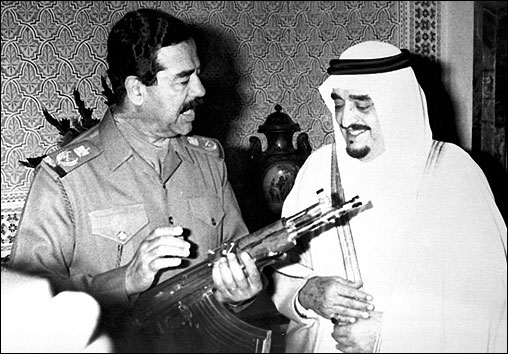
King Fahd presented Kalashnikov to another pervert Saddam Hussein [Fahd ordered Mutawwas to Issue Fatwa against the Same Saddam when Saddam fingered Wahabi Kuwait [Kuwait is even worst than Saudi Arabia] Enjoy the picture and after the pictutre read about the Debauch, Womanizer, Gambler Khadimul Haramian Sharifain.
http://cache.boston.com/bonzai-fba/Third_Party_Photo/2006/12/29/1167409329_2813.jpg


Khadim ul Harmain Sharifain - Shah Fahad The Debauch - In reality, it was a test of the ebullient Fahd’s capacity to govern. The Crown Prince would have to live down his personal reputation as a reckless womanizer, drinker, and gambler. REFERENCE: King Fahd’s Saudi Arabia by Harvey Sicherman August 12, 2005 http://www.fpri.org/enotes/20050812.middleeast.sicherman.fahdsaudiarabia.html

Real Face of King Fahd: There were stories of all night sessions at seedy clubs in Beirut, of affairs with belly dancers, and of the wife of a Lebanese businessman paid $100,000 a year to make herself available. Then in 1969, Fahd was said to have lost $1,000,000 in a single dusk-to-dawn marathon of Scotch-fuelled gambling at the tables of a MonteCarlo nightclub. He was summoned back to Riyadh by his brother, the then King Faisal Abdul Aziz ibn Saud. REFERENCE: Life and legacy of King Fahd By Paul Wood BBC defence correspondent Last Updated: Monday, 1 August 2005, 10:14 GMT 11:14 UK http://news.bbc.co.uk/2/hi/4734505.stm

Saudi Arabia’s King Fahd: [The Mutawwa in Chief due to his fingering Streets of Pakistan are burning] Real Face: His visits with his retinue of 3,000 had earned the local tradesmen riches indeed. It is estimated that an extra €30,000 (£21,000) a day was spent just in Puerto Banus. As heir apparent, Fahd first visited Marbella in 1974 and stayed at the Incosol hotel and spa. He booked 100 rooms but some of the princesses didn’t like the decor so he ordered the dark carpets to be changed to white. As a reward, Fahd left the hotel a tip of $300,000 — enough for the entire staff to receive, in effect, an extra year’s salary. He told one Spanish journalist that he liked Marbella because “it was a land blessed by Allah”, referring to the Arab occupation of most of Spain from the 8th to the 13th century. In the early 1980s he started the construction of his Mar Mar Palace, a replica of the White House. Because of increasing ill health (he suffered a stroke 10 years ago), he last visited in August 2002, just after a £134m refurbishment of the palace. REFERENCE: Marbella mourns its own King Midas King Fahd’s epic spending enriched his favourite part of Spain, says Deirdre Fernand From The Sunday Times August 7, 2005 http://www.timesonline.co.uk/tol/news/article552402.ece

Vice-President George H. W. Bush returns from his trip to the Middle East, where he has passed along a message to Iraq to step up its air war against Iran (see July 23, 1986). The covert machinations nearly become public knowledge when US embassy officials in Saudi Arabia, learning of the Saudi transfer of US arms to Iraq earlier in the year (see February 1986), question the Saudi ambassador to the US, Prince Bandar. Bandar, fully aware of the arms transfer, tells the officials that the transfer was “accidental” and the amount of arms transferred was negligible. The State Department is also curious about the transfer, warns that the arms transfer violates the Arms Export Control Act, and says it must inform Congress of the transfer. Such a notification would endanger the entire process, and possibly short-circuit another arms deal in the works, a $3.5 billion transfer of five AWACS planes to Saudi Arabia, of which Congress has already been informed. But after the White House notifies the chairman of the Senate Foreign Relations Committee, Richard Lugar (R-IN), and mollifies Lugar by telling him the arms sales to Iraq were “inadvertent,” “unauthorized,” and involved only a “small quantity of unsophisticated weapons,” Lugar agrees to keep silent about the matter. Another senator later approaches Lugar about rumors that Saudi Arabia is sending US arms to Iraq, and recalls that “Dick Lugar told me there was nothing to it, and so I took his word.” [NEW YORKER, 11/2/1992] REFERENCE: August 5, 1986: Covert Arms Sales to Iraq Nearly Revealed http://www.historycommons.org/context.jsp?item=us_iraq_80s_134#us_iraq_80s_134 Profile: Bandar bin Sultan a.k.a. "Bandar Bush", Prince Bandar http://www.historycommons.org/entity.jsp?entity=bandar_bin_sultan


Shaking Hands: Iraqi President Saddam Hussein greets Donald Rumsfeld, then special envoy of President Ronald Reagan, in Baghdad on December 20, 1983. REFERENCE: US NATIONAL SECURITY ARCHIVE Shaking Hands with Saddam Hussein: The U.S. Tilts toward Iraq, 1980-1984 National Security Archive Electronic Briefing Book No. 82 Edited by Joyce Battle February 25, 2003 http://www.gwu.edu/~nsarchiv/NSAEBB/NSAEBB82/

What a joke that Aal-e--Saud and Saudi Muttawwa Abd-al-Aziz ibn Abd-Allah ibn Baaz issued a Fatwa of Takfeer [Apostasy] against Saddam Hussein [that too after he was no more of any use to Corrupt Aal-e-Saud and Wahhaabi Muttawwas whereas an Anarchist Pakistan Ahl-e-Hadith Scholar Late. Ehsan Elahi Zaheer [who was on the payroll of Aal-e-Saud and Saudi Muttawwas rather he was student of Salafi Islamic scholars such as Muhammad Nasiruddin al-Albani and Abd-al-Aziz ibn Abd-Allah ibn Baaz] had addressed Sddam Hussein and his Ba'ath Party Member [as per Saudi Fatwa "Apostate, Secular, Socialist i.e. KAAFIR] REFERENCE: Ehsan Elahi Zaheer http://en.wikipedia.org/wiki/Ehsan_Elahi_Zaheer
صدام حسين مع إحسان إلهي ظهير رحمه الله - فيديو نادر

URL: http://www.youtube.com/watch?v=P68GstP37go

Really sometime "This Muslim Ummah" is so hypcortie that one wants to puke.


Secretary of Defense Dick Cheney, accompanied by senior aide Paul Wolfowitz and US CENTCOM commander-in-chief General Norman Schwarzkopf, visits Saudi Arabia just four days after Iraq invades Kuwait (see August 2, 1990). [SCHOOL OF INTERNATIONAL AND PUBLIC AFFAIRS OF COLUMBIA UNIVERSITY, 8/3/2000; DUBOSE AND BERNSTEIN, 2006, PP. 100] Cheney secures permission from King Fahd for US forces to use Saudi territory as a staging ground for an attack on Iraq. Cheney is polite, but forceful; the US will not accept any limits on the number of troops stationed in Saudi Arabia, and will not accept a fixed date of withdrawal (though they will withdraw if Fahd so requests). Cheney uses classified satellite intelligence to convince Fahd of Hussein’s belligerent intentions against not just Kuwait, but against Saudi Arabia as well. Fahd is convinced, saying that if there is a war between the US and Iraq, Saddam Hussein will “not get up again.” Fahd’s acceptance of Cheney’s proposal goes against the advice of Crown Prince Abdullah. [SCHOOL OF INTERNATIONAL AND PUBLIC AFFAIRS OF COLUMBIA UNIVERSITY, 8/3/2000; DUBOSE AND BERNSTEIN, 2006, PP. 100-101] With Prince Bandar bin Sultan translating, Cheney tells Abdullah, “After the danger is over, our forces will go home.” Abdullah says under his breath, “I would hope so.” Bandar does not translate this. [MIDDLE EAST REVIEW OF INTERNATIONAL AFFAIRS, 9/2002; HISTORY NEWS NETWORK, 1/13/2003] On the same trip, Cheney also visits Egypt’s Hosni Mubarak, who rejects Cheney’s request for US use of Egyptian military facilities. Mubarak tells Cheney that he opposes any foreign intervention against Iraq. [SCHOOL OF INTERNATIONAL AND PUBLIC AFFAIRS OF COLUMBIA UNIVERSITY, 8/3/2000] US forces will remain in Saudi Arabia for thirteen years (see April 30-August 26, 2003). REFERENCE: August 5, 1990 and After: Cheney Secures Permission for US Forces to Attack Iraq from Saudi Arabia http://www.historycommons.org/context.jsp?item=a080590cheneysaudi#a080590cheneysaudi Profile: Bandar bin Sultan a.k.a. "Bandar Bush", Prince Bandar http://www.historycommons.org/entity.jsp?entity=bandar_bin_sultan


USA/Great Britain/King Fahd financed Iraq Iran War but when Saddam Hussein entered Kuwait [Worst than Saudi Arabia] Fahd ordered Saudi Retard Toady Mutawwas to Issue Fatwa against the Same Saddam. Debauch Saudi Wahabi Somersault Fatwa of Takfeer against Saddam Hussein. In 1996 then-UN Ambassador Madeleine Albright was asked by 60 Minutes correspondent Lesley Stahl, in reference to years of U.S.-led economic sanctions against Iraq, “We have heard that half a million children have died. I mean, that is more children than died in Hiroshima. And, you know, is the price worth it?” To which Ambassador Albright responded, “I think that is a very hard choice, but the price, we think, the price is worth it.” - BAGHDAD, Oct. 10 — A team of American and Iraqi public health researchers has estimated that 600,000 civilians have died in violence across Iraq since the 2003 American invasion, the highest estimate ever for the toll of the war here. The figure breaks down to about 15,000 violent deaths a month, a number that is quadruple the one for July given by Iraqi government hospitals and the morgue in Baghdad and published last month in a United Nations report in Iraq. That month was the highest for Iraqi civilian deaths since the American invasion. But it is an estimate and not a precise count, and researchers acknowledged a margin of error that ranged from 426,369 to 793,663 deaths. It is the second study by researchers from the Johns Hopkins Bloomberg School of Public Health. It uses samples of casualties from Iraqi households to extrapolate an overall figure of 601,027 Iraqis dead from violence between March 2003 and July 2006. REFERENCE: Iraqi Dead May Total 600,000, Study Says By SABRINA TAVERNISE and DONALD G. McNEIL Jr. Published: October 11, 2006 http://www.nytimes.com/2006/10/11/world/middleeast/11casualties.html

Donald Rumsfeld meets Saddam Hussein 1983

URL: http://www.youtube.com/watch?v=zaP7ZrmkcuU

Late. Abd al-Aziz ibn Abd Allah ibn Baaz [Saudi Grand Mufti who issued Fatwa against Saddam and then against Osama Bin Ladin] - When Saddam invaded Kuwait - [Immediately a Fatwa was issued against Saddam - "During the Iran-Iraq war, Saudi Arabia bankrolled the Saddam Hussein regime with the express approval of Washington DC which at that time saw Saddam Hussein as a bulwark against Shia fundamentalism. It came as a terrific shock to the Saudi Royals when Saddam Hussein turned his attention to Kuwait and Saudi Arabia. Again, the Royal family turned to the Ulema and obtained (with difficulty) a Fatwa, permitting the use of non-Muslim foreign troops on Saudi soil to defend Saudi Arabia against a foreign invader - one the Ulema regarded as a secular apostate. Thus the Saudi Royal family invited the USA to send it its troops for Operation Desert Storm- the operation to defend Saudi Arabia and liberate Kuwait - largely at Saudi expense." As per 9/11 Commission Report “In August 1990, Iraq invaded Kuwait. Bin Ladin, whose efforts in Afghanistan had earned him celebrity and respect, proposed to the Saudi monarchy that he summon mujahideen for a jihad to retake Kuwait. He was rebuffed, [Saudi Fatwa issued in 90s against Osama Bin Ladin - http://abdurrahman.org/jihad/binlaadin.pdf Usama Ibn Ladin Al-Kharijee (our position toward him and his likes) - By Abdul Aziz Ibn Abdullaah Ibn Baz [PDF] - Taken from http://www.troid.org/] and the Saudis joined the U.S.-led coalition. After the Saudis agreed to allow U.S. armed forces to be based in the Kingdom, Bin Ladin and a number of Islamic clerics began to publicly denounce the arrangement. The Saudi government exiled the clerics and undertook to silence Bin Ladin by, among other things, taking away his passport. With help from a dissident member of the royal family, he managed to get out of the country under the pretext of attending an Islamic gathering in Pakistan in April 1991.”

"QUOTE

Misconception: The Islaamic Threat

In recent years, a great deal of attention in the media have been given to the threat of "Islaamic Fundamentalism". Unfortunately, due to a twisted mixture of biased reporting in the Western media and the actions of some ignorant Muslims, the word "Islaam" has become almost synonymous with "terrorism". However, when one analyses the situation, the question that should come to mind is:

Do the teachings of Islaam encourage terrorism?

The answer: Certainly not!

Islaam totally forbids the terrorist acts that are carried out by some misguided people. It should be remembered that all religions have cults and misguided followers, so it is their teachings that should be looked at, not the actions of a few individuals. Unfortunately, in the media, whenever a Muslim commits a heinous act, he is labeled a "Muslim terrorist".

However, when Serbs murder and rape innocent women in Bosnia, they are not called "Christian terrorists", nor are the activities in Northern Ireland labeled "Christian terrorism". Also, when right-wing Christians in the U. S. bomb abortion clinics, they are not called "Christian terrorists". Reflecting on these facts, one could certainly conclude that there is a double-standard in the media! Although religious feelings play a significant role in the previously mentioned "Christian" conflicts, the media does not apply religious labels because they assume that such barbarous acts have nothing to do with the teachings of Christianity. However, when something happens involving a Muslim, they often try to put the blame on Islaam itself - and not the misguided individual.

Certainly, Islaamic Law (Sharee'ah) allows war - any religion or civilisation that did not would never survive - but it certainly does not condone attacks against innocent people, women or children. The Arabic word "jihaad", which is often translated as "Holy War", simply means "to struggle". The word for "war" in Arabic is "harb", not "jihaad". "Struggling", i.e. "making jihaad", to defend Islaam, Muslims or to liberate a land where Muslims are oppressed is certainly allowed (and even encouraged) in Islaam.

However, any such activities must be done according to the teachings of Islaam. Islaam also clearly forbids "taking the law into your own hands", which means that individual Muslims cannot go around deciding who they want to kill, punish or torture.

Trial and punishment must be carried out by a lawful authority and a knowledgeable judge. Also, when looking at events in the Muslim World, it should be kept in mind that a long period of colonialism ended fairly recently in most Muslim countries. During this time, the people in these countries were culturally, materially and religiously exploited - mostly by the so-called "Christian" nations of the West. This painful period has not really come to an end in many Muslim countries, where people are still under the control of foreign powers or puppet regimes supported by foreign powers.

Also, through the media, people in the West are made to believe that tyrants like Saddam Hussein in Iraq and Moamar Qaddafi in Libya are "Islaamic" leaders - when just the opposite is true. Neither of these rulers even profess Islaam as an ideology, but only use Islaamic slogans to manipulate their powerless populations. They have about as much to do with Islaam as Hitler had to do with Christianity! In reality, many Middle Eastern regimes which people think of as being "Islaamic" oppress the practice of Islaam in their countries. So suffice it to say that "terrorism" and killing innocent people directly contradicts the teachings of Islaam. .......... Prepared by: Abu 'Iyaad REFERENCE: Misconception: The Islaamic Threat http://www.fatwa-online.com/aboutislaam/0020221.htm http://www.fatwa-online.com/index.htm http://www.fatwa-online.com/worship/jihaad/jih009/index.htm

Question: O esteemed Shaykh, what is happening now (in Iraaq) so what is the position of the Muslim towards this trial, and is there a Jihaad, and are do those soldiers who are in the Gulf have the ruling of being mujaahideen, and may Allaah reward you.

Shaykh Ubayd al-Jaabiree: I dont know why this question (is asked) when, when we have just ended the speech with what I consider to comprise the answer to it and to its likes. However, despite this, just so that it is said, that Ubayd has neglected some of the questions.

So I say: Firstly, not all of the Iraaqi society is Muslim. Rather, amongst them is the Marxist, amongst them is the Ba'athist Heretic, and amongst them are numerous orientations. And there are Muslims amongst them...

And amongst them are the Raafidah. And the positions of the Scholars towards the Raafidah is well known, amongst them are those who declared them Disbelievers.

Secondly, we have Rulers and those who have authority, and it is obligatory to give them hearing and obedience, and around our rulers are those who have knowledge, and experience, and speciality in the political affairs. So we do not undermine them, and we have already mentioned previously that the general affairs are not for just any person. Rather, they are for whom? For those in authority.

And as it is appropriate, I also say that those who call to cutting off from the products of America and Britain and others, then those people have a resemblance to the Raafidah. Shaykh ul-Islaam Ibn Taymiyyah mentions in Minhaaj us-Sunnah, in the first volume, and I believe it is page 38, "From the stupidity of the Raafidah is that they do not drink from the river that was unearthed (i.e. dug out, like a well) by Yazeed". So those Harakiyyoon and Hizbiyyoon, have resembled the Raafidah. And what an evil model (that is). And the most repugnant for a person that his model, and way is that of the Raafidah.

Thirdly, the banner of fighting in Iraaq, who is carrying it? It is carried by Saddaam Hussain at-Takreetee, and he is the leader of the Ba'athi Party in his land...and the Ba'athi Party, is secularist, disbelieving, heretical. Its foundation is upon mixing and not differentiating between a Sunni Muslim, Guidance from the Scholars Concerning Iraaq and between the Jew, Christian, Communist, and others. They are all the same, equal. And for this reason, their slogan is, as their poet has said:

I believe in, -- (Shaykh Ubayd): I seek refuge in Allaah --
I believe in al-Ba'ath as the Lord which has no partner
And in Arabism as a religion, which has no other (religion)

This is their religion, qawmiyyah (nationalism) and shu'oobiyyah, and their religion is not Islaam. So built upon this, the one who fights under the banner of the Iraaqi government, then he is fighting under a banner of disbelief. And we do not dispute that the people of Iraaq have the right to defend themselves. They can defend themselves, their blood, their honour and their wealth, they can defend those who transgress upon them, whether America or Britain or other than them.

So it is obligatory upon us, the community of Muslims that we ask Allaah in our supplication that He delivers the Muslims amongst the people of Iraaq. So whoever said O Allaah save the [Iraaqi Society]1 , then he has erred. This supplication of his reaches even the Marxist and the Communist. And the Ba'ath Party is at the front of the [supplication of the] one who supplicates for the Iraaqi society (in general). No, but supplicate to Allaah that He delivers the Muslims amongst the people of Iraaq. And that he relieves them of their distress. This is what I can add now. .......... Translated by: Abu 'Iyaad REFERENCE: NEWS\ Monday 31 March 2003 Shaykh 'Ubayd al-Jaabiree on the Position Towards Iraq From a Paltalk Session today 31/03/2003 at 8:30pm UK Time http://www.fatwa-online.com/news/0030331.htm

"UNQUOTE" 
Saudi Arab's Fatwa (Religious Edict) against Al-Qaeda & Osama Bin Laden