Showing posts with label Blasphemy against Sahaba. Show all posts

Saturday, August 11, 2012

Qazi Hussain Ahmed quotes Blasphemous Mawdudi.


ISLAMABAD: The Supreme Court has converted the letters of Justice (R) Wajihuddin Ahmed, Qazi Hussain Ahmed and Muhammad Hussain Mehnati against obscenity and vulgarity on the media into a petition and issued notices to chairmen PTA and Pemra and has fixed it for hearing on July 27, 2012. The petition is marked 104/2012 and the case will be heard in the open court on Friday. The SC order issued on Wednesday titled “Regarding control of obscene and other objectionable material carried in the media” reads: “Take notice that three separate letters were received from Justice (R) Wajihuddin Ahmad, Qazi Hussain Ahmad, ex-Ameer Jamaat-e-Islami Pakistan and Muhammad Hussain Mehnati, Ameer Jamat-e-Islami Karachi on the subject cited above and on placing all these letters before the honourable Chief Justice of Pakistan. His lordship was pleased to call reports from chairman PTA and Chairman Pemra. After perusal of the said reports, the honourable Chief Justice of Pakistan was pleased to pass the following order; ‘Treat this matter as petition under article 184(3). Put up in court. Notice to attorney general, chairman Pemra and to petitioners be issued for 27.07.2012.’ “Take further notice that the matter has been registered as the Constitutional petition No 104/2012 and is fixed for hearing on 27.07.2012 in Court House Islamabad.”The major issues regarding obscenity highlighted in the petition involve airing of illegal Indian channels through cable network, obscene and vulgar dramas on Pakistani channels, immoral advertisements on TV channels, illegal CD channels distributed by cable networks in connivance with Pemra, and in particular the entertainment segments in the news bulletins on Pakistani news channels.


Following complaints from the two respected public figures, the Human Rights Cell of the apex court, following CJ’s direction, had sought views from chairman Pemra and chairman PTA, both of whom have given routine bureaucratic responses without any concrete assurance that the menace would be effectively checked and controlled. Chairman Pemra in his response to the Supreme Court wrote: “The local market is flooded with smuggled and pirated CDs, DVDs, decoders, dishes and cards, which are proliferating obscenity through broadcast media and distribution service. On its part, Pemra took action against distribution and sale of illegal decoders and seized the equipment of Zee TV package. This action was challenged in the Lahore High Court (LHC) and the court was pleased to suspend the seizure. Consequent to which Pemra had to return the equipment. Nevertheless, Pemra has not stopped its efforts in this regard. It may kindly be appreciated that Pemra cannot fully eradicate this menace and it will only be possible with coordinated efforts of all other relevant agencies as well.” It is important to mention here that whenever the Supreme Court takes up the issue of obscenity and vulgarity some objectionable Indian TV channels are closed for a few days but they stage a comeback. Even on Wednesday when the Supreme Court issued this latest order and fixed the case for Friday, sources told The News that Indian TV channels were closed in some big cities. Sources say a huge amount of money is involved in allowing illegal CD channels, distribution of illegal Indian TV channels and in many other similar illegal acts. REFERENCE: SC takes suo moto notice of obscenity in media Ahmad Noorani Thursday, July 26, 2012 http://www.thenews.com.pk/Todays-News-13-16359-SC-takes-suo-moto-notice-of-obscenity-in-media Qazi Hussain Ahmed Daily Jang 10 August 2012http://e.jang.com.pk/pic.asp?npic=08-10-2012/Karachi/images/11_07.gif Friday, August 10, 2012, Ramazan ul Mubarak 21, 1433 A.H. http://jang.com.pk/jang/aug2012-daily/10-08-2012/col2.htm

Jamaat e Islami Ka Iqamat e Deen By Sheikh Touseef Ur Rahmaan


http://www.youtube.com/watch?v=ZmOpS02bUNo

Jamaat e Islami By Sheikh Tauseef Ur Rehman


http://www.youtube.com/watch?v=iKY5S5z11zs


A BRIEF HISTORY OF THE MAUDUDI CALAMITY Translation of an editorial by Maulana Yoosuf Banauri in the Rajab 1396 Issue of the 'Bayyinaat' : - In order to master any subject, it is incumbent that one remain in the company and benefit from the master of that subject. It is an accepted fact that for any simple or artistic occupation a teacher or even a guide is necessary. Without these even an intelligent and genius cannot reach the desired stage, be it in the fields or engineering, medicine, or any other subject for that matter. For every occupation or trade it is necessary and incumbent that one should at least learn the basics from a teacher. In this manner when it is necessary to seek knowledge and guidance in materialistic fields, how can it be possible to attain the Uloom of Nubawwat - Teachings of the Ambiyaa Alaihis salaam. - and the intricacies of the Shari'ah without the guidance of tutor? The sciences of this nature are beyond the grasp of human intelligence. They have reached the Ummat through the Wahi (revelations of the Al-mighty, and continues through heavenly training, rearing, divine commands, instructions and guidance. Then in these Divine Sciences the attention and considerations of the tutor and guide; and the practical participation in his company has a more important bearing than words. The attaining of correct thinking, understanding and practical Tarbiyah (rearing) is more important than only attaining knowledge. On that ground, the longer the companionship of a master, the more benefit and experience one will reap. The more perfect the tutor, the more benefit and excellence will be attained. As the purpose of the Uloome Nubuwwat is the guidance of the creation of Allah, in its understanding, there is a strong probability, through the enmity of the accursed Shay- taan, to be led astray. The Shaytaan does not interfere where one strives to attain perfection in material aspects. The Shaytaan sits in comfort. He does not need to interfere, nor is it necessary for him to show his enmity. However, where the hereafter and religion are concerned, the Shaytaan becomes restless in creating mischief. He uses his strength in every possible manner, where success and Hidaayah may be turned into ruin and to cause deviation from the straight path. The greatest asset of the accursed Iblis is 'Talbis', that is to mix the truth with falsehood in such a manner, that where a thing outwardly appears to be beneficial, in reality it becomes a source of wrong doing and detriment. Then too bearing in mind that the tricks of the human Nafs supercedes this. it is human nature to be arrogant, haughty, deceptive, showoff and have love for rank and high status. These are such diseases that it is difficult to eradicate them even after lengthy training and discipline.

For this reason it is incumbent to remain in the companionship of a master for quite some time, in order to save oneself from the effects of the Shaytaan.


If Allah's grace and mercy are present, then surely one reforms, other-wise, the human just wanders around in the desert of knowledge and intellectualism. After studying the Educational History of the world, this point becomes very clear that all the mischief and chaos that were created, were all at the hands of intellectuals and geniuses. During the period of Ilm (knowledge) a greater portion of fitnah (mischief) appeared by the way of ilm. Even among the Ulamaa E Haq, many geniuses due to their sharp intelligence and eccentricity became victims of their wrong thoughts and ideas. This fact became evident that by completely relying on their own acuteness and flowing intellect, they became entangled in llmi Kibr (educational arrogance), and self-conceited of their own views. They were not fortunate enough to undergo a beneficial amount of spiritual training. As a result, this led them to great lengths. In our times there exist many such examples. Since they possess llmi acumen and, as many a time they say or write excellently, they become a cause for additional fitnah. Those individuals who were not fortunate enough to attain a deep knowledge or a spiritual training, easily become their adherents and quickly begin supporting and endorsing their new ideologies. The Shaytaan is always busy in his occupation. A personality that may be of use to guide and direct the Ummah, becomes a means of deviation and ruin for the Ummah. There are examples of these in every era. Imaam Ghazali Rahmatullahi alaih has written in his 'Maqaasidul Falaasifah' that after observing the correctness in the elementary and mathematical sciences of the Greeks, the people began to accept all their teachings as correct. They accepted the teachings of the Greeks even in the subjects of Theology and natural philosophy, which led them astray. These words of Imaam Ghazali are very surprising and true. The Shaytaan finds in these Situations an ideal opportunity to lead people astray. Well, when the very learned, geniuses and capable people can become entangled in such fitnahs, then those personalities who possess very little llmi capabilities and have a tremendous ability to write, and are quick witted and intelligent, but void of a spiritual training under an accomplished master they very quickly become engulfed in self-conceitedness and begin to degrade the Ummah. All the scholarly researches of the Ummat are despised; all the great deeds of the salaf-us-saaliheen are made a joke of and a laughing stock; and by criticising every personality from beginning till the end, falls in a deep and dangerous pit, becoming a means of leading all humanity into destruction. Among such people today is a famous personality by the name of Janab Abdul A'laa Maududi Saheb, Maududi was born on Rajab 3, 1321 AH (September 25, 1903 AD) in Aurangabad, who was acute and quick witted since childhood, but was troubled by economic difficulties. In the beginning he was employed by the 'Medina periodical at Bijnor. Thereafter, he was attached to the "Muslim', a magazine of the Jamiat Ulama e Hind. After a few years he was employed by the 'Al-Jamiat', Delhi, a journal of the Jamiat Ulama e Hind, Which was then probably published every third day. His articles captioned 'Tarikh ke Jawaahir Paaro' appeared with great lustre. In this manner Maududi Saheb was trained as a writer by Maulana Ahmed Saeed Saheb. After the death of his father Maududi Saheb was unable to complete his studies, but had to leave studies during the early Arabic primary stages, nor was he fortunate enough to attain a secular education. He later studied English and attained some competence in it. He greatly benefited from the books, magazines and writings of reputable authors of those days. His writing ability increased by the day. Unfortunately he was unable to benefit from any religious institution, neither became a graduate of modern education, nor did he gain the company of an experienced and proficient Aalim of the Deen. He has admitted this in an article published during the era of United India in reply to some questions posed to him by Maulana Abdulhaq Madani Muradabadi. He was unfortunate to experience the company of Niyaaz Fatehpuri, an atheist and infidel.


By this association and friendship many incorrect tendencies and inclinations were adopted. In 1933 he began publishing the 'Tarjumanal-Quran' from Hyderabad, Deccan, wherein he published splendid articles. Some llmi and literary things began to appear using the best style and methods. At that time the political situation in the country was very shaky. The movement to free India was in its decisive stages. The best intellectuals of the country were involved in the freedom of struggle of India from the British Maududi Saheb adopted a different stand from the rest and engendered the cry of 'Iqaamate Deen' and 'Hukumate Ilaahiyyah'. He strongly and forcefully criticised all the factions invloved in seeking the freedom of India. His simple and innocent panegyrists thought that Maududi Saheb was the last straw for the valuable Deen. As a result very quickly praises began to be showered upon him from the pens of Maulana Sayyid Sulayman Nadwi, Maulana Manaazir Ahsan Gilani and Maulana Abdulmaajid Darybadi. Evidently at that time Maududi Saheb was only a name of an individual. As yet he had no missionary aim, nor an association or movement. Due to his forceful writings and statements, some among the Ahle Haq began having great hopes in him. By virtue of his preparedness and through the encouragement of Chaudary Muhammad Niyaaz, the foundation of 'Darul Islam' was laid in Pathankot. The Muslim League and Congress began to be degraded.


Such articles were written by him, as well as a book on the political turmoil of the time appeared whereby he began receiving praises from his followers. The political causes stimulated its acceptance. A meeting was held in Lahore, and the foundation of his Imaarat was formally laid. A speech prepared by him was read out, wherein the duties of a present-day Ameer were outlined. Among the participants were also such famous personalities as Janab Maulana Manzoor No'mani, Maulana Abulhassen Ali Nadwi, Maulana Amin Ahsan Islaahi and Maulana Mas'ud Aalam Nadwi. Maududi Saheb was elected the Chief Ameer and the above mentioned four personalities were elected deputy Ameers. The Jamaa'at e Islami formally came into existence. It's constitution and charter were published. The public looked forward to it and from every side hopes began to be attached. Six months had not passed by when Maulana (Manzoor) No'mani Saheb and Maulana Ali Mia Saheb (Abulhassen Ali Nadwi) resigned. They have observed his llmi deficiencies and lack of sincerity. They were unable to continue their relationship. These gentlemen kept silent and did not inform the Ummah openly and clearly about their reason for disassociating themselves. I was at that time teaching at Jamia Alma Dabhel. I inquired from these two personalities about their reason for quitting. They said many things but no satisfactory clarification was delivered. I understood the view of Marhum Maulana Mas'ud Alam and Maulana Amin Ahsan Islaahi were quite similar as far as beliefs and conduct were concerned. Hence they remained for some time as Maududi Sahebs right hand men. Maulana Mas'ud Aalam assisted through the medium of Arabic literary writings and magnificently translated into Arabic the writings of Maududi Saheb. He also trained a few pupils in this field. Maulana Islaahi through his special style and way assisted the Maududi Movement. As a result many good writers and assistants joined the movement. A few excellent books were written on communism and a few other subjects i.e. interest alcohol purdah. etc. A few good books were also written for the modern youth. Some worthy articles were published in the 'Tafheemaat and Tanqeehaat'. Ways and means were adopted to impress the Arabs especially the Sheikhs of Saudi Arabia.


Successful strategies were adopted. All those writings that were contributed by Maududi Saheb's associates were published in such a manner as if all these writers were indebted to him. As a result the personality of Maududi Saheb gained fame. He reaped fame from the writings of his associates. He is incapable of composing in Arabic or English. The names of translators do not appear on his books that are translated into other languages. It is not mentioned that this book is translated by Mas'ud Aalam or Aasim Haddaad. People get the notion that this literary intellectual of the Urdu language is also an Imaam of the Arabic language. A short period had passed where Maulana Gilani Saheb and Sayyid Sulayman Nadwi Saheb became aware and foresaw its detrimental effect; that these writings were a means of creating a new fitnah. He (Maulana Gilani) ceased to address him by the titles conferred on him such as 'Mutakallim e Islam' etc. Maulana Gilani Saheb wrote critical articles under the headings of 'Khaarijiyyate Jadidah' Maulana Daryabadi's 'Sidqe Jadid'. Maulana Sayyid Husayn Ahmed Madani Saheb was perhaps the first among the Ulama who pinpointed this fitnah in his Correspondence. Gradually other Ulama began to air their views. Maulana Muhammad Zakariyya Saheb studied all the available printed Maududi literature and wrote a valuable booklet on this subject. It is regretted that this booklet has not been printed yet. In this connection an Ustaaz of Madrasah Mazaahirul Uloom Saharanpur Maulana Zakariyya Quddusi Saheb became inclined towards Maududi Saheb. Taking this into view and trying to correct him Shaykhul Hadith Saheb wrote a letter to him explaining all Maududi Saheb's errors and incorrect interpretations of the Deen.

This letter has been published in a booklet form titled 'Fitnah Maudu diyyat' (It is now reprinted under the title 'Jama'at Islamiyyah ek lamhah fikriyyah').

I admired many things about Maududi Saheb and detested many. For along time I did not wish to degrade him. I felt that from his innovated style of presentation the modern generation could benefit. Although at times such compositions appeared from him that it was not possible to endure it but taking into consideration the Deeni well-being I tolerated it and kept silent. I did not foresee that this Fitnah would spread world-wide and have a detrimental effect on the Arab world; that every day from his master pen a new bud would keep on blossoming and indecent words would be used regarding the Sahabah Kiraam Ridhwanulla-hi Alayhim and the Ambiyaa Alayhimus Salaam. Later on such things appeared daily in the 'Tafhimul Quraan'.

Now it has become known without doubt that his writings and publications are the greatest Fitnah of the present time notwithstanding a few beneficial treatises that have appeared It is the case of "and the sin of them is greater than their usefulness". (Surah Baqarah 219).

Now that stage has been reached where to keep silent seems to be a great crime. It is regretted that for forty years an offensive silence was kept. Now the time has dawned where without fear of rebuttal and censure all his writings from A to Z should be thoroughly studied with a view to fulfill the demands for the preservation of the Deen with Haq and justice. Wallahu Subhanahu Waliyut-Tawfique. http://www.allaahuakbar.net/jamaat-e-islaami/maududi/brief_history_of_the_maududi_calamity.htm

Sunday, January 1, 2012

Imran Khan, Fatwa Against Jamat-e-Islami & Islamic Revolution.

KARACHI: Ameer of Jamaat-e-Islami Pakistan Syed Munawar Hassan called up on the nation on Sunday to be prepared for bringing a revolution in the country and viewed that elections held after the revolution will bear better results. Addressing a public meeting at Banaras Chowk area of Karachi on Sunday, the JI chief also said that the nation should be prepared for elections. He claimed that bearded men and Hijab-wearing women would change the fate of the country. Munawar Hassan criticized the government saying it speaks of supremacy of parliament but its deeds were contrary to that. He urged the Chief Justice of Pakistan to ensure implementation of Supreme Court verdicts. Touching the Memo issue, JI chief said it was aimed at defaming the armed forces of country. He also emphasized the need of reviewing foreign policy of country and added that Nato attack on Salal checkpost was an attack on the sovereignty of Pakistan. The USA with the help of India had been trying to weaken Pakistan. The JI chief said his party has never been involved in corruption and therefore there is no such allegation on it. “We dont have any feudal lord in JI,” he said. Syed Munawar Hassan severely criticized the present rulers for making miserable the lives of the people of Pakistan by inflation and skyrocketing prices of petroleum and other things. REFERENCE: JI chief tells nation to be prepared for revolution in country http://www.dawn.com/2012/01/01/ji-chief-tells-nation-to-be-prepared-for-revolution-in-country.html

Syed Munawar Hasan Address To Lahore DHARNA Geo News Live 25 Dec 2011

http://www.youtube.com/watch?v=cBJl5qltdf4


LAHORE, Dec. 28: The Jamaat e Islami chief, Syed Munawar Hasan, has said that there was a strong longing for the blessed Islamic system in Pakistan as well and a Egypt, Tunisia and Morocco like revolution could not be ruled out here prior to the elections. He was addressing large rallies organized by the JI Khyber P. at Karak and Sarai Norang. JI deputy chief, Sirajul Haq, JI provincial chief, Prof. Muhammad Ibrahim and oher local leaders also spoke on the occasion. Syed Munawar Hasan said the need of the time was to boycott Zardaris, Gilanis and such others who were responsible for the present crisis in the country. Besides, he said, the people would have to get rid of the US agents in our ranks in order to avoid memo scandals in future. The JI chief said that there wont be any elections under President Zardari, and remarked that only Zard ( yellow) elections could take place under Zardari. He said the nation would have to get out of the IMF and World Bank clutches to be able to end US interference. He said the US had met a crushing defeat in Afghanistan despite raining tons of gunpowder. Syed Munawar Hasan said that the JI was fighting the dankness all around in the society with courage and determination. He said the western system based on exploitation and revolt from Allah was finally dying and millions of the western people were protesting against that. He said, an Islamic system could be established only by defeating the US and its capitalist system. He condemned the statement of the Planning Commission Deputy Chairman suggesting that winding up the nuclear programme was essential to ensure economic progress. He said this was only US- India – Israel agenda and added that the nation would never accept US slavery or Indian supremacy in the region. Doubting the US announcements to quit Afghanistan by 2014, the JI chief said this was a plain lie as the US had no such intention as it desired to occupy the rich mineral resources of this region. However, he said that if the US did not quit voluntarily, the valiant Afghans would wipe out the Americans on their soil and send their dead bodies home. Syd Munawar Hasan said that the people changing parties at this juncture should inform the people of the misdeeds of their previous parties. REFERENCE: Islamic revolution in Pakistan not far off http://www.munawarhasan.com/en/newsdetail.php?id=159


Syed Munawar Hasan & Imran Khan Meeting in Mansoora Lahore

http://www.youtube.com/watch?v=8LEY_DxumW8

Sita White on Imran Khan's Illegitimate Child.

http://www.youtube.com/watch?v=2SoEW2aZU2Y


A Los Angeles court ruled that cricket hero-turned-politician Imran Khan was the legal father of a four-year-old illegitimate southern California girl. "Imran Khan is the father of the child," superior court commissioner Anthony Jones said on August 13, after a brief hearing. Khan, who had refused to co-operate by taking a blood test for the genetic determination of paternity, did not show up for the proceedings. His attorneys also failed to appear, so a default judgement was entered. Khan led Pakistan to a World Cup triumph in 1992. Earlier this year, he failed in his bid to become prime minister of Pakistan. "We believe the complaint, as originally filed, was ill-motivated," said Khan's New York attorney, Bernard Clair. "We believe the mother may have been the unwitting tool of my client's opponents." Sita White, who lives in Beverly Hills, had a relationship with Khan in 1987-88 and, when they met again in Los Angeles on October 2, 1991, she told him she wanted to have his baby, her attorney Gloria Allred said. "We did not request child support," Allred said. "We hope that, one day, he will open his heart to his little daughter and give her the love, respect and support every little girl deserves. "White got pregnant and Khan told her he hoped it was a boy. When he learnt the baby would be a girl, Khan expressed disappointment and said the child would not be able to play cricket. He urged White to have an abortion, but she refused," Allred said. Tyrian Jade was born on June 15, 1992, at Cedars-Sinai Medical Center. Since her birth, Khan has neither seen nor spoken to the child although he and White have spoken periodically during that period," said Allred. "He never paid any child support." During his quest to become prime minister, Khan denied having fathered an illegitimate child, which could have made him ineligible to become prime minister. "He categorically denies the paternity of this child," Clair said. "We think to use the child as a pawn in such a publicity circus demonstrates, to us at least, that the mother has other reasons for pursuing paternity." Khan, 42, said he dated and frequented night clubs during his days as a cricketer and, before that, as a student at Oxford University. But, since retiring from sports in 1992, he said he has transformed himself into a devout Muslim. He even vowed to marry a woman who observed purdah (life behind the veil). But, in 1995, he married British heiress Jemima Goldsmith. His political opponents have attacked Jemima, the daughter of the late English billionaire, Sir James Goldsmith, for her Jewish heritage. Khan says, though his wife's ancestors were Jewish, she was Protestant and had converted to Islam to marry him. UNI. REFERENCE: Imran Khan fathered illegitimate child, rules California court http://m.rediff.com/news/aug/14imran.htm 


LAHORE, Dec. 29: The Jamaat e Islami chief, Syed Munawar Hasan, has said that the people have lost faith in the present electoral system and the country was heading towards an Islamic revolution. Addressing a big public meeting at Bannu on Thursday, he said that the elections in the country had only added to the worries of the masses. The law and order was deplorable, the power crisis was aggravating day by day and price spiral and unemployment had made the life of the people a hell. The JI chief said that the end of the dictatorial regimes of Hosni Mobarak and Col. Gaddafi had given a ray of hope to the Muslim masses. He said the people of Libya, Tunisia, Egypt and Morocco had followed the teachings of Hasan al Banna Shaheed and Syed Abul Ala Maudoodi and supported the Ikhwanul Muslimoon which helped them bring about a revolution. He said a large majority of Pakistanis wanted an Islamic revolution in this country and they would not accept slavery of the western colonialism. He said, the US wanted to punish Pakistan for is defeat in Afghanistan and it was using its slaves like the ANP for the purpose, and the ANP was minting dollars in the process. He said the ANP had always opposed brave Pushtoons. It was behind the bomb blasts in the Khyber P. and had been supporting India on the Kashmir issue. He said the elections in this country had never yielded positive results. The elections held under the civil and military rule had crushed the masses sentiments. The country’s foreign policy was serving the US interests which had endangered the independence of the country. He assured the masses that the JI alone could steer the country out of the present crisis and bring relief to them. The JI deputy chief, Sirajul Haq, JI provincial chief, Prof. Muhammad Ibrahim Khan also spoke on the occasion. REFERENCE: People have lost faith in the present electoral system and the country was heading towards an Islamic revolution. http://www.munawarhasan.com/en/newsdetail.php?id=160

Saudi Arabian Scholar on Blasphemous Founder of Jamat-e-Islami i.e. Mawdudi - Mawdudi, Qutb and the Prophets of Allaah http://www.salafipublications.com/sps/downloads/pdf/NDV080001.pdf  


Mawdudi Was a Blasphemous Founder of Jamat e Islami

Deobandi Fatwas against Mawdudi, Jamat-e-Islami, Barelvis, Ahl-e-Hadith & Shias

Differences In Ummat & Siraat e Mustaqeem By SHEIKH MUHAMMAD YUSUF LUDHYANVI (RA) http://ia700100.us.archive.org/3/items/February2010/DifferencesInUmmatSiraatEMustaqeemBySheikhMuhammadYusufLudhyanvira.pdf


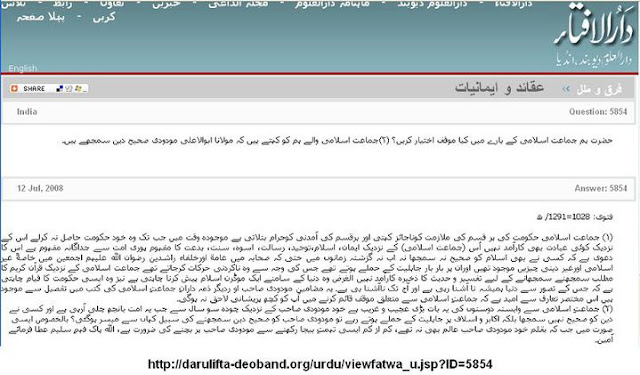
Deobandi Fatwa Against Mawdudi and Jamat e Islami


    DEOBANDI SCHOLARS ISSUED FATWA AGAINST JAMAT-E-ISLAMI

https://blogger.googleusercontent.com/img/b/R29vZ2xl/AVvXsEi5eJxDpekWBP2e1xsPOEEfPfU5LccUQVEpqyNFM9iJWwQuiA_PsBxRCQiW_QrqOreiGkwFZBR-VoAH_HeZV5E9BGD80dVtcr-JTmH3gJNKyoFVsU0CnPUaL-4ciAasRd2OgXZlQLeWYisT/s1600/1.jpghttps://blogger.googleusercontent.com/img/b/R29vZ2xl/AVvXsEjkmPAZUpjkWthyphenhyphenF0NXDh46bAiofEVoGEIJz9Cr4nRR-BDa7OxlDhrws7AjRRKan1X47vREFB7TtZjdzhCIjc9X4tMcjJBmW7k49sUQNd8B8mxJfqyeuegUxxafOujonARNM1OjrJfzvK07/s1600/2.jpg
https://blogger.googleusercontent.com/img/b/R29vZ2xl/AVvXsEgftc4OpcQjpgKRmobY7AuCnJLyB5qnl_KNBO3JHBqG-ejzMUuuurcgZV18fJ4P2IIQPokTtG2OnxGVwmaJOk6qWE7bffaAHA7Fc2ugAywjAQyQ-aFOHgOWWqnZDnel6-DHLGo-01jJTdQL/s1600/3.jpg
https://blogger.googleusercontent.com/img/b/R29vZ2xl/AVvXsEi0naCpxd4xnerQ6K3_R40AFrdcO6RhRkwdHyB8kkO3kBQ2Q6RLzvi9aTAkw_qFAhdJOlYCt5eHNY9e90W89e7kutAr72fKEO6WTNEasA24X52TA415jMTbsL4N12GrSbi2Vn0cm7CXSsjD/s1600/4.jpg
https://blogger.googleusercontent.com/img/b/R29vZ2xl/AVvXsEi00c7ZWhXhX0qjzpPcln3wYbrq9ogrlUQo32ry6VPBzkrtYnt9DGZnM9FY8d0wAdUw0-1VWeC7dZa2LEJ0aV2B91PYamnjDQ5aRCFVdVJrAcfDdJ2r7KuSIS70RK9_H8P6IUhfPxfZt7on/s1600/5.jpg
https://blogger.googleusercontent.com/img/b/R29vZ2xl/AVvXsEj9BDrKn-rExz8JNeV5SJC6U5IhstLtbPRZp3ySwCrfC2ARNRoejQ5f-eewDEDYn68sGBSNxoG57yblPlBi4nNBSDdn7zqs16oBb8z3aIqwV_tw8_cPnhi9XEOq9NYdzgjg3Wy1n_4udeUu/s1600/6.jpg
https://blogger.googleusercontent.com/img/b/R29vZ2xl/AVvXsEieuBOys5sRX3g40hoKPb2NBP0VX2cRzQJfokoJEN3j2fEoW1clqyV7R9fWnKTqit9GyasTiQikVc1hHc7iTNE0hAUPnvvMkrK4bpheq-K_-qVJ1mTDK7sZrGfujgfvos8sZ-MMZrfIa03x/s1600/7.jpg


Tuesday, October 21, 2008

A different view on Maulana Mawdudi [Jamat-e-Islami]


Read A book mentioned below to know as to what kind of Filthy Language Mawlana Mawdudi and his brother Khomeini used against Prophets [PBUT] and against the Companions [May Allah be pleased with everyone of them] of Prophet Mohammad [PBUH]. The book has provided the original quotes from Mawdudi’s book with the editions and page number. Mudodi Khumeni do bhai, Moudoodi and Khumeni(shia) two Brothers http://www.scribd.com/doc/15702018/Mudodi-Khumeni-do-bhai-Moudoodi-and-Khumenishia-two-Brothers-a-deep-researc-book-by-Deoband-Ahlesunnat-wal-jamat

"QUOTE"

Courtesy: Dr Shabbir Ahmed

http://www.ourbeacon.com/


Dear reader, our Imams and Mullahs are in the habit of answering questions that were never asked! In fact, they invent hypothetical situations.


THE MULLAH-IN-CHIEF OF THE 20TH CENTURY: MAUDUDI (1903-1979)

We will have to be brief about Maududi since he has written volumes upon volumes of nonsense. But a few glimpses should sufficiently demonstrate how the Mullah is playing god to his fans even after his death.

His Name:

Before presenting some glimpses of the famous Mullah Maududi’s wisdom and knowledge, let us reflect on his full name and title, Maulana Syed Abul A’la Maududi. The name translates as: “Our Master, Owner, the Father of the Most Glorious, Maududi”. It is strange that the man claiming to be a great Islamic scholar lived 76 odd years with this name. Does it need much insight to see that the very name is shrieking outright divinity and Shirk? According to the Quran, Maulana (our Master) is none but Allah (9:51). And, obviously, Al-A’la (the Most Glorious) can be none but God. Note: In this chapter, as an example, 1:31 will mean Vol 1 page 31.

His Impact:

The treacherous, imbecile Maududi, through his long, confused, confusing and inconclusive writings, has frozen the minds of millions of simple Muslims for the last half century making sure that the Ummah remains stuck in the spider-web of the manmade, counterfeit, Hadithi, Number Two Islam (N2I). The forsakers of the Quran got exactly what they deserved. A significant factor behind his popularity has been the generous royal Saudi support as in the case of the Egyptian Mullah-in-Chief, Syed Qutb in the 1950s.

Maududi’s ‘Brilliance’:

Let us examine some brilliance of Maududi through his famous Six Volume Tafseer, Tafhimul Quran (Urdu), by Idara Tarjumanul Quran, Lahore, November, 1982. We will turn to his other writings from time to time, with due reference given.

The Captive Women:

1:340 means Vol 1 Pg 340. The summary and conclusion of his discussion on war captives, Vol 1 Pg 340: Even today, the government must distribute the women war captives among Muslim soldiers and the soldiers should “use” them. This rule will apply to women regardless of whether they belong to the People of the Book, or any other religion. How would the Mullahs feel if Muslims, getting thrashed all around the world today, had their women treated by the ‘infidels’ in this abominable fashion?

The Quran, verse 47:4 states that the captives of war must be freed either for ransom (e.g. exchange of POWs) or as an act of kindness as soon as the battle ends. There is no third option. When an eminent scholar differed with him and showed how the Quran has closed the door of slavery forever, Maududi responded, “The error of this man lies in that he relies on the Quran to form his opinion.” (Tafhimat 2:292)

Slavery: Maududi further alleges that:

1 - A slave owner can sell his slave whenever and to whomever he pleases.

2 - The act of kindness means that the captives be made slaves and given into the ownership of (Muslim) individuals.

3 - A bondwoman given to any man by the rulers is as legal and binding a process as Nikah (marriage).

4 - A captive of war will remain a slave even if he or she embraces Islam.

5 - If a slave tries to escape or create mischief, the master has the right to kill him/her.

6 - While the Shari’ah (religious law made up by Mullahs) has limited the number of wives to four, it places NO LIMIT to the number of concubines a man can possess. He can have sexual relations with them freely. There is no reason for any man to feel bad about having sex with these (captured) concubines. (Tafhimul Quran 1:340 onwards, and 5:14 onwards)

Beware! Dear reader, whenever you encounter statements like “Islam says this,” or “Shari’ah states that,” know that it is almost invariably the Mullah’s own wishful thinking rather than the Word of God.

The Prophet’s Broken Teeth: In Tafhimul Quran 5:14 and Tarjaman-ul-Quran 1975 Pg 93, Maududi, on the spurious authority of Ibn Hisham, happily relates that the idolater Sohail bin ‘Umro was captured at the Battle of Badr. Some companions wanted to break his teeth, for he was a fiery orator against Islam. The Prophet admonished, “No! If I break his teeth, Allah will break my teeth even though I am a Prophet.” Sohail was left alone, but even then, after one year, at the Battle of Uhud, the exalted Prophet’s teeth were broken. In the Quran, Allah promises to protect the Prophet (S) from people (5:67). What sinister point is Maududi trying to make? Did the Prophet (S) really lose his teeth in the Battle of Uhud? He lived nine more years after that battle. I have not come across a single narrative suggesting any missing teeth on the person of the exalted Prophet.

Child Molestation:

It is not only permissible to give in marriage the girls who have not had their menstrual periods yet. Rather, it is also permissible for the husbands to have sexual intercourse with them. Now it is obvious that something that has been allowed by the Quran, no Muslim has the right to declare it forbidden. (Mullah Maududi, Tafhimul Quran 5:571). Did he marry ‘off’ his daughters or nieces at age 6 or 9?

The Mullahs are in the habit of opposing the Quran since the Glorious Book hurts their evil desires. The big question arises here, “Does the Quran permit this nonsense?”

Here is the answer:

The Marriageable Age: According to the Mullahs, the beginning of the menstrual cycles in a girl and nocturnal emissions in a boy are firm indicators of their age of marriage. To the unfortunate Mullah, everything revolves around sex. A Hadith from Bukhari atrociously tells us that a girl can have Nikah (the marital contract) at 6 and the marriage can be consummated at age 9 since the exalted Prophet did that with Hazrat Ayesha! Is there any wonder that the West call him a child-molester? Why don't then the Sunnah-peddlers "marry off" their daughters at 6 and 9? Many countries set an arbitrary 16 years for the girl and 18 years for the boy. The Divine Wisdom enshrined in the Quran makes things so sensible.

It sets up three rational criteria:

1 - Sufficient maturity to grant consent. (4:21)

2 - Ability to sign a legal contract. (4:19)

3 - Competence to take care of one's own finances. (4:21)


If Someone Dies of Hunger:

If someone dies of hunger, he dies because Allah had written for him to die of hunger. (Tarjumanul Quran, Jan. 1966). Should the government and the community be so easily absolved of their fundamental duty? The Prophet (S) is reported to have said in a well-known Hadith, “If a single person sleeps hungry in a community, Allah removes His protection from that people.” Also, Hazrat Umar is reported to have said, “If a dog were to die of hunger by the Euphrates, I am afraid Umar will be held responsible.”

How to Establish a Solid Islamic State: Maududi shows a brilliant way to establish a solid Islamic state: Send notice to the population that they must announce within one year whether they should be considered Muslims or non-Muslims. After that one year, all children born to Muslims will be considered Muslims. All those who register as Muslims will be forced to observe the worships and rituals of Islam, five prayers a day, Friday prayers, 2.5 percent charity well-documented, fasting in the month of Ramadhan, Pilgrimage to Makkah for the affluent, sacrificing a sheep or goat at least once a year etc. Then whoever falls short of these obligations of Islam, will be beheaded. (Murtad Ki Saza, Punishment of the Apostate, August 1953, Pg 76). Please note that many Mullahs considered Maududi a heretic apostate. He might have been the first to be put to sword. If this brilliant concept of Maududi is implemented, all the Muslim population of that ‘solid’ Islamic state will walk around with out heads on their shoulders.


The Prophet Was Forgetful: The Prophet came to lead prayers. People lined up. He then started to leave, realizing that he was “junbb” (he had not done the post-coital wash). He left the standing lines and went to take a bath. Then he came back with water trickling. (Tarjumanul Quran, Oct 1956). Maududi presents this insult on the authority of Bukhari reminding the reader that Bukhari also states that it is Satan who causes men to forget during Salaat.


The Noble Ones Lived In Glass Houses: Maududi and other “experts” seem anxious to prove that the Prophet (S) was a forgetful person and that he and his companions walked around junbb. Did the exalted Prophet and his companions live in glass houses and had no sense of privacy? Were they so obsessed with sex? Or is it our Mullahs who are so obsessed? There are ample traditions filled with references to sex, ways of making love, lust, post-coital bath, menstruation, divorce, suckling, slaves, concubines, houris, etc with shameless detail. The grand Vision and the Supreme Ideology of Islam remain elusive to these small minds. The Prophet (S) and his companions were busy creating the noblest revolution in human history and they had no time for this kind of nonsense.

Copies of the Quran Were Burned: Hazrat Uthman burned six copies of the Quran which were all in different tongues. Allah and Rasul had not ordered him to do this. (Syed Maududi, Tarjumanul Quran 1975 Pg 39). Did Maududi witness this? Does the Quran state that it has been revealed in different ways, tongues or dialects?

Is There Life In The Grave? The belief of life in the grave is dangerous and that of no life is also dangerous. (Maududi, Tarjumanul Quran, Dec. 1959). The all knowing Mullah should have checked with the Quran to find the answer. Dead means dead. It is the human nafs, or self that lives on, not the material body. And according to the Quran, the dead do not return to this world. (23:100, 32:12). Death is a prolonged state of sleep until the Day of Resurrection, according to the Quran as shown below.

36:51 And when the Trumpet is blown, out of their disintegrated states to their Lord they will run.

36:52 They will say, “Oh, woe to us! Who has awakened us from our beds of sleep? ---.”

Doom of the Grave – Without Judgment: These two verses strongly dismiss the clergy-peddled false concept of punishment in the grave. Will God punish the dead before the Day of Resurrection and before Judgment? Many kinds of suffering (‘Azaab) are named in the Quran but ‘Azaabil Qabr (Doom of the Grave) is not mentioned even once. But Mullah Maududi writes in his Tarjaman-ul-Quran Dec. 1959: Most people will suffer the doom of the grave until the Day of Resurrection, some of them because they used to eat in bed.

Maududi’s Religious Freedom: In an Islamic country, non-Muslims will have full rights to spread their belief, but we will not allow any Muslim to change his or her religion. (Tarjumanul Quran, Dec.1959 Pg 269). The Mullah would behead the ‘apostate’. Can you see the blatant and silly contradiction here? According to the Quran, there is no compulsion in religion. (2:256)

Ah! The ‘Infidel’ Kids:

Children of non-Muslims will go to Paradise and will be made slaves of the owners of Paradise. (Ref same, Pg 134). The Mullah probably lived under the wishful thinking that he would be the owner of Paradise! How about slavery, even in Paradise? Maududi never thought that his own children could be eternal slaves.

The daughters of non-Muslims who died young will be made hoors of Paradise. (Asia, Lahore, June 14, 1969). And how will they be treated? According to Maududi, the men of Paradise will have their young, full-breasted houris indoors in their palaces. And the little infidel 'houri girls', eternally staying little, will live in beautiful outdoor tents. Men of Paradise will have sex with them whenever they go about strolling in the evenings. Ah, the poor ‘infidel’ kids!

Telling Lies May Be Mandatory:

Truth is one of the most important principles of Islam and lying is one of the greatest sins. But in real life, needs arise when telling lies is not only allowed, rather it becomes mandatory. (Tarjumanul Quran, May 1958 Pg 54)

Temporary Marriage (Mut’ah) is permissible under certain circumstances. (Tarjumanul Quran, August 1955). Maududi puts forward an example: If a man and woman get stranded on an island, as soon as they procure food, they should go ahead and indulge in sex regardless of their marital status.

Calling Upon The Dead Saints:

In response to a question concerning praying at gravesites to the dead saints, Maududi maintains, “It is possible that you may be calling, but they may not be listening. It is also possible that they may be able to listen, but their soul might not be there and you may be calling nobody. Also, it may be that they might be having sex or praying to their Lord and you may tease them in your selfishness.” (Ref same, Pg 261). It is possible that Maududi had lost his mind. It is also possible that he has no idea of what he is talking about. See Quran 36:51-52 above.

Imam Abu Hanifa’s Fiqh has converted Islam into a frozen Hindu Shastra. (Tarjumanul Quran 1:136). [This one makes sense. SA]

About Allama Sir Muhammad Iqbal:

In reply to a question regarding Sir Allama Iqbal’s critical view of questionable traditions, Maududi sarcastically states, “In the presence of other scholars, there is no need to know his views.” (Reference same, Pg 170). Allama Iqbal was a scholar par excellence and one of the greatest exponents of the Quran through his world-renowned poetry. Any scholarly work in Urdu ignoring the great Allama speaks of the mental destitution of the writer. Also, he was a benefactor of Maududi, providing the jobless Mullah with an opportunity to work at Pathankot. Yet, we do not find a single reference to his sublime thoughts or top class poetry in Maududi’s voluminous writings.

The more ancient the Mullah, the more authoritative he becomes. A dead Mullah also becomes more revered and authoritative. The Quran warns against blind following of ancestors and equates it with disbelief. (5:104 and many other verses).

Pre-emptive Divorce:

The Mullah-in-Chief of the 20th century blindly follows the ancient ‘authorities’, e.g. Hanafi jurists: If a man utters “divorce” three times even before marriage, the woman he weds will be instantly divorced. (Reference same, Pg 188). How’s that?

Dear reader, these were just a few glimpses of the brilliance of Maududi. Only space limits us from presenting quite a few more gems.

Let us finish with one more:

SUCKLING ON THE BREASTS OF A YOUNG WOMAN:

This is a horrible Hadithi joke. Bukhari writes that Hazrat Ayesha’s goat had eaten up the date-leaf upon which were written two Quranic verses. This is supposed to have happened when there was chaos at home because of the demise of the Prophet (S). One of those verses was about stoning the ‘Sheikh and Sheikhah, a mature or married man and woman, committing adultery. The other verse was about the grown-up men suckling on a young woman.

The goat-eaten, non-existent, “Ten Sucklings Verse” (the so-called Ayah Ridha'at) is a horrible joke. The 'Imams' of Hadith report that Hazrat Ayesha advised women of an 'easy' way to admit unrelated men into their privacy. Let any grown up unrelated man suckle on the woman's breasts on ten different occasions and lo and behold! He becomes a Mahram (one who is a family member and can intrude into their privacy from then on). (Hadith 1934 Ibn Majah, 30:12 Malik’s Muwatta and Bukhari about the ‘criminal’ goat). About foster mothers, the Quran clearly states:

4:23 The following women are prohibited for you in marriage: Your … foster-mothers who have ever nursed you, foster-sisters …

The verse is obviously talking of babies and their foster mothers. Children become related to one another in a solemn bond of brotherhood or sisterhood by nursing from a common woman. The woman attains the honor of becoming their mother. According to Maududi, Imam Hanbal says that suckling on a woman on three occasions will confer the bond of suckling relationship on a child. But Imam Shafi’i differs saying that it has to be five times. However, to an aesthetically sound mind the principle is quite clear. But our jurists and Mullahs get entangled in silly disputes.

On Pg 338 Vol 1 of his Tafhim, Mullah Maududi writes that although the jurists differ on the age of suckling, even if a grown up man suckles on a woman, he will enter into the bond of suckling! But the foolishness does not end here. Maududi asserts in Tarjumanul Quran that the amount of milk actually swallowed is of terrible importance. How much milk? Maududi frantically seeks help from Imam Abu Hanifa and Imam Malik and comes up with a solution. Well, the amount is that which will be enough to break the fast of a fasting person. However, the three Mullahs fail to elaborate how much milk will be sufficient to break a fast. The Mullahs have neither the sense, nor the courage to reject Ahadith that insult human intelligence, such as this one of a grown up man suckling on a strange woman! Would the Mullahs advise this nonsense to their wives, sisters and daughters? Who knows if Maududi did that?

Ayatullah As-Syed Murtaza Hussain Nasir Ferozabadi, the compiler of “Life Events of Seven Sahaba” happily accepts the great insult but shows his ‘sensitivity’ by expressing his dismay on the reported judgment of Hazrat Ayesha and Hanbal for neglecting an important issue: “The man would have to handle the female breasts.” Maududi is least concerned about it.

Oh, another question. What if a woman has no milk? "Imam" Abu Yousuf said: Sucking at BOTH the dry breasts of a woman will fulfill the Shari'ah law, provided it is done on ten different occasions. (Gharaib fil Tahqiq-il-Mazahib Wa Tafhimul Masaail, Vol 2 Pg 137).

"UNQUOTE"

Monday, October 20, 2008

Veracity of Tabari's Islamic History - 39


Faiz wrote:

Salam all,

Ali (ra) charred Abdullah bin Saba to death. Or did he?

If Ali (ra) was one of those who migrated with the Prophet (sws), left his home to support the Prophet (sws), if he was really as pious and knowledgeable and merciful as he is reported to be---then I must say that the story of Abdullah bin Saba is a total hoax and fabrication. To burn people is only Allah’s prerogative.

Irfan
========================================

Dear Sir,

I am giving Hadith and History both and leave it to you to decide what is the truth and what is false?


Narrated 'Ikrima:

Some Zanadiqa (atheists) were brought to 'Ali and he burnt them. The news of this event, reached Ibn 'Abbas who said, "If I had been in his place, I would not have burnt them, as Allah's Apostle forbade it, saying, 'Do not punish anybody with Allah's punishment (fire).' [Chapter Dealing with Apostate : Bukhari].

The Prophet Mohammad (PBUH) once passed by a burnt anthill. When he saw it he asked, “Who has burnt it?” When he was told, he said, “Only the Lord of Fire has the right to punish with fire." [Sunnan Abu Dawud].

Ibn Jareer Tabari in his Histroy says:

"QUOTE"

"Tareekh Tabari"

One morning a Khariji name Abd-al-Rahman ibn Ibn Muljam Muradi, attacked Hadhrat Ali [May Allah be pleased with him] when he [May Allah be pleased with him] was leading the Fajr Prayers, and stabbed him with a poisoned sabre.

"Who struck me?" he asked Hazrat Hassan [May Allah be pleased with him]. They at once brought the cruel assassin into the Khalifas presence. Hazrat Ali [May Allah be pleased with him] recognized his assailant, for Ibn Muljam had once worked for him as a servant. It was during that time that the Hazrat Ali [May Allah be pleased with him] had said to Ibn Muljam,: "Ibn Muljam, my end is in your hand."

On that occasion Ibn Muljam had said: "Far be it from me, O Imam. Let my hand wither if I should do such a thing." He had then begged to be put to death.

Hazrat Ali [May Allah be pleased with him] asked Ibn Muljam: "What have I done to you, Ibn Muljam; have I touched your honor, property or person?" Overcome with fear and dread, Ibn Muljam managed to say: "By no means; only the judgement belongs to Allah alone.

Khalifa said: "Your words are true, but your intention is false."

They took Ibn Muljam away and put him in jail under surveillance. Turning to Hazrat Hasan [May Allah be pleased with him] the Khalif said later: "If I recover from this wound it will be my business to deal with him. If I die, kill him with a single stroke of the sword, so that the divine law is carried out. Take care not to kill him with cruelty or torture, for I once heard your grandfather Muhammad (Sall Allahu alaihi wa Aalihi wa Sallim) say: "Do not kill even a rabid dog with torture and pain."

Hazrat Ali [May Allah be pleased with him] could not survive that injury and passed away. Hazrat Hassan and others as mentioned by Tabari killed Ibn Maljam not with one single stroke but very slowly, they cut his hands, then legs and they poked his eyes with hot Iron Rod and after cutting him into many pieces then had Ibn Maljam burnt to ashes.

"UNQUOTE"

Tuesday, October 14, 2008

Mawdoodi and Jamat-e-Islami Part - 4

Read A book mentioned below to know as to what kind of Filthy Language Mawlana Mawdudi and his brother Khomeini used against Prophets [PBUT] and against the Companions [May Allah be pleased with everyone of them] of Prophet Mohammad [PBUH]. The book has provided the original quotes from Mawdudi’s book with the editions and page number. Mudodi Khumeni do bhai, Moudoodi and Khumeni(shia) two Brothers http://www.scribd.com/doc/15702018/Mudodi-Khumeni-do-bhai-Moudoodi-and-Khumenishia-two-Brothers-a-deep-researc-book-by-Deoband-Ahlesunnat-wal-jamat


Erooth Mohamed wrote:

People who blindly accuse great scholar Maudoodi only serves anti-islam, the contribution of Syed Maudoodi, Banna and Qutb was un-comparable that directly challenged colonial forces while ulemah standstill towards modern attacks on Islam and Muslims which effectively countered by them, and they organized groups that still uncomparable. Othodox and salaf called people only served one way or other to this imperialism, and they had nothing to counter anti-islam forces even today.
=========================================================


Dear Mohamed,


No harm in opposing the Wetsern Imperialism and Colonial Forces but [if you talk of Islam and Shariah as in the case of JI] the methods must be adopted which are given in Quran and Hadith [i.e. As per Mr. Shamim - Wahi Ghair Matlu i.e. Bukhari and other Hadiths] not the other way around e.g. Anarchy in which the Followers of Mawdoodi, Jamat-e-Islami and its Rogue and Vagabond student wing aka Islami Jamiat Talaba. The latest example is Hussain Haqqani [a trainee of Mawdoodi and a Former Goon of IJT of Karachi University then right hand man of General Zia and now the right hand man of Asif Ali Zardari and Ambassador of Pakistan for the USA. Hussain Haqqani is a Pimp Par Excellence. There was a Deviant Batini Sufi Sheikh in the Mountains of Khorasan [Central Asia] known as Hassan Ibn Sabbah whose disciples were known as Hasheeshain [Assassins] and they used to follow their Sheikh aka Sheikh ul Jabal [Old Man on the Mountain] and kill anybody on the orders of their Sheikh who used to reside in Qila Al Amut. Later on these deviants were completely wipedout from the face of the earth by Mongols under Helegu Khan. For me Mawdoodi is the Hassan Bin Sabbah and his disciples are Assassins and JI HQ in Lahore-Punjab Pakistan. is Qila Al Amut of Jamat-e-Islami.


I have found worst scum of earth in Jamat-e-Islami and IJT members e.g. back stabber [Mohsin Kush] of worst kind, deceivers, adulterers and sanctimonious pricks.


A Minor Glimpse of Mawdoodi's 'Pure Islamic Training' to Jamat-e-Islami Fascist Student Wing IJT as per daily news papers and then read detail history of Jamat-e-Islami's Terrorist Wing IJT.

1- Students rise for Imran, against IJT Unprecedented campus march By Mansoor Malik

http://www.dawn.com/2007/11/16/nat6.htm


LAHORE, Nov 15: A large number of Punjab University students on Thursday held a protest demonstration against Islami Jamiat Tulaba (IJT) for its manhandling of Pakistan Tehrik-i-Insaaf Chief Imran Khan.

2- APDM asks JI to stay away from protest By Our Correspondent

http://www.dawn.com/2007/11/16/top7.htm


SWABI, Nov 15: The Awami National Party, Pakistan Muslim League (N) and Pakistan Tehrik-i-Insaf which are in the All Parties Democratic Movement (APDM) on Thursday asked Jamaat-i-Islami to stay away from their protest to be held here on Friday.

3- Freedom doesn’t come easy By Ayaz Amir

http://www.dawn.com/weekly/ayaz/ayaz.htm


This brings me to Imran Khan’s manhandling at the Punjab University, Lahore, by activists of the Islami Jamiat-i-Tulaba, the student wing of the Jamaat-i-Islami. Not only was he prevented from holding a demonstration and courting arrest, as he had intended, but he was seized and confined in one of the departments before being handed over to the police. Words fail me to describe this shameful incident. But Imran has not been diminished by it. He continues to stand tall. He is a brave man who has showed great courage during the post-martial law period. It is the Jamiat and its parent body, the Jamaat, which look small. Manhandling one of the few national heroes we have and then handing him over to the police: can anything be more despicable? But even in evil there can be some good. If May 12 exposed the true face of the MQM, Nov 14 has revealed the ugly face of the Jamiat and the Jamaat. Qazi Hussein Ahmed’s populist posturing had led many simpleminded souls to believe that the Jamaat had changed its spots. The incident with Imran dispels such illusions.

The Jamaat remains wedded to an ideology suspiciously close to fascism, (which makes one wonder about the uses to which Islam has been put in this country). From Gen Yahya onwards it has worked as a handmaiden of our spook agencies, the dark forces who have always undermined democracy. As a matter of policy its student wing has practiced unabashed violence to promote its political ends. Indeed, when the definitive history of the collapse of Pakistani education is written, the Jamiat’s ‘danda-bardar’ (baton-wielding) tactics will figure prominently in it.

4- Imran Khan’s arrest

http://www.dawn.com/2007/11/16/ed.htm#3


It is also important to take note of the IJT’s behaviour. The group has more or less terrorised the Punjab University for the last year or so, bullying the administration into taking certain decisions like shutting down the musicology department or disrupting cultural functions. The self-professed morality police seem to be upset that Mr Khan was invited to the PU campus without their knowledge, as if the university is their sole turf. This self-righteous attitude coupled with coercive force — similar to another fiery ethnic student group’s in Karachi — has never been taken to task by university administrations or the political leadership of the parties the student groups belong to. This time a JI leader has condemned the behaviour of IJT but it must be followed through by stern action against them. No student group should have a monopoly on campuses.

5- Imran caught on the wrong foot By Asha’ar Rehman

http://www.dawn.com/2007/11/16/op.htm#2


Imran Khan came to the campus in the face of ‘stay-away’ warnings from Islami Jamiat-i-Talaba. He was pushed and shoved and insulted and thrown to the keepers not long after. Did the Jamaat-i-Islami leadership know what was about to happen or was it a personal initiative of their student wing to assail the idol? While the first possibility is highly unlikely in the case of ‘the most organised political force in the country’, in either case it is as dangerous an occurrence for the Jamaat as it is for Imran Khan and his Justice Party. For the Jamaat is nothing without its ‘likeminded’ allies.


BORN-again Muslims are not good enough for Islamists. The sorry drama enacted on the Punjab University campus in Lahore on Nov 14 should solve the mystery for those emerging from the sidelines to claim the command of a team of motivated students in whose selection and training they have played no part.


"QUOTE"

The most important of the Jama‘at’s unions is the Islami Jami‘at-i Tulabah (IJT). Unlike the labor or the peasant unions, the IJT has no ideological justification. It does not galvanize support among any one social class. However, it has proved to be effective in battles against Jama‘at’s adversaries, it has diversified the party’s social base, and it has served as an effective means of infiltrating the Pakistani power structure. As the most important component of the Jama‘at’s organization, its workings and history both encapsulate and explain the place of organization in the Jama‘at and identify those factors which control continuity and change in its organization over time.


Central to contemporary Islamic revivalism is the role student organizations have in translating religious ideals into political power. The IJT, or the Jami‘at as it is popularly known, is one of the oldest movements of its kind and has in its own right been a significant and consequential force in Pakistani history and politics. In this capacity it has been central to the Islamization of Pakistan since 1947. It has served as a bulwark against the left and ethnic forces and has been active in national political movements such as those which brought down the Ayub Khan regime in 1969 and the Bhutto regime in 1977.


The roots of IJT can be traced to Mawdudi’s address before the Muslim Anglo-Oriental College of Amritsar on February 22, 1940, in which, for the first time, he alluded to the need for a political strategy that would benefit from the activities of a “well-meaning” student organization. Organizing Muslim students did not follow immediately, however. Not until 1945 did the Jama‘at begin to turn its attention to students. The nucleus organization was first established at the Islamiyah College of Lahore in 1945. The movement gradually gained momentum and created a drive for a national organization on university campuses, especially in Punjab, that would support the party. The IJT was officially formed on December 23, 1947, in Lahore by twenty-five students, most of whom were sons of Jama‘at members, and the newly formed organization held its very first meeting that same year. Other IJT cells were formed in other cities of Punjab, and notably in Karachi. It took IJT three to four years to consolidate these student cells into one organization centered in Karachi, and IJT’s constitution was not ratified until 1952.


IJT was initially conceived as a missionary (da‘wah) movement, a voluntary expression of Islamic feelings among students, given shape by organizers dispatched by the Jama‘at. Its utility then lay in the influence it could have on the education of the future leaders of Pakistan, which would help implement Mawdudi’s “revolution from above.” IJT was at the time greatly concerned with attracting the best and the brightest, and it used the exemplary quality of its members—in education as well as in piety—as a way to gain acceptance and legitimacy and increase its following. Although organized under the supervision of the Jama‘at, IJT was greatly influenced by the Muslim Brotherhood of Egypt, which its members learned about from Sa‘id Ramazan, a brotherhood member living in Karachi at the time. Between 1952 and 1955, Ramazan helped IJT leaders formalize an administrative structure and devise an organizational strategy. The most visible marks of the brotherhood’s influence are IJT’s “study circle” and all-night study sessions, both of which were means of indoctrinating new members and fostering organizational bonds.


Initially IJT saw its primary concern as spreading religious propaganda on university campuses. In 1950 it launched its first journal, ‘Azm, in Urdu; it was soon followed by an English-language magazine, Student’s Voice, in 1951. IJT members were, however, as keenly interested in politics as in religious work. Hence, it was not long before they turned their attention to campus politics. Their involvement was not at the time an end in itself, but a means to check the growth of the Democratic Student Federation and the National Student Federation, the two left-wing student organizations on Pakistani campuses.


Throughout the 1950s, opposition to the left became the party’s propelling force. It was on a par with Islamic consciousness, to the extent that the student organization’s view, in large measure, took shape in terms of its opposition to Marxism. All issues put before the students were soon boiled down to choices between antithetical and mutually exclusive absolutes, Islam and Marxism. Although this was a missionary attitude inferred from the Jama‘at’s doctrinal teachings, in the context of campus politics it controlled thought and, hence, action. The conflict between Islam and Marxism soon culminated in actual clashes between IJT and leftist students, confrontations that further radicalized the IJT and increased its interest in campus politics. Egg tossing gradually gave way to more serious clashes, especially in Karachi and Multan. Antileftist student activism had become the IJT’s calling and increasingly determined its course of action. Once part of the Jama‘at’s holy community, it now began to look increasingly like a part of its political organization, hardly a source of comfort for the Jama‘at’s leaders, especially as between October 1952 and January 1953 leftist student groups clashed violently with police in the streets of Karachi, greatly radicalizing student politics. The tactics and organizational power of left-wing students in those months taught the IJT a lesson; it became more keenly interested in politics and began to organize more vigorously.


As radical politics spread in Karachi, the Jama‘at persuaded the IJT to temporarily move its operations elsewhere to keep it away from student politics.From that point on, Lahore was its base of operations, and the IJT found a voice in Punjab, Pakistan’s most important province. It recruited in the numerous colleges in that city and across the province, which proved to be fertile. In Lahore, IJT leaders could also be more closely supervised by Jama‘at leaders, and as a result the students became more involved in religious discussions and education. With increasing numbers of the organization’s directors elected from Punjab, in 1978–1979 the organization’s headquarters were permanently moved to Lahore.


Despite its moderating influence, the party proved unable to restrain the IJT’s drift toward political activism, especially after the anti-Ahmadi agitations of 1953–1954 pitted Islamic groups against the government. The Jama‘at had had a prominent role in the agitations and as a result had felt the brunt of the government’s crackdown. The IJT reacted strongly, especially after Mawdudi was tried for his part in the agitations by the government in 1954. The student organization had ceased to view itself merely as a training organization for future leaders of Pakistan; now it was a “soldiers brigade,” which would fight for Islam against its enemies—secularists and leftists—within the government as well as without. The pace of transformation from a holy community to a political organization was now faster in the IJT than in the Jama‘at itself. By 1955 Mawdudi had begun to be concerned with this new direction and the corrupting influence of politicization. However, the Jama‘at’s own turn to political activism following Machchi Goth obviated the possibility of restraining the IJT’s political proclivities, and by the mid-1960s it had abandoned all attempts at checking the IJT’s growing political activism and was instead harnessing its energies. With the tacit approval of Mawdudi, the students became fully embroiled in campus politics and to an increasing extent in national politics.


Between 1962 and 1967, locked in battle with Ayub Khan, the Jama‘at diverted the students from confrontation with the left and from religious work to opposition to Ayub Khan and his modernist religious policies. They stirred up unrest on Pakistani campuses, initially to oppose the government’s attempt to reform higher education then to protest against the concessions made to India at the end of the Indo-Pakistan war of 1965. Their agitation led to clashes, arrests, and incarceration, which only served to institutionalize agitation—increasingly in lieu of religious work—as the predominant mode of organizational behavior; it also attested to the potency of student power.


Not surprisingly the IJT was pushed farther into the political limelight between 1969 and 1971 when the Ayub Khan regime collapsed and rivalry between the People’s Party and the secessionist Bengali party, the Awami League, resulted in civil war and the dismemberment of Pakistan. The IJT, with the encouragement of the government, became the main force behind the Jama‘at’s national campaign against the People’s Party in West Pakistan and the Awami League and Bengali secessionists in East Pakistan. The campaign confirmed the IJT’s place in national politics, especially in May 1971, when the IJT joined the army’s counterinsurgency campaign in East Pakistan. With the help of the army the IJT organized two paramilitary units, called al-Badr and al-Shams, to fight the Bengali guerrillas. Most of al-Badr consisted of IJT members, who also galvanized support for the operation among the Muhajir community settled in East Pakistan. Muti‘u’l-Rahman Nizami, the IJT’s nazim-i a‘la (supreme head or organizer) at the time, organized al-Badr and al-Shams from Dhaka University. The IJT eventually paid dearly for its part in the civil war. During clashes with the Bengali guerrillas (the Mukti Bahini), numerous IJT members lost their lives. These numbers escalated further when scores were settled by Bengali nationalists after Dhaka fell.


The fights with the left in West Pakistan and the civil war in East Pakistan meant that the IJT’s penchant for radical action had clearly eclipsed its erstwhile commitment to religious work. The party’s attitude toward its student wing was, by and large, ambivalent. Although pleased with its political successes, the Jama‘at nevertheless mourned its loss of innocence. Yet, despite its trepidations, the party in the end proved reluctant to alter the IJT’s course, for the students were delivering tangible political gains to the party, which had little else to work with. While Mawdudi may have, on occasion, chastised student leaders for their excesses, other Jama‘at leaders such as Sayyid Munawwar Hasan (himself a one-time leader of the IJT) and Khurshid Ahmad (again a former IJT leader) were far more tolerant. They saw the political situation before the Jama‘at at the end of Ayub Khan’s rule and during the Bhutto period (1968–1977) in apocalyptic terms and felt that the end thoroughly justified the means. The IJT’s power and zeal, especially in terms of the manpower needed to wage demonstrations, agitate, and conduct electoral campaigns, were too valuable for the Jama‘at to forego. Political exigencies thenceforth would act only to perpetuate the Jama‘at’s ambivalence and expedite the IJT’s moral collapse.


The Jama‘at’s ideological perspective, central as it has been to the IJT, has failed to keep the student organization in check. The IJT and the Jama‘at have been tied together by Mawdudi’s works and their professed ideological perspective, and IJT members are rigorously indoctrinated in the Jama‘at’s ideology. Fidelity to the Jama‘at’s reading of Islam is the primary criterion for membership and for advancement in the IJT. Jama‘at’s ideology is indelibly imprinted on the IJT and shapes the student organization’s worldview. But as strong as discipline and ideological conformity are among the core of IJT’s official members, they are not steadfast guarantees of obedience to the writ of the Jama‘at. Most of the IJT’s power comes from its far more numerous supporters and workers, who are not as well trained in the Jama‘at’s ideology, nor as closely bound by the IJT’s discipline. In 1989, for instance, while the number of members and sympathizers stood at 2,400, the number of workers was 240,000. The ability of the ideological link between the Jama‘at and the IJT to control the activities of the student organization is therefore tenuous. The political interests of the IJT often reflect the demands of its loosely affiliated periphery and can easily nudge the organization in independent directions; Nizami’s decision to throw the lot of the IJT in with martial rule in East Pakistan in 1971 is a case in point. In addition, organizational limitations have impeded the Jama‘at’s ability to cajole and subdue the IJT. The two are clearly separated by formal organizational boundaries, which create visible constraints in the chain of command between the them. Hence, while since 1976 a deputy amir of the Jama‘at has been assigned to supervise the IJT, his powers are limited to moral persuasion.


The IJT grew more independent of the Jama‘at, and the party more dependent on the students, with the rise to power of Bhutto in 1971. The Jama‘at had been routed at the polls that year, while the IJT, fresh from a “patriotic struggle” in East Pakistan, had defeated the People’s Party’s student union, the People’s Student Federation, in a number of campus elections in Punjab, most notably in the University of Punjab elections, and had managed to sweep the various campuses of Karachi. The IJT’s victories breathed new life and hope into the dejected Jama‘at, whose anguish over the student organization’s conspicuous politicization gave way for now to admiration and awe. The IJT had “valiantly stood up” to the People’s Party and won, parrying Bhutto’s political power. The victory had, moreover, been interpreted to mean that Mawdudi’s ideas could win elections, even against the left.


Following its victory, the IJT became a more suitable vehicle for launching anti–People’s Party campaigns than the Jama‘at, which as a defeated party was hard-pressed to assert itself. Unable to function as a mass-based party before the widely popular People’s Party, the Jama‘at increasingly pushed the IJT into the political limelight. The student organization soon became a de facto opposition party and began to define the parameters of its political control accordingly. When in August 1972 the people of Lahore became incensed over the kidnapping of local girls by Ghulam Mustafa Khar, the People’s Party governor of Punjab, for illicit purposes, they turned to the IJT. The organization obliged, raised the banner of protest, and secured the release of the girls by staging sizable demonstrations. The IJT performed its role so effectively that it gained the recognition of the government. IJT leaders were among the first to be invited to negotiate with Bhutto later that year, once the People’s Party had decided to mollify the opposition.


The IJT’s rambunctious style was a source of great concern to the People’s Party government. The student organization had not only served as the vehicle for implementing the Jama‘at’s political agenda but also was poised to take matters into its own hands and launch even more radical social action. While the Jama‘at advocated Islamic constitutionalism, the IJT had been advocating Islamic revolution. The tales of patriotic resistance and heroism in East Pakistan gave it an air of revolutionary romanticism. The myths and realities of the French student riots of 1968, which had found their way into the ambient culture of Pakistani students, provided a paradigm for student activism which helped the IJT articulate its role in national politics and to formulate a strategy for mobilizing popular dissent.


The IJT thus became the mainstay of such anti-People’s Party agitational campaigns as the nonrecognition of Bangladesh (Bangladesh namanzur) movement of 1972–1974, the finality of prophecy (khatm-i nubuwwat) movement and the anti-Ahmadi controversy of 1974, and the Nizam-i Mustafa (Order of the Prophet) movement of 1977. As a result, the IJT found national recognition as a political party and a new measure of autonomy from the Jama‘at. The organization also developed a penchant for dissent, which given that it was an extraparliamentary force, could find expression only in street demonstrations and clashes with government forces. The IJT soon adapted well to militant dissent and proved to be a tenacious opponent of the People’s Party—a central actor in the anti-Bhutto national campaign that eventually led to the fall of the prime minister in 1977. Success in the political arena took the IJT to the zenith of its power, but it also restricted it to being a consummate political entity.


Following the coup of July 1977, the IJT continued on its course of political activism. It collaborated closely with the new regime in suppressing the People’s Party, used government patronage to cleanse Pakistani campuses of the left, and served as a check on the activities of a clandestine paramilitary organization associated with the People’s Party, al-Zulfiqar, in urban centers. The IJT also played a critical role in mobilizing public opinion for the Afghan war, in which the organization itself participated wholeheartedly, producing seventy-two “martyrs” between 1980 and 1990.


Political activism, therefore, contrary to expectations, escalated rather than abated during the Zia period. It had proved to be an irreversible process, an end in itself that became detached from the quest for an Islamic order. As a result, even though Pakistan was moving toward Islamization, the pace of political activism only increased. The students became embroiled in a new cycle of violence, fueled by rivalry with other student organizations.


Campus violence by and against the IJT and continuous assassinations, which claimed the lives of some eighty student leaders between 1982 and 1988, began to mar the heroic image which the IJT had when it was in opposition to Bhutto.[46] Violence became endemic to the organization and was soon directed against the IJT’s critics off campus. The resulting “Kalashnikov culture,” efficacious as it had proved to be in waging political campaigns and intimidating opponents, was increasingly difficult for the Jama‘at either to control or to approve of. Nor was General Zia, determined to restore stability to Pakistan, willing to tolerate it.


Despite pressures from Zia, the Jama‘at was unable to control its student group. Zia therefore proceeded to ban all student union activities in February 1984, which led to nationwide agitation by the IJT. Mian Tufayl (then amir), following pleas from the general, interceded with the IJT, counseling patience, but to no avail. The IJT’s intransigence then began to interfere with the Jama‘at’s rapport with Zia and affect the party’s image. It was only when the IJT realized the extent of popular backlash against its activities, which translated into defeats in a number of campus elections between 1987 and 1991, that it desisted to some extent from violence on Pakistani campuses. The tempering of the IJT’s zeal was, however, merely a lull in the storm; the transformation of the student body into a militant political machine has progressed too far to be easily reversed.


The IJT’s central organization is modeled after the Jama‘at’s. At the base of its organizational structure are the supporters (hami), loosely affiliated pro-IJT students; next come the workers (karkun), the backbone of the IJT’s organization and its most numerous category; the friends (rafiq); the candidates for membership (umidvar-i rukniyat); and finally, the members (arkan). Only members can occupy official positions; the most important office is the nazim-i a‘la (supreme head/organizer). The organizational structure at the top is replicated at lower levels, producing a set of concentric circles which extend from the lowest unit to the office of nazim-i a‘la. Each IJT unit has its own nazim (head or organizer) elected by IJT members of that unit.


The first four layers of the IJT’s organizational structure have shura’s which are elected by IJT members of that unit. An IJT votary may participate in several elections for nazim or shura’ each year. For instance, he can vote in dormitory, campus, university, city, province, and national elections for nazim. The IJT’s activities and interorganization matters are supervised by the secretary-general (mu‘tamid-i a‘la), appointed by the nazim-i a‘la. Lower units of the IJT also have secretaries-general (mu‘tamids), who are selected by their respective nazims and the secretary-general of the higher unit. Each level of the IJT forms a self-contained unit and oversees the activities of the one below it. For instance, the command structure extends from the IJT’s national headquarters to the Punjab IJT, the Lahore IJT, the IJT of various universities in Lahore, the IJT of the campuses in each university, and finally the IJT of departments, classes, and dormitories in each university. On each campus, units monitor student affairs, campus politics, relations between the sexes, and the workings of university administration and faculty, at times acting as the de facto administrators of the university. The IJT regularly uses the university campus as its base of operations and utilizes university facilities such as auditoriums and buses for its purposes. Admission forms to the university are sold to applicants, generating revenue and control over the incoming students. The IJT uses strong-arm tactics to resolve the academic problems of its members or associates, provides university housing to them, and in some cases gains admission for them to the university.The IJT also has subsidiary departments for international relations, the press, and publications which deal with specific areas of concern and operate out of IJT headquarters.


This organizational structure is duplicated in the IJT’s sister organization, the Islami Jami‘at Talibat (Islamic Society of Female Students), which was formed at Jama‘at’s instigation in Multan in September 1969. This organization works closely and in harmony with the IJT, extending the power of the latter over university campuses. Most Talibat members and sympathizers, much like the IJT’s founding members, come from families with Jama‘at or IJT affiliation. Their ties to the Talibat organization are therefore strong, and as a result the requirements of indoctrination and ideological education are less arduous.


The principal problem with the IJT’s organizational setup is an absence of continuity, a fault which is inherent in any organization with revolving membership. Because they must be students, members remain with the organization for comparatively short periods of time, and leaders have limited terms in office. The nazim-i a‘la and other nazims, for instance, hold office for one year and can be elected to that office only twice. Since 1947 only fifteen nazim a‘las have held that title for as long as two years. The organization has therefore been led by twenty-nine leaders in forty-four years. To alleviate the problems produced by lack of continuity, the IJT has vested greater powers in its secretariat, where bureaucratic momentum assures a modicum of organizational continuity. Also significant in creating organizational continuity has been the IJT’s regional and all-Pakistan conventions, which have been held regularly since 1948. These gatherings
have given IJT members greater solidarity and an organizational identity.


All IJT associates from worker up attend training camps where they are indoctrinated in the Jama‘at’s ideological views and the IJT’s tactical methods. Acceptance into higher categories of organizational affiliation depends greatly on the degree of ideological conformity. To become a full-fledged member, candidates must read and be examined on a specific syllabus, consisting for the most part of Mawdudi’s works. All IJT associates are encouraged to collect funds for the organization through outside donations (i‘anat), which not only helps the IJT financially but also increases loyalty to the organization. Each nazim is charged with supervising the affairs of those in his unit as well as those in the subordinate units. IJT members and also candidates for membership meet regularly with their nazim, providing him with a diary known as “night and day” (ruz’u shab), in which every activity of the member or candidate for membership is recorded.


The logbook details academic activities, religious study, time spent in prayers, and hours dedicated to IJT work. The book is monitored closely, and gives the IJT total control over the life of its associates from the rank of friend up to that of member.

The strict requirements for membership and advancement in the IJT have kept its membership limited. Yet organizational discipline has surmounted any limitations on the IJT’s ability effectively to project power. Its accomplishments are all the more astounding when the actual numbers of the core members responsible for the organization’s vital political role in the 1970s and the 1980s are taken into consideration


2. Distribution of IJT Members, 1974–1992 Punjab Lahore Sind K


Karachi NWFP Baluchistan Total for Pakistan


Source: Jama‘at-i Islami.


1974


Members 82 20 62 40 25 6 175
Friends 881 150 676 350 270 65 1,892


1978


Members 134 38 102 80 41 10 287
Friends 762 106 584 425 233 56 1,635


1983


Members 236 34 131 90 63 20 450
Friends 1,588 190 553 417 284 75 2,500


1989


Members 274 42 200 110 100 10 584
Friends 844 129 616 339 308 30 1,800


1992


Members 256 50 143 107 106 8 414
Friends 2,654 314 1,260 1,403 657 64 3,698


The IJT has also extended its activity beyond the university campus. The circle of friends (halqah-i ahbab) has for a number of years served as a loosely organized IJT alumni association. The IJT has also more effectively extended its organizational reach into high schools, a policy initiated in the mid-1960s but which gathered momentum in the late 1970s, when the IJT reached the limits of its growth on university campuses. Further organizational expansion led the IJT to look to high schools for recruits and to reach the young before other student unions could. This strategy was particularly successful in universities where a large block of students came from particular regions through special quota systems. At the Engineering University of Lahore, for instance, the IJT was increasingly hard-pressed to compete with the ethnic appeal of the Pakhtun Student Federation for the support of students from the North-West Frontier Province. To solve the problem, in 1978–1979 it began recruitment in North-West Frontier Province high schools, creating a base of support among future students of the Engineering University before they arrived in Lahore, where they would come into contact with the Pakhtun Student Federation for the first time. The strategy was so effective that the Pakhtun Student Federation was compelled to copy it.


The IJT’s recruitment of high school students, a program they referred to as Bazm-i Paygham (celebration of the message), began in earnest in 1978. In the 1960s a program had existed for attracting high school students to the IJT, named Halqah-i Madaris (the school wing), but the Bazm-i Paygham was a more concerted effort. Magazines spread the message among its young audience and promoted themes of organization and unity through neighborhood and high school clubs. The project was named after its main magazine, Bazm-i Paygham (circulation 20,000). Additional magazines cater to regional needs. In Punjab the magazine was Paygham Digest (circulation 22,000); in North-West Frontier Province, Mujahid (circulation 8,000); and in Sind, Sathi (circulation 14,000). These journals emphasize not politics but religious education, so students can gain familiarity with the Jama‘at’s message and affinity with the IJT. Bazm-i Paygham has been immensely successful. Since 1983 the IJT has been recruiting exponentially more associates in high schools than in universities. The project has also benefited the Jama‘at; for many of those whom Bazm-i Paygham reaches in high schools never go to university and would not otherwise come into contact with the Jama‘at and its literature. More than a tactical ploy to extend the organizational reach of the IJT, this effort may prove to be a decisive means for expanding the social base of the Jama‘at and deepening the influence of the party on Pakistani society.


Although the IJT was modeled after the Jama‘at, it has transformed itself into a political organization at a much faster pace than the parent party. That the IJT relies more heavily on a periphery of supporters than the Jama‘at has sublimated its view of itself as a holy community in favor of a political organization to a greater extent. For that reason the IJT serves as a model for the Jama‘at’s development, and not vice versa.


While the Jama‘at’s membership has been drawn primarily from the urban lower-middle classes, the IJT has also drawn members from among small-town and rural people. Students from the rural areas are not only more keen on religious issues and more likely to identify with religious groups but are also more likely to be affected by the IJT’s operations on campuses than urban students are. The IJT controls university hostels and provides administrative and academic services, all of which are also more frequently used by rural and small-town students than by city dwellers. In essence, the IJT exercises a form of social control on campuses which brings these students into its orbit and under the Jama‘at’s influence.


The vagaries of Pakistani politics provide rural and small-town students with an incentive to follow the IJT’s lead. Religious parties—the Jama‘at is the most notable case in point—have since 1947 provided the only gateway for the middle and lower-middle classes, urban as well as rural, into the rigid and forbidding structure of Pakistani politics. Dominated by the landed gentry and the propertied elite through an intricate patronage system, political offices have generally remained closed to the lower classes. As a result, once attracted to political activism, rural, small-town, and urban lower-middle class youth flock to the ranks of the IJT in search of a place in national politics. The IJT’s social control on campuses is therefore reinforced by the organization’s promise of political enfranchisement to aspiring students.


A third of the current leaders of the Jama‘at began as members or affiliates of the IJT. The IJT recruits in the ranks of the Jama‘at have created a block of voters in the party who bring with them close organizational bonds and a camaraderie born of years of student activism, and whose worldview, shaped by education in modern subjects and keenly attuned to politics, is at odds with that of the generation of ulama and traditional Muslim literati they will succeed. By virtue of the sheer weight of their numbers, IJT recruits are significantly influencing the Jama‘at and are improving organizational continuity between the Jama‘at and the IJT.


In the final analysis, the IJT has been a successful organization and a valuable political tool for the Jama‘at, though its very success eventually checked its growth and led the organization down the path to violence. Throughout the 1970s, the IJT seriously impaired the operation of a far larger mass party, the People’s Party, a feat accomplished by a small core of dedicated activists. The lesson of this success was not lost on other small aspiring Pakistani parties, who also turned to student activism to gain political prominence. Nor did larger political organizations such as the People’s Party or the Muslim League, who had an interest in restricting entry into the political arena, remain oblivious to student politics as a weapon. They concluded that the menace of student activism could be confronted only by students. The Muslim Student Federation was revived by the Muslim League in 1985 with the specific aim of protecting that party’s government from the IJT. The resulting rivalries for the control of campuses, needless to add, has not benefited the educational system in Pakistan.


3. Jama‘at-i Islami Leaders with a Background in the IJT in 1989–90


Rank in the Jama‘at Level of Affiliation with IJT


Source: Office of the secretary-general of the Jama‘at-i Islami.


Qazi Husain Ahmad Amir Friend


Khurram Jah Murad Deputy amir Nazim-i a‘la


Khurshid Ahmad Deputy amir Nazim-i a‘la


Chaudhri Aslam Salimi Secretary-general Friend


Liaqat Baluch Deputy secretary-general Nazim-i a‘la


Hafiz Muhammad Idris Deputy secretary-general[a] Member/senior Member


Sayyid Munawwar Hasan Amir of Karachi[b] Nazim-i a‘la


‘Abdu’l-Muhsin Shahin Amir of Multan Member


Shabbir Ahmad Khan Amir of Peshawar Member


Rashid Turabi Amir of Azad Kashmir Member


Amiru’’l-‘Azim Director of information department Member


Maqsud Ahmad Secretary-general of Punjab Member


‘Abdu’l-Rahman Quraishi Director of international affairs Secretary-general of Sind


The proliferation of student organizations was also a function of the sacralizing of campus politics. The IJT’s success in the 1970s had pointed to the importance of Islamic loyalties among students. Few other viable “Islamic” student organizations existed then, and the IJT reigned supreme among religiously conscious Pakistani students. The IJT had successfully manipulated this state of affairs, translating disapproval of the People’s Party’s avowed socialism and Bhutto’s indiscreet breaches of Muslim moral sensibilities among the religiously conscious students into victories in campus elections. As a result the IJT was able to produce a single political platform and to win votes far exceeding its numbers—exactly what the Jama‘at had always aimed at and failed to do. Other Islamic parties, however, quickly became aware of the basis of the IJT’s success and, wishing to tap into the same vote bank, strengthened student organizations of their own. Many of these organizations were formed by those who broke away from the IJT. The founders of the Jami‘at-i Tulabah-i Ahl-i Hadith Pakistan (Ahl-i Hadith Student Organization of Pakistan) and the Anjuman-i Tulabah-i Islam (Society of Muslim Students), a student group affiliated with the Jami‘at-i Ulama-i Pakistan (Society of Pakistani Ulama), in 1987–1988, for example, had been members and leaders of the IJT. By 1981, Punjab had become infested with student organizations, most of them associated with right-of-center and religious parties. No longer restrained by their opposition to a common enemy—Bhutto, socialism, and the People’s Party, which the IJT had purged from the campuses between 1977 and 1981—the neophyte student organizations began to nibble at the IJT’s base of support, splintered the religious vote, and significantly reduced the IJT’s power base.


The IJT’s predicament was also precipitated by the authoritarian nature and Islamic image of the Zia regime. Urban students in Pakistan are more politically conscious than rural ones, who are primarily motivated by religious concerns.The People’s Party government in the 1970s, with its authoritarian style and secular posture, had provided the IJT with the means to coalesce the antiauthoritarian urban and the religiously conscious rural students into a single student protest movement. Zia, by appealing to the religious sensibilities of rural students and antagonizing the politically conscious urban students, divided the IJT’s constituency. As a result the IJT began to lose elections on one campus after another, and by 1984 it had become bogged down in a vicious battle with rival student organizations—religious, ethnic, and secular in orientation—to protect its turf. Most small-town campuses in Punjab were lost to the Anjuman. Competition with the Anjuman by 1989 escalated to pitched battles in Gujranwala which left at least one student dead. The Muslim Student Federation, meanwhile, managed to unseat the IJT in a number of Lahore campuses, again culminating in a cycle of assassinations. The violence brought the burgeoning anti–People’s Party alliance, Islami Jumhuri Ittihad (Islamic Democratic Alliance [IJI]), which included both the Jama‘at and the Muslim League, to the brink of collapse in 1989. The People’s Student Federation and the Pakhtun Student Federation in North-West Frontier Province, the People’s Student Federation in Islamabad, and the Baluch Student Federation in Baluchistan went into battle against the IJT. Finally, in rural Sind the People’s Student Federation and Sindhi nationalist student groups and in Karachi and Hyderabad the All-Pakistan Muhajir Student Organization (APMSO), a breakaway of the IJT floated by the Muhajir Qaumi Mahaz (Muhajir National Front), routed the IJT in student elections and restricted its maneuverability on campuses. The Muhajir organization was founded in 1986 by a group of Muhajir IJT members who objected to the Punjabi domination of the IJT. It has since controlled the politics of the urban centers of Sind and has emerged as a formidable force in Pakistani politics. The IJT’s confrontation with the APMSO in 1988 turned Karachi University into a war zone, forcing the military to occupy the university and to close it down. During 1990–1992, when the Jama‘at was a member of the ruling coalition, clashes between the IJT and the APMSO acted as a major source of tension within the IJI government. Fighting simultaneously against religious, ethnic, and secular student organizations has also created confusion in the ranks of the IJT with deleterious consequences.


Despite all these setbacks and after more than a decade of student battles (1980–1992), the IJT continues to remain the most prominent student force in Pakistan. Efforts such as Bazm-i Paygham have helped the IJT to overcome some of the ground lost in the universities, but more important, the IJT has remained the only student organization which exists in every province and on every university campus and therefore is the only student organization capable of acting on a national scale. As a sign of its continued vitality, the IJT has managed to retain control over the University of Punjab, the most important Pakistani university and the prize of student politics.


The greatest significance and long-run effect of the IJT, however, lies in its influence on Pakistani society. Year after year a multitude of students come into contact with the Jama‘at’s literature through the IJT; many even undergo various levels of indoctrination at a formative and impressionable juncture in their lives. Through the IJT, the Jama‘at leaves a permanent mark on the potential thinking and style of future Pakistani leaders, intellectuals, and bureaucrats. Regardless of where the alumni and sympathizers of the IJT go following their graduation, whether they stay close to the Jama‘at or veer off in other directions, they carry the mark of the Jama‘at—its reading of Islam and its social ethos—with them. They become the vehicles for a gradual and yet fundamental process of cultural engineering that is at the center of Mawdudi’s original program and that has far greater social and ultimately political ramifications than the immediate gains of the IJT.


References:


1. Sayyid Abu’l-A‘la Mawdudi, Tafhimat (Lahore, 1965), vol. 2, 286. At that time student activism was rampant in northern India, and critical to the success of the Pakistan movement; Ishtiaq Husain Qureshi, Education in Pakistan: An Inquiry into Objectives and Achievements (Karachi, 1975), 263–65.


2. Interview with Zafaru’llah Khan in JVNAT, vol. 1, 11.


3. Ahmad Anas, “Jami‘at ka Ta’sisi Pasmanzar,” in TT, vol. 1, 113–14.


4. Interview with Khurram Jah Murad in JVNAT, vol. 1, 48.


5. Interviews with Khurshid Ahmad and Absar Ahmad in JVNAT, vol. 1, 144–45 and 153.


6. Interview with Khurshid Ahmad in JVNAT, vol. 1, 127–28.


7. Gilani, in fact, cites combating the left as a reason why the IJT was initially formed; see Sayyid Asad Gilani, Maududi: Thought and Movement (Lahore, 1984), 78.


8. Interview with Khurshid Ahmad.


9. Interview with Zafar Ishaq Ansari, an early leader of the IJT.


10. Interview with Israr Ahmad in JVNAT, vol. 1, 92–99.


11. See Mawdudi’s speeches of May 30, June 19, and October 30, 1955; cited in MMKT, vol. 3, 31–36, 51–54, and 108–17.


12. On November 9, 1969, for instance, Mawdudi told a gathering of IJT members that the important task before them was to rid Pakistani universities of the left; cited in SAAM, vol. 2, 348–49.


13. Salim Mansur Khalid, Al-Badr (Lahore, 1985); and K. M. Aminu’l-Haq, “Al-Badr Commander Bulta Hi,” in TT, vol. 2, 326–54.


14. Interview with Muti‘u’l-Rahman Nizami in JVNAT, vol. 2, 234–35.


15. The Annual Report of Islami Jami‘at-i Tulabah (Lahore, 1988), 4–10.


16. The extent of the IJT’s activities have led to charges, often credible, that IJT workers receive stipends from the Jama‘at, suggesting that furtive financial linkages do exist between the two organizations. One source cites that stipends of Rs. 150 to Rs. 1,000 per month are dispersed among IJT workers, depending on the level and function of the worker or member; Friday Times (September 14, 1989): 11.


17. ‘Abdu’l-Shakur, “Jahan-i Tazah ki Takbirin,” in TT, vol. 2, 71–72.


18. Javid Hashmi, “Ik Jur’at-i Rindanah,” in TT, vol. 2, 51–52.


19. Hafiz Khan, “Zawq-i ‘Amal,” in TT, vol. 2, 23.


20. U. S. Embassy, Islamabad, disp. #5303, 5/7/1979, DFTUSED, no. 45, 61.


21. Information was provided by offices of the Jama‘at-i Islami of Sind, Karachi.


22. Cited in Zahid Hussain, “The Campus Mafias,” Herald (October 1988),


23. On the attack on the offices of the Muslim newspaper in Islamabad, see U. S. Embassy, Islamabad, disp. #7850, 7/12/1979, DFTUSED, no. 46, 1–2.


24. Muhammad Afzal, Zia’s minister of education, negotiated with Khurshid Ahmad, Jama‘at’s overseer of the IJT, on the issue of student violence a number of times. The Jama‘at resisted taking serious measures, in part due to its fear of being unable to control the IJT. The regime then decided to ban all student union activities as a way of clamping down on the IJT; interview with Muhammad Afzal.


25. Interview with Mian Tufayl.


26. Friday Times (September 14, 1989): 11.


27. Hamqadam (July and August 1965).


28. Information provided by the Office of Secretary-General of the IJT.


29. Kiren Aziz Chaudhry and Peter McDonough, “State, Society, and Sin: The Political Beliefs of University Students in Pakistan,” Economic Development and Cultural Change 32, 1 (October 1983): 28.


30. Benedict Anderson, Imagined Communities: Reflections on the Origins and Spread of Nationalism (New York, 1991), 3.


31. The Jama‘at-i Islami was officially divided into Indian and Pakistani organizations in February 1948. Of the organization’s 625 members at the time 385 ended up in Pakistan and 240 remained in India; see JIKUS, 52.


32. The Jama‘at-i Islami of Kashmir was formed in 1947 at the time of Partition. RJI, vol. 5, 61, which gives a list of Jama‘at members in 1947, cites no members in Kashmir. It has, however, been argued that a number of Kashmiris had visited Daru’l-Islam as early as 1937–1938. They set up the first Jama‘at cell in Jamun in 1944 and in Kashmir in 1946; see ‘Ashiq Kashmiri, Tarikhi Tahrik-i Islami, Jamun’u Kashmir (Lahore, 1989), 212–99. The party in that province, however, continued to grow independently of its sister organization centered in Delhi and is today a major actor in the separatist movement in that province. According to Jama‘at sources the Jama‘at-i Islami of Kashmir runs over 1,000 schools in the vale of Kashmir; interview with Khurshid Ahmad.


33. Mumtaz Ahmad, “The Politics of War: Islamic Fundamentalisms in Pakistan,” in James Piscatori, ed., Islamic Fundamentalisms and the Gulf Crisis (Chicago, 1991), 180.


34. As a result the Jama‘at has influenced the development of revivalism across the Muslim world. On the Jama‘at’s influence in the West, the Arab World, Afghanistan, Iran, and Malaysia, see Larry Poston, Islamic Da‘wah in the West: Muslim Missionary Activity and the Dynamics of Conversion to Islam (New York, 1992), 64–93; Emmanuel Sivan, Radical Islam: Medieval Theology and Modern Politics (New Haven, 1985); John L. Esposito, The Islamic Threat: Myth or Reality? (New York, 1992), 154–55; Abdelwahab El-Affendi, “The Long March from Lahore to Khartoum: Beyond the "Muslim Reformation,’ ” British Society for Middle Eastern Studies Bulletin 17, 2 (1990): 138–39; Abdel Azim Ramadan, “Fundamentalist Influence in Egypt: The Strategies of the Muslim Brotherhood and the Takfir Groups,” in Martin E. Marty and R. Scott Appleby, eds., Fundamentalisms and the State: Remaking Polities, Economies, and Militance (Chicago, 1993), 156 and 161; Olivier Roy, Islam and Resistance in Afghanistan (New York, 1990), 68–70 and 80; Said Amir Arjomand, The Turban for the Crown: The Islamic Revolution in Iran (New York, 1988); and Zainah Anwar, Islamic Fundamentalism in Malaysia (Kualalampur, 1989).


35. Mawdudi’s works were, for the main part, translated into Arabic by four of his followers: Mas‘ud ‘Alam Nadwi, Muhammad Kazim, ‘Asimu’l-Haddad, and Khalil Ahmadu’l-Hamidi. The four were all competent Arabists, of whom only Hamidi remains with the Jama‘at today, as the director of the Arabic Translation Bureau. For an outline of the bureau’s activities, see Khalil Ahmadu’l-Hamidi, “Jama‘at-i Islami ki Dasturi Jadd’u Jahd,” in CRTIN, 337–55.


36. Mawdudi’s works began to appear in Iran in the 1960s. They were translated into Persian from Arabic by Ayatollah Hadi Khusrawshahi and members of a translating team working with him. Articles on Mawdudi and excerpts from his works also appeared in various issues of Khusrawshahi’s journal Maktab-i Islam. Following the revolution of 1978–1979, a number of Mawdudi’s works were translated into Persian from Arabic by Ayatollah Sayyid Muhammad Khamana’i. Interestingly, the first Persian translation of a work of Mawdudi was done in Hyderabad, Deccan, by Mahmud Faruqi in 1946; RJI, vol. 4, 90. More recent translations of Mawdudi’s works into Persian have occurred in Pakistan by the Jama‘at, which target the Afghan community of Pakistan.

The Vangaurd of the Islamic Revolution - The Jama‘at-i Islami of Pakistan Seyed Vali Reza Nasr UNIVERSITY OF CALIFORNIA PRESS Berkeley · Los Angeles · London http://publishing.cdlib.org/ucpressebooks/view?docId=ft9j49p32d;brand=ucpress