Showing posts with label Hazrat Omar. Show all posts

Saturday, April 24, 2010

Javed Chaudhry's Lies and Tabbarrah upon Hazrat Omar in Express News.

Deviant Mawdudi [A Lethal Mix of Rafizis and Khawarij] and has left a gift for those who are inspired by him in the shape of a book "Khilafat O Malookiat - Caliphate and Kingship" and that book has instigated every worker, supporter and sympathizer of Mawdudi and Jamat-e-Islami to insult Companions [May Allah be pleased with all of them] of Prophet Mohammad [PBUH] and discuss them in bad light and that too through False and Concocted Narrations compiled in Islamic History and without any check quoted by Mawdudi in his so-called Magnum Opus i.e. "Khilafat O Malookiat - Caliphate and Kingship". These Columnists least bother to even check whether the narration is authentic or concocted. They are least bothered to recite Quran before quoting a lies which says..

يَا أَيُّهَا الَّذِينَ آمَنُوا إِن جَاءكُمْ فَاسِقٌ بِنَبَأٍ فَتَبَيَّنُوا أَن تُصِيبُوا قَوْمًا بِجَهَالَةٍ فَتُصْبِحُوا عَلَى مَا فَعَلْتُمْ نَادِمِينَ

O ye who believe! If a wicked person comes to you with any news, ascertain the truth, lest ye harm people unwittingly, and afterwards become full of repentance for what ye have done. [AL-HUJRAAT (THE PRIVATE APARTMENTS, THE INNER APARTMENTS) Chapter 49 - Verse 6]

It was narrated that Hafs ibn `Asim said: The Messenger of Allah, Prophet Mohammad (peace and blessings be upon him) is reported to have said: “It is enough lying for a man to speak of everything that he hears.” (Reported by Muslim)


Javed Chaudhry was born on January 1st, 1968 in Lalamusa , district of Gujrat, Pakistan. He received his degree in journalism from The Islamia University Bahawalpur. He has Four children and currently resides in Shahzad Town, Islamabad. He started his career in journalism in 1989. He worked at Daily Nawa-i-Waqt, Daily Pakistan,Daily Ummat and Daily Khabrain before joining Daily Jang in 1997. In January 2008, Javed Chaudhry joined Express News (Pakistan) as an anchorperson of a political Talk show “Kal Tak“, in which he analyses current affairs of Pakistan with guests from various think tanks and political parties. REFERENCE: About Javed Chaudhry http://www.javed-chaudhry.com/about-javed-chaudhry/

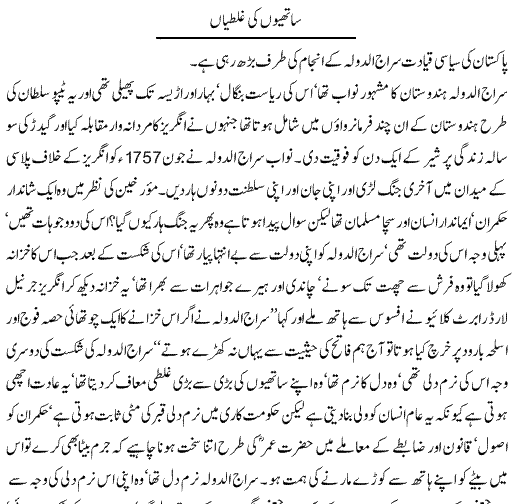
While discussing Pakistani Politics in his column Zero Point which Mr. Javed Chaudhry file in a RAG" Express News, and like a born again Islamic Revivalist Mr. Javed has quoted an incident which is nothing but a flagrant lie [read the background of Concocted Story after the quote of Javed] on Hazrat Omar Bin Khattab [May Allah be pleased with him] "that he whipped his own son for the sake of upholding the Law and Justice". May the readers know as to who was the son, what was his name, from where he got the reference and how authentic the reference is? Saathiuin ki galtiyan – Urdu Columns of Javed Chaudhry Posted by admin 23 April, 2010 http://www.javed-chaudhry.com/saathiuin-ki-galtiyan-urdu-columns-javed-chaudhry/


Authenticity of the Story [Lie] Concocted and quoted by Mr. Javed Chaudhry is as under:

The "Incident" above is narrated by one Saeed Bin Masrooq and this narration is Maudhu "Concocted" [References: Vol 3 Page 269 and Page 274 Kitabul Maudhuat by Abul Faraj ibn Al Jawzi, Page 180 Tadhkirrah al-Mawdoo'aat Wal-Dhu'afaahas by Allamah Muhaddith Tahir Patni, Volume 2 Page 194 Al-La’aali’ al-Masnoo’ah fi’l-Ahaadeeth al-Mawdoo’ah by Jalaluddin Al-Suyuti, ad-Daraqutni says its concocted Volume 2 page 198Al-La’aali’ al-Masnoo’ah fi’l-Ahaadeeth al-Mawdoo’ah by Jalaluddin Al-Suyuti]

Chain of Narration and Narrators:

Muhammad Bin Ubaidullah Asadi, Abu Abdullah Hasan Bin Ali [both are unknown - Majhoolul Hal] and last narrator died 126 Hijri. Saeed Bin Masrooq was a pupil of Imam A'amash and Father of Sufiyan Thauri, never saw or met any Companion of Prophet Mohammad [PBUH], and Chain of narration is missing in the start rather broken. Sufiyan Thauri was an Scholar of Kufa, a Traditionalist (Muhaddith) and expret on Hadith and also an expert of Asma-ur-Rijal (the unique art of research on people). Another narrator is Abdul Quddus Bin Hajjaj who narrated it through Safwan and narrators are Kazzab (Flagrant and Ppathological Liars) and not even worth to be quoted for any narration. [Reference: al-Taqasim wa al-Anwa by Muhammad ibn Hibban ibn Ahmad al-Tamimi al-Busti (Muhaddith) and Vol 3 Page 275 Kitabul Maudhuat by Abul Faraj ibn Al Jawzi]

Sunday, March 22, 2009

Asghar Ali Engineer, Omar, Ali, Hussein and Yazid - 4


CENTRALITY OF JIHAD IN THE POST-QUR’ANIC PERIOD Asghar Ali Engineer

(Islam and Modern Age, March 09)

Husain stood for Islam and Islamic values and Yazid for power

URL: http://www.newageislam.com/NewAgeIslamArticleDetail.aspx?ArticleID=1232

Asghar Ali Engineer

But after death of the Prophet (PBUH) there was no great moral authority to influence people and since there was no formal state structure, it became necessary to evolve a formal state structure. Since there was no available model among Arabs, much had to be copied from Persian and Roman state structures. [Asghar Ali Engineer].

It is unfortunate that these wars for power were often called ‘jihad’ and not only meaning of jihad which originally means struggle for truth was corrupted to mean war in the way of Allah. These wars were anything but war in the way of Allah. Qur’anic doctrine nowhere requires war with sword to spread Islam. So all conquests that took place had nothing to do with religion and were anything but jihad. In fact the series of conquests begin with the 2nd Caliph Umar and Sassanid and parts of Roman Empire were conquered. Unfortunately we do not find much on reasons for these conquests in early sources. It was certainly not for spread of Islam or spread of truth. [Asghar Ali Engineer].

============================================

Dear Editor,

I wonder if Mr Asgher Ali Engineer has even read the Volumes number 2, 3, and 4 of Tabari [he relied on Tabari to condemn Muawiyah and Yazeed] wherein a complete State Structure is given which was left by Prophet Mohammad [PBUH], Mr Asgher Ali should also have tried first two volumes of Tabaqat-e-Ibn-e-Sa'ad, and should also have read Ibn Khaldun's Volume [Rasool and Khulafa-e-Rasool] before passing the comment that;

"QUOTE"

But after death of the Prophet (PBUH) there was no great moral authority to influence people and since there was no formal state structure, it became necessary to evolve a formal state structure. Since there was no available model among Arabs, much had to be copied from Persian and Roman state structures.

"UNQUOTE"

Some of the important facts that need to be kept in mind while passing any judgments about the expidition of Persia (often termed forced conversion) [by the Companions] and killing and expelling the Jews of the Banu Qurayzah and other tribes from Arabia:

The Prophet Mohammad [PBUH] was the last messenger of Allah. With his status as a Rasul, the Prophet Mohammad [PBUH] was in a position to do Itmamu'l-Hujjah [Final Argument] even as an individual. No one after him has that privilege. No individual can do Itmamu'l-Hujjah now because no individual can claim that his propagation has manifested the truth to the extent that no excuse is left to deny it. Indeed, an individual cannot even be absolutely certain of having understood the truth absolutely correctly. He can only be certain that God will reward him for doing his duty as he has 'been given the light to see it'. Only the Prophet Mohammad [PBUH]'s word are final in religion. After the Prophet [PBUH], the responsibility of bearing witness to the truth of Islam was passed on to his Companions [May Allah be pleased with them], who were declared Ummah Wasat (the intermediate people) and the shuhada 'ala'l-Nas (witnesses over people).

The Qur'an says:

And strive for Allah with the endeavour which is His right. He hath chosen you and hath not laid upon you in religion any hardship; the faith of your father Abraham (is yours). He hath named you Muslims of old time and in this (Scripture), that the messenger may be a witness against you, and that ye may be witnesses against mankind. So establish worship, pay the poor-due, and hold fast to Allah. He is your Protecting friend. A blessed Patron and a blessed Helper! [AL-HAJJ (THE PILGRIMAGE) Chapter 22 - Verse 78]

Thus We have appointed you a middle nation, that ye may be witnesses against mankind, and that the messenger may be a witness against you. [AL-BAQARA (THE COW) Chapter 2 Verse 143]

Killing and Expelling the Jews of the Banu Qurayzah:

1- After the Prophet’s migration to Medinah, the Banu Qurayzah, with the other Jewish tribes of the locality, became a party to the Medinah declaration, according to which, these Jewish tribes and the Muslim state of Medinah were to act as alliances against any foreign attacks. According to this declaration, the Jews were allowed complete religious freedom and were granted protection of life and wealth as long as they honored the declaration;

2- Previously, the Banu Qurayzah were given a lesser status than the other Jewish tribe – the Banu Nadheer – which is evident from the fact that the blood money that they were granted, if any of their tribesman was killed by Banu Nadheer was half that of what was granted to Banu Nadheer. The Prophet (pbuh) corrected this injustice and granted the Banu Qurayzah the same political status as that of Banu Nadheer. (Abu Dawood, Kitaab al-Diyyaat, Baab al-Nafs bi al-Nafs, Hadith No. 3896)

3- The Jewish tribes did not honor their part of the Medinah declaration and on the instigation of the Qureish broke the agreement. At this the Banu Nadheer were sent into exile; while the Banu Qurayzah asked forgiveness and requested a renewal of the agreement, to which the Prophet (pbuh) agreed and allowed them another chance (Muslim, Kitaab al-Jihaad wa al-Siyar, Baab Ijlaa al-Yahood min al-Hijaaz, Hadith No. 3312)

4- Even after all this, the Banu Qurayzah joined the alliance that was gathered by the Qureish against the Muslims.

It was in this background that immediately after the confrontation with the confederates (Ahzaab), the Prophet (pbuh) decided to take the Banu Qurayzah to task. Even then, had the Banu Qurayzah sought forgiveness for their betrayal, the Prophet (pbuh) may have given them respite, as he did so in the past. Nevertheless, the Banu Qurayzah had decided to fight the Muslims. This was evident from the fact that when Ali (ra) reached their fort, they openly abused the Prophet (pbuh).

The Muslims kept the forts of Banu Qurayzah under siege for about one month. Ultimately, the Banu Qurayzah requested the arbitration of Sa`d Ibn Mu`aaz (ra) – one of the leaders of the tribe of Aws – a traditional ally of the Banu Qurayzah

and promised that they would accept whatever Sa`d ibn Mu`aaz decides for them. Later on, Sa`d decided that all those among the Banu Qurayzah, who could fight be killed, while all their women and children be taken as slaves and all their wealth and property be confiscated and distributed among the Muslims. Subsequently, the sentence pronounced by Sa`d was implemented by the Muslims.

It should be clear from the facts given above that in the light of their behavior preceding the judgment the Banu Qurayzah deserved a very strict punishment. Furthermore, it is also clear that the punishment was not decided by the Prophet (pbuh), but was actually decided by a person, who was appointed as arbitrator, by the Banu Qurayzah, themselves.

However, one may still be of the opinion that the Prophet (pbuh) should have softened the punishment, even if it was pronounced by an arbitrator, who was appointed by the Banu Qurayzah themselves. On the contrary, the Prophet (pbuh) not only upheld and implemented the decision pronounced by the arbitrator, but also commended it as: ‘in accordance with God’s law’.

To fully understand why the Prophet (pbuh) did not soften or alter the sentence pronounced by Sa`d ibn Mu`aaz, we should keep in mind that Banu Qurayzah were actually Jews, who were subject to the laws of the
Torah.

Deuteronomy 20: 10 – 14 says:

When you draw near to a town to fight against it, offer it terms of peace. If it accepts your terms of peace and surrenders to you, then all the people in it shall serve you at forced labor. If it does not submit to you peacefully, but makes war against you, then you shall besiege it; and when the LORD your God gives it into your hand, you shall put all its males to the sword. You may, however, take as your booty the women, the children, livestock, and everything else in the town, all its spoil. You may enjoy the spoil of your enemies, which the LORD your God has given you.

It was in accordance with this law that Moses (pbuh) ordered the killing of all the men of Midian and taking all their women and children as captives.

Numbers 31: 7 – 11 read as:

They did battle against Midian, as the LORD had commanded Moses, and killed every male… The Israelites took the women of Midian and their little ones captive; and they took all their cattle, their flocks, and all their goods as booty. All their towns where they had settled, and all their encampments, they burned, but they took all the spoil and all the booty, both people and animals.

Obviously, on reciprocal basis, the Israelites themselves were subject to the same divine law. Thus, Sa`d Ibn Mu`aaz pronounced his judgment according to this law, upon which, the Prophet (pbuh) declared that his decision was 'in accordance with God's law'. Furthermore, because of this particular nature and basis of the judgment, the Prophet (pbuh) neither had the right nor the authority to alter it.

Because Sa`d ibn Mu`aaz’s decision was in accordance with the directives of the Torah, which the Jews accepted to be divine and were, therefore, subject to, the Prophet (pbuh) did not alter the decision. It was, in fact, because of this background of the judgment that when Hayee ibn Akhtab – one of the Jewish leaders – was brought to the place where he was to be killed, he looked at the Prophet (pbuh) and said:

By God, I have no regrets in opposing you, but the fact is that whoever tries to deceive God is Himself, ultimately, deceived.

Then he turned toward his people and said:

People, there is no harm in the implementation of God’s laws. This was a directive of God, it was decided, it is a punishment, which God had prescribed for the Israelites.

Thus, the Banu Qurayzah were, in fact, slaughtered by the sword of the Torah – the book, which they, themselves, held to be divine.

References:

This response is primarily based on Shibli Naumani’s “Seerat al-Nabiy”. [History is used as per the criteria used by Asghar Ali Engineer]

The Prophet Mohammad [PBUH] sent Ali Ibn Abi Talib [May Allah be pleased with him] with his flag to the Banu Qurayzah and people started moving toward them. When Ali [May Allah be pleased with him] came close to their forts, he heard them say despicable things about the Prophet [May Allah be pleased with him].

According to Ibn Katheer’s Al-Bidayah wa al-Nihaayah [History is used as per the criteria used by Asghar Ali Engineer to curse not only Yazeed and Muwaiyah but indirectly Hazrat Omar], the Banu Qurayzah were misguided by some of their allies that if the Prophet (pbuh) were to decide their fate, he would kill them all.

Life of the Prophet [Seeratul Alnabwiya by Ibn-e-Hisham Volume 4 Page 201][History is used as per the criteria used by Asghar Ali Engineer]

Asghar Ali Engineer, Omar, Ali, Hussein and Yazid - 3


CENTRALITY OF JIHAD IN THE POST-QUR’ANIC PERIOD Asghar Ali Engineer

(Islam and Modern Age, March 09)

Husain stood for Islam and Islamic values and Yazid for power

URL: http://www.newageislam.com/NewAgeIslamArticleDetail.aspx?ArticleID=1232

Asghar Ali Engineer

The first casualty of transformation of khilafah into monarchy was battle of Karbala which is great tragedy of early history of Islam. It was greed for power on the part of Yazid, son of first Umayyad ruler Mu’awiyah that led to martyrdom of Imam Husain, the grandson of the Prophet (PBUH). Husain stood for Islam and Islamic values and Yazid for power. It was Umayyad greed for power which resulted in killing of members of Prophet’s family. [Asghar Ali Engineer]

=============================================

Yet for all these wars Tabari (the eminent historian) and others have used the term ‘jihad’ which no where comes near the sense in which Qur’an uses the term. [Asghar Ali Engineer]

============================================================

Dear Editor,

Asgher Sahab has relied upon "Duobtful History" to condemn Muawiyah and Yazeed but as per the same so-called Eminent Historian Tabari narrates that Muhammad Bin Abu Bakar [s/o Hazrat Abu Bakar Siddiq - May Allah be pleased with him and was adopted by Hazrat Ali May Allah be pleased with him] was amongst the Murderer of Hazrat Uthman [May Allah be pleased with] but I dont believe this narration because it is an indirect slander upon Hazrat Ali [May Allah be pleased with him] but since criteria by Mr Asghar Ali Engineer [Bohri Shia - A Sect of Mainstream Shia and followers of Zaid Bin Ali bin Zain Al Abidin bin Hussein bin Ali bin Abi Talib] is History through which he condemned Muawiyah and Yazeed and when Criteria is History then the Veracity of History is as under:

Quran cannot be tempered and Hadith can be verified through matching it with Quran and then Chains of Narrations. Regarding Biography of Mohammad [PBUH], how can one be so sure that LIFE SKETCH of Prophet Mohammad [PBUH] is not tempered because it's not Quran. Historian collect everything and one should be very careful when Historian discuss Prophets [PBUT], their Companions [May Allah be pleased with them]


Muhammad ibn Jarir al-Tabari: “I am writing this book as I hear from the narrators. If anything sounds absurd, I should not be blamed or held accountable. The responsibility of all errors or blunders rests squarely on the shoulders of those who have narrated these stories to me.” Tabari's Tareekhil Umam Wal Mulook (The History of Nations and Kings) popularly called "Mother of All Histories" is the first ever "History of Islam" written by 'Imam' Tabari (839-923 CE) at the junction of the third and fourth century AH. He died in 310 AH. [Preface of Tareekhil Umam Wal Mulook (The History of Nations and Kings) by Muhammad ibn Jarir al-Tabari.]

Ahmed Bin Hanbal says:Three kinds of books are absolutely unfounded, Maghazi, Malahem and Tafseer.” (The exalted Prophet's Battles, Dreams and Prophecies, and Expositions of the Qur’an). [Ahmed Bin Hanbal as quoted by ibn Rajab al-Hanbali in Dhayl Tabaqat al-Hanabila (Appendage to the Encyclopedia of Hanbali Scholars)]

Hafiz Ibn Kathir says: Had Ibn Jareer Tabari not recorded the strange reports, I would never have done so. [Tafseer Ibn Katheer (Commentary on Quran) and Al Bidaya Wal Nihaya (History - From Start to End)]

Ibn Khaldun says: The Muslim historians have made a mockery of history by filling it with fabrications and senseless lies. (Muqaddama Ibn Khaldun)

Shah Abdul Aziz Dehelvi says: Six pages of Ibn Khaldoon's History have been deliberately removed since the earliest times. These pages had questioned the most critical juncture of Islamic history i.e. the Emirate of Yazeed and the fiction of Karbala. [Even the modern editions admit in the side-notes that those pages have been mysteriously missing from the ancient original book. [Tohfa Ithna Ashri by Shah Abdul Aziz Dehelvi]

Shah Waliullah Dehelvi says: Imam Jalaluddin Sayyuti's Tarikh-ul-Khulafa is the prime example of how our Historians, Muhaddithin and Mufassirin, each has played like Haatib-il-Lail (One who collects firewood at night not knowing which piece is good and which one is bad). [Izalatul Khifa A'N Khilaafatil Khulafaa by Shah Waliullah]


Example is as under:

"QUOTE"

Muhammad ibn Ishaq ibn Yasar [Birth:85 AH 704 CE Death: 150-153 AH (767)]

The earliest is Ibn Ishaq's Sira, his biography of the Prophet. It is also the longest and the most widely quoted. Later historians draw, and in most cases depend on him. [Uyun al-athar, I, 7, Ibn Sayyid al-Nas (d. 734A.H.)

A contemporary of Ibn Ishaq, Imam Malik [d 179 AH], the jurist, denounces Ibn Ishaq outright as "a liar" and "an impostor" just for transmitting such stories. [`Uyun al-athar, I and ibid, I, 16].

It must be remembered that historians and authors of the Prophet's biography did not apply the strict rules of the "traditionists". They did not always provide a chain of authorities, each of whom had to be verified as trustworthy and as certain or likely to have transmitted his report directly from his informant, and so on. The attitude towards biographical details and towards the early events of Islam was far less meticulous than their attitude to the Prophet's traditions, or indeed to any material relevant to jurisprudence. The attitude of scholars and historians to Ibn lshaq's version of the stories has been either one of complacency, sometimes mingled with uncertainty, or at least in two important cases, one of condemnatlon and outright rejection.

The complacent attitude is one of accepting the biography of the Prophet and the stories of the campaigns at they were received by later generations without the meticulous care or the application of the critical criteria which collectors of traditions or jurists employed. It was not necessary to check the veracity of authorities when transmitting or recording parts of the story of the Prophet's life.[Ibn Sayyid al-Nas (op. cit., I, 121)]

It was not essential to provide a continuous chain of authorities or even to give authorities at all. That is obvious in Ibn Ishaq's Sira. On the other hand reliable authority and a continuous line of transmission were essential when law was the issue. That is why Malik the jurist had no regard for Ibn Ishaq. [Kadhdhab and Dajjal min al-dajajila - Liar and Liar amongst Liars]

His contemporary, the early traditionist and jurist Malik, called him unequivocally "a liar" and "an impostor"[Kadhdhab and Dajjal min al-dajajila - Liar and Liar amongst Liars] "who transmits his stories from the Jews".[`Uyun al-athar, I, 16-7 by Ibn Sayyid al-Nas].

In a later age Ibn Hajar Asqalani further explained the point of Malik's condemnation of Ibn Ishaq. Malik, he said,[Tahdhib al-Tahdhib, IX, 45. See also `Uyun al-athar, I, 16-7] condemned Ibn Ishaq because he made a point of seeking out descendants of the Jews of Medina in order to obtain from them accounts of the Prophet's campaigns as handed down by their forefathers. [ibid.]

Asghar Ali Engineer, Omar, Ali, Hussein and Yazid - 2


CENTRALITY OF JIHAD IN THE POST-QUR’ANIC PERIOD Asghar Ali Engineer

(Islam and Modern Age, March 09)

Husain stood for Islam and Islamic values and Yazid for power

URL: http://www.newageislam.com/NewAgeIslamArticleDetail.aspx?ArticleID=1232

Asghar Ali Engineer

The first casualty of transformation of khilafah into monarchy was battle of Karbala which is great tragedy of early history of Islam. It was greed for power on the part of Yazid, son of first Umayyad ruler Mu’awiyah that led to martyrdom of Imam Husain, the grandson of the Prophet (PBUH). Husain stood for Islam and Islamic values and Yazid for power. It was Umayyad greed for power which resulted in killing of members of Prophet’s family. [New Age Islam]

==========================================

The first casualty of transformation of khilafah into monarchy was battle of Karbala which is great tragedy of early history of Islam. It was greed for power on the part of Yazid, son of first Umayyad ruler Mu’awiyah that led to martyrdom of Imam Husain, the grandson of the Prophet (PBUH). Husain stood for Islam and Islamic values and Yazid for power. It was Umayyad greed for power which resulted in killing of members of Prophet’s family. [Asghar Ali Engineer]

=============================================

Yet for all these wars Tabari (the eminent historian) and others have used the term ‘jihad’ which no where comes near the sense in which Qur’an uses the term. [Asghar Ali Engineer]

============================================================

Dear Editor,

Asgher Sahab has relied upon "Duobtful History" to condemn Muawiyah and Yazeed but as per the same so-called Eminent Historian Tabari narrates that Muhammad Bin Abu Bakar [s/o Hazrat Abu Bakar Siddiq - May Allah be pleased with him and was adopted by Hazrat Ali May Allah be pleased with him] was amongst the Murderer of Hazrat Uthman [May Allah be pleased with] but I dont believe this narration because it is an indirect slander upon Hazrat Ali [May Allah be pleased with him] but since criteria by Mr Asghar Ali Engineer [Bohri Shia - A Sect of Mainstream Shia and followers of Zaid Bin Ali bin Zain Al Abidin bin Hussein bin Ali bin Abi Talib] is History through which he condemned Muawiyah and Yazeed and when Criteria is History then History also tells us:

Since History is quoted here to curse Yazid therefore I will also quote History!

Shia and Sunni Sources on Hasnain's acceptance of Muawiyah's Khilafa:

[Akhbar Al Tawal Al Denwary page 234, Tabari Page 62 Volume 6, Al Imama Wal Siyasa page 173, Maqtal Abi Mikhnaf page 4 published in Najaf]

Hazrat Muawiya [May Allah be pleased with him]'s Excellent Treatment with Hasan and Hussain [May Allah be pleased with both of them]:

Hussain used to go with Hasan to meet Muawiyah in Damascus and at one stance Muawiyah gifted 2 Million Dirham to both and at anothe ocassion he gifted Hazrat Hasan 4 Million Dirham [Al Bidaya Wal Nihaya by Ibn Kathir Page 150 and Page 127 Volume 8] This narration is confirmed by Ibn Abi Al Hadid (Mutazilli Shia) in his translation of Nehjul Balagha page 823 Volume 2] and this further confirmed by Extremist Shias like Abu Mikhnaf in his book Maqtal Abi Mikhnaf page 7].

Note: Maqtal Abi Mikhnaf is a book by Abu Mikhnaf specially written on Karbala Tragedy and from Tabari to present day Speakers of Shia Majlis, this book is quoted for narrating the Tragedy of Karbala.

"QUOTE"

Excerpts from DEFENCE AGAINST DISASTER by QADI ABU BAKR IBN AL-`ARABI Accurately Determining The Position Of The Companions After The Death Of The Prophet, May Allah Bless Him And Grant Him Peace AL-`AWASIM MIN AL-QAWASIM

The first to write to him from the shaykhs of the party, according to what their historian Lut b. Yahya related, were Salman b. Surad, al-Musayyib b. Najba, Rifâ b. Shaddad and Habib b. Muzahir. They sent their letter with `Abdullah b. Sabâ al-Hamdani, and `Abdullah b. Wali. They came to Husayn in Makka on the tenth of Ramadan, 60 A.H. After two days, Qays b. Mushir al-Saydawi, `Abdur-Rahman b. `Abdullah b. al-Kadn al-Arhaji and `Umara as-Saluli went to him with fifty-three pages. After another two days, Haniâ b. Haniâ as-Subayâi and Sa`id b. `Abdullah al-Hanafi hurried to him. (at-Tabari, 6:197 has the texts of some of their letters and the names of some of its people). This continued until they would not meet with their Amir, an-Nu`man b. Bashir on Friday. They called al-Husayn to them. Then when he came, they would expel their Amir and hold him in Syria. They said to one of them, "So the fruits will grow. If you so wish, you will find a large army for you." Al-Husayn sent them his nephew Muslim b. `Uqayl to see if they would be loyal and gather so that he could come to them later. Muslim b. `Uqayl got lost on the way and those with him died of thirst. He wrote to al-Husayn asking him to relieve him of this task. He answered him, "I fear that only cowardice has led you to ask to be excused." Muslim continued until he reached Kufa and twelve thousand of them offered homage to him.

The Amir of Kufa, an-Nu`man b. Bashir, became aware of their movements. He spoke to them and forbade sedition and division. He told them, "I only fight the one who fights me. I will not punish by supposition or suspicion. If you show me your page and you break your pledge of homage, then I will strike you with my sword as long as it is firm in my hand." Yazid knew that an-Nu`man b. Bashir was a forbearing man of piety not suited to opposing a movement like this. He therefore wrote to `Ubaydullah b. Ziyad, his governor over Basra ordering him to take charge of Kufa as well. He commanded him to go to Kufa and to seek out Ibn `Uqayl as the pearl is sought until it is found. Then he should bind him and kill or exile him. `Ubaydullah appointed his brother over Basra and went to Kufa. He met its leaders and took hold of the crisis. It was not long before Muslim b. `Uqayl saw that the opinion of the twelve thousand who had given him allegiance was as thin as air. He found himself alone and cast out. Then he was taken and executed.

Al-Husayn had received the letters of Muslim b. `Uqayl before that, saying that twelve thousand had offered homage to him until death. At the end of the Hajj `Id, he left for Kufa. Ibn az-Zubayr was the only one to encourage him to go out because he knew that the people of the Hijaz would not give him homage as long as al-Husayn was with them. Al-Husayn was the heaviest of people for Ibn az-Zubayr, (At-Tabari, 6:196-197 and look at 6:216-217) and his nephew `Abdullah b. Ja`far b. Abi Talib (2:219). `Abdullah b. Ja`far asked the governor of Yazid over Makka, `Amr b. Sa`id b. al-`As, to write a letter of safe-conduct for al-Husayn to give him hopes of kindness and connection and to ask him to come back. The Governor of Makka granted all that he sought. He told him, "Write whatever you wish and I will seal the letter." He wrote to him and the governor sealed it. He sent it to al-Husayn with his brother Yahya b. Sa`id b. `Is. `Abdullah b. Ja`far went with Yahya. They tried to dissuade al-Husayn from travelling. He refused. (The Governor's letter is in The History of at-Tabari, 6:219-220). No one was above these counsellors in their intellect, knowledge, position and sincerity. `Abdullah b. Muti`, the agent of Ibn az-Zubayr, was one of his advisers who had intellect and sincerity (at-Tabari, 6:196). `Umar b. `Abdur-Rahman b. al-Harith b. Hishan al-Makhzumi held this opinion (at-Tabari, 6125-126), and al-Harith b. Khalid b. al-`As b. Hisham did not neglect to give him counsel (6:216). Even al-Farazdaq the poet told him, "The hearts of the people are with you, but their swords are with the Banu Umayya." (at-Tabari, 6:218). None of this effort turned al-Husayn from this journey which was ill-omened for him, for Islam, and for the Islamic community until this very day and will be until the Last Day.

All of this was due to the crime of his party who encouraged him to rashness, delusion and desire for civil strife, division and evil. Then they disappointed him through their cowardice, baseness, treachery and perfidy. Their heirs were not content with what their ancestors did. They devoted themselves to clouding history and changing the truth and to reversing things. and he sent Muslim b. `Uqayl, his nephew, to them to take allegiance from them and to investigate his followers. Ibn `Abbas forbade him and told him that they had disappointed his father and his brother. Ibn az-Zubayr indicated to him that he should go out, so he went out. When he reached Kufa, Muslim b. `Uqayl had been slain and all of those who had invited him surrendered him. It is enough for you in this to have the warning of the one who is warned.

He persisted and continued out of anger for the deen and to establish the truth. But he, may Allah be pleased with him, did not accept the good advice of the man with the most knowledge among the people of his time. That was Ibn `Abbas. He turned away from the opinion of the shaykh of the Companions, Ibn `Umar.

Well-being lay in what he preferred and his encouraging the unity of the muslims and their devotion to the spread of the call and conquest. He sought the beginning in the end and the straight in the crooked and the greenness of youth in the white hair of old age. His power was not like that nor did he have any helpers who guarded his right or who expended themselves for him. We wanted to purify the earth of the wine of Yazid,

By the claim of those who provoked the sedition who testified to something which they did not know. so we shed the blood of al-Husayn. A calamity came to us which the happiness of time cannot heal. No one came out to him except by using interpretation. They all fought him with what they had heard from his grandfather, the master of the messengers who mentioned the corruption of the situation and warned about getting involved in seditions. He said a lot about that. They included his words, may Allah bless him and grant him peace,

From the hadith of `Arfaja in The Book of the Amirate in the Sahih of Muslim: The chapter of The Judgments of the One who Divides the Muslims when they are United (book 33, hadith 59, pt. 6, p. 22). "There will be defects and flaws. Whoever wants to divide the business of this community when it is united should be struck with the sword, whoever he is." People only presented this and things like it. Even if their leader and the son of their noble al-Husayn expanded his house, his estate or his camels, and even if people came to him to establish the truth and they included Ibn `Abbas, and Ibn `Umar, one should not turn to them. He should remember what the Prophet, may Allah bless him and grant him peace, warned about and what he said about his brother.

i.e "this son of mine is a master. Perhaps Allah will use him to make peace between two large groups of muslims." He saw that it had left his brother while the armies of the land and the great men were seeking him out. How then could it return to him by the dregs of Kufa while the great companions forbade him and held aloof from him? I do not think that this is anything other than submission to the decree of Allah and sorrow for the grandson of the Messenger of Allah, may Allah bless him and grant him peace, for all time. If it had not been for the fact that the shaykhs and notables of the community recognised that it was a matter which Allah had taken away from the people of the House and a state of civil strife which no one should become involved in, they would never have surrendered it.

Ahmad b. Hanbal, in spite of his asceticism and his immense position in the deen and his scrupulousness, still included Yazid b. Mu`awiya in The Book of Zuhd and mentioned what he used to say in his khutba, "When one of you falls ill, is treated and recovers, he should look to the best action he has and cling to it. He should look to the worst thing he has done and leave it." This indicates his immense position with Ibn Hanbal since he included him among the men of Zuhd of the Companions and the Tabi`un whose words were followed and those who are not warned. Indeed, he included him in the group of companions before he proceeded to mention the Tabi`un. Where is this in relation to what the historians say about him and wine and types of corruption? Are they not ashamed? When Allah strips them of virtue and modesty, why do you not desist and hold back when they follow the rabbis and monks rather than the men of excellence of the community? You should reject the heretics and impudent men who are affiliated with the community. "This is a clarification for people and guidance and warning for the fearfully aware." Praise be to Allah, the Lord of the Worlds."

"UNQUOTE"

Hazrat Ali [May Allah be pleased with him] had indeed named his sons after Sheikhain i.e. Hazrat Abu Bakar, Hazrat Omar and Hazrat Usman [May Allah be pleased with all of them]. As per Authentic Shia Sources Prophet Mohammad [PBUH] did have biological daugthers [May Allah be pleased with them] besides Hazrat Fatimah [May Allah be pleased with her] and these daugthers were married later to Hazrat Usman [May Allah be pleased with him]. Not only that Authentic Shia Sources also accept that Hazrat Ali's Daughter Syeda Kulsoom [May Allah have mercy on his soul] was married to Hazrat Omar [May Allah be pleased with him]. Read the details below:

1 - Hazrat Ali's Family.

2 - Hazrat Ali Relationship with Hazrat Omar.

3 - Hazrat Usman's Relation with Prophet Mohammad [PBUH] and Hazrat Ali [Shia Sources]

4 - Aal-e-Ali's relationship with Bannu Ummayya and Aal Marwan [After the Tragedy of Karbala]

Now Read........ ........

Wives and Children of Hazrat Ali [May Allah be pleased with him:

1 - Hazrat Fatimah Bint Mohammad [May Allah be pleased with her]:

Hassan, Hussain, Zainab ul Kubra and Umme Kulthum [she became wife of Hazrat Omar (May Allah be pleased with him and all those who were mentioned earlier.

2 - Umm-ul-Bunian Bint Haram Bin Kalabia [she was related with Shimar Bin Zil Joshan (the alleged Criminal of Karabala){Ref: Jumhartul Ansab by Ibn Hazm}] who was the daughter of Hazam b. Khalid. Hadrat Ali had five sons from her, namely: Abdullah, Jafar, Abbas, Othman, and Umar. All of them were martyred in the battle of Karbala along with Hadhrat Hussain [May Allah be pleased with him].

3 - Laila Bin Masood Bint Khalid Nehshaliya Tameema who was the daughter of Masud. She was the mother of two sons, namely Ubaidullah and Abu Bakr. Both of them were martyred in Karbala.

4 - Asma who was the daughter of Umais. She was in the first instance married to Hadrat Jafar, an elder brother of Hadrat Ali. On the death of Hadrat Jafar, Hadrat Abu Bakr married her. After the death of Hadrat Abu Bakr she married Hadrat Ali. She had to sons from Hadrat Ali, namely: Yahya and Muhammad Al Asghar who martyred in Karbala.

5 - Umama [her mother Zainab was the daughter of Prophet Mohammad - PBUH]d/o of Abi Al Aa's. Her son from Hadrat Ali bore the name of Muhammad Awsat.

6 - Khaula Bint Jafariya was the daughter of Jafar Hanfiyah. She was the mother of the son known as Muhammad b. Hanfiyah aka Mohammad Al Akbar.

7 - Sehba Bint Rabia Taghlibiya who was the daughter of Rabiah. She gave birth to a son Umar, in the daughter Ruqiya.

8 - Umm Saeed Bint Urwa Bin Masood Thaqeefa who was a daughter of Urwa. She bore Hadrat Ali three daughters, namely: Umm-ul-Hasan, Ramlatul Kubra and Rumia.

9 - Mukhbita Bint Amral Qais Bin Adi Al Kalbiya Muhyat was a daughter of the famous Arab poet Imra-ul-Qais. She gave birth to a daughter who expired in infancy.

Hadrat Ali married nine wives in all including Hadrat Fatima. The number of wives at a time however did not exceed four. He had a few slave girls of whom Humia and Umm Shuaib bore him 12 daughters, Nafisa, Zainab, Ruqiya, Umm-ul-Karaam, Humaira, Umm Salma, Sughra, Khadija, Umm Hani, Umm Kulthum Jamana and Maimuna. Hadrat Ali was, in all, the father of 15 sons and 18 daughters. [total = 33 children]

Those who were martyred at Karbala are as under:

Hazrat Ali [May Allah be pleased with him] son's:

Jafar, Abdullah and Usman [sons of Ummul Banin Bin Hazam], Mohammad [son of Ummul Wald], Abu Bakar [son of Laila Bin Masood Armiya], Abbas.

Sons of Hazrat Hussain Ibn Ali [May Allah be pleased with him]:

Ali [Laila Bint Marra bin Arwa Thaqafi (Saqaf: tribe of Shia Hero Mukhtar and Sunni Nasibi Hajjaj Bin Yousuf), Abdullah (son of Rubab Bin Umral Qais Kalbi)

Sons of Hazrat Hasan bin Ali [May Allah be pleased with him]:

Abu Bakar and Qasim.

Sons of Abdullah Bin Jafar Bin Abi Talib:

Aun and Mohammad.

Aqeel Bin Abi Talib:

Jafar, Abdul Rahman, and Abdullah

Sources: [Al Milal Wan Nahal by Ibn Hazm, Jumharatul Ansab by Ibn Hazm, History by Ibn-e-Khaldun and Ansab Aal-e-Abi Talib]

Hazrat Hussain Ibn Ali [May Allah be pleased with him]'s real cousin and Brother In Law Hazrat Abdullah bin Jafar Tayyar Bin Abi Talib [May Allah have mercy on his soul]'s second daughter Syeda Umme Mohammad [May Allah have mercy on her soul] was the wife of Hazrat Ameer Yazeed Bin Muawiyah [May Allah have mercy on his soul]

Source:

{Kitab Nasbul Quraish and Jumharatul Ansab by Ibn Hazm]

1 - Syeda Umme Kulsoom bint Ali Bin Abi Talib [May Allah have mercy on her soul] was the wife of Hazrat Omar [May Allah be pleased with him]

Sources:

{Khulaini reports through Muawiyah Bin Ammar, Abu Jafer Tusi in Tehzeeb Al Ahkam, Tusi reports through Hazrat Baqar, Al Kafi has whole chapter on this marriage "Bab Fi Tarweej Umme Kulsoom", Faroogh Kafi, Ibnen Shehr Ashob Mazandarani, Zainuddin Amili, Manaqib-e-Aal- e-Abi Talib}

Relationship of Hazrat Ali Ibn Talib [May Allah be pleased with him] with Banu Ummayya [Ummayyads] and that relationship through marriages after the Incidents of Siffin and Karbala.

1- Three daughters of Hazrat Ali Ibn Talib [May Allah be pleased with him] were married to Muawiyah bin Marwan, Abdulmalik Bin Marwan, and Amir Kuraiz Ummavi respectively. [Jumharatul Ansab by Ibn Hazm and Al Bidaya Wal Nihaya by Ibn Kathir]

2- Hazrat Ali [May Allah be pleased with him]'s son Hazrat Hasan [May Allah be pleased with him]'s grand-daughters married in Banu Ummayya:

3 - Syeda Nafeesa Bint Zaid Bin Hassan w/o Alwalid Bin Abdul Malik Bin Marwan [Shia Source Umdatul Talib Fi Ansab Aal Abi Talib published in India]

4- Zainab Bint Hassan Masanna w/o Alwalid Bin Abdul Malik Bin Marwan [Jumharatul Ansab by Ibn Hazm]

5 - Umme Qasim Bint Hassan Masanna w/o Marwan bin Aban [Grandson of Hazrat Usman (May Allah be pleased with him)] and after he died she married to Ali Bin Hussain aka Zainul Abideen [Jumharatul Ansab by Ibn Hazm]

6 - Hammada Bint Hassan Massanna w/o Ismail Bin Abdul Malik Bin Abdul Haris Bin Al Hakam [nephew of Marwan Bin Al Hakam (May Allah be pleased with him)] [Jumharatul Ansab by Ibn Hazm]

7- Khadija Bint Hussain Bin Hassan Bin Ali w/o Ismail Bin Abdul Malik Bin Abdul Haris Bin Al Hakam (that was before the marriage of Hammada with him) [Jumharatul Ansab by Ibn Hazm]

8- Most of the daughters [Non Fatimid] of Hazrat Ali [May Allah be pleased with him] married in Banu Jafar, Banu Aqeel, Banu Abbas and Banu Marwan [Jumharatul Ansab by Ibn Hazm]

9 - Syeda Sakina d/o Hazrat Hussain Ibn Ali [May Allah be pleased with him] after the death of Muasab Bin Zubair, married Marwan Bin Al Hakam's grandson Al Asbagh Bin Abdul Aziz Bin Marwan, his econd wife was Umme Yazeed d/o Yazid Bin Muawiyah [Jumharatul Ansab by Ibn Hazm, Al Muarif Ibn Qutaiba, Kitab Nasbul Quraish]

10 - Rabia bint Syeda Sakin Bint Hazrat Hussain Ibn Ali [May Allah be pleased with him] w/o Abbas Bin Al Walid Bin Abdul Malik Bin Marwan [Kitab Nasb Quraish]

Hazrat Uthman Ibn Affan [May Allah be pleased with him] by being son-in-law of Mohammad [PBUH] was also amongst The Ahl Al-Bayt.

As per Shia Books:

A Rafizi Abul Qasim Ali Bin Ahmed Bin Musa [Death: 352 Hijri] in his book Al Istighasa Fi Bidah-es-Salasa had denied that Ruqqaya [May Allah be pleased with her], Umme Kulthum [May Allah be pleased with her], and Zainab [May Allah be pleased with her] were also the daugthers of Prophet Mohammad [PBUH] besides Hazrat Fatimah [May Allah be pleased with her] from Hazrat Khadija [May Allah be pleased with her] whereas Ruqqayya, Zainab and Umme Kulthum were the daughters of Mohammad [PBUH] from Khadija and all three were borne before the Prophethood [Bu'saat]. Abul Qasim above meant to say that these three daughters were borne to Khadija from her earlier husband. Abul Qasim's claims are rejected by books like Nasb Al Quraish, Kashf Al Ghamma Fi Maarifatul Aimma, Umdatut Talib Fi Ansab Aal Abi Talib.

The claim of the above Rafizi was thoroughly rejected by a noted Shia Scholar Abdullah Mamqani in his book Tanqeeh ul Maqal Fi Ahwal Ir Rijal and declared that Prophet Mohammad [PBUH] had four daughters [May Allah be pleased with all of them]. Rafizi Abul Qasim was declared apostate by several noted Shia Scholars like Sheikh Abbas Al Qumi in his Tatamma Al Muntaha, and by another Shia Scholar Allama Aaqa Meer in his Naqd ur Rijal and by another Giant Shia Scholar Mohammad Bin Yaquob Al Kulaini in his Usool ul Kafi's Chapter Bab-e-Tareekh also accepted that Prophet Mohammad [PBUH] has four daughters from Khadija [May All be pleased with her].

Following Shia Books accpeted that Prophet Mohammad [PBUH] had four daughters from Khadjia [[May All be pleased with her].

1- Kitaabul Khisal by Sheikh Sadooq.

2- Tazkaratul Masoomeen.

3- Tuhfatul Awam.

4- Manaqib Ibn-e-Sheher Ashoob.

5- Hayatul Quloob.

6- Jilaul Uyoon.

7- Tehzeeb Al Ahkam.

8- Al Istabsar Mara'atul Uqool.

9- Firoo Kafi.

10- Saafi Sharah Kafi.

11- Kashful Ghama.

12- Qarbul Asnad.

13- Majalisul Momineen.

14- Ailaam ul Wari.

15- Anwaar-e-Naimania.

16- Rijal-e-Kashi.

17- Amali Sheikh Toosi.

"UNQUOTE"


"QUOTE"

Maliki scholar Qadhi Abu Bakr ibn al Arabi in AL-`AWASIM MIN AL-QAWASIM [DEFENCE AGAINST DISASTER] says

He was killed by the sword of his Grandfather's . Yet, ibn al-Arabi did say something very similar. See the text below taken from al-Awasim min al-Qawasim, (pg 231-236, Maktaba al-Asriyyah, Beirut, 2004).

Hanafi School of thought on Khurooj:

Hazrat Hussain Ibn-e-Ali [May Allah be pleased with him] going against Ameer Yazid [May Allah have mercy on his soul] and the Sunni view on Yazid:

O ye who believe! Obey Allah, and obey the messenger and those of you who are in authority; and if ye have a dispute concerning any matter, refer it to Allah and the messenger if ye are (in truth) believers in Allah and the Last Day. That is better and more seemly in the end.[AN-NISA (WOMEN) Chapter 4 Verse 59]

2) Sayyiduna Abu Huraira (Allah be pleased with him) narrates that the Messenger of Allah (Allah bless him & give him peace) said: Whoever obeys me, obeys Allah, and whoever disobeys me, disobeys Allah. And whoever obeys my ruler (amir), obeys me, and whoever disobeys my ruler, disobeys me (Sahih al-Bukhari, no. 6718 & Sahih Muslim, no. 1835).

3) Sayyiduna Anas ibn Malik (Allah be pleased with him) narrates that the Messenger of Allah (Allah bless him & give him peace) said: Listen to and obey your ruler, even if he is an Abyssinian slave whose head looks like a raisin (Sahih al-Bukhari, no. 6723 & Sahih Muslim).

4) Sayyiduna Ibn Abbas (Allah be pleased with him) narrates that the Messenger of Allah (Allah bless him & give him peace) said: Whoever sees his ruler doing something he disapproves of, he should be patient, for no one separates from the (Muslim) group even for a span and then dies, except that he will die a death of (pre-Islamic) ignorance. (Sahih al-Bukhari, no. 6724 & Sahih Muslim, no. 1849).

5) Sayyiduna Abd Allah (Allah be pleased with him) narrates that the Messenger of Allah (Allah bless him & give him peace) said: “A Muslim must listen to and obey (the order of his ruler) in things that he likes or dislikes, as long as he is not ordered to commit a sin. If he is ordered to disobey Allah, then there is no listening and no obedience. (Sahih al-Bukhari, no. 6725 & Sahih Muslim, no. 1839).

The above evidences are clear in establishing the fact that one must obey the ruler even if he is corrupt or a sinner (fasiq). The reason for this, in the words of Allama al-Ghunaymi, is that, there have been many corrupt rulers in Islamic history and never did the predecessors (salaf) rebel against them, rather they used to submit to their rule and establish Jumuâah and Eid prayers with their permission. Also, piety is not a pre-requisite for leadership. (Sharh al-Ghunaymi, p. 110).

Other scholars emphasize that uprising against corrupt leadership results in more tribulation and destruction then the initial oppression of the ruler. With forbearance and tolerance, one's sins will be forgiven. And in reality, the corrupt ruler is imposed by Allah due to our own wrongdoings, thus it becomes necessary that we repent and seek Allah's forgiveness coupled with good actions, as Allah Most High says: Whatever misfortune happens to you, is because of the things your hands have wrought (42:30).. And He says: Thus do we make the wrongdoers turn to each other, because of what they earn (6:129). Therefore, if a nation wants to free themselves from the oppression of their leader, they must refrain themselves from oppressing others.

Imam al-Tahawi (Allah have mercy on him) states in his famous al-Aqida al-Tahawiyya:

We do not recognize uprising against our Imam or those in charge of our affairs even if they are unjust, nor do we wish evil on them, nor do we withdraw from following them. We hold that obedience to them is part of obedience to Allah, The Glorified, and is therefore obligatory as long as they do not order us to commit sins. We pray for their guidance and their wrongdoings to be pardoned . (al-Aqida al-Tahawiyya with the Sharh of al-Ghunaymi, P. 110-111).

363. Well-being lay in what he preferred and his encouraging the unity of the muslims and their devotion to the spread of the call and conquest. He sought the beginning in the end and the straight in the crooked and the greenness of youth in the white hair of old age. His power was not like that nor did he have any helpers who guarded his right or who expended themselves for him. We wanted to purify the earth of the wine of Yazid,

364. By the claim of those who provoked the sedition who testified to something which they did not know. so we shed the blood of al-Husayn. A calamity came to us which the happiness of time cannot heal. No one came out to him except by using interpretation. They all fought him with what they had heard from his grandfather, the master of the messengers who mentioned the corruption of the situation and warned about getting involved in seditions. He said a lot about that. They included his words, may Allah bless him and grant him peace,

365. From the hadith of `Arfaja in The Book of the Amirate in the Sahih of Muslim: The chapter of The Judgments of the One who Divides the Muslims when they are United (book 33, hadith 59, pt. 6, p. 22). "There will be defects and flaws. Whoever wants to divide the business of this community when it is united should be struck with the sword, whoever he is." People only presented this and things like it. Even if their leader and the son of their noble al-Husayn expanded his house, his estate or his camels, and even if people came to him to establish the truth and they included Ibn `Abbas, and Ibn `Umar, one should not turn to them. He should remember what the Prophet, may Allah bless him and grant him peace, warned about and what he said about his brother.

366. i.e "this son of mine is a master. Perhaps Allah will use him to make peace between two large groups of muslims." He saw that it had left his brother while the armies of the land and the great men were seeking him out. How then could it return to him by the dregs of Kufa while the great companions forbade him and held aloof from him? I do not think that this is anything other than submission to the decree of Allah and sorrow for the grandson of the Messenger of Allah, may Allah bless him and grant him peace, for all time. If it had not been for the fact that the shaykhs and notables of the community recognised that it was a matter which Allah had taken away from the people of the House and a state of civil strife which no one should become involved in, they would never have surrendered it.

Ahmad b. Hanbal, in spite of his asceticism and his immense position in the deen and his scrupulousness, still included Yazid b. Mu`awiya in The Book of Zuhd and mentioned what he used to say in his khutba, "When one of you falls ill, is treated and recovers, he should look to the best action he has and cling to it. He should look to the worst thing he has done and leave it." This indicates his immense position with Ibn Hanbal since he included him among the men of Zuhd of the Companions and the Tabi`un whose words were followed and those who are not warned. Indeed, he included him in the group of companions before he proceeded to mention the Tabi`un. Where is this in relation to what the historians say about him and wine and types of corruption? Are they not ashamed? When Allah strips them of virtue and modesty, why do you not desist and hold back when they follow the rabbis and monks rather than the men of excellence of the community? You should reject the heretics and impudent men who are affiliated with the community. "This is a clarification for people and guidance and warning for the fearfully aware." Praise be to Allah, the Lord of the Worlds."

UNQUOTE"

Asghar Ali Engineer, Omar, Ali, Hussein and Yazid - 1


CENTRALITY OF JIHAD IN THE POST-QUR’ANIC PERIOD Asghar Ali Engineer

(Islam and Modern Age, March 09)

Husain stood for Islam and Islamic values and Yazid for power

URL: http://www.newageislam.com/NewAgeIslamArticleDetail.aspx?ArticleID=1232

Asghar Ali Engineer

Jihad in Islam has acquired centrality in history of Islam. In Qur’an it is not jihad but values like justice, compassion and forgiveness are more prominent. While these values are permanent and transcendent, war (for which Qur’an uses the word qital, not jihad) is contextual and defensive only when such situation arises. Rahmah (compassion) is quite central to Islam as it is one of the most prominent names of Allah. Compassion, in fact, is as central to Islamic value-system as in Buddhism. But then question arises why jihad, that too, in the sense of war, became so central to Islam? It is an important question and we must seek answer to this question in the history of Islam.

I think, the whole problem begins with the doctrine though not Qur’anic and which developed over a period of time, that in Islam religion and politics cannot be separated. This doctrine assumed great importance in Muslim countries and all sorts of rulers, monarchs, sultans and sheikhs exploited it to hilt to establish authoritarian regimes which violated all Qur’anic values.

This doctrine that religion and politics cannot be separated was result of religion becoming instrument of seeking power rather than seeking the truth (Haq). The most fundamental purpose of religion is seeking truth, not power. Though ideally power must be based on truth but it is not. Power often results in serious compromises with truth and hence truth is compromised in search of power.

Now the question is how religion in Islamic history came to be associated with power? When the Prophet (PBUH) died there was no state structure. All services were performed by the people purely voluntarily including war services and services for maintaining order in the society. It was purely people’s state, if at all we can call it a state. But after the death of the Holy Prophet the character of the state began to be transformed and by the time of 2nd caliph it acquired all the feature of a formal state structure.

Before we proceed any further we must note that when the Prophet of Islam began to preach in Mecca, Mecca was a stateless tribal society governed by tribal customs and traditions and through consensus of tribal chiefs in policy matters. There was no ruler or ruling class. It was tribal chiefs and traders who had formed their own inter-tribal trade corporations who wielded tremendous clout.

Thus it would be seen that Islam appeared in a society which had no state structure, no army, no policing services and no bureaucracy. Prophet’s mission was to cleanse the society of all moral corruption, obsession with material wealth, neglect of weaker sections of society and promoting belief in one God (tawhid) as belief in multiple gods in Arab society in general and in Mecca in particular, had resulted in mutual tribal conflicts and superstitious practices, some of which has been mentioned in the Qur’an.

Thus it was difficult to build unity among all the people who worshipped different gods and associated different practices and superstitions with different gods. It was also resulting in moral corruption. Accumulation of wealth also came under strong denunciation as it had divided society into rich and powerful and poor, weak and orphans and widows and slaves. These weaker sections of society had no human worth and dignity. They simply provided cheap source of labor.

Islam’s main concern was to promote belief in one God, build unity among all people irrespective of tribal and other affiliations and restore human dignity to all. Piety and moral rectitude, guaranteed nearness to Allah, not riches or tribal affiliations. The Prophet’s whole struggle was to set up such a society of good human beings and hence emphasized equality of all human beings, including of men and women, Arab and non-Arab, rich and poor. This was the main mission of Allah’s Messenger.

And it is for this precise reason that Qur’an made it obligatory for all men and women to enforce evil and contain evil. It is not state’s duty but an individual moral obligation in the Qur’an. This also shows there is no concept of state but concept of society. Also, it would be individual who would be responsible for his/her good or bad deeds before Allah. State’s function is to maintain law and order.

But after death of the Prophet (PBUH) there was no great moral authority to influence people and since there was no formal state structure, it became necessary to evolve a formal state structure. Since there was no available model among Arabs, much had to be copied from Persian and Roman state structures. As there was no fixed model of deciding as to who will head the new fledging state Muslim opinion got divided, some accepting Prophet’s son-in-law as head of the state appointed by the Prophet and some said the Prophet Abu Bakr to succeed him. Shi’ahs accepted Ali as successor and Sunnis Abu Bakr as successor to the Prophet to tackle the affairs of the new community.

Pursuit of power or building up a state was not and cannot be the purpose of any religion. In case of Islam it was mere historical circumstances that brought newly emerging religion and fledgling state together. Thus it cannot be treated as doctrine but historical coincidence. And it was struggle for power which sharply divided Muslims into two major sects and also it was power struggle which resulted in civil war after assassination of third caliph and more than 70 thousand Muslims died in the civil war.

This is the most tragic phase of early history of Islam. Though state had become historical necessity for Muslims in Madina which emerged as centre of power after the death of the Prophet (PBUH) its association with Islam was neither inevitable nor desirable. Pursuit for power, became the main preoccupation of many Muslims Rather than pursuit for truth and moral obligations.

Thus despite the doctrine of fusing religion with politics, urge for power remained strong rather than urge for moral rectitude and truth. Religion and religiosity did not dominate but urge for power did. Ultimately the institution of khilafah which was more democratic and was based on religious values to a great extent was soon replaced by feudal monarchy on the Roman and Sassanid pattern and monarchy was based only on power and religious element totally disappeared. It became dynastic rule first of Umayyads and then of Abbasids.

The first casualty of transformation of khilafah into monarchy was battle of Karbala which is great tragedy of early history of Islam. It was greed for power on the part of Yazid, son of first Umayyad ruler Mu’awiyah that led to martyrdom of Imam Husain, the grandson of the Prophet (PBUH). Husain stood for Islam and Islamic values and Yazid for power. It was Umayyad greed for power which resulted in killing of members of Prophet’s family.

It is unfortunate that these wars for power were often called ‘jihad’ and not only meaning of jihad which originally means struggle for truth was corrupted to mean war in the way of Allah. These wars were anything but war in the way of Allah. Qur’anic doctrine nowhere requires war with sword to spread Islam. So all conquests that took place had nothing to do with religion and were anything but jihad.

In fact the series of conquests begin with the 2nd Caliph Umar and Sassanid and parts of Roman Empire were conquered. Unfortunately we do not find much on reasons for these conquests in early sources. It was certainly not for spread of Islam or spread of truth. The text of treaties mentioned by Baladhuri, the author of Futuh al-Buldan clearly indicate that conquered people were not asked to convert to Islam but negotiated with them the terms of jizya, supply of military provisions, slaves etc. Nowhere are they invited to convert to Islam. If some people convert it was purely a voluntary act.

Yet for all these wars Tabari (the eminent historian) and others have used the term ‘jihad’ which no where comes near the sense in which Qur’an uses the term. The act of conquest was thus a political, not a religious act. The Prophet’s whole struggle (jihad) was for creating a new human being who would be morally upright imbibing values of Qur’an like justice, equality, compassion, wisdom, knowledge truth etc.

It is important to note that for this new human being Qur’an uses the word mu’min often translated as ‘believer’. But the Qur’anic term mu’min is far more comprehensive and refers to qualitative transformation of person’s inner being than simple belief. The Qur’anic term m’umin refers to a new human being fully transformed qualitatively who would be engaged with his society to fight all that is evil which leads to conflict, oppression and exploitation.

However this project of creating new human beings with inner qualities of heart and mind was seriously compromised with the pursuit of power. The word jihad which was originally meant for this inner struggle for moral transformation and creation of new human being, came to be used for wars of conquests and desire for more and more power. The Qur’an was basically addressing these issues of moral and ethical values and permitting war only in defense. This permission was also granted as rich and powerful of the Quraysh were against qualitative transformation of society as it seriously affected their powerful vested interests.

Their whole preoccupation was accumulation of wealth and this was not possible without exploitation and oppression and insensitivity to sufferings of weaker sections of society. The new human being, a mu’min would have been a great danger to their interests and hence they intensified their opposition to emergence of such a movement based on justice, equality and compassion which were central values of this newly emerging movement in Mecca.

When the Prophet (PBUH) migrated to Madina this movement still posed danger to kuffar (unbelievers, rejecters or opponents) of Mecca. They knew Muhammad (PBUH) would be safe and at ease in Madina and will consolidate this position. Hence they entered into an understanding with Jews of Madina who were also unhappy with the new community of believers which was becoming dominant posing threat to their interests (though much closer to them religion-wise but it is conflict of interests which mattered, not similarities of religion).

The kuffars of Mecca began attacking Madina to harass the Prophet and his followers and thus make success of the new movement most difficult, if not impossible. Thus Qur’an permitted Muslims to fight in the way of Allah those who fought against them (Muslims) but cautioned them not to be aggressors as Allah does not love aggressors. Thus no war could not be waged by Muslims unless attacked.

But most of the wars fought by Muslims after the death of the Prophet (PBUH) were not defensive wars as permitted by the Qur’an but aggressive or acquisitive. Moreover, Qur’an never used the word ‘jihad’ for war but it uses the word ‘qital’ for such wars. The word jihad had religious appeal and was used in the Qur’an and hadith for striving for good, for justice, for ushering in non-discriminatory, non-hierarchical society.

Since jihad had great religious appeal the word jihad began to be used for all such wars and that is how jihad began to be used very loosely by Muslim rulers and even wars of aggression and territorial aggrendisement began to be described as jihad by Umayyads and Abbasids and subsequently other rulers which multiplied with weakening of centralized Abbasid state from later part of 10th century onwards. Even when ambitious ruling dynasties of Muslims fought against each other it was called jihad.

Since these rulers were highly influential even among theological circles and subsequent generations were highly ignorant of original meanings of the Qur’anic words and terminologies, jihad ultimately came to be accepted as religious war and any war became religious war in subsequent history of Islam.

Islam had originally emerged among the community of traders and it had adopted a middle path and Qur’an had described Muslims as ummatan wasatat (community of middle path). We also find in hadith literature that middle path is the best path morally and ethically and Muslims were urged to avoid either extremes. Middle path always leads to stability and extremism leads to turmoil and upheavals. Middle path, moreover is the most desirable path for a trading society which prefers stability and seeks to avoid extremes.

But with wars of conquests and expansions of empire, trading society was transformed into a community of warriors. Arabs did indulge into inter-tribal ghazwa (raids) but had no trained armies and the Quraysh of Mecca, who initially became principal opponents of Islam, were mostly traders and were not much interested in warfare. But when their interests were threatened, as pointed out above, they assembled some loosely fighting force and attacked Madina. But they had neither a trained army nor they intended one as they thought Muslims could be finished off with ease.

When parts of Roman Empire and Iran were conquered during Hazrat Umar’s time then also Muslims had no trained and disciplined army. Bedouins and Urban Arabs constituted loose fighting force and it was mere zeal and determination and also support of common oppressed people of these countries that they could win against powerful and well-trained armies. It was nothing short of miracle.

However, such miracles do not recur nor such enthusiasm and determination lasts for ever, and once Arabs tested political power they were tempted to acquire more and more power and gradually that became their preoccupation. Thus the nation of traders was transformed into nation of conquerors. Soon people of conquered countries began to embrace Islam for variety of reasons and they joined Muslims with their martial traditions.

Now Muslim ruling classes acquired all the traits of martial races with hierarchical feudal values and Islamic values began to be sidelined. Islam had laid great emphasis on equality and new martial cum feudal society replaced original Islamic society with its own weltanschauung. The new society was hierarchical with emphasis on superiority of ruling class rather than of pious.

Compassion, mercy, benevolence wisdom were less important that war like virtues and ruthlessness of rulers. Exploitation and oppression are characteristics of those with lust for power and wealth. Centrality of compassion and mercy which are divine virtues was lost and centrality of war in the garb of jihad occupied its place. Islam became now religion of rulers rather than of the oppressed as in the Qur’an.

It was not something unique with Islam. Other religions like Christianity had met the same fate earlier. Christianity too was religion of love, compassion and peace during the time of the Christ and it again it was the poor and the oppressed who had adopted Christianity. Like in the Qur’an Bible also talked about the meek inheriting the earth. The Christians remained most oppressed for about two to three centuries.

However, when Roman emperor embraced Christianity its character was transformed and from religion of the oppressed it became religion of oppressors and subsequent history of Christianity is history of bloodshed and warfare. Its central values were also sidelined. Those who were sincerely religious among Christians began to live life of renunciation and retreats and isolation.

Likewise among Muslims there emerged a group of Sufis who equally resented warfare and bloodshed for political power among Muslims, especially among Umayyads and Abbasids initially and among other non-Arab Muslims subsequently and they too adopted simpler and what they considered as Islamic way of life. For Sufis therefore, real jihad was fighting against ones own desire and lust for power and they termed this jihad as jihad-e-akbar (the greatest jihad). They battled their own desire so that they could imbibe Islamic values and create a society based on compassion, justice and equality.

Their religion, unlike religion of rulers, was not religion of mere rituals but of values. For a ruling class religion is mere bundle of rituals but for those who resist lust for power and battle their own desire, religion is religion of values. For them all human beings are worthy of respect irrespective of their station in life and irrespective of their ethnic origin or religious persuasion. It is for this reason that people of different faiths and social status visit their hospices or graves.

Today in our own times jihad is being grossly misused by power seekers and modern highly destructive weapons like bombs are used to kill innocent people for their political struggle. This is what Qur’an calls fasad (when something goes beyond moderation and causes disorder and mischief), not jihad. Thousands of innocent people are being killed and many youth are made to lay down their lives in the hope of getting paradise in the life hereafter.

In fact these brainwashed youth, falsely enticed by powerful vested interests, waste their life and kill innocent people and cause so much mischief and destruction of life and properties (fasad). It is all because of the misuse of the Qur’anic term jihad which Qur’an uses for creating a just, peaceful and compassionate society sensitive to others suffering. In fact compassion in this sense is as central to Islam as in Buddhism or Christianity.

Now it is for those youth who are properly educated in Islamic values to dedicate themselves to promote compassion and respect for human life and stop monstrosities being committed in the name of Islam. It would be real jihad and it is this jihad which will earn the whole humanity paradise. A truly Islamic society will be one where all are free, free from fear, free from oppression and exploitation.

To pursue such a goal one has to use religion for pursuit of truth, not pursuit for power. When religion is used for pursuit for power, it results in bloodshed and war and when religion is used for pursuit of truth it results in peaceful and compassionate society. Unfortunately ruling classes use religion for pursuit of power by projecting themselves as champions and protectors of religion.

Those who use religion in pursuit of truth carry on their struggle and dedicate themselves for removing sufferings from society and make society humane and worthy of peaceful coexistence for all. Let us bring values of justice, equality, compassion and peace at the centre as it was intended by Islam.

Asghar Ali Engineer is a renowned Islamic scholar and author of several books on Islamic law and politics. He is with the Institute of Islamic Studies, Mumbai.

URL: http://www.newageislam.com/NewAgeIslamArticleDetail.aspx?ArticleID=1232

Thursday, January 15, 2009

Dr. Zakir Naik, Hazrat Omar and Mut‘ah Marriage - 2

Dr. Zakir Naik, Indian Muslim Scholar
New Age Islam wrote:

Islam,Terrorism and Jihad 07 Dec 2008, NewAgeIslam.Com

Muslim response to Mumbai terror in sync with the national mood, but what is wrong with our intellectuals?

http://www.newageislam.com/NewAgeIslamArticleDetail.aspx?ArticleID=1043

Unity among Muslims and Dr. Zakir Naik’s Evil: A Point of View by Dr. Maulana Abbas Ali Naqvi Translation from Urdu by: Syed Raihan Ahmad Nezami

http://www.newageislam.com/NewAgeIslamArticleDetail.aspx?ArticleID=1077

The History of Karbala Abu ‘Ammar’s History of Karbala being published below is bound to prove controversial.

http://www.newageislam.com/NewAgeIslamArticleDetail.aspx?ArticleID=1105

RE:3. Mutah is clearly mentioned in Sura Nisa Ayat number 24. It was also practiced during the reign of Abu Bakr? Who gave Omar the authority to ban it?In doing the above, are you not going against the Quran?[Shaukat]
========================================================

Dear Shaukat Sahab,

As per my humble knowledge:

The Shias quote invalid evidence to support their argument that mut’ah is permissible. For example:

(a)They quote the verse in which Allaah says (interpretation of the meaning):

Also (forbidden are) women already married, except those (slaves) whom your right hands possess. Thus has Allah ordained for you. All others are lawful, provided you seek them (with a dowry) from your property, desiring chastity, not fornication. So with those among them whom you have enjoyed, give them their required due, but if you agree mutually (to give more) after the requirement (has been determined), there is no sin on you. Surely, Allah is Ever All-Knowing, All-Wise.) [al-Nisa’ 4:24]

The Permission to Marry All Other Women

Allah said,

(All others are lawful) meaning, you are allowed to marry women other than the prohibited types mentioned here, as `Ata' and others have stated. Allah's statement,

(provided you seek them (with a dowry) from your property, desiring chastity, not fornication,) meaning, you are allowed to use your money to marry up to four wives and for (the purchase of) as many female slaves as you like, all through legal means,

((desiring) chastity, not fornication.) Allah's statement,

(So with those among them whom you have enjoyed, give them their required due,) means, to enjoy them sexually, surrender to them their rightful dowry as compensation. In other Ayat, Allah said,

(And how could you take it (back) while you have gone in unto each other),

(And give to the women (whom you marry) their dowry with a good heart), and,

(And it is not lawful for you (men) to take back (from your wives) any of what (dowry) you gave them)

Prohibiting the Mut`ah of Marriage

(So with those among them whom you have enjoyed, give them their required due,) was revealed about the Mut`ah marriage. A Mut`ah marriage is a marriage that ends upon a predeterminied date. In the Two Sahihs, it is recorded that the Leader of the Faithful `Ali bin Abi Talib said, "The Messenger of Allah prohibited Mut`ah marriage and eating the meat of domesticated donkeys on the day of Khaybar (battle).'' In addition, in his Sahih, Muslim recorded that Ar-Rabi` bin Sabrah bin Ma`bad Al-Juhani said that his father said that he accompanied the Messenger of Allah during the conquest of Makkah, and that the Prophet said,

(O people! I allowed you the Mut`ah marriage with women before. Now, Allah has prohibited it until the Day of Resurrection. Therefore, anyone who has any women in Mut`ah, let him let them go, and do not take anything from what you have given them.) Allah's statement,

(but if you agree mutually (to give more) after the requirement (has been determined), there is no sin on you.) is similar to His other statement,

(And give to the women their dowry with a good heart). The meaning of these Ayat is: If you have stipulated a dowry for her, and she later forfeits it, either totally or partially, then this bears no harm on you or her in this case. Ibn Jarir said, "Al-Hadrami said that some men would designate a certain dowry, but then fall into financial difficulties. Therefore, Allah said that there is no harm on you, O people, concerning your mutual agreement after the requirement (has been determined).'' meaning, if she gives up part of the dowry, then you men are allowed to accept that. Allah's statement,

(Surely, Allah is Ever All-Knowing, All-Wise.) is suitable here, after Allah mentioned these prohibitions.

Even if we were to say for argument’s sake that this verse indicates that mut’ah is permitted, we would still say that it is abrogated [Mansookh Verses] by the reports in the saheeh Sunnah which prove that mut’ah is forbidden until the Day of Resurrection.

(b) The reports that some of the Sahaabah regarded it as being permissible, especially Ibn ‘Abbaas.

The refutation here is the fact that the Raafidis are following their own whims and desires, because they regard the companions of the Prophet (may Allaah be pleased with them) as kaafirs, then you see them quoting their actions as permissible in this instance and in others.

With regard to those who said that it is permissible, they are among those who did not hear that it had been forbidden. The Sahaabah (may Allaah be pleased with them) – including ‘Ali ibn Abi Taalib and ‘Abd-Allaah
ibn al-Zubayr – refuted Ibn ‘Abbaas’s view that mut’ah was permitted.

It was narrated from ‘Ali that he heard Ibn ‘Abbaas permitting mut’ah marriage, and he said, “Wait a minute, O Ibn ‘Abbaas, for the Messenger of Allaah (peace and blessings of Allaah be upon him) forbade it on the day of Khaybar and (he also forbade) the meat of tame donkeys.” [Muslim]

Thus it becomes clear that there is no evidence in this verse to suggest that mut’ah is permissible.

Allaah has made marriage one of His signs which calls us to think and ponder. He has created love and compassion between the spouses, and has made the wife a source of tranquility for the husband. He encouraged us to have children and decreed that a woman should wait out the ‘iddah period and may inherit. None of that exists in this haraam form of marriage.

Mut’ah or temporary marriage refers to when a man marries a woman for a specific length of time in return for a particular amount of money.

The basic principle concerning marriage is that it should be ongoing and permanent. Temporary marriage – i.e., mut’ah marriage – was permitted at the beginning of Islam, then it was abrogated and became haraam until the Day of Judgement.

A woman who is married in a mut’ah marriage, according to the Raafidis – i.e. the Shi’ah, who are the ones who say that this is permissible – is neither a wife nor a concubine. But Allaah says (interpretation of the meaning):

“And those who guard their chastity (i.e. private parts, from illegal sexual acts) Except from their wives or (the slaves) that their right hands possess, for then, they are free from blame;But whoever seeks beyond that, then those are the transgressors” [al-Mu’minoon 23:5-7]

The Raafidis quote invalid evidence to support their argument that mut’ah is permissible. For example:

(a)They quote the verse in which Allaah says (interpretation of the meaning):

“…so with those of whom you have enjoyed sexual relations, give them their Mahr as prescribed…” [al-Nisa’ 4:24]

They say: this verse indicates that mut’ah is permissible, and the word ‘their mahr (ujoorahunna – lit. their dues or their wages)’ is evidence that what is meant by the phrase ‘you have enjoyed sexual relations’ is mut’ah.

The refutation of this is the fact that prior to this Allaah mentions the women whom a man is forbidden to marry, then he mentions what is permissible for him, and He commands the man to give to the woman he marries her mahr.

The joy of marriage is expressed here by the word enjoyment (‘of whom you have enjoyed sexual relations’).

A similar instance occurs in the Sunnah, in the hadeeth of Abu Hurayrah according to which the Messenger of Allaah (peace and blessings of Allaah be upon him) said: “Woman is like a bent rib, if you try to straighten her you will break her. If you want to enjoy her, then enjoy her while she still has some crookedness in her.” [Bukhari and Muslim]

The mahr is referred to here as ajr (lit. dues or wages), but this does not refer to the money which is paid to the woman with whom he engages in mut’ah in the contract of mut’ah. The mahr is referred to as ajr elsewhere in the Book of Allaah, where Allaah says (interpretation of the meaning):

“O Prophet (Muhammad)! Verily, We have made lawful to you your wives, to whom you have paid their Mahr (bridal-money given by the husband to his wife at the time of marriage)…” [al-Ahzaab 33:50]

It was narrated from ‘Ali (may Allaah be pleased with him) that the Messenger of Allaah (peace and blessings of Allaah be upon him) forbade mut’ah marriage and the meat of domestic donkeys at the time of Khaybar. According to another report, he forbade mut’ah marriage at the time of Khaybar and he forbade the meat of tame donkeys. [Bukhari and Muslim]

It was narrated from al-Rabee’ ibn Sabrah al-Juhani that his father told him that he was with the Messenger of Allaah (peace and blessings of Allaah be upon him) who said, “O people, I used to allow you to engage in mut’ah marriages, but now Allaah has forbidden that until the Day of Resurrection, so whoever has any wives in a mut’ah marriage, he should let her go and do not take anything of the (money) you have given them.” [Muslim]

Mut'ah is Arabic word which means "enjoyment." Actually, it has a deep religious connotation and draws a line of demarcation between the Shi'ahs and the rest of the Muslim Ummah. The books of Hadith and Fiqh written by Shi'ah scholars define mut'ah as "a temporary marriage contracted for a fixed period in return for a compensation." The belief in the sanctity and virtues of mut'ah is an integral part of the Shi'ah faith. In contrast, the rest of the Muslim Ummah considers mut’ah as prostitution.

Shi'ahs justify their belief in mut’ah with the following verse of the Qur'an, and they claim that this verse was revealed specifically to declare the sanctity of mut’ah:

"Also [prohibited to yon are] women already married, except those whom your right hands possess. [This is what] Allah has ordained upon yon. Except for these, all others are lawful, provided yon seek them [in marriage] with gifts from your property, desiring chastity, not lust. So for whatever yon have enjoyed from them, give them their compensation as an obligation. “5

The Shi'ahs also claim that mut'ah was openly practiced during the Prophet's lifetime and that it was the second caliph, 'Umar, who forcefully prohibited this practice. They even go to the extent of saying:

"The believer is perfect only when he has experienced mut’ah. "6

Sunnis acknowledge that mut’ah was a common practice during the pro-Islamic days of ignorance (jahiliyyah) in Arabia. It is stated in at-Tirmidhi's book of hadith in the chapter on marriage that when a man would go to a strange village where he had no acquaintance, he would marry a woman for as long a period as he thought that he would stay so that she could take care of him and his property. This practice continued during the early days of Islam until the Qur'an revealed:

"...And those who abstain from sexualintercourse except with their wives or those [women] whom their right hands possess. "7

The Shorter Encyclopedia of Islam also states that mut'ah was a common practice among Arab travelers and goes back to the fourth century A.D. "When a stranger came to a village and had no place to stay, he would marry a woman for a short time so that she would be his partner in bed and take care of his property." Caetani also concluded that mut’ah in the pagan period was religious prostitution that took place during the occasion of hajj.8

Thus, mut’ah was a loose sexual practice during the pre-Islamic days of ignorance in Arabia. Being an old and established institution, it continued during the early days of Islam. The Prophet (PBUH) also allowed it temporarily on two other occasions, but only under strict, exceptional conditions during the conquest of haybar and during the conquest of Makkah - fearing that those Muslims whose faith was not yet strong might commit adultery during jihad. Shi'ahs widely quote hadiths in relation to these events to support their continued belief in mut’ah. Sunnis accept these hadiths but add that they happened before all of the revelations of the Qur'an were revealed and the religion completed. Historians and commentators on the Qur'an and hadith agree that Islam eradicated most social evils in a gradual way. It is well known that practices like gambling, drinking, and the eating of pork and blood were common during the early days but were gradually prohibited. Likewise, it seems probable that mut’ah was first forbidden to those at Khaybar in the year 7 A.H. and was then completely prohibited to all upon the conquest of Makkah in 8 A.H. Several traditions of the Prophet (PBUH) regarding mut'ah are well documented in books of. hadith, such as the following:

'Ali reported: "On the day of the conquest of Khaybar the Prophet (PBUH) forbade mut'ah and [eating] the flesh of a donkey. "9

Sabrah bin Ma' bad al-Jihani reported: "I went forth with the Prophet (PBUH) for the conquest of Makkah, and he (PBUH) allowed us mut'ah with women. But we had not even left the city [yet] when it was prohibited by the Messenger of Allah (PBUH)."10

According to al-Bayhaqi, Ja'far as-Sadiq, the sixth Shi'ah imarn, regarded mut'ah as fornication."11 And ‘Ali is reported by ad-Darqutni to have said that mut'ah was abrogated when the Qur'anic verses about marriage, divorce, 'iddah.'12 and inheritance were revealed."13 Additionally, there are four hadiths quoted in Saheeh al-Bokhan under the title "The Prophet Finally Forbade Mutah." Three of these relate to the incidents of mut’ah during the early period of Islam. In the fourth hadith 'Ali said to lbn 'Abbas that the Prophet (PBUH) forbade mut’ah and the meat of domesticated donkeys on the day of Khaybar. And in Saheeh Muslim a group of traditions, which go back to Sabrah bin Ma’bad, substantiate that the Prophet (PBUH) permitted mut’ah in the year of the conquest of Makkah. Sabrah went with a companion to a woman, and each offered her a cloak in exchange for mut’ah. She chose the younger person with a shabbier cloak (i.e., Sabrah) and slept with him for three nights. Thereafter, the Prophet (PBUH) forbade it forever.

A Shi'ah might object to the aforementioned information because it is from Sunni sources. The fact is, however, that the Qur'an itself negates the Shi’ah concept of mut’ah. But first, the verse the Shi'ahs present in support of their belief in mut’ah, describing the classes of women with whom marriage is forbidden, should be examined. The last part of the verse reads:

"Except for these, all others are lawful, provided you seek them [in marriage] with gifts from your property, desiring chastity, not lust. So for whatever you have enjoyed from them, give them their compensation as an obligation. " 14

This verse clearly emphasizes the concept of chastity through regular marriage. Mut’ah, on the other hand, is an open license for sexual pleasure with as many women as one can financially afford. The women who engage in mut’ah are hired women; thus, it can be performed with all women irrespective of their age, character, conduct or religion. It requires no witnesses, nor is there any obligation on the man's part to provide food and shelter to the woman. The only precondition is that the woman agrees to the price and the length of the mut'ah and that the man pays her the compensation when he has relations with her. One can discern for himself whether such a practice leads to sheer promiscuity or promotes chastity.

Two terms in the verse under discussion are used by Shi'ah commentators to allow mut’ah. The first word is "ujur" (pi.of ajr), which means "compensation"; the second is "istamta'tum" which can be translated as "what you have enjoyed." So the end of the verse could be translated: "But give them their compensation for what you have enjoyed of them [in keeping with your promise]." Shi'ah commentators claim that "ajr" refers to the price of mut'ah agreed upon by the two parties. On the contrary, Sunnis state that it refers to the mahr (bridal money given by the husband to the wife).

Similarly, Shi'ahs explain the term "istamta'tum" as the physical act of consummation. However, this is contradicted by the following Qur'anic verses:

"There is no blame upon you if you have divorced women whom you have not touched [i.e., the marriage has not been consummated]or specified for them a mahr. But give them [a gift of] compensation [matti’uhunna]. The wealthy has his capability and the poor has his capability – a provision [mata’an] according to what is acceptable, an obligation upon the righteous.”15

“They had their enjoyment [fastamta’u] of their portion, and you have had enjoyment [fastamta'tum] of yours as those before you enjoyed [istamta'a] theirs.” 16

"Their friends among men will say, 'Our Lord, we enjoyed [astamta'a] each other but have reached our term " 17

"O Prophet, say to your wives, if you desire the life of this world and its glitter, then come, I will provide for you [umatti'kunna] and set you free in a handsome manner."18

“O you who have believed, when you marry believing women and then divorce them before you have touched them, no period of waiting have you to count in respect to them. So give them provision [matti'uhunna] and set them free in a handsome manner.” 19

"And on the Day that the disbelievers will be placed before fire, [it will be said to them], 'You used up your good things in the life of this world and enjoyed [wastamt'tum] them.'” 20

All of the aforementioned Qur'anic verses contain words with the root letters of the word “mut'ah” (m-t-'a), such as “istamta'tum", which is a derivative. Yet, none of the verses gives even a hint or connotation of the meaning interpreted by the Shi'ahs. The Shi'ahs do not relate any of these verses to the their concept of mut'ah. One may thus raise the question that if a word used on six different occasions in the Qur'an does not refer to temporary marriage, then how can the same word in a single verse refer to temporary marriage? It should be noted that the Qur'an continues with this statement:

"So many them with the permission of their families and give them their dowers according to what is reasonable. " 21

Such a case is only possible in a regular marriage since these conditions are not necessary in mut'ah. Although the Shi'ahs present the previous verse in support of their belief in mut'ah, they completely ignore this verse, which follows immediately thereafter. The fact is that Shi'ahs are very selective in their quotation of both Qur'anic verses and hadiths. They always present only those that agree with and corroborate their specific beliefs while completely ignoring others. Thus, while quoting verse twenty-four of Surah an-Nisa' and ignoring verse twenty-five, they also "forget" the six other verses that use the same terminology.

The Muslim ummah unanimously upholds that mut'ah is abrogated by all of the Qur'anic verses that speak about marriage, divorce, inheritance, dower, the guardian's permission, the 'iddah of divorced and widowed women, etc. And the following verse leaves no doubt that mut'ah is completely forbidden and unlawful:

"...And those who abstain from sexual inteicomse except with their wives or those [women] whom their right hands possess.” 22

Explaining this verse, lbn 'Abbas said, "All other ways of sexual contact except these two are forbidden." 23

As previously mentioned, Shi'ahs claim that it was 'Umar who forbade the practice of mut'ah and that mut’ah was openly practiced during the lifetimes of the Prophet (PBUH) and Abo Bakr. In fact, Sunnis acknowledge that 'Umar again24 declared mut’ah to be illegal, but they also state that he did not make the ruling from himself. 'Umar was elected caliph just two and a half years after the Prophet's death. Present around him were the respected family inembers and noble companions of the Prophet (PBUH). Had 'Umar's declaration been contrary to the Prophet's practice, a number of these noble people would have objected to it. Yet, nowhere in Islamic history is recorded a single protest against his announcement. Furthermore, since 'Umar was later succeeded by 'Uthman and then 'All, had 'Umal's statements been contrary to the ruling of the Prophet (PBUH), at least one of them would have reestablished the sanctity of mut'ah. Again, there are no records of such abrogation. Oddly enough, ‘Ali left behind a voluminous book, Nahjil-Balaghah, wherein he presented various aspects of Islam and the Muslim state. However, not a single word in favor of mut'ah is mentioned in it. Had 'Umar been wrong, nothing would have prevented 'All from condemning it in his writings. The fact is that ever since the Prophet's death there has been a consensus among the Muslim ummah about the illegality of mut'ah. Perhaps some people might not have been aware of its prohibition and subsequently contracted it after the Prophet's death; however, when 'Umar found out about it, he made another public declaration against it and enforced the ruling as the caliph and head of the Islamic state.

The Shi’ah Fiqh of Mut’ah from Their Own Sources

The following citations from the most authentic Shi'ahbooks, regarded as the basic sources of Shi'ah beliefs and practices, elaborate on the concept of mut'ah. They need to be analyzed in order to determine if mut'ah promotes chastity, as desired by Almighty Allah or if it, instead, leads to religious prostitution and debauchery.

The Proceeded for Contracting Mut’ah

When Hisham Salim asked how one should contract mut'ah, Imam Ja'far as-Sdiq answered that one should say, "I am marrying you for this period of time for this amount of money. When the prescribed period is over, there will be annulment, and there will be no 'iddah after this." 25

No Divorce or Inheritance Involved in Mut'ah

The narrator asked Imarn Baqir about the women of mut’ah. The imam said, “She is not among those four [women classified as wives] because she neither needs a divorce, nor is [a child born of her] entitled to any inheritance. She is like a hired woman!" 26

No Need for Witnesses or Open Declaiation

"There is no need for witnesses or any open declaration in mut’ah.” 27

The Price of Mut’ah

The narrator asked Imam Ja'ftr as-Sadiq, "What should be the minimum compensation for mm'ahl' The imam said,"Anything that the two parties agree upon."28

The Inexpensiveness of Mut’ah

The narrator asked Imam Ja'far as-Sadiq what the minimum compensation for mut’ah could be, and he answered, "One fistful of wheat."

The Least Costly Mut'ah

Mut’ah is a marriage that may last for a very short time. It needs no witnesses, and it has no period of 'iddah. The minimum compensation that could be paid to the woman for sexual relations is one dirham (i.e., less than 25 cents)."29

The Convenience of Mut'ah

Aban bin Tughlaq related that he said to Imam Ja'far as-Sadiq, “Often during my travels I come across a very beautiful woman and am not sure if she has a husband or if she is an adulteress or if she is one of dubious character," The imam responded, "Why should you worry about all of these things? Your duty is to believe what she engage in mut'ah with her.” 30

Mut'ah is Allowed with Women of Dubious Character

The narrator asked Imam Ja'far as-Sadiq, "In al-Kufah there is a woman known for her dubious character. Can I engage in mut'ah with her?" The imam said, "Yes, you may engage in mut'ah with her."31

Mut'ah with Numerous Women

Zararah said, "I asked the imam [i.e., Ja'far as-SSdiq] with how many different girls one can contract mut’ah. He answered, ‘with as many as one likes. These women are like hired girls.” 32

Numerous Sexual Gratifications in Mut'ah

One my have sexual relations with the woman contracted for mut'ah any number of times he desires."33

An Open License with All Women

Mut'ah is allowed with all types of women. She may be a virgin, married, widowed or may belong to any sect, group or religion. She may be a Christian, Jew or Muslim.34 However, mut'ah with a Majusi (Magian) woman is permissible only when one is helpless."35

Mut'ah with One Thousand Women

If one desires, he may have mut'ah with one thousand women since these are like hired women."36

Mut'ah with a Young Girl

Jameel bin ad-Dari said that he asked Imam Ja'fiar as-Sadiq if mut'ah was permissible with a virgin girl. The imam said, "There is no harm in it if the girl is not too young. However, all of the collectors of hadith agree that a nine-year-old girl is not considered too young."37

The Commission of Mut’ah

'Ali asked the Prophet (PBUH),38 What is the reward of the person who participates in the virtuous deed of arranging the mutual meetings of a man and woman?" The Prophet (PBUH) said, "He will receive the same reward as the two who engage in mut’ah.”

Blessings of Mut’ah

The Prophet (PBUH) said,39 "The man who contracts mut'ah once will be saved from the Hellfire. One who contracts it twice will be in the company of vitreous men [in Paradise]. And the one who contracts it three times will be my companion in firdaws [the highest level of Paradise]."

Mut’ah - A Blessing from Allah

No one can close the door of blessings which Allah opens for His servants, Imam Ja'far as-Sadiq said, “Mut' ah is one of the blessings of Allah."40

Mut'ah - A Security for Paradise

If a man contracts mut'ah once in his lifetime, Allah will grant him Paradise.41

Mut'ah - A Savior from Shirk

One who contracts mut'ah is saved from shirk (the greatest sin of ascribing partners to Allah).42

Mut'ah - A Pardon from All Sins

The father of Saleem bin 'Aqabah said that he asked Imam Ja'far as-Sadiq if there was reward in agreeing to mut’ah. The imam said, "Yes, if it is practiced for seeking the pleasure of Allah and to oppose those who deny the sanctity of mut'ah.

Thus, when a person engages in mut’ah, all of his private talking to the woman is recorded as virtues. When he extends his arms towards the woman, this is also written as virtue. When he engages in the sexual act with the woman, Allah forgives all of his sins. When the two take a bath, Allah showers His blessings upon them and forgives their sins equal to the amount of hair [on their bodies]." The narrator inquired in surprise, "Equal to the amount of hair on their bodies?" The imam replied, "Yes, for every one single hair [wet by the water]. But their reward is reduced by the amount of hair that may not be wet."43

Mnt'ah - A Pardon of Sins for Practicing Women

It is narrated by Imam Baqir that the Prophet (PBUH) said, "When I was being taken to Heaven during the Mi'raj (ascension), Jibreel met me and told me, '0 Muhammad, Allah has promised to forgive all of the sins of those women who practice mut’ah.”44

Denying Belief in Mut'ah

One who does not believe that we (i.e., the Shi'ah imams) will reappear and role (the world in the future) and one who does not believe in the sanctity of mut'ah is not from among us.45

Punishment for Not Performing Mut'ah

The Prophet (PBUH) said, 'The men and women who die without performing mw'ah even once in their lives will appear on the Day of Judgment with their ears and nose cut and [their faces] deformed.” 46

Mut’ah - A Safeguard Against the Hellfire

Imam Ja'ftr as-Sadiq narrated from the Prophet (PBUH) that one third of the body is saved from the Hellfire if one contracts mut’ah once. Two thirds of the body is saved if one contracts mut’ah twice, and the whole body is saved from Hell if one contracts mut’ah three times. " 47

Mut'ah - A Deed of Allah's Virtuous Servants

It is narrated that once the Prophet (PBUH) was sitting among his companions and the discussion came to the topic of mut'ah. The Prophet (PBUH) said, "Do you know what is the reward of mut'ah?” The companions answered, "No," The Prophet (PBUH) then said, "Jibreel just came to me and said, '0 Muhammad, Allah sends His blessings to you and commands you to instruct your ummah to engage in the practice of mut'ah since this is the practice of [Allah's] virtuous servants.” 48

Mut'ah - A Ladder to the Stages of Piety

One who engages in mut'ah once gets the status of Imam al-Husayn. One who engages in it twice becomes equal in status to Imam al-Hasan. The one who performs it three times reaches the position of Imam 'Ali. And he who practices it four times acquires the level and position [equal to that] of the Prophet(PBUH)." 49

Great Reward for Women Who Donate Their Compensation

For the woman who donates back her compensation to the person who contracts mut'ah with her and for the woman who foregoes her dowry, Allah will reward her with 40,000 cities of light and 70,000 dresses of velvet and tfi3/(silk brocade)...And Allah will reward her with 70,000 more dresses from Heaven for each quarter of a dirham she donates back... And for each quarter of a diiham Allah will also assign 1,000 angels who will continue writing virtues in her account until the Day of Judgment. 50

I'arat al-Furuj (Loaning of Vaginas)

The Shi'ah books of fiqh carry a separate chapter entitled "I’arat al-Furuj" This could literally be translated as "The Loaning of Vaginas." Under this heading the Shi'ah imams have discussed the various conditions under which a woman can be temporarily given to another person. The books give details as to how a woman can be loaned only for the pleasure of seeing her naked body or for the pleasure of enjoying her lasses or for the pleasure of having sexual intercourse with her. Most of these descriptions are very explicit and are not even worthy of being reproduced here. The following are a few of their milder quotations:

A man asked Imam Ja’far as-Sadiq if it was permissible to temporarily loan a woman to another person. The imam said, "It is not permissible." Then he hesitated for a moment and added, "There is no harm if one offers his slave girl to one of his brothers." 51

Imam Abu 'Abdullah [Ja'far as-Sadiq] said, "If a person allows another person to kiss his slave girl, then such a kiss is permissible, and the man should be contented with the kisses alone; but if he offers him her vagina, then everything is permitted. "52

A narrator stated, 'I said to Imam Abu 'Abdullah [Ja'far as-Sadiq], 'a few of our friends have narrated from you that if a person offers his slave girl to another person, she is permissible to him.' The imam responded, this is correct... ' I asked, 'a certain person has a fine, beautiful slave girl who is a virgin. He keeps her only for himself but says to one of his brothers to enjoy the girl except her vagina. Would sexual intercourse be lawful with her?' The imam said. No, enjoy what is permitted to yon by your brother.' I further asked. What if that man gets carried away by his desire and engages in sexual intercourse?' The imam said, this would be very improper.' I then asked, Would that man be called a fumigator?' The Imam said. The man would not be called a fomicator. Rather, he would be called dishonest. If the girl was a virgin, he should pay to the master one tenth of her price; otherwise, the fine will be one twentieth of the price of the slave girl.’” 53

It must be pointed out that these sayings of the Shi'ah imams and their interpretation of the Holy Qur'an should not be taken as their personal views. The Shi'ahs claim that it was Allah and His Prophet (PBUH) who made mut’ah a blessing for the Muslim ummah. The following citations by Imam Abu 'Abdullah Ja'far s-Sadiq further explain this Shi'ah point of view:

"The Qar'an was revealed to declare the sanctity of mut’ah. The Prophet(PBUH) also practiced mut'ah. " 54

"Allah has prohibited'all intoxicating drinks for the Shi'ahs, but instead He has granted them mut'ah. " 55

"The Qur'an was revealed to justify mut’ah, and people practiced it in accordance with the sunnah of the Prophet (PBUH) "56

Two basic points should be made concerning the aforementioned quotations. The sayings of the Shi’ah imams in Shi'ah doctrines are classified as 'hadith’ Technically; Shi'ahs make no distinction between the sayings of the Prophet (PBUH) and those of their imams. The quotations given in earlier pages thus occupy the status of 'hadith" in their eyes and serve as the foundation of the Shi'ah faith and practice. Furthermore, all of the citations in the preceding pages are from the most authentic and original Shi'ah sources. Tafseer al-Qummi and Tafseer Minhaj as-Sadiqeen are two of the earliest and most reliable Shi'ah commentaries on the Qur'an. Additionally,

Usul al-Kafi and Furu' al-Kafi the most fundamental and original sources of Shi'ah hadith. The earlier editions of both "Kafis" had an inscription on the title page, reading: According to Imam al-Mahdi, this book is kafi [sufficient] for our Shi'ahs." The other two books quoted from are Tahdheeb al-Ahkam and Man La Yahduruhul-Faqeeh. These are classified among the four, basic source books of Shi'ah beliefs called al-Kutub al-arba'ah and are regarded as the most reliable sources of Shi'ah fiqh.Usul al-Kafi and Furu'al-Kafi are the other two books from these four.

All citations given in the preceding pages thus come from the most respected Shi'ah sources of hiadth and fiqh. Consequently, the belief in the sanctity, blessings and merits of mut’ah constitutes an integral part of the Shi'ah faith. Thus, it is not possible for someone to consider himself a Shi'ah and not believe in the sanctity and merits mut'ah.

Now it is left to the reader's judgment to decide if the practices of mut’ah are in harmony with the tenets of the Qur'an and the Prophet's teachings. Would such a practice establish a society based upon piety, righteousness and chastity, or rather, would it open the doors for lust, lewdness and debauchery? It is clear from the aforementioned presentation that this type of society would necessarily be opposed to a society based upon the Sunni interpretation of the Qur'an and hadith, in which mut’ah is totally forbidden and regarded as fornication, adultery and prostitution.

Unfortunately, very few people realize the significant differences between Sunni and Shi'ah beliefs. Most Shi'ah writings and preaching revolve around the emotional issues of love for the Prophet's family members, the virtues of 'Ali, the martyrdom of al-Husayn, etc. A number of people are attracted to Shi'ism because of the sensitivity and emotional nature of these issues. They do not realize that Shi'ahs have grossly misrepresented the Qur'an, as well as distorted and forged hadiths. The concocted belief in the sanctity and virtues of mut'ah is a classic example of such distortion.

Islamic history has shown that wherever Shi'ahs have gained political power, the sanctity of mut'afi was enforced even at the cost of human life. During the reign of Akbar (the great Mongol emperor in India), the chief justice, Qadhi Ya'qub Manikpuri, was sentenced to death for his verdict that mut’ah was not permissible in Islam.57 Many people coming from the Indo-Pakistan subcontinent would testily to the fact that a number of Sunni heads of state in undivided India embraced Shi'ism only to justify their lust for free sex, while claiming to practice mut'ah. The brutal fact is that when prostitution was legalized by the British in undivided India, a great many prostitutes were initially from the Shi'ahs, perhaps practicing it as a virtuous deed.

It seems appropriate to conclude this discussion with the following questions; If an Islamic state is established based upon Shi'ah doctrines or if the Shi'ahs are allowed to practice their religious beliefs, who would organize the "religious duty" of supplying young girls with which one could engage in the practice of mut'ah? Would the state or the Shi'ah community issue religious licenses to a few virtuous women to take up the profession of mut'ah on a full-time basis or would devout Shi'ahs allow their wives, mothers, sisters and daughters to participate in the virtues of mut'ah in their free time? Moreover, how would these girls be religiously different from the prostitutes sitting in a brothel? Indeed, not one of the Shi'ah books of hadith or fiqh has yet answered these questions.

As previously mentioned, none of the references cited in the previous pages come from the earliest and original Shi'ah sources. Therefore, one could perhaps say that these sources are obsolete and that the contemporary Shi'ah scholars and literature do not propagate such beliefs about mut'ah. In order to dispel such misconceptions, presented below are two citations from the work of Mullah Baqir Majlisi, whom Ayatullah Khomeini considered to be an authority on Shi'ah beliefs.

It should be recalled that Majlisi (d. 1111 A.H.) is one of the most respected Shi'ah scholars. He wrote approximately sixty very comprehensive and voluminous books. In several of his writings Khomeini has referred to Majlisi's works. As a matter of fact, Khomeini recommended in his Kashfal-Asrar that Shi'ahs read Majli’s books.58 One of Majli’s books deals exclusively with the virtues of mut'ah. It has been translated into Urdu by a contemporary Shi'ah scholar named Syed Mohammad Jafar Qudsi and is entitled Ijala Hasna. The following quotations are from these recent sources:

"The Prophet (PBUH) said, 'One who performs mot'ah with believing woman is like the one who visits the House of God [i.e.,theKa'bah] seventy times”59

"[For the] one who excels in this virtuous deed [of mut'ah], Allah will raise his levels [of faith and piety]... [On the Day of Judgement] he will pass on the bridge over Hell with the speed of light... Seventy rows of angels will accompany him... and he will enter Paradise without giving the account [of his life]. 0'Ali, one who helps fellow Muslim brother [to contract mut'ah] will also receive these blessings and rewards. "60

To conclude this discussion, aquotation from Ayatullah Khomeini is presented:

It is permissible to engage in mut’ah with a fornicator woman but with a disliking in [one's] heart, especially if she is a well-known and professional fornicator. When a person contracts mut'ah with her, he should advise her to quit the profession of fornication."61

In other words, a man should first have his sexual gratification with a prostitute and then should advise her to quit her profession. Could this be Islam? Isn’t it obvious which belief Sunni or Shi'ah, represents the authentic religion of Islam? Should one enjoy the "virtues" of mut'ah or accept Islam, which is free from such corrupt practices?

For the benefit of a casual reader, who may have been grossly mislead by the references given in earlier sections, it must be reiterated that never did the Prophet (PBUH), 'Ali, or Ja'far as-Sadiq declare the "sanctity and blessings" of mut'ah. The fact is that none of the authentic books of hadith document any of these statements; instead, in order to justify mut'ah, Shi'ahs have wrongfully attributed these statements to such noble people and have subsequently hurt the reputations of these magnanimous personalities of Islam.

The art of writing bibliographies in Eastern literature is vastly different from that in Western literature. Most Eastern bibliographies quote only the book's name, followed by the author. Citations of publishers and the publication year are not generally found. This is because, in the past, most books were published by the authors, and each book had only one publication. As such, it is very difficult to write the bibliographies of Shi'ah sources. Shi'ah publishers consistently alter the sequence and contents of their original books. Two recent publications of the same book often have two different sets of information. Strangely enough, when a Shi'ah publisher reprints a book, he often changes its contents. Thus, two editions of the same book by the same publisher may also have two different sets of information. Consequently, a researcher may find difficulty in locating the cited pages of Shi'ah books. All of the references given in the preceding pages, however, are authentic and come from reliable Shi'ah and Sunni sources. In order to help the reader to appreciate the reliability and authenticity of the references utilized in this discussion, the bibliography presented here has been annotated, and Shi'ah and Sunni sources have been duly classified.

Reference:

Abu Isa, Muhammad bin Isa (d.279A.) Sunan at-Tirmidhi; Cairo: Egypt, Maktabah Mustafa al-Babi, 1949. A source book of Sunni hadith containing 2028 original collections.

Babawayh, Shaykh as-Sadiq bin Ja’far Muhammad bin 'Ali (d. 381AH.), Man Li Yahduruhul-Faqeeh, Najaf, Iraq: Matba'ah an-Najaf, 1376 A.H. A source book considered being one of the four original collections of Shi’ah Hadith.

Gibbs, H. A. R. and Kramer, J. H Shorter Encyclopedia of Islam, Leiden: J. R. Brill, 1961.

Ikram, Shaykh Muhammad, Roodh-e-Kausar, Lahore: Pakistan, Ferooz Sons, 1958. A classical Urdu work used as a university textbook.

Kashani, Fathullah (d. 988 A.H.), TafseerMinhaj as-Sadiqeen,Tehran, Iran: Dar al-Kutub al-lslamiyyah, 1396 A.H. One of the most famous and respected Shi'ah Qmr'amc conmimlaries.

Khomeini, Ayatullah, Tahreer al-Waseelah, Najaf, Iraq: Matba'ah al-Adab, 1390 A.H. A most voluminous work on Shi'ah fiqh by the recent Shi’ah imam and leader of the Iranian revolution. It consists of two volumes, consisting of 656 and 650 pages, respectively.

Kulayni, Muhammad bin Ya'qub Abu Ja'far (d. 329 A.H.), Furu'al-Kafl, Tehran, Iran: Dar al-Kutub al-lslamiyyah, 1374 A.H. The most famous and original collection of Shi'ah hadith dealing with the furu (details) of Shi'ah beliefs and practices. It contains 16.199 original collections.

Kulayni, Muhammad bin Ya'qub Abu Ja'far (d. 329 A.H.), Usul al-Kafi, Tehran, Iran: Dar al-Kutub al-lslamiyyah, 1374 A.H. The most famous and respected collection of Shi'ah hadith. The earlier editions carried an inscription on the title page that read:

"According to Imam al-Mahdi this book is kafi [sufficient] for our Shi'ahs."

Muslehuddin, M., Mut’ah, Lahore, Pakistan: Islamic Publication Ltd., 1974, A contemporary book that discusses the illegality of mut’ah according to the Qur’an and the sunnah.

Muslim, lbn al-Hajjaj (d. 261 A.H.)Saheeh Muslim, Delhi, India: Alsah Almatabi, 1349 A.H. A source book of Sunni hadith containing 12,000 original collections. It is regarded to be the most reliable work after al-Bukhari.

Qudsi, Syed M. Jafar, Ijala Hasna, Lahore, Pakistan: Imamia General Book Agency, n.d. An Urdu translation of Mullah Biqir Majlisi’s book on mut’ah. Several different editions of the book have been published in India and Pakistan.

Qummi, 'Ali bin lbraheem (d. 381 A.H.), Tafseer al-Qummi,Najaf, Iraq: Matba-ah an-Najaf, 1386 A.H. Regarded to be the oldest and most respected Shi'ah Qur'anic commentary.

Tusi, Shaykh Abu Ja'far (d. 460 A.H.), Tahtheeb al-Ahkam,Tehran, Iran: Dar al-kutub al-lslamiyyah, n.d. A source book of Shi'ah Hadith. It is considered to be one of the four original collections of Shi'ah.